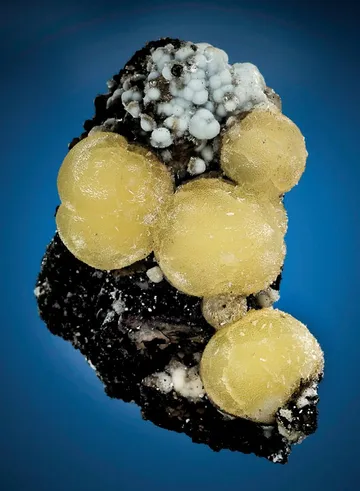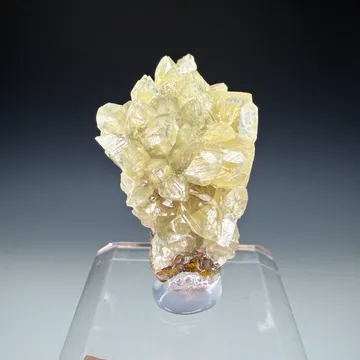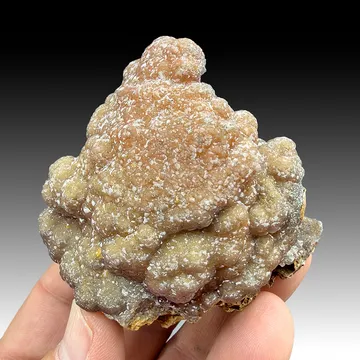
Smithsonite from 79 Mine, Arizona — apple to green botryoidal and crusted specimens prized for color, texture, and oxidized-zone locality in Gila County.
Key facts
The 79 Mine is one of the great Arizona names for green smithsonite: not the pastel blue-green, broad botryoidal material of the Kelly Mine, and not the sugary, color-zoned crystals of Tsumeb, but a distinctly desert-Arizona style of cuprian smithsonite—apple green to deep grass green, commonly botryoidal, mammillary, or crusted over limestone and iron-stained matrix. The best pieces have a glossy, “melted wax” surface; others show a softer velvet sheen, especially where the botryoidal surface is made of very fine radial crystal growth.

Photo: Wikimedia Commons
The appeal of 79 Mine smithsonite lies in its balance of color, texture, and locality character. Fine specimens are unmistakably oxidized-zone pieces: zinc carbonate laid down in open cavities and fractures, often with hemimorphite, calcite, aurichalcite, rosasite, wulfenite, and manganese oxides. The green color is generally attributed in the trade to copper-bearing smithsonite, and the locality has long been sold under “cuprian smithsonite” when the color is strong enough to justify the varietal emphasis.
Geologically, the 79 Mine is a lead-zinc-copper replacement and vein-replacement system in the Banner Mining District of Gila County, on the southwestern flank of the Dripping Spring Mountains near Hayden. The collectible smithsonite came not from the rich sulfide ore sought by commercial miners, but from oxidized, low-grade pockets and stopes where earlier mining left cavities, walls, and mineralized back waiting for later collectors. This is why the mine has a dual identity: historically a small but productive lead-zinc-silver-copper mine, and mineralogically a far richer collector’s locality than its tonnage alone would suggest.

Photo: Wikimedia Commons
Collectors look first for color: saturated apple green, grassy green, or deep translucent green is far more desirable than the ordinary gray, tan, brown, or white smithsonite that also occurs at the mine. The next factors are surface quality and continuity. A broad, unbroken crust of rounded botryoids on a stable matrix can be more desirable than a larger plate with bruised high points, exposed matrix windows, or dull white coatings. Association pieces with calcite, aurichalcite, rosasite, hemimorphite, or wulfenite can be excellent, but the best examples keep the smithsonite visually dominant rather than burying it in later coatings.
Historically, the mine is best known among collectors for aurichalcite, hemimorphite, wulfenite, and green smithsonite. Recent specimen work by the current claim holders and invited collectors has shown that the old locality is not exhausted: pockets of green smithsonite were still being recovered in the 2020s, though access is tightly controlled and production remains a trickle rather than a commercial flood.
Search for specimens: View all smithsonite specimens from 79 Mine, Arizona, USA
The 79 Mine, also written Seventy-Nine Mine or 79th Mine, lies in the Chilito–Hayden area of the Banner Mining District, Dripping Spring Mountains, Gila County, Arizona. Historical names attached to the locality include the McHur prospect, Seventy-Nine property, and 79th Mine. The mine is north-northwest of Hayden and west of the old Chilito settlement, in a rugged desert setting of rough roads, cactus, mine dumps, and surviving structural remains.
The deposit is a small but geologically intricate Pb-Zn-Cu-Ag-Au-Mo-Sb-V-Fe occurrence. The principal ore minerals were galena, sphalerite, pyrite, and chalcopyrite, with quartz and carbonate gangue. The mineralization occurs as replacement bodies in shattered, thin-bedded shale and impure limestone of the Naco Formation, and as small discontinuous vein-replacement bodies in fractured and brecciated rhyolite porphyry. The system was controlled by pre-ore fractures and channelways; later oxidation produced the vivid secondary minerals now prized by collectors.
Published locality summaries describe an ore zone roughly 335 m long, about 12 m wide, with mineralization extending from the surface to about 152 m depth. Six bedded zones were mined, and historical workings reached roughly 450 ft deep, with thousands of feet of drifts, raises, shafts, and stopes. The main shaft was developed on the massive pyrite orebody, and the mine ultimately reached multiple levels.
The mine was discovered in 1879 by Mike and Pat O’Brien, which gave the property its name. Early and intermittent operations eventually gave way to larger-scale work beginning around 1919, when the Continental Commission Co. worked lead carbonate ore from the Discovery orebody. Ownership and operation shifted repeatedly through the Seventy-Nine Mining Co., Seventy-Nine Lead-Copper Co., Shattuck-Denn Mining Corp., Callahan Zinc-Lead Co., Grisson Mines, ACM Corp., and later specimen-mining interests. Commercial mining was affected by litigation, low metal prices, water, and the ordinary economics of a small lead-zinc-copper deposit.
The 1920s and 1940s were especially important operating periods. A concentrator was built on the property in the late 1920s, and by the Shattuck-Denn period the mine was shipping sulfide ore containing lead, zinc, copper, and silver. Reported total historical production is commonly given in the range of several million dollars in period values. The mine ranked notably in Arizona lead production in 1929, and the ore carried appreciable silver.
The collector era is a separate chapter. Many of the best mineral specimens were recovered not during normal commercial ore production, but later, from oxidized areas of the mine that were not the focus of metal mining. John Mediz of Copper City Rock Shop and others mined or handled specimens from the locality into the late twentieth century. Mudslides associated with an El Niño episode intruded into the workings in the late 1990s, interrupting access and specimen work. The mine was later reopened for specimens under new ownership, with 1879 Minerals LLC formed in 2017 and refurbishment work carried out to keep selected workings usable and safe.
Access is not public. The 79 Mine is on mining claims, with locked gates, controlled entry, and no casual collecting. Modern collecting is by the owners and invited experienced guests; collectors do not simply drive in and dig. The underground environment is dusty, lead-bearing, and physically demanding, with low stopes, ladders, fragile crystals, heat and humidity in some areas, and the constant problem of getting delicate specimens to the surface without damage.
The notable modern specimen areas include the third-level Hemimorphite Stope, fourth-level Aurichalcite and Wulfenite stopes, and the Smithsonite Stope, including fourth-level sublevel areas. The fifth-level Smithsonite Stope has also been described as a productive source for recent fine smithsonite and aurichalcite. The mine’s modern reputation rests on a suite of colorful oxidized minerals: cuprian smithsonite, aurichalcite, hemimorphite, wulfenite, rosasite, cerussite, calcite, chrysocolla, and a long list of rarer lead, zinc, copper, sulfate, carbonate, vanadate, phosphate, and oxide species.
Smithsonite from the 79 Mine is most familiar as botryoidal to mammillary crusts on matrix. Individual rounded lobes may range from tiny bead-like surfaces to larger swollen botryoids, sometimes merging into broad, undulating plates. The best pieces show a thick, continuous layer rather than a mere stain or thin dusting. In hand, strong examples have a wet, vitreous luster, with curved highlights running over the botryoids. Some surfaces are semi-velvety or satinlike, especially where the botryoidal skin is made up of extremely fine radial growth.
The signature color is green. Fine 79 Mine smithsonite ranges from light apple green through yellow-green and grass green to darker, richer forest green. Many specimens show two-tone coloration, with pale apple-green areas grading into darker green zones across the same crust. The green material is commonly described as copper-bearing or cuprian smithsonite in the specimen trade. Ordinary smithsonite from the mine may also be white, gray, brown, tan, or duller green; these pieces are much less sought after unless they are strongly associated with other minerals.
The habit is usually crustal and botryoidal rather than sharply euhedral. Vug linings and pocket plates are the classic format. Some pieces preserve the geometry of the pocket wall, while others are small three-dimensional chunks with smithsonite coating multiple faces. Crystalline surfaces can be subtly sparkly under magnification, but the collector appeal is usually the rounded mass and color rather than discrete rhombohedral crystals.
Typical collectible specimens range from thumbnail to small cabinet size. Miniatures around 3–6 cm are common in old and recent trade listings, and small-cabinet pieces around 6–9 cm are a natural size class for good display specimens. Cabinet plates over 10 cm with attractive green coverage are much less common and command attention, especially if damage is limited to the edges or back. Documented examples include pieces around 5–7 cm from 1990s finds, a 9.4 x 7.4 x 1.6 cm small-cabinet auction specimen, and a 10.2 x 6.4 x 1.9 cm cabinet plate with deep green botryoidal smithsonite.
Associated minerals are important to reading a 79 Mine specimen. Hemimorphite is very common in the mine and may occur as sparkling clear to white crystals, crusts, or botryoidal material. Aurichalcite appears as pale to bright blue acicular sprays, sometimes in cavities lined with hemimorphite and calcite. Rosasite can form tiny blue-green hemispheres or velvety aggregates, and is sometimes seen on or near smithsonite. Calcite may occur as white discs or small crystals on green smithsonite. Wulfenite, when present, adds yellow to orange tabular crystals; such combinations are desirable but often delicate. Manganese oxides and iron oxides may appear as black or brown specks, stains, or embedded spheres on the smithsonite surface.
Quality depends on five main factors: color saturation, luster, coverage, surface preservation, and associations. The top tier is bright to deep green, lustrous, continuous botryoidal smithsonite on stable matrix, with no distracting bruising on the high points. A white secondary coating can hide good color; in some documented recent pieces, a thin white smithsonite coating was removed by a brief hydrochloric acid cleaning to reveal green smithsonite beneath. That kind of preparation is part of the locality’s modern specimen history, but it also makes documentation and trustworthy provenance more important for high-end pieces.
The 79 Mine is a classic enough locality that provenance matters. Labels may read “79 Mine,” “Seventy-Nine Mine,” “79th Mine,” “Hayden,” “Chilito,” “Banner District,” “Dripping Spring Mountains,” “Gila County,” or “McHur prospect.” These names can all point to the same general locality, though better labels will specify the mine rather than merely “Hayden, Arizona.” A level or stope designation, when credible, adds value: examples include the 400 level, fourth-level sublevel, Smithsonite Stope, Aurichalcite Stope, Wulfenite Stope, and third-level Hemimorphite Stope.
For authenticity, the strongest visual clue is the specific green botryoidal style. Fine 79 Mine smithsonite usually has a compact rounded surface, apple-green to deep green color, and an oxidized Arizona matrix. It can be confused with green smithsonite from other zinc deposits, and with hemimorphite from the same mine when the habit is botryoidal. Smithsonite is denser and generally reacts with acid as a carbonate; hemimorphite is a zinc silicate and will not behave the same way. Because acid testing can damage a specimen, it should be done only on an inconspicuous broken edge or by an experienced person, and high-value pieces are better identified by provenance, visual comparison, and, when necessary, analytical testing.
There is no well-established, locality-specific fake category comparable to dyed Moroccan vanadinite or glued Chinese fluorite repairs, but mislabeling and over-attribution are realistic concerns. “Arizona green smithsonite” can be loosely assigned to 79 Mine because the locality is famous and marketable. Conversely, some older 79 Mine pieces were labeled simply “Hayden” or “Gila Co.” and may be overlooked. Good old labels from established collections, dealer provenance from the Arkenstone, Weinrich, Well-Arranged Molecules, D. Joyce Minerals, or Copper City Rock Shop circles, and documentation tying a piece to a known 1990s or recent pocket all improve confidence.
Condition is the major grading issue. Botryoidal smithsonite presents high rounded surfaces that chip, scuff, and bruise easily. Look for flattened or matte high spots, fresh white chips, exposed matrix windows in the green layer, repaired cracks through plates, and losses around the perimeter where the specimen was pried from the pocket wall. Edge damage is common and often acceptable if the display face is strong; broad bruising across the front is much more serious. Thin plates can also be fragile, especially where smithsonite is only a crust over limestone or limonite.
Coatings deserve close inspection. Some green smithsonite from the mine may be naturally overgrown by white smithsonite, and documented cleaning has used hydrochloric acid to remove the white layer. Properly done, that can produce beautiful specimens; poorly done, it can dull calcite, undercut matrix, remove desirable associated carbonate minerals, or leave etched surfaces. If a specimen has calcite associations, ask whether it has been acid-cleaned, because calcite is much more vulnerable than smithsonite. A bright green face with missing or etched calcite may tell part of the preparation story.
Rarity is uneven. Ordinary gray, tan, brown, or white smithsonite from the 79 Mine is not rare. Attractive green smithsonite is much scarcer, and fine, lustrous green pieces with continuous coverage are genuinely desirable locality specimens. Association pieces with aurichalcite, rosasite, calcite, hemimorphite, or wulfenite can be rarer still, though they should be judged as complete mineral specimens rather than as mere “species combinations.”
Market availability fluctuates. Old 1990s pieces still emerge from collections, and recent underground work has released a modest trickle of new green smithsonite. Public collecting is closed, so supply depends on the current claim holders and on recycled older material. Auction records and dealer listings show that modest miniatures and small-cabinet pieces can appear in the low hundreds of dollars, while better cabinet plates, very rich color, old labels, and exceptional association pieces can move significantly higher.
The 79 Mine has the kind of origin story that western mineral localities seem designed to produce. Mike and Pat O’Brien discovered the deposit in 1879, and the mine took its name from that year. Michael O’Brien lived in a dugout near the property; the remains of that dwelling can still be seen, a spare reminder that before the mine became a collector locality, it was a hard desert prospect in the Dripping Spring Mountains.
By 1919, the Continental Commission Co. was working the Discovery orebody at a reported 50 tons of lead carbonate ore per day. The logistics were pure early Arizona mining: ore went by burro to the railway at Hayden Junction before a road was built in the 1920s so trucks could carry ore onward to rail shipment and smelting. In the 1928 period, the Seventy-Nine Lead-Copper Co. built a 60-ton concentrator on the property and treated more than 10,000 tons of zinc-lead ore from the Discovery and Massive Pyrite orebodies.
The mine’s commercial life was repeatedly interrupted by litigation, metal prices, ownership changes, and underground realities. In 1940 the Shattuck-Denn Mining Corp. took over, shipping lead-zinc sulfide ore at a reported rate of 500 tons per month. Concentrates traveled out of the district: sulfide ore to a flotation mill in Bisbee, lead concentrate to El Paso, and zinc concentrate to Amarillo. By the Callahan Zinc-Lead period, the mine had reached seven levels. Water below the seventh level, about 500 ft beneath the surface, became a barrier to deeper exploration when no pump was available.
For collectors, the richest story is that the miners’ ore was not the collectors’ prize. The sulfides that paid the bills—galena, sphalerite, pyrite, chalcopyrite—were not generally the minerals that made the 79 Mine famous in display cases. The desirable specimens were hidden in low-grade oxidized zones that commercial mining could ignore. That is why the mine could be both a past producer and, decades later, a living specimen locality.
The modern underground accounts are vivid because they are not romanticized. Collecting at the 79 Mine means rough roads, locked gates, a private claim, ladders to lower levels, dust that can contain lead, low-ceilinged stopes, and enough grime that a full change of clothes is part of the field kit. Essential equipment is not a screen and a bucket, but a helmet, respiratory mask, hammer drill, chisels, hammer, knee pads, gloves, picking tools, and enough wrapping to keep delicate mineral plates from destroying themselves before reaching daylight.
The smithsonite story tightened in late 2023, when David Joyce found a small pocket of light green smithsonite in the floor of the Smithsonite Stope. The find was limited, but it proved that worthwhile green material still remained. Small vugs turned up from time to time, some with aurichalcite or calcite. These are the kind of finds that test a collector’s patience: a vug only 5 cm across can be beautiful in place and nearly impossible to remove intact.
Then came April 2024. While working in the Smithsonite Stope on the fourth level, David chiseled into a large new pocket of green smithsonite. Several excellent deep green specimens came out of the zone. After he told Cody Schwenk, the two returned and collected the remaining specimens, including pieces described as truly outstanding. One 10 cm specimen was photographed with a thin white smithsonite coating and then again after cleaning; it is now displayed at the Alfie Norville Gem and Mineral Museum in Tucson. That before-and-after is unusually instructive for collectors: at the 79 Mine, the green can be hidden under white smithsonite, and preparation can reveal what the pocket wall originally concealed.
The same modern field reports describe two kinds of smithsonite pockets. Some are clean from the start, lined with green smithsonite and needing little preparation; these may carry calcite crystals and occasional aurichalcite. Others are coated by a thin white smithsonite layer that can be removed by a quick hydrochloric acid dip. Those coated pieces may carry tiny hemispheres of rosasite on the white surface, a small but telling association that adds to the locality’s mineralogical fingerprint.
The 79 Mine also offers stories of near misses. In the wulfenite workings, a wulfenite crystal about 2 cm on edge was photographed in a vug on a bed of rosasite in the Smithsonite Stope. It did not survive extraction. That one small loss says much about the mine: great specimens can be seen underground, admired under a headlamp, and still never become specimens in a cabinet.
The broader modern collecting history is equally full of named pockets and personalities. The third-level Hemimorphite Stope yielded a major blue hemimorphite zone in 2022, with dozens of flats of robin’s-egg blue botryoidal material. In 2024 and 2025, new extensions still produced fine pieces. The fourth-level Aurichalcite Stope produced light blue acicular sprays in cavities of hemimorphite and calcite, while a mid-2024 chrysocolla seam opened into a cavity of rich deep-blue botryoidal and stalactitic material. The Wulfenite Stope, by contrast, is remembered as hot, humid, unstable, and punishing, with paper-thin crystals that can break during extraction, during the climb out, or later in transit.
The mine’s personality is not only underground. The approach passes through a classic Sonoran landscape of saguaros and ocotillos against the Dripping Spring Mountains. Near the workings are remnants of the old mine plant and, memorably, the remains of a 1935 Chevrolet standard two-door sedan once associated with the mine manager. That rusting car, the old mill and compressor building, and the surviving dugout all frame the specimens with a sense of place. A fine green 79 Mine smithsonite is not just a zinc carbonate crust; it is a piece of a desert mine that has lived several lives—prospect, producer, closed working, collector’s secret, and still, occasionally, a pocket waiting in the dark.