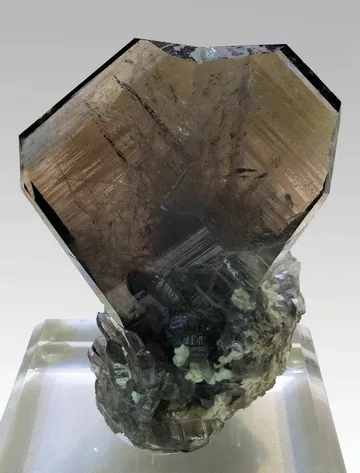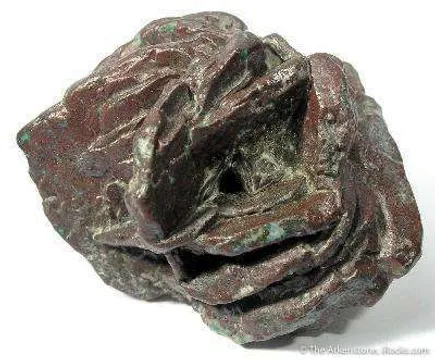
10th Ore Zone, Intrepid Potash East mine, USA: blue halite in sylvite seams, gemmy, sharply cubic, a collector landmark in the Carlsbad Potash District.
Key facts
The 10th Ore Zone of the Intrepid Potash East mine is one of the defining modern localities for blue halite: not merely blue salt, but intense, gemmy, sharply cubic halite locked in and on clear to white sylvite from a commercial sylvinite ore horizon deep in the Carlsbad Potash District of southeastern New Mexico. Its collector importance rests on a rare convergence of industrial geology and specimen luck. The host is the Upper Permian Salado Formation, part of the Ochoan evaporite sequence of the Delaware Basin, where halite, sylvite, carnallite, polyhalite, anhydrite, and other bittern salts record repeated restriction and concentration of Permian marine brines. In the East mine, the 10th zone was historically a sylvinite ore target: a potassium-chloride ore made chiefly of sylvite with halite, clay, and accessory evaporite species.
What changed the locality from an industrial potash mine into a mineral-collecting landmark was the discovery of exceptional specimen seams in the 10th zone, especially the “Blue Ice” seam in December 2009 and the “Frozen Blue” seam in July 2011. These seams yielded dark blue to violet-blue halite cubes, many partly or completely encased in sylvite, with some crystals showing clear outer zones, purple internal zoning, or dramatic blue cores suspended in colorless material. The best pieces are miniature to cabinet-size compositions: saturated blue halite cubes rising from, or seemingly frozen inside, glassy to sugary sylvite, with enough matrix to give context but little enough to avoid the crumbly, massive look of ordinary ore.
Regional View
Country View
The visual signature of the locality is unmistakable. Ordinary Carlsbad sylvinite can be attractive in a technical way, but the 10th Ore Zone specimen seams produced a sculptural mineral aesthetic: hard-edged blue cubes, sometimes inky at the center and paler at the margins, contrasting with white, colorless, or translucent sylvite cleavage and sylvinite matrix. Fine pieces are prized because the crystals are not recent surface efflorescences; they are deep-mine evaporite specimens from a now-inaccessible underground occurrence, collected during a short window before mine convergence closed the productive area.
Search for specimens:
The locality is the 10th Ore Zone within the Intrepid Potash East mine, historically the Kerr-McGee mine, in the Carlsbad Potash Mining District of Eddy and Lea Counties, New Mexico. The mine shaft locality is recorded in sec. 4, T21S, R31E, New Mexico Principal Meridian, about 15 miles east of Carlsbad. Mindat gives the East mine’s coordinates as 32.50417, -103.78222, and records the succession of mine names that collectors still encounter on labels: Kermac mine from 1965 to 1975, Kerr-McGee mine from 1975 to 1985, Vertac mine from 1985 to 1988, Fermetia mine from 1988 to 1989, New Mexico Potash mine from 1989 to 1996, Mississippi Potash East mine from 1996 to 2004, and Intrepid Potash East mine from 2004 onward. This label history matters: a specimen marked “Kerr-McGee,” “Mississippi Potash East,” or “Intrepid East” may refer to the same underground mine, and the finest 10th-zone blue halites commonly circulate under the Kerr-McGee name because the mine’s older name remained entrenched among collectors.
Geologically, the 10th Ore Zone is a bedded evaporite potash deposit in the Salado Formation, Upper Permian Ochoan Series. The Salado Formation in the Carlsbad district is dominated by halite and muddy halite, with potash concentrated mainly in the McNutt Potash Member. The Carlsbad district contains 12 recognized potash ore zones: 11 in the McNutt Member and one in the upper Salado. The 10th zone lies high in the numbered ore-zone sequence, between regionally useful sulfate marker beds, and is classically described as a tripartite cluster of potassium-bearing evaporite beds with halite above and below. In the district-scale stratigraphy, the 10th zone includes sylvinite and carnallitite facies, with halite, argillaceous halite, and sulfate marker beds as important companions.
The ore is sylvinite, meaning a rock composed chiefly of sylvite, KCl, and halite, NaCl, with clay and minor sulfate and magnesium-potassium salts. Detailed work on the 10th zone recognized massive, lens, and disseminated sylvite styles. The massive deposits are stratiform; lens deposits may be discordant, very rich in sylvite, and only centimeters to about a meter thick; disseminated sylvite fades into halite or argillaceous halite. In the East mine’s 10th Ore Zone, the specimen-producing seams were not ordinary run-of-mine sylvinite but unusual pure to nearly pure sylvite seams containing included halite crystals. These seams were exposed by mining and later by spalling from the ribs and fallen blocks in old drifts, creating the extraordinary collecting conditions described by Philip Simmons.
The 1978 geological study of the 10th Ore Zone by Gunn and Hills treated the zone as 6 to 10 feet thick overall and emphasized that it formed in a broad, shallow, supersaline basin during late Ochoan time. The lower member commonly grades upward from argillaceous halite to sylvinite and carnallitite as salinity increased. The middle member is similar but usually less clay-rich, interpreted as having accumulated under a deeper, more stable brine layer. The upper member returns to halite, sylvinite, and carnallitite facies and is overlain by halite and the 119 Marker Bed. The study also noted that favorable mining conditions occur when sylvite-rich facies in multiple members stack one above another, and that barren clay pods, salt horses, and carnallite-rich intervals can interrupt ore continuity.
Mining history is inseparable from the district’s industrial role. Sylvite was first identified in the Carlsbad potash field from the Snowden-McSweeney No. 1 McNutt oil test, and refined potash production began in 1931 with the United States Potash Company. The East mine itself began in 1965 under Kerr-McGee/Kermac ownership. The 10th Ore Zone was historically the East mine’s principal sylvinite source, but modern Intrepid operations have shifted: East mine production is now focused on underground room-and-pillar mining of langbeinite-bearing ore from the 3rd, 4th, and 5th zones for Trio®, while muriate of potash production at Intrepid’s New Mexico operations comes from solution-mined brines. The East plant was converted to a langbeinite-only operation in April 2016, so collector specimens from the famous 10th-zone blue halite seams belong to a closed chapter of the mine’s specimen history rather than an ongoing collecting flow.
Collecting access today should be regarded as closed. This is an active industrial mine environment, not a public collecting locality, and underground access is controlled by the operator and by mine safety rules. More importantly for collectors, the celebrated blue halite area itself became inaccessible through mine convergence by 2014. Reports from the collecting period describe a low, compressed drift in which the original mined height had been greatly reduced, and subsequent convergence cut off the specimen-producing ground. Current availability is therefore limited to pieces collected during the 2009–2014 window, specimens distributed by the original collectors and dealers, museum pieces, and resales.
The notable pockets were not open vugs in the classic hard-rock sense but specimen seams and spalled mine-rib material. The “Blue Ice” seam, discovered in December 2009, first brought widespread attention to the district’s potential for world-class crystallized blue halite. The “Frozen Blue” seam, discovered in July 2011 at the East mine, was the richest and most important occurrence. There, pure sylvite seams ranging from a few centimeters to about a meter thick enclosed abundant blue halite crystals. Some crystals were sawed or broken by mining, but others survived intact in fallen wall slabs or loose on the floor. Exceptional individual halite crystals reached roughly 25 cm without damage, and a number of major matrix pieces entered important collections, including the New Mexico Bureau of Geology Mineral Museum and the Lyda Hill collection.
Halite from the 10th Ore Zone is the locality’s great prize: cubic, sharply formed, deep blue to violet-blue crystals, commonly embedded in or perched on colorless to white sylvite and sylvinite matrix from the “Blue Ice” and especially “Frozen Blue” seams. Published and illustrated specimens range from small, intense thumbnails with blue cubes around 1.5–2 cm to major cabinet pieces, including a 13.7 cm purple-toned halite photographed under backlighting, a 14.9 cm “Frozen Blue” specimen with only a corner of the blue halite exposed from its sylvite envelope, and the celebrated 18.2 cm “Royal Passion” halite-sylvite piece from the Frozen Blue seam that appeared on the January-February 2013 Mineralogical Record cover. The best specimens here are not simply blue cleavage chunks: they show complete or nearly complete cubic form, glassy transparency, strong blue saturation, undamaged edges, and a natural sylvite association that makes the halite look suspended or “frozen” in clear potassium chloride; ordinary pieces tend to be cleaved, contacted, color-zoned without form, or embedded in friable ore matrix.
Sylvite from the 10th Ore Zone is both the ore mineral and the essential display partner for the blue halite. In the specimen seams it occurs as clear, colorless, white, or translucent potassium chloride, commonly as cleavage masses and crystalline sylvite that encases blue halite cubes; in the broader ore zone, studies describe sylvite as coarse to pegmatitic, subhedral to euhedral crystals, usually clear or milky when charged with fluid inclusions, with hematite-rich red rims that may be corroded, recrystallized, or left as floating remnants where replacement has occurred. Collector-quality sylvite from this occurrence is usually valued less as a stand-alone species than as matrix and contrast: the finest examples show transparent to snowy-white sylvite holding a saturated blue halite cube, while more massive sylvite can be friable and visually dull unless it preserves the “frozen” relationship clearly. A pure sylvite cleavage from the Frozen Blue seam has been documented, but most desirable pieces remain halite-sylvite combinations rather than isolated sylvite specimens.
Other minerals documented from the 10th Ore Zone and the East/Kerr-McGee mine include carnallite, polyhalite, anhydrite, kieserite, langbeinite, leonite, epsomite, and clay minerals including montmorillonite in the mine’s common assemblage. Gunn and Hills treated sylvite as the dominant ore mineral of the 10th zone, with carnallite and minor kieserite, langbeinite, leonite, and epsomite in halite or argillaceous halite host rocks; they also noted that kieserite can alter to epsomite on pillars exposed to mine air. Polyhalite and anhydrite are important in the 119 and 120 Marker Beds, while carnallite-rich and kieserite-bearing “salt horses” interrupt the ore. No verified type-locality mineral is tied to the 10th Ore Zone itself; its rarity lies instead in the preservation of highly aesthetic blue halite-sylvite specimens from a deep industrial evaporite mine.
Specimens from this locality require more discipline than many collectors expect. Halite and sylvite are soluble chlorides, and both suffer in sustained humidity, condensation, damp storage, or repeated handling with moist fingers. Good 10th Ore Zone pieces can be surprisingly stable in a dry cabinet, especially compared with delicate efflorescent evaporites, but they should be kept away from humid rooms, ultrasonic cleaning, water, steam, and open-air display in damp climates. Use sealed boxes or gasketed cases with fresh desiccant; handle with clean, dry hands or nitrile gloves; and avoid dramatic temperature swings that invite condensation.
Condition is central to value. The locality produced many cleaved or contacted blue halite pieces, and even colorful examples may have broken cube edges, sawed contacts, bruising, or etched faces from mine exposure and preparation. Premium specimens show complete cubic geometry, high luster, saturated blue or blue-purple color, transparency, and a stable, attractive sylvite association. Matrix pieces are especially desirable because complete halite cubes on sylvite or within sylvite are much rarer than loose cleavage chunks. However, the matrix is commonly soft, salty, and clay-bearing, and some specimens were legitimately stabilized to prevent crumbling. Stabilization of friable matrix should be disclosed but is not automatically disqualifying for this locality; hidden repairs to broken halite cubes, rebuilt edges, glued-in crystals, or undisclosed coatings are more serious concerns.
The most common mislabelling issue is historical naming. “Kerr-McGee mine,” “Kermac,” “Mississippi Potash East,” and “Intrepid Potash East” may all refer to the same East mine under different operators, but a good label should also specify the 10th Ore Zone and, when known, “Blue Ice” or “Frozen Blue.” Another source of confusion is district-level labelling: Carlsbad Potash District blue halite exists from more than one mine or zone, so a specimen labelled only “Carlsbad, New Mexico” should not automatically be upgraded to the 10th Ore Zone without provenance. The strongest provenance names include Philip Simmons, Enchanted Minerals, documented Mineralogical Record figures, New Mexico Bureau of Geology Mineral Museum pieces, and dealer labels that record the 2009–2014 collecting period.
Blue color in halite from potash deposits is generally associated with radiation-induced lattice defects, and Carlsbad specimens are commonly discussed in relation to natural radioactivity from potassium-bearing sylvite, especially K-40. Collectors should not treat the specimens as a radiation hazard, but they should understand that the blue color is an internal structural-color phenomenon, not paint or dye. Artificially dyed halite exists in the broader market, and blue salt from other localities can be misrepresented; at this locality, natural pieces usually show color zoning, cubic morphology, and intimate sylvite association rather than an evenly stained, surface-only color.
Market availability is finite. The productive area is no longer accessible, and the specimens that appear today are almost entirely resales, older dealer stock, or collection deaccessions. Small but attractive blue halite-sylvite pieces continue to circulate, while cabinet-size, undamaged, matrix-rich examples from Frozen Blue are increasingly treated as modern classics. The strongest pieces compete with the best blue halites from European salt mines, but they have a distinct American identity: Permian potash ore, commercial mine provenance, and a short, well-documented collecting window.
The story of the Frozen Blue seam reads less like a conventional pocket opening and more like the discovery of a lost room in a working industrial mine. Philip Simmons had already helped bring Carlsbad blue halite to wider attention after the December 2009 “Blue Ice” discovery. By July 2011, in the Intrepid Potash East mine, he and his collecting partners were following old drifts in the 10th Ore Zone where mining had cut through two nearly pure sylvite seams. These seams were not broad caverns or glittering museum geodes. They were low, confined mine workings, with ribs spalled away and slabs of salt fallen onto the floor.
The first approach to the Frozen Blue area was physically tight. Simmons described crawling through a 40 cm pinch point on the discovery trip. Beyond it, he began seeing dark blue cubes “frozen” in the mine ribs and in fallen spalls of sylvite-bearing rock. Then came the moment every field collector imagines but almost never experiences: blue crystals were lying on the ground. In the first collecting trips, the work required very little tooling. Specimens could be picked up from the drift floor, wrapped, and carried out. The most vivid descriptions make clear that this was not a small scattering of color chips; nearly all the dark forms visible along the floor and ribs in the discovery photographs were crystals waiting to be collected.
The underground setting was already closing in. One caption to an early Frozen Blue seam photograph notes that the drift was less than 1 meter high, though it had originally been more than 2 meters tall. That detail gives the find its urgency. The same mine convergence that helped break rib material free and expose collectible pieces was also gradually sealing the area. Collecting there meant crawling through compressed passages, working spalled slabs, and extracting crystals from sylvite envelopes before the ground became unreachable.
The finest crystals were far better than the older Carlsbad material that collectors had known. Simmons wrote that the quality was many orders of magnitude beyond previous finds, and the surviving cubes under an inch were abundant enough to produce superb miniatures. Larger crystals could be astonishing: some blue halite cubes reached about 25 cm without damage. Several specimens became named or landmark pieces because of how they appeared in sylvite. One 7.3 cm specimen, with a blue halite cube completely encased in sylvite, helped inspire the “Frozen Blue” name. Another 14.9 cm piece had only a small corner of the halite exposed, making the blue crystal look literally trapped in ice.
Preparation was part of the story. Many of the halite crystals were completely encased in sylvite and had to be mechanically exposed. One early “good day’s haul” was carried home for prep, with sylvite removed from around halite cubes to reveal the color and form. Another roughly 15 cm specimen was found on the ground already displayable and needed only to be wrapped and placed into a wheeled crate for the trip back to the mantrip. An 18.7 cm prepared specimen from the find later entered the Lyda Hill collection, a sign of how quickly the best Frozen Blue pieces moved from mine-floor discoveries to serious institutional and private collections.
There were also oddities that could only come from such a chemically active salt environment. A 5.5 cm crystal was noted for having a colorless outer zone over a blue interior—the reverse of the usual zoning pattern. Simmons interpreted it as a blue halite crystal that had sat in a pool of water long enough for colorless halite to crystallize over it. Nearby brine pools also produced post-mining colorless halite groups and intergrown halite-sylvite specimens, reminders that even after mining, the old workings remained a living evaporite laboratory.
The collecting window closed quickly. The panel continued to yield exceptional specimens until 2014, when mine convergence made the whole blue halite area inaccessible. The finality of that closure is important for collectors. This was not a famous pocket that might be reopened with more digging, nor a surface locality where patience may reveal the next seam. It was a deep mine occurrence in a commercial potash operation, sealed by ground movement and by modern access restrictions. The Frozen Blue seam’s short life—discovery, feverish collecting, preparation, publication, and closure within only a few years—is a major part of why the best pieces now carry the aura of a contemporary classic.