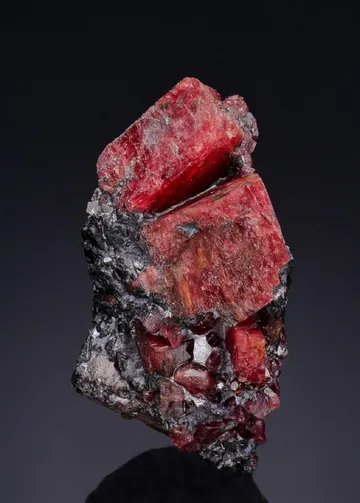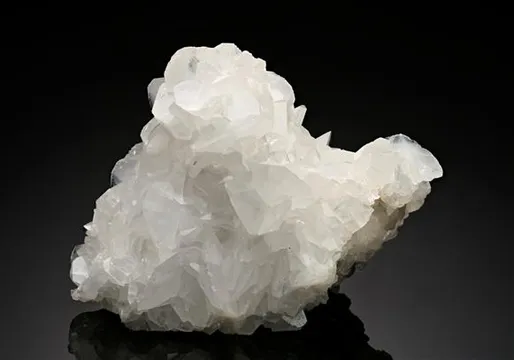
Zinc Corporation Mine, Australia — a renowned Broken Hill locality yielding red rhodonite, alabandite on calcite, and rare bannisterite, prized by collectors.
Key facts
Zinc Corporation Mine is one of the great collector names on the Broken Hill Line of Lode, the long, steeply dipping silver-lead-zinc orebody that made far-western New South Wales one of the world’s classic mineral provinces. For specimen people, “Zinc Corp” does not simply mean ore. It means a very particular Broken Hill aesthetic: manganese-rich silicates and carbonates from a high-grade metamorphosed Pb-Zn-Ag system, sometimes opening into late cavities where fragile, sculptural minerals grew with a freedom rarely granted in such a crushed and folded orebody.
The mine sits on the southern part of the Broken Hill lode system, within the broader Southern Operations mine area. The lode belongs to the Broken Hill-type family of metamorphosed stratiform Pb-Zn-Ag deposits: sphalerite and galena ore, recrystallized and remobilized under high-grade Proterozoic metamorphism, wrapped in a gangue assemblage rich in rhodonite, bustamite, calcite, quartz, fluorite, garnet, pyroxenoids, feldspar and other Mn-Ca-Fe-Zn minerals. That metamorphic ancestry is what separates Broken Hill specimens from ordinary hydrothermal vein material. The best pieces look old in the geological sense: sharply crystalline, but with a dense, compact, silicate-rich toughness that speaks of heat, pressure and deformation before the final cavity growth.
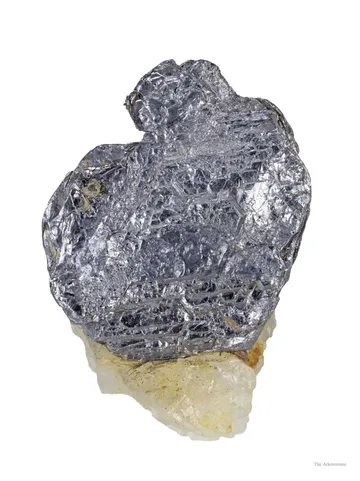
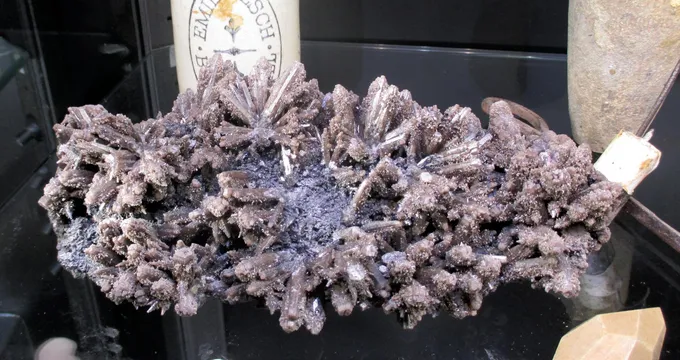
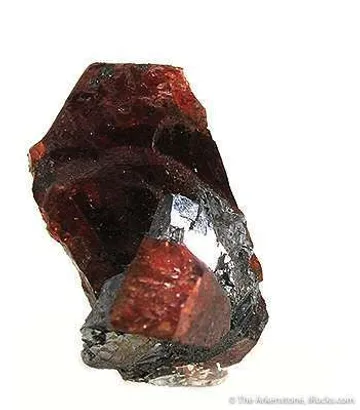
Zinc Corporation Mine is especially prized for three specimen families. The first is transparent to gemmy red rhodonite, among the most famous rhodonite crystal material ever found. The second is alabandite on calcite, especially the 18 Level material: black to brown-black, branching or fan-like manganese sulphide with white dog-tooth calcite and alteration skins of hausmannite. The third is the extraordinary 1966 discovery of well-crystallized bannisterite from the 12 Level, a rare phyllosilicate that Broken Hill produced in far better crystallized form than collectors had any right to expect.
Regional View
Country View
Historically, the mine is also important because the Zinc Corporation began not as a conventional underground operator but as a company formed to solve Broken Hill’s zinc problem: the enormous stockpiles of zinc-rich tailings left by earlier lead-silver mining. Its later acquisition of the South Blocks leases and the construction of the Zinc Mine shaft tied the company directly into primary mining along the lode. The large steel headframe, the circular crushing house, mill and office complex remain part of Broken Hill’s industrial landscape, but the Zinc Oval and Zinc Mine site is not open to the public.

Photo: Wikimedia Commons
The finest Zinc Corporation specimens are not merely representative Broken Hill pieces; they are reference pieces. A cabinet specimen from the 18 Level can show why Broken Hill alabandite is considered among the best of its species. A small red rhodonite from the 1700 ft level may be a jewel-like object rather than a gangue mineral. A black, micaceous bannisterite plate from the 12 Level can look like a mineralogical impossibility: a rare species, in large crystals, from a place better known to the mining world for tonnage and metal.
Search for specimens: View all specimens from Zinc Corporation Mine, Australia
Zinc Corporation Mine is part of the Broken Hill district, Yancowinna County, New South Wales, and lies near the western to south-western end of the main Broken Hill Line of Lode. The locality is recorded as the Zinc Corporation Mine, or ZC Mine, within the Southern Operations Mine. In the modern mine framework, the Southern Operations include the old Zinc Corporation, New Broken Hill Consolidated and Southern Cross mine areas; Perilya Broken Hill has operated the Broken Hill mines since acquiring the assets from Pasminco in 2002, and recent NSW EPA material still identifies Perilya’s Southern Operations as an operating lead-zinc-copper mine on the Line of Lode.
Geologically, Zinc Corporation belongs to the giant Broken Hill Pb-Zn-Ag system hosted by high-grade metamorphic rocks of the Willyama Supergroup. The Broken Hill deposit is the namesake example for Broken Hill-type deposits: stratiform to strata-bound sulphide mineralization in a strongly deformed Proterozoic metamorphic terrane, with abundant manganese-rich and calcium-rich gangue. Modern discussions of the orebody divide the system into lead-rich and zinc-rich lenses and lodes, including 3 Lens, 2 Lens, 1 Lens and the A, B and C lodes. The gangue assemblages are not uniform: some lenses are especially rich in rhodonite, calcite, wollastonite or quartz, while the zinc lodes are typically dominated by sphalerite with galena and other sulphides.
At the Zinc Corporation and New Broken Hill Consolidated mines, the ore and gangue were worked through a complex underground system rather than through collector-friendly open pockets. Sulphide ore consisted of galena, sphalerite or marmatite, chalcopyrite, pyrrhotite, pyrite, löllingite, tetrahedrite and related species in a silicate-carbonate gangue. The gangue names familiar to collectors—rhodonite, bustamite, calcite, quartz, garnet, fluorite, manganoan hedenbergite, apatite and manganese-bearing calcite—were also mine-scale rock-forming minerals in parts of the lode. That is why Zinc Corporation specimens often look like fragments of an orebody rather than simple vein crystals.
The company history begins with the metallurgical challenge of zinc recovery. The Zinc Corporation was formed in 1905 to treat zinc-rich tailings from the early Broken Hill mines. In 1911 it acquired the Broken Hill South Blocks Company leases and began underground mining at the southern end of the Line of Lode. A major redevelopment followed in the 1930s: construction of the steel headframe over the Main Shaft began in 1936, and nearby surface facilities, including the circular crushing house, concentration mill and offices, were erected in 1939. The Main Shaft was rated for 0.9 million tonnes of ore haulage per year. The old Zinc Mine surface complex closed in 1988 when operations were transferred to the NBHC Mine under Pasminco.
Ownership followed the consolidation of Broken Hill mining. The Zinc Corporation expanded from tailings retreatment into primary mining, became part of Consolidated Zinc, then Conzinc Rio Tinto of Australia, then Australian Mining and Smelting. In 1988 Australian Mining and Smelting merged with North Broken Hill interests to form Pasminco. Perilya purchased the Broken Hill operation from Pasminco’s administrator in 2002. For collectors, that corporate chain matters because old labels may say Zinc Corporation, Consolidated Zinc, CRA, AM&S, Pasminco, NBHC or simply Southern Operations, and some labels compress the old mine names in ways that obscure the exact shaft, level or pocket.
Collecting access today is effectively closed. The Zinc Oval and Zinc Mine locality is explicitly described by Broken Hill tourism as not accessible to the public, and the broader Southern Operations area is an active industrial mine environment under environmental and operational regulation. Modern specimens reach the market almost entirely from old miner collections, Broken Hill dealer stocks, dispersed Australian collections, museum exchanges, and a smaller number of pieces saved during underground work in the mid-20th century. The best labels are those that retain a level, mine and date or provenance name.
The classic specimen-producing zones are well enough documented to make Zinc Corporation more than a generic Broken Hill label. The 1700 ft level produced celebrated gemmy, blood-red rhodonite groups, including Albert Chapman Collection specimens now in the Australian Museum. The 18 Level produced the great alabandite-calcite material, including arborescent alabandite with white dog-tooth calcite and black hausmannite alteration skins, and it is also tied to pale to blue fluorite with calcite and alabandite. The 12 Level produced the remarkable bannisterite discovery of 1966, associated with rhodonite and calcite, from fractures thought to be related to the Central Fault. Calcite-rich parts of 2 Lens between about the 18 and 20 levels are documented for bustamite; the wider Zinc Corporation–NBHC workings also yielded manganese-bearing calcite, rhodochrosite, quartz, kutnohorite, stolzite, pyrosmalite-(Mn), inesite and other Broken Hill rarities.
Rhodonite from Zinc Corporation Mine is at its best as transparent to gemmy red bladed crystals rather than the massive pink material many collectors know from manganese deposits elsewhere. The most famous examples came from the 1700 ft level and from two 1966 cavities in the Zinc Corporation Mine: one yielded perfect, transparent, rich red crystals several centimetres long in partially altered feldspar, while a smaller cavity produced larger crystals to about 6 cm that were less gem-like. Australian Museum specimens from the Albert Chapman Collection include a 5 x 3 x 0.7 cm blood-red, sharp, parallel bladed group from the 1700 ft level and a smaller 3.5 cm specimen from the same level. Zinc Corporation rhodonite may occur with calcite and black ferroan bannisterite, and also with galena, sphalerite, arsenopyrite, spessartine and other Broken Hill gangue minerals. The best pieces here are judged on transparency, ruby-red saturation, undamaged terminations, separation of blades, and clear association with calcite or bannisterite; ordinary pieces are massive, cleaved, duller pink, or visually indistinguishable from broader Broken Hill rhodonite without a solid old label.
Calcite from Zinc Corporation Mine ranges from white dog-tooth crystals on sulphide and alabandite matrix to pale pink manganese-bearing calcite, and it is an essential part of the mine’s specimen identity rather than a mere accessory. The 18 Level alabandite pockets produced contrasting white dog-tooth calcite with arborescent alabandite, and the Australian Museum records an 11 x 29 x 23 cm alabandite-with-calcite specimen from No. 18 Level at 2600 ft, registered in 1967. Manganese-bearing calcite from the Zinc Corporation Mine is represented in the Albert Chapman Collection by a 10 x 6 x 7 cm specimen, and collector-market examples include baby-pink aggregates of small tapered scalenohedra and rounded rhombs that fluoresce red under both shortwave and longwave ultraviolet light. The most desirable calcites from this locality have sharp, clean scalenohedral form, a distinct pink Mn-bearing color or strong contrast against black alabandite, and minimal bruising to crystal tips; plain white cleaved calcite without level or association is much less compelling.
Alabandite is one of the signature minerals of Zinc Corporation Mine, and the Broken Hill material is among the best and largest alabandite known. The classic source is the 18 Level, including specimens from No. 18 Level at 2600 ft, where black to brown-black alabandite formed arborescent, branching, divergent and fan-like aggregates, commonly on or in calcite. Many pieces are partly coated or altered to hausmannite, giving the surfaces a dark oxide skin, while white dog-tooth calcite provides the standard visual contrast. Fine specimens can be cabinet-sized: the Australian Museum records an 11 x 29 x 23 cm alabandite-with-calcite specimen acquired in 1965 from former Broken Hill miner Richard “Dick” Cannon, and other documented Zinc Corporation examples reach 12 cm or more. Good Zinc Corporation alabandite is sculptural, upright, sharply ribbed or branching, and securely associated with calcite; ordinary pieces are broken black masses, oxidized crusts without form, or specimens whose matrix has lost the diagnostic 18 Level look.
Quartz at Zinc Corporation Mine is less glamorous than rhodonite or alabandite, but it is geologically and paragenetically important because quartz is one of the recurring gangue minerals of the Broken Hill lode system and is documented from the Zinc Corporation workings, including ordinary quartz, smoky quartz and amethyst-labeled material in locality records. In specimens, quartz may appear as saccharoidal to crystalline matrix with calcite, gahnite, chalcopyrite, galena, rhodochrosite, neotocite and other manganese-rich minerals; water-clear quartz crystals are noted on at least some rhodochrosite-on-sturtite material attributed to the ZC Mine. Quartz-rich pieces from Zinc Corporation are best when they serve the locality story—supporting rhodochrosite, kutnohorite, calcite, gahnite or sulphides, or preserving the quartz-gangue texture of the orebody—rather than as isolated quartz crystals. Collectors should value sharp association, old labels and matrix context over size alone, because quartz from Broken Hill is common as rock but far less often compelling as a display species.
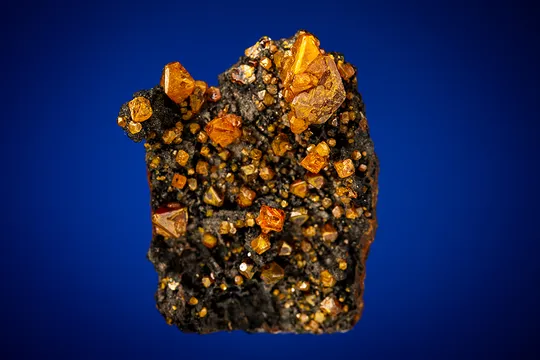
Beyond these four collector staples, Zinc Corporation Mine is documented for an unusually rich suite of Broken Hill minerals: galena, sphalerite or marmatite, chalcopyrite, pyrite, pyrrhotite, arsenopyrite, löllingite, tetrahedrite, bournonite, gahnite, magnetite, spessartine, bustamite, inesite, pyroxmangite, manganilvaite, pyrosmalite-(Mn), bannisterite, hemimorphite, hisingerite, rhodochrosite, manganese-bearing calcite, kutnohorite, baryte, fluorite, stolzite, apophyllite-group minerals and chabazite. Bannisterite is the standout rarity: not a type mineral for Zinc Corporation, but the 12 Level material produced exceptionally large, well-crystallized plates that remain among the finest specimens of the species. The historically described Broken Hill mineral “sturtite” was reported from the Zinc Corporation Mine and later work treated it as material in the hisingerite-neotocite series, a useful reminder that some old Broken Hill labels preserve names whose modern status may be more complicated than the label suggests.
The main authenticity issue with Zinc Corporation Mine specimens is not widespread fakery but locality precision. Broken Hill produced similar-looking material from multiple mines along the Line of Lode, and old labels often say only “Broken Hill” or use corporate names that changed through time. Zinc Corporation, NBHC, Pasminco Southern Operations and Perilya Southern Operations can all appear on related material, but they do not always identify the exact old working. For high-value specimens, a label with level information—12 Level for bannisterite, 18 Level or 2600 ft for alabandite-calcite, 1700 ft level for gemmy rhodonite—is much stronger than a broad Broken Hill attribution.
A documented mislabelling concern involves fluorite-calcite-sulphide specimens: collectors have noted that some pieces labeled North Mine closely match the 18 Level Zinc Corporation matrix and association, especially where pale to blue fluorite occurs with calcite, dark alabandite-like material, marmatite and pyrite. The prudent approach is conservative. Keep the received label, but if comparison strongly suggests Zinc Corporation 18 Level material, record that as a probability or note, not as a replacement fact unless there is hard provenance.
Rhodonite and bustamite are another practical identification problem. Both occur at Broken Hill, both may be pink to salmon or reddish brown, and both can occur in the Zinc Corporation–NBHC system. True Zinc Corporation rhodonite of the best grade is typically deeper red, more transparent and sharper bladed; bustamite tends to show salmon to pinkish-orange, rounded to greasy-looking crystals, commonly in calcite-rich parts of 2 Lens. Visual identification can be hazardous on small broken fragments, so valuable “rhodonite” or “bustamite” pieces deserve either excellent provenance or analytical confirmation.
Condition is critical. Zinc Corporation rhodonite commonly cleaves and chips along blade edges, so even small nicks stand out on gemmy red crystals. Alabandite aggregates are brittle and may be naturally altered to hausmannite; a dark oxide coating is not automatically damage, but broken branch tips and repaired sprays matter. Calcite is soft and easily bruised, especially on dog-tooth tips and pale pink scalenohedral aggregates. Manganese-bearing calcite can fluoresce strongly red under ultraviolet light, but UV response should be treated as supporting evidence rather than proof of locality.
Market availability is thin but real. Commoner calcite, quartz-bearing pieces, small rhodochrosite, and less aesthetic sulphide-gangue specimens appear periodically. Fine Zinc Corporation alabandite on calcite, gemmy red rhodonite, and large crystallized bannisterite are genuinely scarce and typically come from older Australian collections or high-end dealer inventories. Provenance names such as Albert Chapman, Milton Lavers, Dick Cannon, Ed David or long-established Broken Hill collectors can add meaningful value when the label trail is credible.
The most vivid Zinc Corporation collecting story is underground, in the beam of a miner’s cap lamp. Max Vincent, working on the 18 Level of the Zinc Corporation Mine, encountered a vug where all he could see was “large dogtooth calcite crystals as far, and even beyond, as the beam from my cap lamp could reach.” It is the sort of sentence every collector understands at once: not a laboratory description, not a production statistic, but a human moment inside a pocket. The same account says that encounters like this drew Max Vincent and his twin brother Frank into collecting Broken Hill minerals. For today’s collector, that story gives the 18 Level alabandite-calcite material its setting: these were not casual surface finds, but pockets opened during mining, briefly visible before the ore stream and the crusher reclaimed most of what the lode had made.
Albert Chapman’s finest Zinc Corporation rhodonite also has the directness of a field story. The celebrated 5 x 3 x 0.7 cm blood-red group from the 1700 ft level, now in the Australian Museum, was bought by Chapman from a miner at Broken Hill about 1965. Its jagged row of sharp, parallel blades has been compared to the sails of the Sydney Opera House. That specimen later entered one of Australia’s most important mineral collections and appeared in major publications, but its first modern chapter was simple: a miner had it, Chapman recognized it, and a small red crystal group from a deep level of the Zinc Corporation Mine became a world reference rhodonite.
The alabandite story is similarly tied to a miner’s hands. The Australian Museum’s large 18 Level alabandite-with-calcite specimen, registered in 1967, was acquired through an exchange with former Broken Hill miner Richard “Dick” Cannon in 1965. The specimen is huge by alabandite standards—11 x 29 x 23 cm—and displays branching manganese sulphide darkened by hausmannite alteration against white dog-tooth calcite. It is easy to forget that a specimen of that size had to survive mining, handling, hoisting, trimming, exchange and decades of curation. Most comparable material did not.
There is also a landscape story above the mine. In 1936, as Zinc Corporation prepared a new mine complex on bare, drifting ground at the south-western edge of Broken Hill, Albert Morris argued that fencing could allow native vegetation to regenerate naturally before tree planting even began. The first fenced area, about 22 acres on the south-west side of the works, greened so dramatically after rain that Morris gained the support of A. J. Keast, the Zinc Corporation manager. With mining-company backing, rabbit- and stock-proof fencing expanded into a broad arc of regeneration reserves on the southern and western outskirts of town. What began as protection for new mine buildings helped become one of Australia’s landmark arid-zone restoration projects, and it remains a striking counterpoint to the underground world of sulphides and manganese silicates: the same Zinc Corporation landscape produced both world-class rhodonite and a practical demonstration that Broken Hill’s dust could be fought with fences, seed and patience.