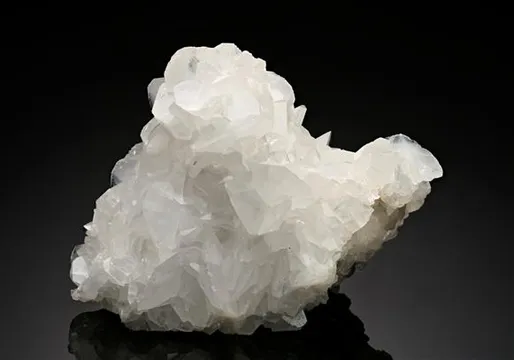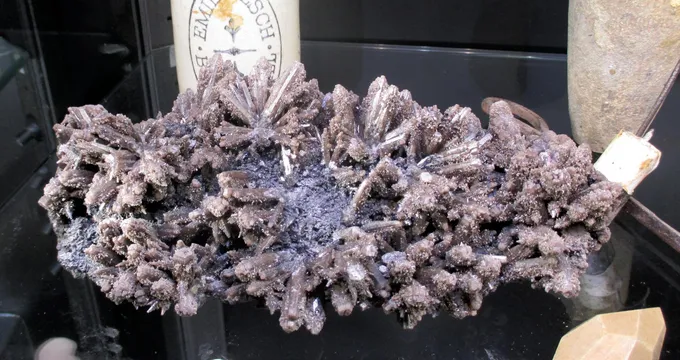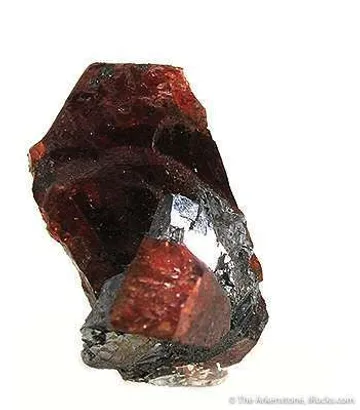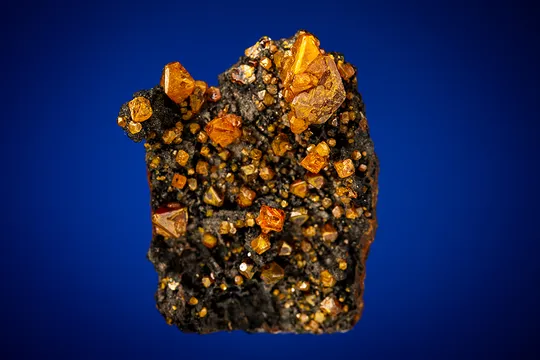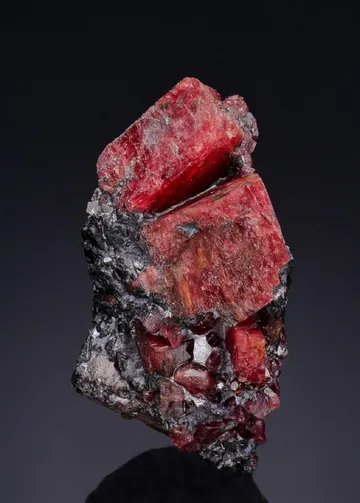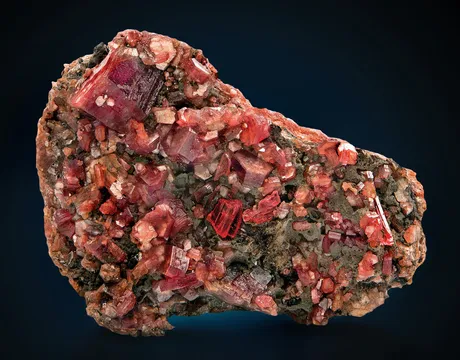
New South Wales — a mineral province with Broken Hill’s vivid azurite and cerussite, Garrawilla orange zeolites, Prospect prehnite, and Lightning Ridge opal.
Key facts
New South Wales is not a single-specimen locality so much as a mineral province in miniature: an entire state whose classic specimens come from sharply different geologic worlds. In the far west, Broken Hill is the great name—an immense Paleoproterozoic silver-lead-zinc system in the Willyama Supergroup of the Curnamona Province, famous for its oxidized-zone suites of cerussite, anglesite, pyromorphite, azurite, smithsonite, chlorargyrite, embolite, stolzite, rhodonite, spessartine, and native silver. In the New England district, granitic and greisen systems at Kingsgate, Elsmore, Emmaville, Torrington, and related fields produced molybdenite, bismuth species, cassiterite, smoky quartz, topaz, beryl, and a long list of specialty minerals. Around Coonabarabran and Tambar Springs, the Jurassic Garrawilla Volcanics gave collectors handsome orange zeolites—especially stellerite and heulandite—in basalt cavities with drusy quartz. Around Sydney, the Prospect dolerite intrusion became one of Australia’s great prehnite localities, producing green, yellow, brown, and even dark botryoidal masses from quarry vugs. And in the north-west, Lightning Ridge and White Cliffs place New South Wales at the centre of the world’s black-opal story.
The best New South Wales specimens have a look that is easy to recognize once seen: Broken Hill pieces are typically vivid and sculptural, with saturated blue azurite, lustrous white cerussite, green-to-yellow pyromorphite, dark manganese oxides, garnet-rich gangue, and old-mine patina; Kingsgate molybdenite is silvery, soft, foliated, and commonly perched on white or smoky quartz; Elsmore cassiterite is dark, adamantine, twinned, and sometimes set on quartz or greisen; Garrawilla stellerite and heulandite show warm orange zeolite blades and sheaves on basalt; Prospect prehnite forms rounded skins, hemispheres, and mammillary plates that can be apple-green, honey-yellow, or brown. The state’s strength is its range: very few collecting regions can place black opal, classic silver halides, world-class prehnite, good molybdenite, lustrous cassiterite, and first-described rare species into one coherent collecting story.
Regional View
Country View
For the serious collector, New South Wales rewards locality discipline. A label that simply says “New South Wales” may be acceptable for a thumbnail drawer, but the value and meaning of a specimen often depend on whether it is Broken Hill Proprietary Mine, Kintore opencut, Block 14, Junction Mine, A.B.H. Consols, Kingsgate, Elsmore Tin Mine, Garrawilla Station, Portobello Station, Prospect Quarry, Great Cobar Mine, Mt Hope, Mineral Hill, Lightning Ridge, or White Cliffs. These are not interchangeable names. Each represents a different environment of mineral growth, a different mining history, and a different set of preservation and identification issues.
Search for specimens: View all specimens from New South Wales, Australia
New South Wales spans several major geologic provinces. The oldest exposed rocks lie around Broken Hill in the far west, within the Curnamona Province, where the Willyama Supergroup hosts the famous Broken Hill Line of Lode. To the east, the Lachlan Orogen carries a long metallogenic history of gold, copper, silver, base-metal, and volcanic-associated systems. Farther north-east, the New England Orogen and its granites, greisens, pegmatitic bodies, and alluvial fields supplied many of the state’s tin, tungsten, molybdenum, bismuth, topaz, quartz, sapphire, and beryl specimens. Between and over these older belts lie the Sydney and Gunnedah basins, basaltic provinces, later intrusive rocks, and sedimentary basins, including the opal-bearing Cretaceous rocks of the Lightning Ridge region.
Broken Hill is the dominant collector name. The orebody was discovered in 1883 by Charles Rasp, a boundary rider who recognized mineralization on the feature that gave the city its name. The district developed into one of the great silver-lead-zinc camps of the world, and its oxidized zone became a legendary source of display minerals. The primary ore is part of a giant metamorphosed stratiform base-metal system, but the collector minerals came in large part from later weathering, supergene enrichment, and open-space crystallization in the oxidized and transitional zones. The result was a spectacular mixture of lead carbonates and sulphates, silver halides, copper carbonates, arsenates, phosphates, manganese oxides, garnets, silicates, and rare secondary species.
Different Broken Hill workings have distinct reputations. The old Proprietary Mine yielded outstanding azurite, cerussite, anglesite, smithsonite, and other oxidized-zone classics. The Kintore and Block 14 open cuts, worked in the late twentieth century, were particularly rich in secondary minerals and type-locality rarities, including arsenates and phosphates in cavities, gossan, garnet-bearing gangue, and oxidized lead-zinc material. The Junction Mine’s Browne’s Shaft produced notable silver minerals from a Consols-type galena-siderite vein, including native silver, dyscrasite, acanthite, pyrargyrite, proustite, and polybasite. The A.B.H. Consols Mine was another important source of silver and silver halides, including native silver in calcite, chlorargyrite, iodargyrite, and related material.
North-east of Broken Hill, the Silverton and Purnamoota district includes Thackaringa-type deposits in which siderite, goethite after siderite, quartz, galena, tetrahedrite, native silver, pyromorphite, and other secondary minerals occur in veins and gossans. Silver specimens from this district, especially from the Umberumberka Mine area, tend to be on siderite or iron oxide rather than in the Broken Hill lode matrix, and careful labels should not casually fold them into “Broken Hill” unless the old provenance supports it.
The Cobar district is a separate western NSW collecting tradition, best known historically for copper, gold, and base-metal mining. The Great Cobar Mine and related fields produced azurite and malachite specimens, including old collection pieces that entered the George Smith and Albert Chapman collections. These Cobar azurites are often valued for their age, Australian pedigree, and association with the nineteenth- and early twentieth-century copper boom rather than for the abundance of modern finds.
The New England mineral fields form another pillar of New South Wales collecting. Kingsgate, east-southeast of Glen Innes, is an old molybdenum-bismuth district of quartz pipes carrying molybdenite, native bismuth, bismuthinite, bismuth oxides and molybdates, arsenopyrite, wolframite-group minerals, and numerous rare secondary Bi-Mo-As species. Production records are incomplete, but the field was the largest molybdenum and bismuth producer in NSW to the end of the twentieth century, with a heyday from about 1905 to 1920. Collectors prize Kingsgate specimens when metallic molybdenite books, plates, or rosettes are aesthetically exposed on quartz, especially with bismuthinite or later yellow and orange molybdate alteration minerals. Because the field consists of many pipes and mines rather than one single “Kingsgate Mine,” conservative labels generally use “Kingsgate” unless the individual pipe is securely known.
Elsmore, Stannifer, Tingha, Emmaville, and Torrington represent the tin and granite-pegmatite side of the New England story. Elsmore is a prime cassiterite locality, especially for dark, lustrous, multiply twinned crystals on quartz or greisen. Torrington is closely linked to the Mole Granite and W-Sn-F mineralization, and is known among collectors for smoky quartz, citrine, topaz, beryl, wolframite-group minerals, cassiterite, fluorite, and other granitic-suite species. Old and modern labels may say “New England, NSW,” but serious cataloguing should push farther: Elsmore, Torrington, Bismuth Dam, Butlers Road, Kingsgate, Emmaville, or a named mine if supportable.
The Garrawilla Volcanics near Coonabarabran, Tambar Springs, Garrawilla Station, Portobello Station, and Glendowda Station produced some of the state’s most appealing zeolite specimens. The orange stellerite and heulandite occur in cavities in Jurassic basalt, accompanied by analcime and drusy quartz. Many older specimens were sold through Coonabarabran shops or labelled as Coonabarabran, Gunnedah, or simply Garrawilla; today, careful collectors recognize the broader Garrawilla Volcanics/Tambar Springs district and avoid over-precise labels unless the station or vug source is documented.
Prospect Quarry, west of Sydney, was worked for dolerite and associated rock for roadstone and construction aggregate, but mineral collectors remember it for prehnite. The Prospect intrusion is a Jurassic alkaline mafic body intruded into Sydney Basin rocks. Its cavities and late-stage secondary assemblages produced prehnite, analcime, calcite, pectolite, apophyllite, natrolite, laumontite, heulandite-group minerals, chabazite, and related species. The best prehnite specimens are botryoidal or mammillary masses with strong colour and luster, sometimes etched free of later calcite. The old quarry complex has been altered by decades of quarrying and redevelopment, and collecting access is not comparable to the mid-twentieth-century period when specimens entered many Sydney collections.
Lightning Ridge and White Cliffs are governed by a different collecting reality: they are opal fields with formal claim and prospecting systems. Lightning Ridge is the premier black-opal field, with precious opal in nodules, seams, fossils, and associated potch in Cretaceous sedimentary rocks. White Cliffs is an older opal field with its own history and distinctive material. Modern opal collecting and mining require appropriate authorization, and casual removal from claims or prospecting blocks is not equivalent to ordinary rockhounding.
Quartz from New South Wales is best understood by district: at Broken Hill it is an accessory and gangue mineral in oxidized and sulphide assemblages, at Silverton it appears as small clear crystals on goethite or with siderite, at Kingsgate it forms the pipe and vug matrix for molybdenite, bismuthinite, native bismuth, and later Bi-Mo minerals, and in the New England granitic fields it becomes a specimen species in its own right as clear, milky, smoky, citrine, and pale brown crystals. Strong collector pieces usually have either a meaningful association—molybdenite on quartz from Kingsgate, cassiterite on quartz from Elsmore, or zeolite on drusy quartz from Garrawilla—or well-formed crystals with transparency and intact terminations; ordinary quartz without a precise NSW sublocality is far less compelling than a labelled piece from Kingsgate, Torrington, Elsmore, Broken Hill, or the Garrawilla district.
Native silver from New South Wales is dominated by the Broken Hill district, where it occurs both as ore and as collector specimens in the oxidized and transitional systems of the Line of Lode, the Consols-type veins, and nearby Thackaringa-style deposits. The Junction Mine’s Browne’s Shaft produced especially important specimens from a galena-siderite vein, including arborescent groups, crystal aggregates, tarnished wires, and large masses that were sometimes exposed by dissolving away enclosing siderite; the A.B.H. Consols Mine yielded silver in calcite as films, plates, wires, curled ram’s-horn forms, and arborescent masses. The most desirable NSW silver specimens have visible native metal rather than merely argentiferous ore, a secure Broken Hill, Junction, Consols, Silverton, or Umberumberka provenance, and old-collection documentation; black tarnish from acanthite or silver-sulphide alteration is part of the locality character and should not be aggressively polished away.
New South Wales stellerite is the warm orange zeolite of the Garrawilla Volcanics, chiefly represented by specimens from the Tambar Springs–Coonabarabran–Garrawilla Station area, where basalt cavities produced bladed crystals, sheaves, bow-ties, and ball-like aggregates with analcime and drusy quartz. Good pieces show lustrous, translucent peach to orange stellerite sitting clearly on dark basalt or sparkling quartz rather than chalky, abraded, or massive cavity fillings; the best single groups can reach several centimeters and have enough isolation to show the fan-like crystal habit. Because stellerite and stilbite-Ca can be visually indistinguishable, and because many older specimens were labelled Coonabarabran, Gunnedah, or Garrawilla without precision, analytical confirmation and conservative locality wording add real value.
The classic New South Wales molybdenite is from Kingsgate, a field of quartz pipes east-southeast of Glen Innes where molybdenite occurs with bismuth minerals, arsenopyrite, quartz, and later secondary molybdates and bismuth minerals. Collectors look for bright silvery hexagonal plates, foliated books, rosettes, or curved crystal aggregates placed on clean quartz, sometimes with bismuthinite or yellow ferrimolybdite-type alteration; large plates are impressive but are commonly bent, bruised, or cleaved because molybdenite is very soft and flexible. Fine Kingsgate molybdenite has long been considered among the best from Australia, and the strongest examples combine old provenance, undamaged metallic faces, and an attractive contrast against quartz rather than a dark massive ore lump.
Cassiterite from New South Wales is strongly associated with the New England tin fields, especially Elsmore, Stannifer, Emmaville, Tingha, and Torrington, where tin mineralization occurs in veins, greisen, granites, pegmatitic quartz, and alluvial concentrates. Elsmore specimens are particularly prized for lustrous dark brown to black, multiply twinned tetragonal crystals on quartz or greisen, sometimes with muscovite or smoky quartz; collector-quality crystals may be small but sharp, while larger pieces command attention when they retain gloss and crystal definition rather than appearing as battered alluvial lumps. The best specimens show bright adamantine luster, twinning, intact crystal edges, and a specific Elsmore or New England sublocality; ordinary heavy black cassiterite without matrix or label is much less desirable.
Azurite is a major New South Wales display mineral from Broken Hill, Cobar, Mt Hope, and Mineral Hill, but the most storied specimens are the old Broken Hill oxidized-zone plates and the historic Cobar copper-mine pieces. Broken Hill azurite may occur as dark blue crystal groups with cerussite, malachite, cuprite, silver halides, smithsonite, anglesite, and other oxidized minerals, while Great Cobar and Mt Hope specimens often show azurite with malachite and quartz, sometimes as partly altered or pseudomorphed copper-carbonate material. Good NSW azurite is judged by saturation, luster, crystal sharpness, and association, with old collection provenance adding heavily; dull massive blue copper carbonate is commoner than a clean plate of sparkling crystals from Proprietary Mine, Great Cobar Mine, Mt Hope, or Mineral Hill.
New South Wales opal means, above all, Lightning Ridge black opal, with White Cliffs forming the other great historic NSW field. Lightning Ridge material is valued for bright play-of-colour on a dark or black body tone, and it occurs as nodules, seams, potch-and-colour, opalized fossils, and polished cabochons; the district has also produced scientifically important opalized bones, shells, plant remains, and other fossils from Cretaceous rocks. The best collector specimens have natural form, vivid colour, stable dryness, and clear field attribution—Lightning Ridge, Coocoran, Grawin, Glengarry, Sheepyard, or another specific field when known—while commercial stones are judged additionally by body tone, brightness, pattern, thickness of colour bar, cut, cracking, and treatment status.
Smoky quartz from New South Wales is chiefly a New England granite-field mineral, with Torrington, Bismuth Dam, Butlers Road, Kingsgate, Tingha, Oban, and related localities supplying brown, smoky, and citrine-leaning quartz crystals and groups. Torrington district specimens include single crystals and clusters reported to significant cabinet size, while Kingsgate pieces are especially attractive when smoky quartz hosts metallic molybdenite or bismuthinite. The best examples have undamaged terminations, even smoky colour, transparency, and documented sublocality; pieces sitting between smoky quartz and citrine should be described honestly by appearance rather than forced into a more commercial variety name.
New South Wales mimetite is chiefly a Broken Hill secondary lead-arsenate mineral, especially from oxidized-zone pockets and late twentieth-century open-cut material at Kintore and related Broken Hill workings, with occurrences also documented in museum collections and old mine material. It appears as yellow, colourless, white, or brownish crystals, crusts, and aggregates on goethite, coronadite, quartz, malachite, smithsonite, and other oxidized gangue, and it can be visually confused with pyromorphite without analysis. The best NSW mimetites are not necessarily large; they are sharp, bright, well-contrasted, and labelled to a specific Broken Hill source, especially Kintore or a mine where mimetite has been confirmed rather than assumed from colour.
Pyromorphite from New South Wales is best known from Broken Hill and the Silverton region, where lead-rich oxidized zones produced green, yellow-green, cream, tan, and pale crystals with cerussite, galena, coronadite, smithsonite, goethite, quartz, spessartine, and other minerals. Broken Hill is historically important enough for pyromorphite to be treated as a classic locality, with strong examples from Kintore and old lode material, while the Silverton district includes small cream to tan pyromorphite crystals on goethite or siderite at places such as the Daydream Mine. Fine pieces show sharp hexagonal prisms or rounded aggregates with colour and sparkle; because pyromorphite and mimetite intergrade and imitate one another, analysed or well-documented specimens carry a premium.
Heulandite from New South Wales is most appealing in the Coonabarabran–Garrawilla zeolite district, where orange heulandite and stellerite occur with analcime and drusy quartz in basalt cavities on stations such as Portobello, Glendowda, and Garrawilla. Specimens are typically cabinet to miniature plates or cavity sections, with pearly to vitreous orange crystals surrounded by fine quartz sparkle; the best pieces have fresh colour, open vugs, and good contrast against basalt or quartz rather than massive zeolite fill. Heulandite is also recorded from Prospect, but there it is an occasional accessory in a prehnite-zeolite assemblage rather than the locality’s headline mineral.
The classic New South Wales prehnite locality is Prospect Quarry, where the Jurassic dolerite intrusion west of Sydney produced world-class mammillary, botryoidal, and rounded prehnite masses in cavities and seams with calcite, pectolite, analcime, pyrite, natrolite, laumontite, apophyllite, and other secondary minerals. Colours range from transparent white and pale apple-green through yellow-green, honey-yellow, reddish brown, deep golden brown, and very dark tones; much prehnite was once hidden or coated by later calcite and some specimens were cleaned or etched to reveal the prehnite surface. The best Prospect pieces have strong colour, glossy rounded form, minimal bruising, and a secure old quarry label, since older material may be labelled Prospect, Toongabbie, Parramatta, BMI Quarry, Styles Quarry, or simply “Sydney.”
Beyond these headline species, New South Wales is exceptionally rich in rarities and type-locality minerals. Broken Hill and its open cuts are associated with first-described species including kintoreite, segnitite, mawbyite, yancowinnaite, kolitschite, nyholmite, plimerite, raspite, and brokenhillite, among others; the district also produced celebrated specimens of cerussite, anglesite, smithsonite, rhodonite, spessartine, stolzite, chlorargyrite, embolite, iodargyrite, bromargyrite, marshite, dyscrasite, proustite, pyrargyrite, and acanthite. Kingsgate has added modern Bi-Mo rarity interest with kingsgateite and colchesterite as type-locality species, along with koechlinite, bismoclite, bismite, native bismuth, bismuthinite, gelosaite, sardignaite, mambertiite, and related secondary minerals. Prospect contributes classic analcime, pectolite, calcite, apophyllite, natrolite, and prehnite pseudomorphs after laumontite; the New England fields add topaz, emerald and aquamarine beryl, wolframite-group minerals, scheelite, fluorite, monazite, sapphire, zircon, and alluvial gem suites.
New South Wales specimens demand careful labelling. “Broken Hill” can cover many mines, leases, shafts, and open cuts, and the difference between Proprietary Mine azurite, Kintore mimetite, Block 14 secondary arsenates, Junction Mine silver, and Silverton-region native silver is not cosmetic—it is part of the specimen’s identity. Likewise, “Kingsgate Mine” is often an imprecise label because Kingsgate is a mineral field of many quartz pipes and mines; unless the pipe or mine name is documented, “Kingsgate, Gough Co.” is the safer wording. Garrawilla zeolites have often been sold as Coonabarabran or Gunnedah, and Prospect prehnite may carry old labels such as Toongabbie, Parramatta, BMI Quarry, or Styles Quarry. These historical labels are not automatically wrong, but they should be interpreted rather than silently “corrected.”
The most common identification trap in NSW zeolites is stellerite versus stilbite-Ca. Attractive peach-orange bow-ties from the Garrawilla Volcanics have long circulated as stellerite, and much good material is correctly regarded that way, but morphology alone is not definitive. X-ray diffraction and chemistry are the meaningful tests. Mimetite versus pyromorphite is another recurring Broken Hill problem, because the two apatite-group species can look alike and can occur in the same oxidized lead environment. If a specimen is unusually important, colour is not enough evidence.
Condition is central. Broken Hill cerussite, anglesite, pyromorphite, azurite, and silver-halide specimens are commonly old and fragile; edge bruising, repaired points, dust in crystal pockets, and historic acid cleaning all occur. Silver halides such as chlorargyrite, bromargyrite, embolite, and iodargyrite are photosensitive and should be stored away from prolonged strong light. Native silver naturally tarnishes, and black acanthite coatings can be part of the original paragenesis; polishing silver in place may destroy both patina and value. Molybdenite from Kingsgate is very soft, cleaves easily, and can be bent or rubbed bright by careless handling. Prehnite from Prospect is tougher than many zeolites but often has rounded surfaces that show bruises and saw marks readily. Opal should be evaluated for crazing, dehydration cracks, oiling, resin treatment, assembled doublets or triplets, dyed imitations, and synthetic material; natural Lightning Ridge black opal with untreated colour and stable condition deserves documentation.
Availability varies sharply by district. Lightning Ridge opal remains commercially available, but fine black opal is expensive and increasingly specialized. Broken Hill classics are mostly old collection material, and the best historic cerussites, silver halides, azurites, pyromorphites, and smithsonites are heavily competed for. Kingsgate molybdenite and Elsmore cassiterite still appear on the market, including field-collected pieces, but fine undamaged examples are scarcer than casual listings suggest. Garrawilla zeolites remain obtainable in modest sizes, while top cabinet stellerite and heulandite with strong colour and lustre are harder. Prospect prehnite is essentially a classic old-locality material; fine pieces with early provenance are much better than common green botryoidal prehnite sold without sublocality support.
The New South Wales mineral story begins, for many collectors, with a sheep station worker walking over an odd ridge in 1883. Charles Rasp thought the dark, heavy material he found at the “broken hill” might be tin oxide. It was not tin. The discovery led to the Broken Hill silver-lead-zinc field, the Line of Lode, and one of the great mining cities of Australia. Within only a few years, rich silver had transformed a remote station landscape into a mining camp that drew workers, engineers, investors, dealers, and museum agents. By 1891, Broken Hill was already one of the world’s great sources of lead, zinc, and silver, and the collector minerals coming out of the oxidized zone were as spectacular as the ore was profitable.
Broken Hill produced not just wealth but characters. Edward Aldridge, who had no specialist mineral training, became one of the city’s great collectors. During his lifetime he built a collection of nearly 5,000 mineral specimens, including crystallised anglesite, azurite, cerussite, chlorargyrite, malachite, smithsonite, and stolzite. After his death in July 1909, important parts of his collection moved into public institutions: the Australian Museum, the former Mining Museum, the Technological Museum, and the NSW Government all received specimens. For collectors today, an Aldridge label is more than a name; it is a line back to the oxidized lode when major specimens were still being pried from working ground.
One of the best Broken Hill collecting stories concerns an azurite plate now in the Albert Chapman Collection at the Australian Museum. The specimen came from the Proprietary Mine and was collected in the 1950s. According to the museum’s account, a trucker was asked by a miner to help remove it from rock, placing his hand over the crystals to protect them while the miner chipped around the specimen. When the piece came free, the trucker simply kept his hand over the prize, walked away, and drove off. Years later, in the 1960s, Albert Chapman heard a tip in a Broken Hill pub and tracked the specimen to the trucker’s house. It was sitting on a mantelpiece, dusty and neglected. Chapman bought it, had it cleaned, and the deep blue crystals re-emerged as one of those pieces that make the Broken Hill oxidized zone feel almost theatrical.
At Kingsgate, the drama is quieter but no less collector-specific. The field is not one mine but a maze of quartz pipes scattered over a broad area east-southeast of Glen Innes. Its heyday came between about 1905 and 1920, when molybdenite and bismuth were the economic targets. A century later, collectors still argue labels: Old 25 Pipe, Sachs’ Mine, Kingsgate Mining Company ground, or simply Kingsgate. The Australian Museum’s molybdenite holdings preserve the human side of this field through Freda Sachs, niece of Valentine Sachs, owner of Sachs’ Mine. Freda had enough mineralogical knowledge to work in the museum’s mineral department in the early 1940s, and her link to Kingsgate helped build a collection of molybdenite that became part of Australian mineral folklore.
The Garrawilla zeolite fields have their own quieter magic. In 1863, Colonial Geologist Samuel Stutchbury discovered the zeolite deposits in the Coonabarabran region. Later, in 1933, Oliver Chalmers of the Australian Museum went into the field and collected many examples. The setting is not a metal mine but basalt country, where hot spring waters associated with Jurassic volcanism left cavities lined with orange zeolites, analcime, and drusy quartz. Generations of collectors bought these specimens under shop labels—Coonabarabran, Gunnedah, Garrawilla—and only later did the geography of the Garrawilla Volcanics, Tambar Springs, and individual stations become a serious labelling question.
Lightning Ridge adds a different kind of field narrative, where the collector is often also a miner, gambler, lapidary, amateur palaeontologist, and storyteller. The opal may be a gem, but the fossils can be scientific treasures. Fossil material from the Ridge is commonly fragmentary and is often found by miners or recovered from tailings, yet the field has produced the only dinosaur material known from New South Wales and some of Australia’s few Mesozoic mammals. In 2024, researchers announced evidence of an “Age of Monotremes” from opalised jaws found in the Lightning Ridge opal fields, including new fossil monotreme genera. Elizabeth Smith and her daughter Clytie of the Australian Opal Centre were central to that story, after decades of work searching and saving fossils from the opal fields. At Lightning Ridge, a miner’s castoff can become a museum specimen, a gemstone, or a clue to a vanished Cretaceous world.