






A collector's guide to Zagi Mountain, Pakistan: its geology, mining history and notable minerals, illustrated with the 143 specimens documented from this locality on EarthWonders.
Key facts
Zagi Mountain is one of the great modern collector localities for rare-earth-element minerals: a modest hill near Kafoor Dheri and Warsak, northwest of Peshawar, that has produced specimens with a mineralogical punch far out of proportion to its size. The collecting interest here is not an industrial open pit or a conventional ore mine, but a system of Alpine-type fissures and weathered pockets in riebeckite- and aegirine-bearing alkaline granite gneiss of the Warsak igneous complex. Those fissures concentrated rare earths, fluorine, titanium, zirconium, beryllium, barium, phosphorus, and silica into an assemblage that collectors immediately recognize: lustrous reddish-brown Bastnasite, golden to red Rutile, orange-brown Xenotime, brown Synchysite, smoky Quartz shot through with black riebeckite and golden rutile needles, rare Genthelvite, Titanite, Aegirine, Parisite, Monazite, Baotite, Hingganite, and a suite of lesser REE and Ti-Zr minerals.
The best specimens have the visual language of Alpine clefts but with an alkaline-granite chemistry: bright, sharply bounded single crystals and floaters; gemmy amber to root-beer Bastnasite with beveled hexagonal terminations; prismatic Xenotime crystals that can be surprisingly large for the species; smoky quartz crystals internally lit by sprays of rutile and black amphibole; and rare matrix combinations on albite, microcline, quartz, and dark riebeckitic or aegirine-rich rock. Historically, Zagi Mountain matters because its first fine Bastnasite specimens entered the market under a false Afghan source before the locality was corrected, and because subsequent study made the hill the type locality for Hingganite-(Nd), Nd2□Be2Si2O8(OH)2.
Regional View
Country View
Zagi is also a cautionary locality: labels have traveled through several spellings and political geographies, including Zegi Mountain, Zagai Sar, Zaga Ghar, “Shinwaro,” Mulla Ghori, Khyber Agency, FATA, Peshawar District, and Khyber Pakhtunkhwa. For specimens, the mineralogical locality is the important constant: Zagi Mountain near Hameed Abad Kafoor Dheri, southeast of Warsak Dam, in the Warsak alkaline-granite area northwest of Peshawar.

Photo: Wikimedia Commons
Search for specimens: View all specimens from Zagi Mountain, Pakistan
Zagi Mountain is a low, isolated hill area roughly 3 by 5 km in extent, rising about 150 to 200 m above the surrounding plain near Kafoor Dheri, about 4 to 5.5 km south or southeast of Warsak and roughly 30 to 40 km northwest to north-northwest of Peshawar. Its bedrock belongs to the Warsak igneous complex, part of the broader Peshawar Plain alkaline igneous province. The essential collector geology is gneissic alkaline A-type granite: microcline and albite with quartz, aegirine, riebeckite and related amphiboles, astrophyllite, biotite, muscovite, fluorite, ilmenite, zircon, titanite, and abundant rare-earth-bearing accessory minerals.
The specimen-producing bodies are best described as Alpine-type fissures, pockets, and veins developed in the alkaline granite gneiss rather than as continuous ore seams. The weathering style is crucial. Many of the best crystals were not freshly broken out of hard rock but recovered loose in decomposed granitic material, collapsed pocket debris, and nearby alluvial gravels. This explains the abundance of sharp individual floaters and single crystals with only small contacts, along with the occasional waterworn or naturally abraded crystal. Matrix pieces exist, but Zagi’s reputation rests heavily on complete loose crystals and small combinations that survived weathering.
Mineralization is rare-earth-rich and chemically distinctive. Cerium-dominant fluorcarbonates such as Bastnasite-(Ce), Synchysite-(Ce), and Parisite-(Ce) occur with phosphate species such as Xenotime-(Y) and Monazite-(Ce), beryllium-bearing silicates including Hingganite-(Y), Hingganite-(Nd), Gadolinite-group minerals, and Genthelvite, plus titanium and zirconium phases including Rutile, Titanite, Ilmenite, Baotite, Gramaccioliite-(Y), Zircon, and related oxides. The collector-visible gangue is generally quartz, feldspar, riebeckite, aegirine, albite, microcline, astrophyllite, and iron-stained pocket debris.
Specimen production has been episodic and largely artisanal. Fine Bastnasite reached international collectors in the late 1990s, initially sold under the invented Afghan locality “Shinwaro,” supposedly in the mountains of Konar Province; by 2001 that attribution had been corrected to Zagi Mountain. Herb Obodda’s involvement was central to recognizing and publicizing the locality internationally, and the 2004 Mineralogical Record and extraLapis accounts established Zagi as a major rare-earth specimen source. Local accounts also describe Pakistani dealers and miners bringing “strange” crystals to Obodda in the 1990s, before the material’s real identity and collector value were widely understood.
The most important early pockets yielded large, transparent to translucent Bastnasite crystals, with some pieces still unsurpassed for the species. Later limited finds added fine Xenotime, Rutile, rare Baotite, Riebeckite-in-Quartz combinations, and more recently Synchysite-(Ce) and Hingganite material of analytical interest. The 2009–2010 quartz finds are especially prized for glassy smoky crystals included with golden rutile needles and lustrous black riebeckite; these are not merely “included quartz” curiosities, but aesthetic, species-rich specimens from the same alkaline fissure environment.
Access today should be treated as local, controlled, and uncertain rather than as an open collecting site. The hill lies in a sensitive region near the historic Peshawar–Warsak–Khyber corridor, and specimen recovery has been conducted by local miners and dealers rather than by public recreational collecting. Reported current production is sporadic; good material appears through Pakistani dealers, Peshawar mineral-market networks, established international dealers, and collector resales. For serious collectors, provenance and analytical confidence often matter as much as aesthetics, because Zagi specimens frequently involve visually similar rare-earth minerals.
Bastnasite-(Ce) is the signature Zagi mineral and the species by which most collectors first learned the locality: reddish-brown, amber, root-beer, honey, and occasionally yellow-zoned crystals, commonly tabular, blocky, prismatic, or bipyramidal, with bright luster and beveled hexagonal geometry. Average crystals are under 2.5 cm, but exceptional prismatic specimens have reached roughly 6–7 cm, a size range that places Zagi among the world’s elite Bastnasite sources. The best pieces are transparent to translucent, lustrous, sharply terminated floaters or matrix specimens on quartz, albite, microcline, or dark alkaline-granite gangue; inclusions of rutile, riebeckite, and astrophyllite add locality character, but excessive abrasion, dull surfaces, incomplete terminations, and misidentified Parisite-style habits lower confidence and value.
Rutile from Zagi occurs both as independent crystals and as inclusions in quartz and Bastnasite, typically golden, red, reddish brown, or dark metallic, with the most attractive examples showing sharp prismatic forms, flattened crystals, striated faces, reticulated or sagenitic arrangements, and dramatic contrast against smoky quartz or dark riebeckite. Matrix specimens include Rutile on Ilmenite and Rutile with Quartz, Riebeckite, Aegirine, and Bastnasite-(Ce); loose crystals and included needles can range from millimetric sprays to multi-centimeter display pieces, with documented cabinet-quality rutile-bearing quartz from the 2009–2010 finds. At Zagi, the collector premium goes to clean geometry, strong red or golden internal reflections, undamaged terminations, and clear association—especially rutile-rich smoky quartz where the needles are bright, dense, and naturally enclosed rather than merely lying on broken surfaces.
Xenotime-(Y) is one of Zagi’s great achievements: prismatic to tetragonal, brown, orange-brown, greenish-golden, honey, and sometimes color-shifting crystals that can reach several centimeters, with reported Zagi crystals to about 6 cm and gallery-documented examples around 7 cm. The crystals may occur as loose floaters, stacked prismatic groups, or crystals on quartz and feldspar, and some specimens contain or are associated with astrophyllite, rutile, riebeckite, microcline, and smoky quartz. Good Zagi Xenotime is sharp, lustrous, three-dimensional, and visibly crystalline rather than crude; the best pieces have complete terminations, translucency at the edges, balanced color, and enough size to be appreciated without magnification, while matrix examples are notably scarcer and especially desirable when the crystal is well exposed.
Synchysite-(Ce) from Zagi is a more recent and less common collector prize than Bastnasite or Xenotime, but the best crystals have the same alkaline-fissure look: lustrous brown to amber-brown, doubly terminated, tapered, shuttle-like to prismatic crystals, sometimes with riebeckite needle inclusions or perched on albite with black actinolite- or amphibole-like needles. Notable specimens include single crystals around 3.2–3.3 cm and matrix examples several centimeters across; the mineral has been documented from Zagi with Aegirine in the occurrence data and with albite/amphibole-rich matrices in dealer-documented specimens. Fine pieces are judged by confirmed identification, luster, full termination at both ends, translucency at the tips, and natural matrix placement; ordinary pieces are more massive-looking, contacted, or difficult to distinguish visually from other brown REE fluorcarbonates without analysis.
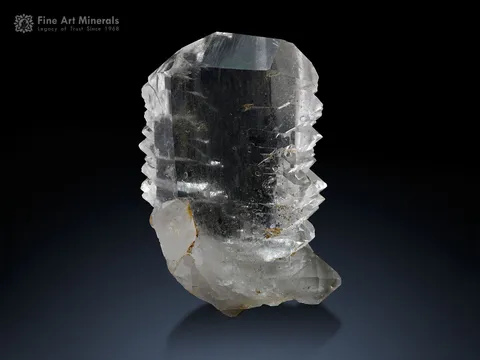
Quartz at Zagi is important chiefly as a host and stage for the rare-mineral assemblage: clear to smoky, sometimes doubly terminated, sometimes in glassy groups, and famously included with golden Rutile, black Riebeckite, and hairlike Astrophyllite, with additional associations including Bastnasite-(Ce), Xenotime-(Y), Parisite-(Ce), Fluorite, Hematite, Aegirine, Hingganite-(Y), Albite, and feldspar. The 2009–2010 included-quartz finds are especially collectible, and standout specimens show transparent smoky crystals densely but cleanly threaded by rutile or riebeckite, with needles oriented dramatically through the body of the quartz rather than hidden in cloudy zones. Good pieces are transparent enough to read the inclusions, undamaged at the terminations, and compositionally interesting; ordinary pieces are included but cloudy, fractured, iron-stained, or aesthetically confused.
Riebeckite is a common rock-forming amphibole in the Warsak alkaline granite, but crystallized Zagi specimens are far less common, and its best collector expression is as lustrous black needles or blades in vugs and, especially, as inclusions in quartz. Zagi quartz with riebeckite can show numerous dark, sharply defined acicular crystals; a documented 9.0 cm smoky quartz combination from the 2009–2010 finds contained both golden rutile and jet-black riebeckite, with the longest riebeckite needle about 4.5 cm. The most desirable Riebeckite specimens are not dull massive amphibole, but clear quartz windows into intact black needles, or rare free-standing crystals associated with Rutile, Bastnasite, Fluorite, Astrophyllite, Aegirine, Albite, Parisite, Rhabdophane, Hingganite, Titanite, or Xenotime.
Genthelvite from Zagi is rare, analytically significant, and visually deceptive, which makes confirmed specimens especially attractive to advanced collectors. The best Zagi pieces are sharp, brown to translucent brown crystals, with notable examples reaching several centimeters—one well-known specimen is about 3.7 x 3.3 x 2.5 cm, and another documented crystal is around 5.0 x 3.5 cm, extraordinary sizes for this uncommon Be-Zn silicate. Confirmed Zagi Genthelvite has been supported by SXRD and EDS work, but the locality also has a history of suspect “genthelvite” labels later questioned or shown to be Titanite or other minerals; for this species, crystal form, provenance, and analysis matter more than a pretty brown dodecahedral-looking shape.
Titanite is documented from Zagi as CaTiO(SiO4), most often associated in the occurrence record with Microcline and occasionally with Riebeckite, and it occupies an important collector niche because some brown, wedge-shaped or bipyramidal-looking Zagi crystals have been confused with rarer species. Zagi Titanite specimens are generally smaller and less celebrated than the locality’s Bastnasite, Xenotime, and Rutile, but sharp lustrous crystals on feldspar-rich matrix are worth attention, especially when they retain a distinct wedge habit rather than appearing as broken brown fragments. Good Zagi Titanite is well terminated, isolated, lustrous, and honestly labeled; the most important “quality” factor here is not just aesthetics but avoiding confusion with purported Genthelvite or other rare REE minerals.
Aegirine at Zagi is both a rock-forming component of the alkaline granite and a specimen association that sharpens the locality’s visual identity: black to dark greenish-black prismatic crystals or needles with Hingganite-(Nd), Hingganite-(Y), Quartz, Smoky Quartz, Bastnasite-(Ce), Albite, Riebeckite, Synchysite-(Ce), Rutile, and Parisite-(Ce). It is not usually collected from Zagi as large standalone show crystals; rather, it gives contrast and paragenetic context to rare-earth specimens, particularly Bastnasite and Hingganite pieces, and to included quartz. Good Zagi Aegirine is sharp, lustrous, and visibly crystallized rather than merely black matrix, and specimens become much more desirable when the aegirine frames a rare REE species or appears as clean inclusions in transparent quartz.
Beyond these headline minerals, Zagi Mountain has an unusually rich documented list for such a compact locality. Hingganite-(Nd), Nd2□Be2Si2O8(OH)2, is the locality’s confirmed type-locality species and occurs as microscopic to millimetric zones in prismatic hingganite crystals intergrown with Hingganite-(Y); the type material is associated with Aegirine, Microcline, Fergusonite-(Y), and Zircon. Baotite is another Zagi trophy rarity, with a very small number of crystals reported by Herb Obodda and regarded as rivaling those from Baotou, the species’ type locality. Other documented or notable species include Bastnasite-(La), Parisite-(Ce), Monazite-(Ce), Rhabdophane-(Ce), Gadolinite-(Ce), Gadolinite-(Y), Hingganite-(Ce), Gramaccioliite-(Y), Fluorite, Albite, Microcline, Orthoclase, Astrophyllite, Ilmenite, Pyrophanite, Brookite, Hollandite, Hematite, Opal var. Hyalite, Magnesio-riebeckite, Thorite, Zircon, and Baryte.
Zagi Mountain specimens demand unusually careful labeling. The most famous historical mislabel is “Shinwaro,” an invented Afghan locality used for early Bastnasite specimens before Zagi was established as the true source. Older labels may also say Mulla Ghori, Khyber Agency, FATA, NWFP, Zegi Mountain, Zagai Sar, or simply “near Warsak”; these are not automatically wrong in a historical-label sense, but modern locality data should be reconciled to Zagi Mountain, Hameed Abad Kafoor Dheri, Peshawar District, Khyber Pakhtunkhwa, Pakistan.
Species identity is the main authenticity issue. Brown Zagi REE minerals can be treacherously similar by eye: Bastnasite, Parisite, Synchysite, Xenotime, Monazite, Hingganite, Gadolinite-group minerals, Titanite, and even weathered or iron-stained feldspar can be confused on casual inspection. Documented discussions and analyses have shown that some specimens sold as Genthelvite were actually Titanite or other materials, and several tabular or dipyramidal crystals sold under different REE fluorcarbonate names have tested as Bastnasite-(Ce). For expensive Genthelvite, Hingganite-(Nd), Synchysite, Parisite, Baotite, Gadolinite, or unusual “new find” material, analytical support by EDS, Raman, XRD, or single-crystal work is more than a luxury.
Condition problems are typical of a weathered-pocket locality. Loose crystals may be natural floaters, but they may also show rolled edges, dull faces, iron staining, rehealed-looking but actually abraded contacts, missing terminations, and pocket clay in crevices. Bastnasite has only moderate hardness, is brittle, and can show cleavage or surface bruising; avoid ultrasonic cleaning and harsh acids. Rutile is tougher but slender needles in quartz can be misleadingly exposed at broken surfaces. Quartz combinations should be checked for repaired side crystals, glued-on matrix, and whether rutile or riebeckite needles are truly included inside the quartz rather than superficially attached.
Radioactivity is usually a handling footnote rather than a crisis, but this is an REE locality with Monazite and Thorite in the assemblage, so prudent collectors should treat dusty broken material carefully, avoid inhaling fines from trimming or cleaning, and store labeled radioactive species with normal mineral-collection precautions. Hingganite-(Nd) type material is reported nonfluorescent under shortwave and longwave UV; fluorescence is not a major selling feature for the Zagi suite. The real premium is crystal quality, identity, and provenance.
Market availability is uneven. Zagi Bastnasite remains visible in the trade, from modest thumbnails to expensive gemmy miniatures and rare cabinet pieces, while top early crystals are increasingly locked in collections. Xenotime, Synchysite, confirmed Genthelvite, Baotite, and fine Riebeckite/Rutile-in-Quartz combinations are significantly scarcer. New material continues to appear sporadically through Pakistani dealers and international resale channels, but the best old pieces—especially those tied to Herb Obodda, Fine Art Minerals, iRocks, Fabre, Crystal Classics, or published photographs—carry a provenance premium.
The Zagi story begins with a false mountain. When the first impressive Bastnasite crystals reached the collector market in 1999, they were said to come from “Shinwaro,” supposedly high in the mountains of Konar Province, Afghanistan. It was a romantic label: remote, Afghan, difficult, and plausible to buyers already used to seeing treasures move through Peshawar from across the border. By 2001, that story had collapsed. The crystals were Pakistani, not Afghan, and the true source was Zagi Mountain near Warsak and Kafoor Dheri. For collectors, that correction matters because a “Shinwaro” label on a Bastnasite is not necessarily a red flag against the specimen itself—it may be a period label from the earliest years of the Zagi trade.
One Pakistani account gives the human side of that first recognition. Zakir Ullah, also known as Jhulay Lal, recalled working in 1994 with the American mineral dealer Herbert P. Obodda and handing him crystals of a “strange mineral” at a time when advanced mineral testing was not readily available locally. Obodda took samples to the United States; they were tested and proved to be Bastnasite. The irony, as Zakir Ullah later told it, was that the trade was innocent because neither side initially grasped the full rarity and value of the material. After that, Obodda bought a substantial quantity of large crystals, and foreign buyers began to pursue them with urgency. Zakir Ullah remembered a 1999 lot of 200 crystals with Bastnasite, “superbly clear and shimmering,” and said that after selling that lot he had never again seen such rarities in the market.
The scientific story has its own collector-market trigger. In December 2018, Russian collector Pavel Martynov supplied Anatoly Kasatkin with a loose prismatic crystal sold simply as hingganite from a Pakistani dealer. Under SEM/EDS, the crystal turned out not to be compositionally simple: it contained zones corresponding to Hingganite-(Y) and a neodymium-dominant analogue. That zoned collector specimen became the basis for Hingganite-(Nd), approved as IMA 2019-028 and later described in The Canadian Mineralogist. The holotype fragment went to the A.E. Fersman Mineralogical Museum in Moscow, while the lesson stayed in the marketplace: a small, dark greenish-brown Zagi crystal can carry mineralogical information invisible to the eye, and even commercially available “hingganite” needs analysis before its suffix can be trusted.
Zagi’s included quartz also developed a quiet collector mythology. The finest 2009–2010 specimens are not large by Brazilian quartz standards, but they are intensely local in character: smoky, glassy crystals threaded by golden rutile and jet-black riebeckite, sometimes with needles several centimeters long. On one well-documented specimen, the longest black riebeckite needle measured about 4.5 cm inside a 9.0 x 8.4 x 6.1 cm smoky quartz group. That is the kind of specimen that explains why Zagi is not merely a “rare species” locality. At its best, it made rare-earth geology visible as sculpture.
-156558.jpg)