






Upper Kohistan District, Pakistan - an ultramafic locality yielding forsterite (peridot) crystals and Kohala baryte, with rare PGE minerals for collectors.
Key facts
Upper Kohistan is a collector’s name that has always carried more geological than administrative neatness. In specimen labels, “Kohistan” may mean the present Upper Kohistan District along the Indus, the older undivided Kohistan District, or the broader Kohistan island-arc belt that crosses northern Pakistan. For collectors, that distinction matters because the most familiar “Kohistan” specimens are the bright Pakistani peridots long traded from the Sapat/Suppat area, while the formally documented Upper Kohistan District mineral record is anchored by the Jijal mafic-ultramafic complex and the Kohala baryte deposit. Taken together, they belong to one of the great exposed arc-root settings on Earth: slices of ultramafic mantle, lower-crustal granulite, chromitite, gabbroic rocks, and suture-zone geology brought to the surface along the Himalayan collision zone.
The district’s mineralogical personality is ultramafic. The Jijal complex, exposed near the Indus valley around Jijal and Patan, is a deep, high-pressure fragment of the Kohistan island arc, famous in the literature for garnet granulites, dunite, pyroxenite, chromitite, and platinum-group-element mineralization. Those rocks do not usually produce showy cabinet specimens in the way an alpine cleft or pegmatite does; their importance is in polished sections, ore microscopy, geochemistry, and the extraordinary list of microscopic PGE minerals: sperrylite, merenskyite, moncheite, atheneite, temagamite, melonite, electrum, native gold, and tetra-auricupride among them. For collectors who prize locality science, Jijal is a locality to read under a microscope rather than merely admire under a lamp.
By contrast, the peridot specimens sold under Kohistan/Sapat labels are unapologetically visual. The best crystals are saturated lime to grassy green forsterite, lustrous and naturally terminated, sometimes standing in clusters on pale serpentinized matrix or dark magnetite-rich material. Fine pieces have a quality that separates them from ordinary olivine: a real crystal outline, transparency, and lively internal light rather than granular green rock. Black acicular ludwigite-vonsenite inclusions, when present, give some Pakistani peridots a diagnostic-looking dark silk that collectors often prize rather than penalize.
Regional View
Country View
Upper Kohistan is therefore best understood as a serious collector’s regional page rather than a single-pocket locality. It is a place where old labels, modern district boundaries, specimen commerce, and arc-root geology overlap. A peridot labelled simply “Kohistan, Pakistan” should be read with caution and curiosity: it may be a shorthand for the classic Sapat/Suppat material of the Kohistan arc rather than a precise statement of present-day district administration. A Jijal or Kohala specimen, on the other hand, belongs squarely to the Upper Kohistan District record and carries a different kind of appeal—scientific, rare-metal, and petrographic.
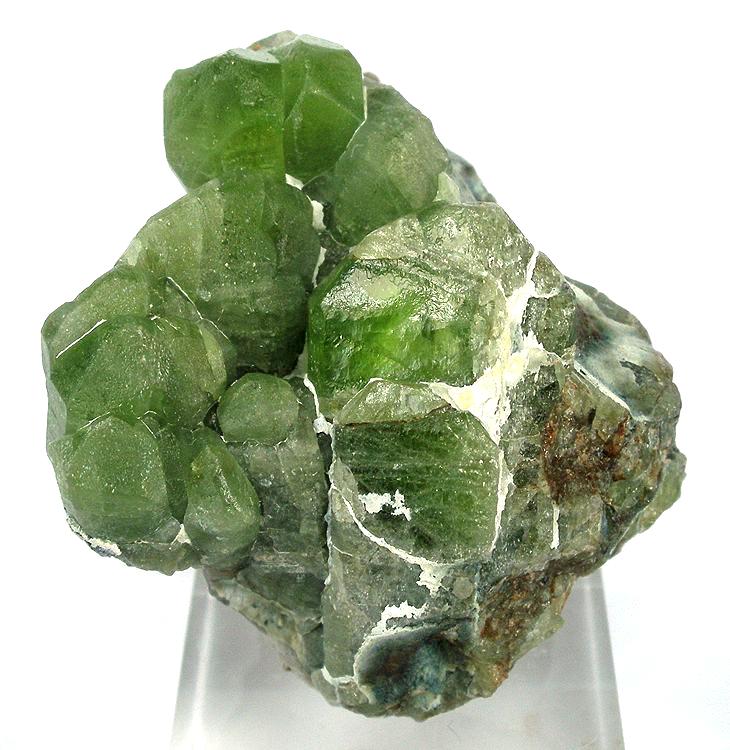
Photo: Wikimedia Commons
Search for specimens: View all specimens from Upper Kohistan District, Pakistan
The mineral localities documented for Upper Kohistan District are not a tidy suite of collector mines. They are outcrops and deposits in the Kohistan arc, a Cretaceous island-arc terrane now exposed in the Himalayan collision zone. The Jijal complex is the district’s principal mineralogical locality in the literature. It is described as a mafic-ultramafic complex and tectonic wedge near the Indus valley, with chromite deposits named at Shungial, Kuroo, Gabara, Manidara, Kokial, and Serai. The rock association includes dunite, peridotite, pyroxenite, chromitite, gabbroic to granulitic rocks, hornblende-bearing assemblages, magnetite, ilmenite, sulfides, and a suite of platinum-group minerals. These are not specimen-pocket minerals in the marketplace sense; they are mostly ore-mineral and microprobe discoveries in chromitite, sulfide-bearing ultramafic rock, and associated mafic cumulates.
The geology of Jijal is important because it exposes a deep arc section close to the Main Mantle Thrust/Indus suture. Published work on the Jijal complex treats it as a lower-crustal to mantle-level component of the Kohistan arc, with garnet granulites overlying or associated with ultramafic rocks. The ultramafic part contains dunite, peridotite, pyroxenite, and chromitite; the granulitic rocks record high-pressure lower-crustal conditions. For a collector, that means a Jijal label carries the scientific romance of a crust-mantle boundary rather than the expectation of open vugs and sparkling hand specimens.
The PGE mineralization at Jijal is the district’s most mineralogically distinctive ore assemblage. Economic-geology studies recorded platinum-, palladium-, nickel-, copper-, tellurium-, arsenic-, and gold-bearing minerals, including sperrylite, merenskyite, moncheite, melonite, atheneite, temagamite, hessite, tetra-auricupride, electrum, and native gold, with base-metal sulfides such as chalcopyrite, bornite, cubanite, pentlandite, pyrrhotite, pyrite, millerite, marcasite, and violarite. These minerals are rarely meaningful as loose aesthetic specimens; their value lies in polished ore mounts, reference material, and the documented paragenesis of an ultramafic-mafic arc-root complex.
The Kohala deposit adds a very different commodity to the district record: baryte. The published and database record for Kohala is much simpler than Jijal’s, listing baryte from a vein-type deposit. It should not be confused with the peridot-producing Sapat/Suppat material or with the chromite-PGE assemblages of Jijal. In collector terms, Kohala is a documented locality name for baryte in Upper Kohistan District, but there is little evidence that it has produced a large modern specimen trade comparable to Pakistan’s pegmatite or peridot localities.
Peridot adds the label complication. Classic Pakistani peridot is tied in the literature to the Sapat mafic-ultramafic complex and the Sapat Valley/Sapat Gali area of the Kohistan arc, with most modern locality hierarchies placing Sapat Gali under Naran, Kaghan Valley, Mansehra District. Older labels and trade labels commonly use “Kohistan,” “Kohistan District,” “Soppat,” “Suppat,” “Sapat,” or simply “Pakistan.” EarthWonders specimens grouped here reflect that collector usage. The deposit itself is described in the literature as gem peridot occurring in pockets and veins along shear zones in partially serpentinized dunite, associated with chrysotile-rich serpentine, magnetite, magnesite, talc, chromite, clinochlore, and locally ludwigite-vonsenite inclusions.
Mining history is correspondingly mixed. Jijal chromite has been reported and locally mined, with the Manidara area specifically cited in provincial mineral-resource summaries. Its PGE minerals were not a classic specimen-mining target; they were recognized through geological and ore-mineralogical investigation. Sapat peridot, by contrast, entered the international gem and mineral market dramatically in the early 1990s. Published accounts describe large quantities of gem peridot reaching market, much of it recovered by crude methods that broke many crystals. The Sapat mine area is high, remote, and difficult; gemological accounts place the mine at about 4,500 m elevation and describe routes involving long horseback and hiking approaches or mule-track access from the Kaghan side.
Collecting access today should be treated as restricted, local, and non-casual. None of the Upper Kohistan District localities should be approached as open recreational collecting ground. The terrain is remote, mountainous, politically and logistically complex, and mineral rights and land permissions must be respected. The safest and most realistic route for collectors is through reputable dealers with clear old labels, modern locality clarification, and disclosure of repairs or assembly. For Jijal material, expect reference pieces, polished sections, or academic material rather than aesthetic cabinet specimens. For peridot, expect a market dominated by loose crystals and rough, with true, undisturbed matrix specimens far less common.
Peridot sold under Upper Kohistan/Kohistan labels is the vivid Pakistani forsterite material of the Sapat-Suppat collector tradition: yellowish green to lime and grassy green crystals from pockets and veins in sheared, partially serpentinized dunite of the Kohistan arc. The crystals are commonly euhedral to subhedral, but many pieces on the market are broken singles because recovery methods historically favored gem rough over undamaged mineral specimens; most crystals reported in the early literature were under 3 cm, while exceptional crystals reached about 15 cm and roughly 2 kg. The best collector pieces show natural terminations, glassy luster, enough transparency to glow when backlit, and either a convincing ultramafic matrix association—magnetite, serpentine/chrysotile, talc or magnesite-bearing material—or distinctive black acicular ludwigite-vonsenite inclusions. Ordinary pieces are merely green fragments; fine Kohistan/Sapat-style specimens have form, color, translucency, and locality character all at once.
Other minerals documented from Upper Kohistan District are led by the Jijal complex assemblage: chromite, magnetite, ilmenite, olivine-group minerals, clinopyroxene, garnet-group minerals, hornblende-group minerals, zircon, serpentine, and a significant suite of sulfides, tellurides, arsenides, and native-metal phases. The rarest names are not showy display species but microscopic platinum-group and precious-metal minerals: sperrylite, merenskyite, moncheite, melonite, atheneite, temagamite, hessite, tetra-auricupride, electrum, and native gold. The Kohala deposit contributes baryte to the district record. In the broader Kohistan/Sapat collector usage associated with these peridot specimens, the important accessory and inclusion minerals include magnetite, chromite, serpentine/chrysotile, clinochlore, magnesite, talc, and ludwigite-vonsenite needles inside peridot.
The first collector issue is locality precision. A label reading “Kohistan, Pakistan” is not enough. It may refer to the present Upper Kohistan District, the old undivided Kohistan District, the broader Kohistan arc, or the Sapat/Suppat peridot locality that modern references commonly place in Mansehra District. For high-value peridot, preserve the old label but add a modern clarification: “Sapat/Suppat area, Kohistan arc, Pakistan” or, where the evidence supports it, the more precise Sapat Gali/Naran/Kaghan Valley hierarchy. For Jijal or Kohala specimens, the Upper Kohistan District label is much more straightforward.
The main authenticity concern is artificial assembly. Pakistani specimen markets have been documented as containing reconstructed specimens, glued crystals on matrix, resin-like adhesives, disguised repairs, dyed stones, and mounted crystals presented as natural matrix pieces. That warning applies especially to valuable peridot-on-matrix specimens, because loose peridot crystals are common relative to convincing matrix examples. Inspect every junction under magnification. Look for glossy seams, trapped dust, unnatural gaps, crushed-rock-and-resin filler, repeated broken surfaces that fit too neatly, or crystals perched on matrix that does not match the expected ultramafic association. A repaired loose crystal is not automatically unacceptable, but it must be disclosed and priced accordingly.
Condition is a serious grading factor. Peridot has good hardness, but specimen crystals are brittle, commonly fractured, and often cleaved or bruised during extraction. Many Pakistani crystals show edge wear, broken backs, contact areas, internal veils, or missing terminations. These are normal in the market, but the premium goes to complete, lustrous crystals with sharp natural terminations and minimal edge abrasion. Backlighting is useful for judging transparency, but do not mistake transparency alone for specimen quality; a clean broken shard is gem rough, not a great mineral specimen.
Ludwigite-vonsenite needles are a useful clue but not a certificate. Their black acicular habit is famously associated with Pakistani peridot and can make a crystal more interesting, especially when the needles are visible without overwhelming the green body color. Still, inclusions should support origin, not replace provenance. Magnetite association is also desirable, but matrix claims deserve scrutiny because magnetite-rich fragments and peridot crystals can be artificially combined.
Peridot is generally not valued for fluorescence, and cleaning should be conservative. Avoid thermal shock, ultrasonic cleaning, aggressive acids, and prolonged soaking of matrix specimens, especially those with serpentine, talc, magnesite, repaired contacts, or clay-filled seams. Use a soft brush, room-temperature water only when appropriate, and keep labels with the specimen. For faceted or loose rough material, treatment is not normally the central issue; for collector specimens, repair, reconstruction, and mislabelling are the greater risks.
Market availability is good for loose Pakistani peridot crystals and rough, but selective for fine specimens. Small to medium loose crystals appear regularly. Strong matrix pieces, undamaged naturally terminated crystals, large transparent singles with no brownish cast, and aesthetic clusters are much scarcer. Jijal PGE species, by contrast, should be considered specialist micro or polished-section material rather than a regular mineral-show commodity.
The great modern story of Kohistan/Sapat peridot begins with a market jolt. In the early 1990s, Arizona still supplied most of the world’s commercial peridot, and clean stones over 10 ct were rare enough to be memorable. Then Pakistani material began arriving in quantity. By 1994, large clean green rough from the Sapat Valley had entered the international gem and mineral markets, and cutters suddenly had something they almost never had before: peridot that was large, bright, and consistent enough for serious suites.
One published journey from rough to finished jewel is especially vivid. In February 2004, an experienced manufacturer bought 8 kg of Sapat Valley peridot rough—about 40,000 carats. The parcel included large pieces up to 35 g, but the dream of simply cutting giant flawless gems ran into the reality of inclusions and fractures. The rough was studied on a light box and with strong incandescent or fiber-optic light, sorted, marked, sawn, and preformed. The first expectation was a 20% recovery, or around 8,000 carats of finished gems; the actual yield was about 6,500 carats, or 16.2%. From that mass, the cutter and manufacturer selected material uniform enough to produce a matched Asscher-cut suite.
The final jewelry suite contained 54 peridots weighing 350.40 ct in total, with individual stones from 3.57 to 18.30 ct. Van Cleef & Arpels designed the suite in Paris and made the finished pieces in its New York atelier. Five master jewelers worked on the necklace, bracelet, ring, and earrings for more than 900 combined hours, using platinum alloyed with ruthenium and diamonds of D-E color and VVS clarity. For mineral collectors, the remarkable part is that all this began as rough from a remote Himalayan ultramafic shear-zone deposit—the same geological environment that gives crystal collectors their green terminated forsterite specimens.
The mine approach itself has become part of the locality’s mythology. Gemological reporting placed the Sapat peridot mine at roughly 4,500 m, or about 15,000 feet, above sea level. One account described access as a seven-hour horseback ride followed by a two-day hike from the nearest populated area, with the Jalkot Valley route considered dangerous and unsuitable for nonlocals. Geological Survey of Pakistan material describes another approach from the Kaghan side: road travel to Sohch village on the Kunhar River, then a roughly 20 km mule track to the mine area. These details explain a great deal about the specimens. A remote, high-altitude deposit worked primarily for gem rough is not kind to delicate matrix pieces; every intact crystal that survived extraction, transport, sorting, and trade did so against the odds.
M. Qasim Jan and M. Asif Khan, “Petrology of gem peridot from Sapat mafic-ultramafic complex, Kohistan, NW Himalaya,” Geological Bulletin, University of Peshawar, 29, 17–26, 1996 — The core petrological paper for Pakistani Sapat/Suppat peridot, documenting pockets and veins in sheared serpentinized dunite, associated minerals, chemistry, inclusions, and crystal sizes.
M. Qasim Jan, Asif M. Khan and Sufyan Qazi, “The Sapat mafic-ultramafic complex, Kohistan arc, North Pakistan,” Geological Society, London, Special Publications, 74, 113–121, 1993 — Foundational description of the Sapat layered mafic-ultramafic complex and its ultramafic cumulates at the tectonic base of the Kohistan arc.
Pierre Bouilhol, Urs Schaltegger, Massimo Chiaradia, Maria Ovtcharova, Andreas Stracke, Jean-Pierre Burg and Hamid Dawood, “Timing of juvenile arc crust formation and evolution in the Sapat Complex (Kohistan–Pakistan),” Chemical Geology, 280, 243–256, 2011 — U-Pb zircon geochronology and isotope study placing Sapat magmatic accretion between about 105 and 99 Ma.
Zaheen Ullah et al., “Mineralogy and PGE geochemistry of chromitites and peridotites of the Sapat Complex in the Indus Suture Zone, northern Pakistan,” International Geology Review, 65, 1719–1744, 2023 — Modern chromitite and peridotite study interpreting the Sapat Complex in a supra-subduction-zone ophiolitic setting.
M. Qasim Jan and R. A. Howie, “The Mineralogy and Geochemistry of the Metamorphosed Basic and Ultrabasic Rocks of the Jijal Complex, Kohistan, NW Pakistan,” Journal of Petrology, 22, 85–126, 1981 — Classic mineralogical and geochemical treatment of the Jijal complex, central to understanding Upper Kohistan’s arc-root rocks.
D. J. Miller, R. R. Loucks and M. Ashraf, “Platinum-group element mineralization in the Jijal Complex, Pakistani Himalayas,” Economic Geology, 86, 1093–1102, 1991 — Key paper for the Jijal PGE assemblage, including rare platinum- and palladium-bearing minerals documented from Upper Kohistan District.
Robert E. Kane, “The Creation of a Magnificent Suite of Peridot Jewelry: From the Himalayas to Fifth Avenue,” Gems & Gemology, 40, 288–302, 2004 — Detailed gemological and cutting history of an 8 kg Sapat Valley peridot parcel and the resulting Van Cleef & Arpels suite.
Talha H. Bakht and M. Moeez Shah, “Reconstructed Specimens and the Rise of Deceptive Practices in Pakistan,” Gems & Gemology, Winter 2025 — Important market-integrity note documenting glued, reconstructed, dyed, oiled, and otherwise altered Pakistani gemstone and specimen material.
S. Ali, Y. Iqbal and R. Ubic, “Phase and Microstructural Characterization of Hazara Barite, Pakistan,” JPMS Conference Issue Materials, 2011 — Reference cited for baryte at the Kohala deposit in Upper Kohistan District.
Mindat: Upper Kohistan District, Khyber Pakhtunkhwa Province, Pakistan — Regional mineral-locality database page for the district, including Jijal complex and Kohala deposit entries.
Mindat: Jijal complex, Upper Kohistan District — Best single database entry for the district’s mafic-ultramafic and PGE-bearing locality.
Mindat: Kohala deposit, Upper Kohistan District — Locality page for the documented baryte occurrence at Kohala.
Mindat: Peridot from Sapat Gali, Naran, Kaghan Valley, Pakistan — Useful reference for the classic Pakistani peridot material often traded historically under Kohistan/Suppat/Sapat labels.
Wikimedia Commons: Forsterite-256945.jpg — Open-license photograph of a classic Sapat/Soppat matrix peridot cluster.
Wikimedia Commons: Péridot (Pakistan).JPG — Open-license photograph of Pakistani Sapat Gali peridot crystals.
GIA: The Creation of a Magnificent Suite of Peridot Jewelry — Essential article connecting the Sapat Valley peridot deposit to major gem cutting and high jewelry.
GIA: Reconstructed Specimens and the Rise of Deceptive Practices in Pakistan — Current cautionary reading for buyers of Pakistani matrix specimens and gemstones.

.JPG)