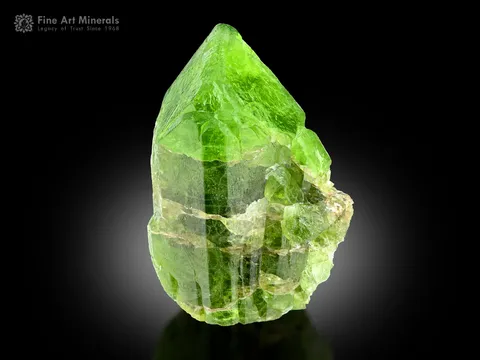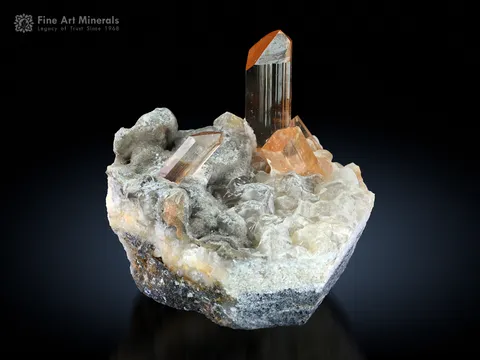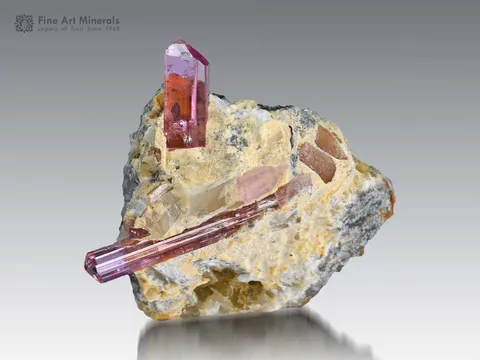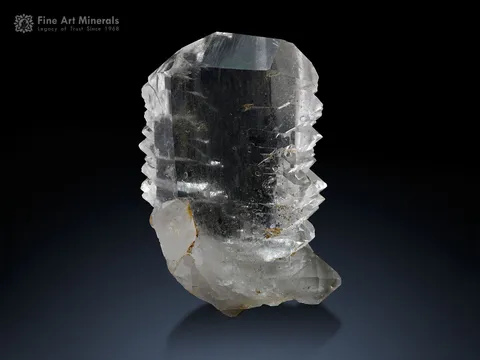
North Waziristan District, Pakistan, faden quartz from Miram Shah fissures; sculptural, glassy crystals with Alpine-cleft form and rare fluorvesuvianite.
Key facts
North Waziristan occupies an unusual place in the Pakistan mineral-specimen story: it is not a pegmatite district like Shigar or Stak Nala, but a rugged frontier district whose best-known collector specimens are quartz from fissure-style openings around the Miram Shah area. The signature pieces are faden quartz: flattened, distorted, water-clear to milky quartz groups stitched through by a white internal “thread,” often perched as airy, three-dimensional sprays rather than as blocky vein lumps. Good examples have the classic Alpine-cleft look—bright luster, sharp terminations, glassy windows, floating or near-floating form, and a visible faden line that gives the specimen both structure and movement.
Behind those collector pieces is a much broader geologic setting. North Waziristan includes part of the Waziristan Ophiolite Complex, a dismembered slice of ancient oceanic lithosphere exposed along the suture between the Indo-Pakistan plate and the Afghan microplate. Its ultramafic and mafic rocks—serpentinized dunite, serpentinite after harzburgite, pyroxenite, gabbro, dolerite, basalt, plagiogranite, pillow lavas, and associated sediments—host industrial and ore minerals such as chromite, copper mineralization, and manganese ores. For collectors, however, the district’s identity is still overwhelmingly tied to quartz, with rarer curiosities such as reported fluorvesuvianite adding a small but intriguing second chapter.
Regional View
Country View
The finest North Waziristan quartz is collectible because it looks unlike the massive milky vein quartz common in many mining districts. The best pieces are sculptural: tabular or bladed crystal groups, stacked and bent along healed growth seams, with glassy faces alternating with milky internal veils. Some specimens from Miram Shah are etched floaters, showing jagged and smooth natural surfaces together, while others form elegant faden sprays rising from small quartz or rock bases. That combination—tectonic-looking form, gemmy clarity, and graceful open architecture—is what makes the locality memorable in a Pakistani suite.

Photo: Wikimedia Commons

Photo: Wikimedia Commons
Search for specimens: View all specimens from North Waziristan District, Pakistan
North Waziristan District lies in northwestern Pakistan, within Khyber Pakhtunkhwa, along the Afghanistan border. The specimen labels most familiar to collectors use older political geography—“FATA,” “North Waziristan Agency,” “Miram Shah,” “Miran Shah,” “Miranshah,” or simply “Waziristan.” Since the administrative merger of the former Federally Administered Tribal Areas into Khyber Pakhtunkhwa, the modern district label is North Waziristan District, Khyber Pakhtunkhwa Province, Pakistan. Miram Shah is the district headquarters and the key name attached to the best-known quartz specimens.
The district’s bedrock story is dominated by the Waziristan Ophiolite Complex, one of Pakistan’s major ophiolitic belts. Published work describes it as a tectonically dismembered complex of ultramafic mantle rocks, mafic crustal rocks, sheeted dikes, pillow lavas, gabbros, plagiogranites, and pelagic sediments. Later geochemical work interprets parts of the complex as forearc or supra-subduction-zone oceanic lithosphere that was ultimately emplaced during collision between the Indo-Pakistan plate and the Afghan microplate. In practical collector language, this is a broken, faulted, serpentinized, mineralized mountain belt—not a single neat mine or one continuous orebody.
The ore mineralization belongs to several settings. Chromite is associated with serpentinites and ultramafic rocks, particularly in podiform bodies typical of Alpine-type ophiolite chromite deposits. Published work on Waziristan chromitites records aluminochromite with chromian chlorite and/or chromian serpentine plus magnetite, and alteration rims developed during metamorphism or hydrothermal alteration. Copper mineralization is reported in altered volcanic rocks and fracture fillings in the Muhammad Khel–Boya part of the ophiolite belt, with modern mining centered on the Muhammad Khel Copper Mining Project. Manganese deposits occur at Saidgi and Shuidar areas within metachert above metavolcanic rocks; the important ore mineral there is braunite, with cryptocrystalline quartz/chalcedony and minor hematite documented in the Shuidar deposits.
The quartz specimens that collectors buy from North Waziristan are not ore specimens in the chromite-copper-manganese sense. They are fissure quartz, commonly described in the trade as Alpine-type faden quartz from the Miram Shah area. Faden quartz forms where quartz grows and repeatedly heals in an opening fracture, preserving a white, threadlike seam through flattened or elongated crystals. North Waziristan pieces range from small thumbnails and miniatures to cabinet specimens over 10 cm, and the better examples show a continuous, readable faden line, good transparency, lively luster, and minimal bruising along the exposed edges.
Mining history in the district is complex because specimen quartz, chromite, copper, manganese, and construction materials belong to different scales of activity. Chromite occurrences at Mohammad Khel/Syed Abad and Saidgi have long been noted in district mineral summaries and in mineralogical literature on the ophiolite. Copper has moved into a more formal industrial phase: the Muhammad Khel Copper Mining Project is reported by project operators as active since 2019, with an open-pit mine and a 1,500-ton-per-day copper beneficiation plant. PMDC has also described exploration work on the Waziristan copper project in the broader context of metallic-mineral investment opportunities.
The faden quartz pockets appear to have been collected and marketed through the Pakistani specimen trade rather than through a publicly documented, named specimen mine. The most useful locality name for collectors remains Miram Shah Tribal Area, North Waziristan. Specimen photographs and dealer records show pieces available by at least the late 2000s, including faden groups, etched floaters, and colorless to milky rock-crystal specimens. Later market offerings continued to present North Waziristan as a source of faden quartz, and small lots still appear periodically, but top-quality, damage-free, highly architectural groups are much less common than ordinary loose crystals or bruised plates.
Field access should be treated as highly restricted. North Waziristan is not a casual collecting destination, and independent field collecting is not realistic for most foreign or domestic collectors without formal permissions, current security clearance, local arrangements, and mineral-rights authorization. Current travel advisories for Khyber Pakhtunkhwa, including the former FATA districts, remain severe because of terrorism and kidnapping risks. For collectors, the safe and ethical route is the established specimen market: buy well-provenanced material, keep old labels, and avoid assuming that a modern district name guarantees modern collecting access.
Quartz from North Waziristan is best represented by faden and rock-crystal specimens from the Miram Shah area: colorless, whitish, milky, or partly gemmy crystals, often flattened or elongated along a healed white seam. Miniature to cabinet-size groups are known, with documented examples around 10–13 cm across or tall, and the strongest pieces are sharply terminated, lustrous, transparent at the tips or along windows, and arranged as open, three-dimensional sprays rather than as compact plates. Some pieces show chloritic green inclusions or coatings, and at least one Mindat photo record notes rutile as an associated mineral based on photographic data. The best North Waziristan quartz has a clean, visible faden line, undamaged edges, and sculptural balance; ordinary pieces tend to be milky, bruised, incomplete, or too massive to show the distinctive fissure-growth character that gives the locality its appeal.
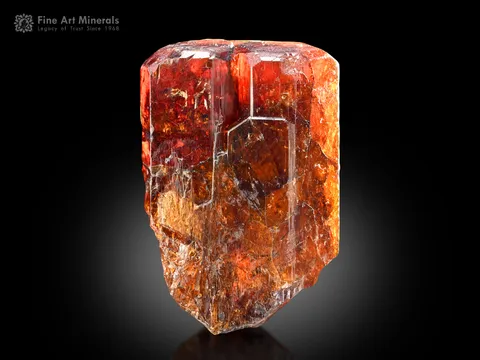
Other documented minerals from North Waziristan reflect the ophiolite as much as the specimen trade. Braunite, quartz var. chalcedony, and hematite are recorded from manganese deposits at Saidgi and Shuidar, especially around Tor Kade Khel and Barzai. Chromite, magnetite, serpentine, forsterite, enstatite, epidote, calcite, chlorite-group minerals, amphibole/hornblende-group minerals, clinopyroxene, plagioclase/feldspar, chalcopyrite, and pyrite are tied to the Waziristan Ophiolite Complex and its altered mafic-ultramafic rocks. The district is not known as a type locality for a valid mineral species, but it has produced a notable rarity: fluorvesuvianite has been reported from North Waziristan, with smoky blue-purple, blockier, backlit-gemmy specimens offered from a limited find, although Mindat marks the species with uncertainty and the exact sublocality remains unspecified.
North Waziristan quartz is a locality where labels matter. Older specimens may be labelled “Miram Shah,” “Miran Shah,” “Miranshah,” “North Waziristan Agency,” “FATA,” “NWFP,” or simply “Waziristan, Pakistan.” Those labels are not automatically wrong; they reflect older administrative usage or simplified dealer geography. The real concern is overbroad Waziristan labelling. South Waziristan localities such as Tole/Wana also produced faden quartz, and the habits can be similar enough that loose or relabelled pieces may drift between North and South Waziristan in the market. A specimen specifically from Miram Shah/North Waziristan is preferable to one labelled only “Waziristan,” unless the old label trail is strong.
The main authenticity issue is not synthetic quartz—it is attribution and repair. Faden quartz forms in fragile, flattened crystals, so repaired breaks, reattached sprays, and edge bruising are common risks. Examine the faden seam carefully under magnification: a natural thread should continue internally through the quartz and be accompanied by natural growth features, not look like a glued join or a surface-painted line. Check exposed terminations and long knife-edge faces for small chips; these can be visually distracting on otherwise transparent pieces. Etched floaters should show natural luster and irregular solution textures, not freshly ground or polished surfaces.
Colorless North Waziristan quartz is not expected to show dramatic fluorescence, and fluorescence should not be used as a locality test. Chloritic inclusions or coatings are part of the normal visual range, but green color alone does not prove North Waziristan origin. Avoid any specimen sold with vague claims of “Himalayan faden quartz” if the price depends on North Waziristan provenance but the dealer cannot supply a credible label history.
Market availability is moderate for average faden quartz and much tighter for excellent pieces. Small and miniature examples still appear regularly from Pakistani dealers, mixed Waziristan lots, and old collections. Fine cabinet specimens with glassy crystals, clean terminations, an obvious faden, and no repairs are scarcer and command a premium over ordinary milky plates. Reported fluorvesuvianite from North Waziristan is a rarity-market item: small, limited-find pieces should be bought only with analytical confidence or from dealers who stand behind the identification.
One of the most revealing North Waziristan specimen stories is not a mine tale but a photography problem. A 12.6 x 5.7 x 3.9 cm Miram Shah quartz floater, photographed by Rob Lavinsky before March 2010, was described as “very hard to photograph” because its character lived inside the crystal as much as on the surface. It was not the clean textbook faden spray collectors usually picture. It was a large, naturally etched crystal, its faces shaped by corrosive pocket fluids into a mix of jagged and smoothed forms, with euhedral pits cut into the sides and a gemmy interior that made the specimen more compelling in hand than in a flat image. That is a useful warning for this locality: the camera often misses what the light does when it enters a Waziristan quartz crystal.
Another Miram Shah specimen, 10.8 x 6.7 x 4.5 cm, shows why the locality became a standard reference point for Pakistani faden quartz. The group is a sweep of sharp, lustrous, colorless crystals arranged around several internal white fadens, with the crystal growth stretched into a sculptural line rather than a squat cluster. The old description calls the faden form “well known from this area,” which matches what collectors have seen on the market for years: when the locality is good, the quartz does not merely sit on a shelf—it seems to record movement, opening, and healing in the fracture where it grew.
The industrial side of North Waziristan tells a very different story. Near Muhammad Khel, the district’s copper mineralization has been developed as an open-pit mine and beneficiation plant reported by operators to have been operational since 2019. Project descriptions emphasize a 1,500-ton-per-day plant and a workforce with substantial local participation. That modern copper operation is not the source of the classic faden quartz specimens, but it shows the same district from another angle: a terrain long known to mineralogists for ophiolite-hosted chromite, manganese, and copper moving from reconnaissance geology into organized mining.
Raham Jalil, Olivier Alard, Bruce Schaefer, Liaqat Ali, Muhammad Sajid, Mohamed Zaki Khedr, Mohammad Tahir Shah, and Muhammad Naveed Anjum, “Geochemistry of Waziristan Ophiolite Complex, Pakistan: Implications for Petrogenesis and Tectonic Setting,” Minerals, 13(3), 311, 2023 — Modern open-access geochemical study interpreting the Waziristan Ophiolite Complex as supra-subduction-zone/forearc-related oceanic lithosphere, with detailed field observations near Muhammad Khel.
M. Qasim Jan, Brian F. Windley, and Ashraf Khan, “The Waziristan ophiolite, Pakistan; general geology and chemistry of chromite and associated phases,” Economic Geology, 80(2), 294–306, 1985 — Foundational paper on the Waziristan ophiolite and its podiform chromitites, including aluminochromite chemistry and alteration relationships.
M. T. Shah and A. Khan, “Geochemistry and origin of Mn-deposits in the Waziristan ophiolite complex, north Waziristan, Pakistan,” Mineralium Deposita, 34(7), 697–704, 1999 — Key reference for Saidgi and Shuidar manganese deposits, documenting braunite with cryptocrystalline quartz/chalcedony and interpreting the ores as submarine hydrothermal/effusive in origin.
Mindat: North Waziristan District, Khyber Pakhtunkhwa Province, Pakistan — Collector-oriented mineral list for the district, including quartz, chromite, braunite, chalcedony, hematite, and reported fluorvesuvianite.
Mindat: Miram Shah Tribal Area, North Waziristan District, Khyber Pakhtunkhwa Province, Pakistan — Specific locality page for the quartz-producing Miram Shah area, including alternate spellings and photo records.
Mindat occurrence record: Quartz from Miram Shah Tribal Area, North Waziristan District — Occurrence record for quartz from Miram Shah, with photo data and associated-mineral information.
Mindat: Saidgi Mt area, Waziristan ophiolite, North Waziristan District — Locality page for Saidgi manganese-related minerals, including braunite, quartz, and chalcedony at Tor Kade Khel.
Handbook of Mineralogy: Fluorvesuvianite — General species reference for fluorvesuvianite and its type locality; useful context for evaluating the reported North Waziristan fluorvesuvianite specimens.
“Muhammad Khel Copper Mining Project | North Waziristan” — Afaq Ahmed — Short video record of the Muhammad Khel copper operation in North Waziristan.
“North Waziristan's Copper will become gold for Pakistan? | Muhammad Khel Copper Mining Project” — GTV NETWORK HD — Pakistani news segment on the Muhammad Khel copper project and its regional economic significance.
“Copper mine project in North Waziristan became fully operational” — Aaj News — News video covering the operational status of the North Waziristan copper mine project.
Mindat: North Waziristan District, Khyber Pakhtunkhwa Province, Pakistan — Best starting point for verified collector-locality hierarchy and mineral list.
Mindat: Miram Shah Tribal Area, North Waziristan District — The most relevant locality page for classic North Waziristan quartz specimens.
Mindat: Quartz from Miram Shah Tribal Area — Photo-rich quartz occurrence record with locality and association data.
Wikimedia Commons: Quartz-263723.jpg — Freely licensed photograph and description of a fine faden quartz group from Miram Shah.
Wikimedia Commons: Quartz-135037.jpg — Freely licensed photograph and description of a large etched quartz floater from Miram Shah.
Mindat: Waziristan ophiolite, North Waziristan District — Locality page summarizing the ophiolite complex, its rock types, and associated minerals.
Mindat: Saidgi Mt area, Waziristan ophiolite — Useful page for manganese-associated braunite, chalcedony, and quartz in the district.
Mindat: Mohammad Khel, Waziristan ophiolite — Locality page noting chromite mining in serpentinite host rock.
Raham Jalil et al., 2023, Minerals: Geochemistry of Waziristan Ophiolite Complex — Detailed modern geochemical framework for the ophiolite and its tectonic setting.
M. Qasim Jan, Brian F. Windley, and Ashraf Khan, 1985, Economic Geology: Waziristan ophiolite and chromite — Classic chromite and ophiolite reference for North Waziristan.
M. T. Shah and A. Khan, 1999, Mineralium Deposita: Mn-deposits in the Waziristan ophiolite complex — Key publication for Saidgi and Shuidar manganese mineralization.
Pakistan Mineral Development Corporation: Investment Opportunities — Official PMDC page noting Waziristan copper exploration and metallic-mineral opportunities.
Mineral Exploration & Development Operation: Muhammad Khel Copper Mining Project — Operator page for the modern Muhammad Khel copper project, including open-pit and beneficiation-plant details.
Frontier Works Organization: Muhammad Khel Copper Mining — Project page summarizing location, plant capacity, and operational history for the copper mine.
U.S. Department of State: Pakistan Travel Advisory — Current security context for travel to Khyber Pakhtunkhwa and the former FATA districts.
UK Foreign, Commonwealth & Development Office: Pakistan regional risks — Additional official travel-risk guidance for North Waziristan and surrounding regions.