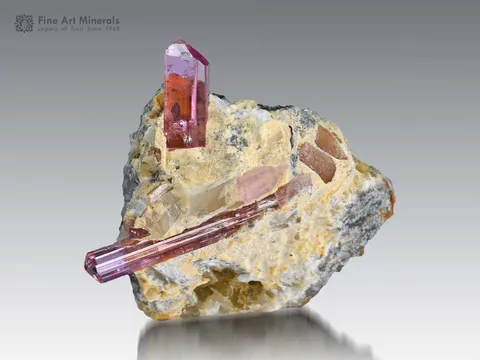
Katlang, Pakistan: distinctive pink-to-violet-pink topaz from Ghundao Hill, colored by chromium in carbonate-rich veins; prized by collectors despite preservat…
Key facts
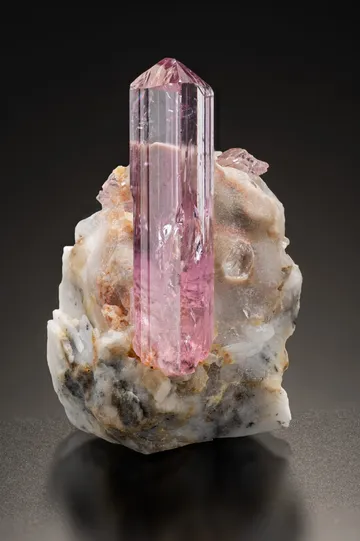
Katlang is the name collectors use for one of the most distinctive topaz localities on earth: the pink-to-violet-pink topaz deposit of Ghundao Hill, north of Katlang in Mardan District, Khyber Pakhtunkhwa, Pakistan. Unlike the familiar pegmatite or rhyolite occurrences that dominate the topaz world, the classic Katlang material occurs in calcite-quartz-white mica veins cutting folded, faulted calcareous rocks. The locality became famous because its best topaz is naturally pink to violet-pink, colored principally by trace chromium rather than by later laboratory treatment. In hand specimen, the finest pieces have a look that is instantly memorable: glassy, peach-pink to cyclamen-pink prismatic topaz crystals rising from white calcite, quartz, or pale feldspathic matrix, sometimes with dark gray limestone giving a dramatic contrast.
Regional View
Country View
The deposit’s importance is not just gemological. Katlang forced mineralogists to reconsider how pink, chromium-bearing topaz could form in carbonate-rich metamorphic rocks at relatively low temperature. Early writers debated whether the crystals were derived fragments later cemented by calcite or products of hydrothermal-pneumatolytic activity within the veins. Later isotopic and fluid-inclusion work placed the mineralization within the Eocene Himalayan tectonothermal story, with metamorphic fluids moving through carbonate rocks rather than a simple pegmatite model. For collectors, that geology explains the locality’s characteristic preservation problems as well as its beauty: many crystals are cleaved, fractured, etched, or partly locked in calcite, while a small number escaped with the clarity, termination, and matrix balance that make Katlang pieces coveted.

Photo: Wikimedia Commons
Search for specimens: View all specimens from Katlang, Pakistan
The classic Katlang topaz workings are centered on Ghundao Hill, an isolated, knob-like hill rising from the agricultural plain north of the town of Katlang and north of Mardan. Historic descriptions place the hill a few kilometers north of Katlang and describe it as a small carbonate outcrop standing apart from the surrounding plain. Published measurements vary slightly, but the hill is consistently portrayed as a compact body only a few hundred meters across, with near-vertical to steeply folded calcareous strata, phyllitic or shaly interbeds, and limestone breccias.
The host rocks have been described in older literature as part of the Lower Swat-Buner Schistose Group and in later regional usage as correlative with the Alpurai Group, including the Kashala Formation. The important collector’s point is that this is not a granite pegmatite pocket locality. Katlang topaz occurs in carbonate country rock: recrystallized gray limestone, schistose marble or calcareous schist, and associated breccia. The productive structures are calcite and quartz veins, especially the coarser, more persistent veins developed along faults and fold-related openings. These are the veins that supplied the topaz, quartz, muscovite, talc, limonitic clay, and carbonate assemblage familiar from classic specimens.
The best-known ore—or more accurately gem-mineral—bodies are not broad ore zones but vein systems and pockety openings within those vein systems. Published descriptions distinguish short, narrow, fine-grained white calcite veins from larger coarse calcite veins that may be several meters long and, in places, much wider. Topaz is concentrated mainly in the larger, coarser calcite-quartz veins, in stockworks, tension gashes, breccia cavities, and saddle-reef-like structures controlled by folding and faulting. Crystals may be completely embedded in calcite, protrude into vugs, or lie loose in broken vein debris. This is why many old-time Katlang specimens show topaz partly engulfed by white calcite or perched against quartz and carbonate rather than sitting in an open pegmatite cavity.
Mining history at Katlang began in the modern gem literature with the discovery of topaz at Ghundao in the fall of 1972. Local residents reportedly dug crystals secretly and took them to the Peshawar market. Government attention followed quickly: the West Pakistan Industrial Development Corporation studied the hill in January 1973, and prospecting rights later passed through government mineral-development channels. Systematic work came with the Gemstone Corporation of Pakistan, which had taken over the deposit by the late 1970s and began organized exploration and mining in the early 1980s under A. H. Kazmi’s supervision. By the early 1980s the workings were mainly open cuts and trench-like incisions blasted into known topaz-bearing calcite veins, with miners using picks, hammers, pneumatic drills, and controlled charges to free calcite blocks for hand breaking.
Production figures from the government-operated period show both the small scale and the significance of the deposit. Spengler reported about 10,000 carats recovered for the February 1981–82 period, about 17,000 carats for February 1982–83 together with roughly 150 exceptional collector specimens, and about 28,000 carats for February 1983–84 with about 180 collector specimens. Gübelin, Graziani, and Kazmi recorded total gem-quality pink topaz production of 72,076 carats up to November 1984, with annual production then in the 20,000–30,000 carat range. Those numbers sound large until one remembers that much of the output consisted of small, fractured, or cutting-grade pieces, while matrix specimens with transparent pink crystals remained uncommon.
Collecting access today should be regarded as restricted, local, and permission-based. Recent field accounts describe small-scale, locally run mining, secretive access, and the need for community permission; they also describe the well-known “parallel” mine on top of Ghundao Hill and nearby activity around Shamozai. Field photographs from recent visits show trench-like workings, miners drilling for explosives, rest huts on the hill, and calcite veins followed as the main guides to topaz. For outside collectors, Katlang is therefore not a casual field-collecting stop. Specimens normally reach the market through Pakistani miners and dealers, Peshawar/Namak Mandi channels, specialist dealers, or older collections.
Notable finds from Katlang are best understood pocket by pocket rather than as one continuous orebody. The earliest surface and near-surface trenches near the top of the hill supplied the crystals that made the locality famous in the 1970s. The government period opened deeper trenches and produced both gem rough and a modest number of fine collector specimens. Later dealer reports and Mindat photo records show classic pieces from Ghundao Hill, plus material attributed to the broader Katlang-Shamozai area. The best pockets yielded unusually high proportions of fine pink material; Spengler noted that while grade A crystals represented about 10% of production overall, some pockets reportedly ran as high as 60% grade A. Those pocket-to-pocket differences are one reason fine matrix pieces have always seemed scarcer than loose cleaved crystals or small gem fragments.
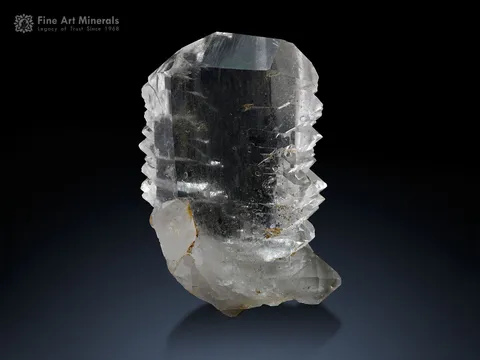
Katlang topaz is the locality’s defining mineral: transparent to subtransparent crystals in colorless, pale beige, brownish, champagne, orange-yellow, pink, violet-pink, and rare richer purple tones, with the most desirable collector pieces showing natural cyclamen-pink to peach-pink color caused chiefly by chromium. Crystals are commonly prismatic, stubby-tabular to elongated, with well-developed striated prism faces and etched or cleaved terminations; most individual crystals are under about 3 cm, though larger crystals and exceptional old specimens are known, including reports of crystals over 7.5 cm and later collector specimens to several centimeters on matrix. The classic association is white to gray calcite with quartz, muscovite, talc, limonitic clay, and dark gray carbonate host rock, and the best specimens separate themselves from ordinary Katlang material by three things at once: saturated stable pink-to-violet color, glassy transparency with minimal internal cleavage, and a natural, undamaged presentation on contrasting calcite-quartz matrix rather than a loose broken crystal.
Calcite at Katlang is both the principal vein mineral and the main display matrix for the topaz; it occurs as white, gray, brownish, fine- to coarse-grained vein calcite, locally sparry or subtransparent, and in early descriptions individual calcite crystals or masses reached substantial sizes within the veins. As a collectible species in its own right, Katlang calcite is usually valued for context rather than as a world-class calcite locality: pieces with crisp white calcite supporting pink or champagne topaz have far greater appeal than plain carbonate fragments, while calcite that preserves open vug texture, sharp contrast, and undissolved natural surfaces is preferable to heavily trimmed or acid-etched matrix. Because topaz crystals are frequently enclosed in, protruding from, or partly surrounded by calcite, the best calcite-bearing specimens show the vein story clearly—white carbonate, quartz, and topaz frozen together in the same small structural opening.
Other documented Katlang minerals include quartz, muscovite, mica-group minerals, talc, dolomite, pyrite, albite, epidote, fluorapatite, and garnet-group minerals. Quartz is the most important associate after calcite, occurring with topaz in the productive veins and commonly as transparent to milky crystals or masses. Muscovite is reported as small greenish crystals or laths, locally mixed with clayey cavity fill; talc is noted in the greenish alteration assemblage; pyrite appears in altered or oxidized form in the limestone; and dolomite and other accessory species reflect the carbonate-rich host environment. Katlang is not known primarily as a type-locality for new mineral species; its mineralogical distinction lies in the unusual carbonate-hosted, metamorphic-fluid topaz paragenesis and the naturally chromium-colored pink topaz it produced.
Katlang topaz is one of those localities where locality and treatment questions matter as much as aesthetics. Natural pink Katlang topaz owes its color chiefly to trace chromium and has been shown in classic studies to be stable under conditions that fade many treated topazes. However, GIA reported in 2005 that treated-color orange topaz was appearing in the Peshawar market, with pale topaz from the Katlang area described as starting material; the induced color could be vulnerable to heat and, in some cases, probably to light. Recent field-trade accounts likewise warn that some pink topaz encountered in Namak Mandi is treated or not truly Katlang material. For high-value stones or loose crystals, advanced testing—UV-Vis spectroscopy, inclusion study, RI/SG comparison, and a credible lab report when warranted—is prudent.
Mislabelling is also a real issue. Pakistani topaz from pegmatite localities in Gilgit-Baltistan, Afghanistan-adjacent trade material, Brazilian heated topaz, and irradiated orange or pinkish topaz can all be offered with loose or optimistic locality names. Genuine Katlang matrix pieces should make geological sense: pink to peach topaz with calcite, quartz, carbonate matrix, and sometimes muscovite or talc is consistent; a suspicious pegmatitic assemblage should prompt questions. Mindat discussion has even documented corrections of Pakistan topaz photos misassigned to other localities, with calcite matrix helping point them back to Ghundao Hill.
Condition is the central quality factor. Topaz has perfect basal cleavage, and Katlang crystals were commonly fractured by tectonism before mining, then often damaged again by blasting and extraction. Even very gemmy crystals may show internal cleavage, basal breaks, etched terminations, repaired-looking natural cracks, or tiny bruises along prism edges. This does not automatically disqualify a specimen—Katlang is a damage-prone locality—but price should reflect it. The premium goes to undamaged or minimally damaged, well-terminated, transparent crystals on original matrix, especially with strong natural pink, violet-pink, or peach color.
Matrix handling requires equal care. Calcite is soft and acid-sensitive, so acid cleaning can destroy the very context that makes a specimen valuable. Ultrasonic cleaning is risky for topaz because of cleavage and existing fissures, and sudden temperature changes should be avoided. Short-wave ultraviolet fluorescence has been reported variably in Katlang material—AIGS observed white short-wave fluorescence and long-wave inert behavior in some crystals, while GIA recorded weak to distinct responses amplified in fractures—so fluorescence should be treated as supporting observation, not as a stand-alone authentication test.
Market availability is intermittent. Loose small crystals and cleaved fragments appear more often than good matrix pieces. Fine matrix specimens from older production, especially crystals in the 2–4 cm range with glassy luster and saturated natural color, are scarce and command strong competition. The locality is still represented in the market, including recent locally sourced pieces, but supply is not steady, and the best examples are usually absorbed quickly by specialist collectors.
The old descriptions of Katlang read almost like a stage setting before the gemstone enters. William H. Spengler began his 1985 account not with chemistry but with ruins: two-thousand-year-old Buddhist monasteries scattered around the hilltops of the Katlang valley, relics of a line of culture stretching from Sarnath to Bamiyan. Below them lay green fields, irrigation canals, villages, mosques, and minarets. From the southern fringe of the valley, he saw the little hillock standing alone in the agricultural plain—the unassuming knob that contained a treasure the ancient builders apparently never knew: pink topaz.
The discovery story, as recorded in the formal gemological literature, begins in the fall of 1972. Local residents found the crystals at Ghundao, dug them secretly, and carried them to the Peshawar market. Government attention followed after the illegal digging became known. By January 1973 the hill had been studied by the West Pakistan Industrial Development Corporation, and through the 1970s the rights passed through government mineral-development bodies before the Gemstone Corporation of Pakistan took systematic control. That sequence—secret village digging, Peshawar dealer circulation, then state-supervised mining—is typical of many Pakistani gem stories, but Katlang had a special twist: the stones were not just pretty topaz; they were a naturally pink, chromium-bearing material from a carbonate hill barely a few hundred meters across.
By the early 1980s, Spengler found a mine that was both organized and rudimentary. On the east face of the hill, nearly a dozen major trenches had been cut, with smaller trenches penetrating perhaps 15 meters beneath the surface. Deeper work became dangerous because the limestone walls could collapse, so engineers considered tunneling into the veins. The working scene was compact and vivid: two compressors powered pneumatic drills and hammers; dynamite was used, but charges were kept away from visible veins and pockets; miners followed crystallized veins with hand tools; crystals went straight into lockboxes under the eyes of security staff; debris left in large wheelbarrows. The workforce was only about two dozen laborers, supported by a geologist, a mining engineer, mechanics, security, and administrative staff.
Production figures from that period give the story scale. In February 1981–82, about 10,000 carats were recovered. In February 1982–83, production rose to 17,000 carats, along with about 150 exceptional crystal specimens set aside for collectors. In February 1983–84, the figure climbed again to 28,000 carats plus 180 collector specimens. Yet the grading system reminds us how selective the good material was. Grade A meant unflawed crystals with fine pink color, but only about 10% of production reached that level overall, even though certain pockets reportedly yielded up to 60% grade A material. Another 30% was good pink but flawed, another 30% more heavily flawed or of poorer color, and the remainder opaque or low grade. A pocket at Katlang could therefore change a miner’s week, a dealer’s inventory, and a collector’s opportunity all at once.
Some individual stones entered the literature as landmarks. Spengler photographed a 37 carat gem at the Gemstone Corporation of Pakistan headquarters in Peshawar, courtesy of Managing Director Brigadier Kaleem ur Rehman Mirza, along with an accompanying crystal. He also recorded a large 135 gram prismatic crystal photographed through Karachi dealer Issa Jaffar. Gübelin, Graziani, and Kazmi later cited the largest cut pink topaz then recorded from Katlang as 37.76 carats. These are not enormous by topaz standards, but for naturally pink Katlang material they are significant: the deposit’s fame has always depended less on size than on stable color, brilliance, and the rarity of clean crystals.
A recent field account from Origin Gems brings the locality into the present with a very different tone: not a government mining project, but a small, secretive, community-controlled hill. Their team set out without firm contacts and eventually found their way by speaking with a local mechanic who helped make the right introductions. Permission mattered. They were told that a previous group of French gemologists had been refused access, and they attributed their own success to language, patience, and cultural connection. Once allowed onto the hill, they described a difficult, slippery climb through soft debris toward the famous “parallel” mine on top of Ghundao Hill, where one wrong move could be serious.
Their description of mining is blunt and recognizable to anyone who has visited small colored-stone workings. The miners follow calcite veins because the veins are the indicators; the surrounding slate or carbonate rock may be quarried for construction, but the pale vein material is what draws attention. A miner drills holes for dynamite. The charges are placed. Everyone scatters for cover. Then the blasts echo across the valley, and after the dust settles the miners return to the rubble, searching for topaz. The same method that exposes the crystals also breaks them: topaz’s perfect cleavage means blasting can turn otherwise valuable crystals into fragments.
The modern account also gives the landscape back to the stones. Ghundao Hill is surrounded by farmland, including sugarcane fields, and local houses built of mud and straw that stay comparatively cool in summer and warm in winter. The team saw marine fossils in the rock walls near the mines, a striking reminder that the carbonate host began as ancient seafloor before Himalayan deformation lifted, folded, and fractured it. Nearby Shamozai workings were also visited and described as producing champagne to yellow “imperial” colors, with pink topaz also confirmed on site. For a collector holding a small Katlang matrix specimen, those details matter: the stone is not an abstract pink crystal, but a remnant of a hill where farmers, miners, fossil-bearing limestone, calcite veins, dynamite, secrecy, and global collector demand all intersect.