






A collector's guide to Khyber Pakhtunkhwa Province, Pakistan: its geology, mining history and notable minerals, illustrated with the 57 specimens documented from this locality on EarthWonders.
Key facts
Khyber Pakhtunkhwa matters to mineral collectors because it is not a single locality so much as a tightly folded mineral province: a sweep of Himalayan, Hindu Kush, and suture-zone terrane where emerald, peridot, garnet, corundum, quartz, rare-earth minerals, and unusual tourmalines have all reached the specimen market under one provincial name. The collector’s map is anchored by three very different geological stories. In Swat and Shangla, emeralds and chromium-rich tourmalines formed where hydrothermal fluids worked through talc-carbonate-altered ultramafic rocks in the Indus Suture Zone. In the Kaghan-Naran region, gem corundum and the celebrated Sapat peridot occur in high mountain metamorphic and ultramafic settings. Near Peshawar and the old Khyber/FATA belt, Zagi Mountain and related occurrences contributed rare-earth minerals, riebeckite- and astrophyllite-included quartz, and a locality-history puzzle that still matters on old labels.
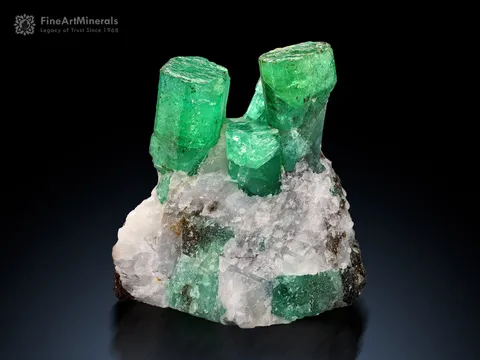
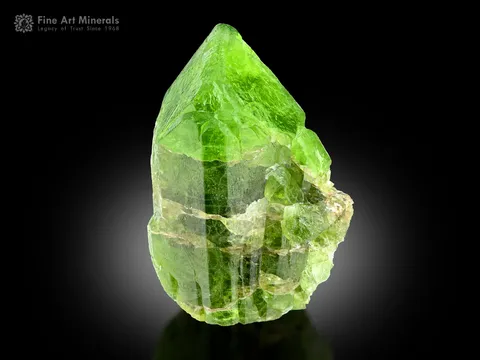
The finest Khyber Pakhtunkhwa specimens are immediately recognizable. Swat emeralds can be saturated bluish green to vivid green crystals on pale talc-carbonate matrix, often with dark dravite-like tourmaline, fuchsite, magnesite, quartz, calcite, or pyrite. Sapat peridot is prized when it survives as a real terminated crystal rather than simply gem rough: transparent green, sharp-edged, and alive with internal fire. Bajaur hessonite is a modern collector favorite for its cinnamon to honey-orange grossular crystals, sometimes remarkably large and lustrous for the variety. Zagi Mountain pieces, by contrast, are mineralogical cabinet specimens: sharp honey-brown bastnäsite-(Ce), rare hingganite-(Nd), genthelvite, riebeckite, aegirine, rutile, xenotime, and quartz from alpine-type veins in alkaline granite gneiss.
Regional View
Country View
The province’s importance is amplified by Peshawar and Namak Mandi, the trade route through which much of northern Pakistan’s gem production has historically moved. That market role means labels can be broad, commercial, or old-fashioned: “NWFP,” “FATA,” “Swat,” “Khyber,” “Pakistan,” and occasionally obsolete or erroneous Afghan attributions all appear on specimens that modern collectors would now place within Khyber Pakhtunkhwa or its merged tribal districts. For serious collectors, the best pieces are not simply “from Pakistan”; they are tied to a real district, mine, or geological belt—Mingora, Gujar Killi, Charbagh, Shamozai, Sapat Gali, Batakundi, Mana Mine at Barang-Turghao, Tole/Wanna, Zagi Mountain.

Photo: Wikimedia Commons
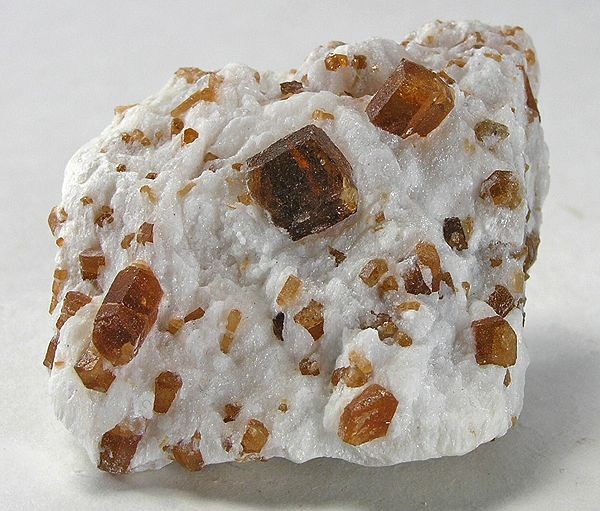
Photo: Wikimedia Commons
Search for specimens: View all specimens from Khyber Pakhtunkhwa Province, Pakistan
Khyber Pakhtunkhwa’s specimen-producing deposits fall into several distinct types. The most famous are the non-pegmatitic emerald deposits of the Swat-Shangla belt, where beryl occurs in talc-carbonate and magnesite-rich altered ultramafic rocks along the Indus Suture Zone. The essential geological contrast is classic emerald geology: chromium, magnesium, nickel, and iron supplied by ultramafic rocks; beryllium and boron-bearing fluids introduced along fractures, shear zones, quartz veins, and stockworks. The Mingora ophiolitic mélange is the key host in the Swat emerald field, with emerald mineralization concentrated in limonitized fractures, fault planes, tension gashes, quartz-calcite veinlets, and pockets or nests in talc-chlorite-magnesite schist. Associated minerals include magnesite, talc, quartz, calcite, fuchsite, chromite, pyrite, pyrrhotite, pentlandite, gersdorffite, tremolite, actinolite, and chromium-rich dravitic tourmaline.
The principal Swat emerald mines and districts include Mingora, Gujar Killi, Charbagh, Shamozai, and Makhad, with Gujar Killi and Mingora especially important to gem and specimen collectors. Mingora is the oldest modern Pakistani emerald mine and has produced intensely colored small stones as well as specimen crystals in limonitic, talcose, quartz-bearing matrix. Gujar Killi, reached historically by a road from Mingora and then on foot into the valley, is famous for dark to medium bluish green emeralds, some of which cut fine stones despite a tendency toward dark tone. Its emeralds are typically hexagonal prisms; rough was reported commonly in the 1–10 carat range, while much larger crystals were recovered, including crystals well over 100 carats. The best matrix specimens show crisp green beryl set against pale talc-carbonate or quartz-calcite host, ideally with enough matrix contrast to make the crystal stand out.
North and northeast of Mansehra, the Kaghan-Naran area adds a second major gemstone setting. At Sapat Gali, gem forsterite-peridot occurs in ultramafic rocks and shear-controlled zones, associated with serpentine, talc, magnetite, magnesite, calcite, chlorite, ludwigite, and related borate or oxide phases. Many peridot crystals entered the gem trade as rough, but collector-grade examples are those with natural faces, transparency, fresh green color, and minimal bruising. Nearby Upper Kaghan localities, including Batakundi and Besal/Besar variants on old labels, are known for corundum—ruby and sapphire—occurring in high-elevation metamorphic settings. Production has been modest and sporadic, and much of the corundum is small, included, or cabochon grade; well-formed specimen crystals are correspondingly scarce.
The Bajaur and Mohmand districts, once commonly encountered on labels as part of FATA, produce a different suite. The Mana Mine at Barang-Turghao in Bajaur is the best-known modern Khyber Pakhtunkhwa source for hessonite grossular specimens. These garnets are prized for their orange, honey, cinnamon, and sherry tones, with some crystals far larger than collectors expect for hessonite. The broader Bajaur-Mohmand-Malakand belt also has reports of green grossularite or tsavorite-like garnet in graphitic schist and associated metamorphic rocks, along with serpentine, actinolite, nephrite, marble, chromite, and emerald prospects.
Zagi Mountain, near Hameed Abad Kafoor Dheri in Peshawar District and close to the Warsak area, is mineralogically exceptional. The occurrence is hosted in alkaline granite gneiss of the Warsak igneous complex and is best understood as an alpine-type vein locality rather than a conventional gem mine. It has produced bastnäsite-(Ce), bastnäsite-(La), baotite, genthelvite, gadolinite-group minerals, hingganite-(Nd), hingganite-(Y), xenotime-(Y), monazite-(Ce), riebeckite, magnesio-riebeckite, aegirine, astrophyllite, zircon, rutile, brookite, hematite, fluorite, quartz, and related rare-earth species. Zagi’s reputation grew rapidly after specimens appeared in the late 1990s and early 2000s, but the locality history was complicated by early labels assigning some material to a fictitious “Shinwaro” locality in Konar Province, Afghanistan.
Quartz occurs across the province in several collector styles. Swat’s emerald system contains quartz veins and stockworks, commonly as part of the emerald-bearing structural network rather than as isolated showy quartz pockets. South Waziristan, especially Tole/Wanna, has supplied faden quartz and “mud quartz” groups from alpine-type openings, including glassy crystals on thin matrix plates. Zagi Mountain quartz is valued less for classic clarity than for inclusions—riebeckite, magnesio-riebeckite, astrophyllite, or other fibrous and acicular phases that produce blue, smoky, or patterned interiors.
Mining in the province ranges from state exploration history to small-scale private workings. The Gemstone Corporation of Pakistan played an important role in early modern exploration, mining, and regulation of several Swat emerald deposits. Since the early 1970s and particularly in recent decades, many emerald, garnet, peridot, and corundum operations have been privately worked, leased, seasonal, artisanal, or small scale. Modern collecting access is not casual. Many localities are active mines, high-elevation prospects, politically sensitive former tribal areas, or privately controlled claims. Collectors normally encounter specimens through Pakistani dealers, Peshawar/Namak Mandi trade channels, established international dealers, or older collections rather than by field collecting.
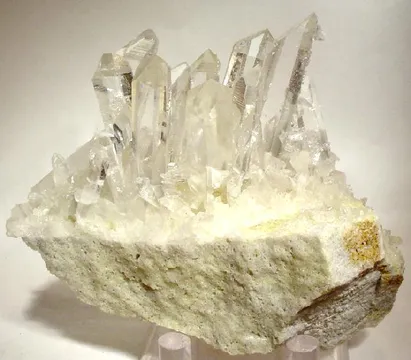
Quartz from Khyber Pakhtunkhwa is best judged by locality because the province produces several very different looks: faden quartz and “mud quartz” groups from the Tole/Wanna area of Lower South Waziristan, quartz vein and stockwork material from the Swat emerald belt, and included quartz from Zagi Mountain. The South Waziristan pieces that appeal most to collectors are glassy, gemmy faden clusters rising cleanly from a thin plate of matrix, with distinct white faden threads, open space between crystals, and little bruising; ordinary pieces are loose, milky, clay-coated, or crowded. Zagi Mountain quartz is collected for character rather than classic purity, especially crystals with blue to dark fibrous riebeckite or astrophyllite-style inclusions associated with the alkaline granite-gneiss rare-earth suite. In the Swat emerald deposits, quartz is more important as a geological companion—veins, stringers, and stockworks that helped localize emerald, chromium-rich tourmaline, fuchsite, calcite, and magnesite—than as a stand-alone display mineral.
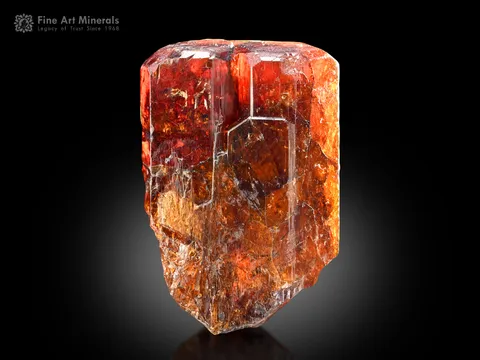
Grossular from Khyber Pakhtunkhwa is represented by both orange hessonite-style material and green grossularite reported from the Swat-Malakand-Bajaur region. The most collectible modern grossular specimens are from the Mana Mine at Barang-Turghao in Bajaur District, where crystals can be unusually large for hessonite, translucent to gemmy, and sharply formed, with cinnamon, honey, orange-brown, and sherry tones. Literature on Pakistan’s garnets also records green grossularite associated with graphitic schist in the Jambil area of Swat, near Kot in Malakand, and near Targhao in Bajaur, while hessonite is described from quartz-mica schist near Targhao. Top specimens combine size, luster, saturated color, and an undisturbed crystal surface; lesser pieces may still be attractive but are commonly darker, chipped, opaque, or visually busy.
Garnet in Khyber Pakhtunkhwa is not a single-species story: the province has produced almandine from Chitral and Kaghan/Naran areas, green grossularite from Swat-Malakand-Bajaur settings, hessonite from Bajaur, and broader garnet occurrences tied to metamorphic and ultramafic belts. For collector specimens, the Bajaur hessonite clusters have the strongest modern identity, but garnet labels from Khyber Pakhtunkhwa can also reflect older or less precise district-level attributions such as Swat, Malakand, Mohmand, Chitral, or “FATA.” The best garnet specimens from the province have complete crystal form rather than just gem rough, visible translucency, and matrix contrast where present; otherwise, they risk looking like dark broken abrasive-grade garnet, which is also known from parts of KP.
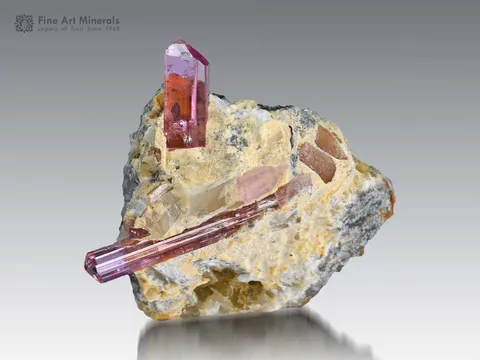
Ruby from Khyber Pakhtunkhwa is principally tied to corundum occurrences in the Upper Kaghan-Naran and Swat-Dir region, with literature noting corundum at Timurgara in Dir and Shah Dheri and Kalam in Swat, and ruby potential along a belt extending from Timurgara as well as marble-hosted ruby at Batakundi in the Kaghan Valley. The Batakundi material is typically small, deep red to pinkish red, and commonly included, and production has been limited compared with the more famous Central Asian marble-hosted ruby deposits. The strongest collector pieces are matrix specimens with recognizable hexagonal corundum crystal form, vivid red or pink-red color, and convincing geological context; ordinary or lower-grade pieces are opaque, fractured, small, or too close in appearance to spinel, garnet, or dyed material without laboratory confirmation.
Khyber Pakhtunkhwa hessonite is most strongly associated with the Mana Mine at Barang-Turghao in Bajaur District and with older reports of honey-yellow euhedral crystals in quartz-mica schist near Targhao. These are among the more distinctive Pakistani garnet specimens: cinnamon to sherry-orange grossular crystals, sometimes forming lustrous clusters with striated faces and impressive size for the hessonite variety. A good piece should show sharp form, glassy luster, warm body color without going muddy black-brown, and as much completeness as possible; matrix pieces are scarcer and desirable when the contrast is natural and stable. Early market confusion with spessartine has been documented, so serious hessonite purchases from Bajaur deserve either an analytical history, a trusted dealer pedigree, or at least careful optical and compositional confirmation.
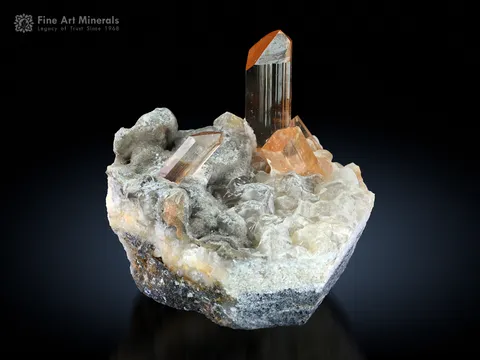
Uvite-labeled specimens from the former North-West Frontier Province, now Khyber Pakhtunkhwa, are best known to collectors as deep sherry-brown to orange-brown tourmaline crystals perched on very white talc matrix, with individual crystals reaching about a centimeter on documented specimens. Their appeal lies in contrast: vitreous, gemmy, isolated tourmaline crystals standing proud of soft chalky talc, rather than dark tourmaline lost in dark matrix. Care is needed with nomenclature, because the Swat emerald deposits contain abundant chromium-rich magnesian tourmalines that have been described in the mineralogical literature principally as dravite and oxy-dravite compositions, and collector labels may use older or generalized tourmaline names. The best Khyber Pakhtunkhwa uvite-style pieces are bright, isolated, undamaged crystals on intact talc matrix; ordinary examples are rubbed, stained, friable, or too poorly documented to separate confidently from other Mg-rich tourmalines.
Other minerals documented from Khyber Pakhtunkhwa make the province far broader than its six most visible EarthWonders species suggest. Swat’s emerald deposits have produced emerald, trapiche-type emerald, chromian muscovite/fuchsite, chromium-rich tourmaline, magnesite, talc, calcite, pyrite, pyrrhotite, pentlandite, gersdorffite, chromite, tremolite, and actinolite. Sapat Gali is a benchmark for forsterite-peridot associated with serpentine, magnetite, magnesite, talc, chlorite, calcite, brucite, ludwigite, and vonsenite. Zagi Mountain is the province’s rare-mineral jewel box, with bastnäsite-(Ce), bastnäsite-(La), baotite, genthelvite, hingganite-(Y), hingganite-(Ce), hingganite-(Nd), xenotime-(Y), monazite-(Ce), synchysite-(Ce), riebeckite, magnesio-riebeckite, aegirine, rutile, brookite, fluorite, zircon, thorite, and hyalite. Hingganite-(Nd), Nd2◻Be2Si2O8(OH)2, is especially important because Zagi Mountain is its type locality.
The first collector issue is locality precision. “Khyber Pakhtunkhwa” is acceptable as a province-level label, but it is not enough for a serious specimen if better information exists. Mingora emerald, Gujar Killi emerald, Sapat Gali peridot, Batakundi ruby, Mana Mine hessonite, Tole/Wanna faden quartz, and Zagi Mountain rare-earth minerals are very different specimens from very different geological settings. Older labels may say North-West Frontier Province, NWFP, FATA, Khyber Agency, Bajaur Agency, Mohmand Agency, or simply “Pakistan.” Those names can be historically correct for older specimens, but modern cataloguing should translate them carefully into current districts where possible.
Zagi Mountain material has a famous locality-warning attached to it. Some bastnäsite and associated rare-earth specimens first appeared with an Afghan “Shinwaro” or Konar Province attribution; that locality was later shown to be bogus, and the material is now tied to Zagi Mountain in the Peshawar District/Warsak area. Old labels preserving the error are historically interesting, but they should not be repeated as fact.
Swat emeralds require normal emerald caution plus locality-specific awareness. Many Swat stones are included and fractured, and GIA work has documented filling in some samples with mixtures including cedarwood oil and Araldite 6010. For cut stones and specimen crystals with significant gem areas, disclosure of oil or resin matters. Strong color alone is not proof of origin, and high iron content can make some Swat emeralds relatively inert under both longwave and shortwave ultraviolet light, so lack of fluorescence should not be treated as suspicious by itself. Matrix specimens are also vulnerable to restoration: emerald crystals in soft talc-carbonate or limonitic matrix can be glued, repaired, or improved with oil, resin, or surface cleaning.
Ruby and red corundum from Pakistan deserve laboratory caution. The regional trade includes ruby, sapphire, spinel, garnet, and synthetics moving through the same markets, and red spinel has a long history of being sold or described as ruby. GIA has also reported reconstructed or deceptive Pakistani-market specimens, including synthetic ruby mounted on natural host rock and parcels containing mixtures of natural, heated, glass-filled, and synthetic ruby. A Khyber Pakhtunkhwa ruby specimen should show convincing corundum crystal form, credible matrix, and ideally analytical confirmation if value is significant.
Bajaur hessonite has its own pitfall: some material was reportedly offered at first as spessartine before being recognized as grossular. Visually, orange garnets can be treacherous. A good label should say grossular var. hessonite, not merely “orange garnet,” unless the chemistry is uncertain. Repairs are also worth checking; hessonite crystals can detach from contrasting matrix and be reattached, and at least one documented dealer specimen explicitly noted a repair.
Condition is central across the province. Talc and magnesite matrices bruise and powder; limonitic emerald matrix can stain and crumble; Sapat peridot cleaves and chips readily along edges; faden quartz from Waziristan often has fragile matrix plates; and Zagi rare-earth specimens may contain radioactive accessory minerals such as thorite or uranium-bearing rare-earth phases in the broader assemblage. Normal cabinet handling is sufficient for most pieces, but avoid dust inhalation when trimming or cleaning, keep friable talc matrix dry, and store emerald and peridot away from heat, ultrasonic cleaners, acids, and aggressive solvents.
Market availability varies sharply. Swat emerald and Sapat peridot are regularly available as gems and rough, but top natural matrix specimens are much scarcer. Bajaur hessonite appears in small waves and older dealer stocks rather than as a constant supply. Zagi Mountain rare-earth minerals are available mainly through older collections and specialized dealers, with top bastnäsite-(Ce), hingganite-(Nd), and well-included quartz commanding strong locality premiums.
When Swat emeralds entered the modern gem world, they did so through a mountain chain rather than a polished marketing campaign. Mingora, the earliest modern mine, was discovered in 1958, and the better-known Swat mines—Mingora, Gujar Killi, Charbagh, Makhad, and later Shamozai—passed from state exploration into a patchwork of private workings. The first international splash came in 1981, when Swat emeralds appeared at the Tucson Gem and Mineral Show. By then the geology was already telling a collector’s story: green beryl in talc-carbonate rock, its color born of chromium-bearing ultramafics, its pockets localized by limonite, quartz, calcite, and fractures in the suture where continents had collided.
Gujar Killi had a particularly vivid early description. The deposit lay near the village of Gujar Killi, east-northeast of Mingora, high enough that winter snow closed it from December through March. Reaching it meant driving from Mingora toward Bazar Kot and then walking through the valley. The emerald-bearing body was not a grand open cavern but a structural puzzle: talc schist, talc-carbonate schist, carbonate blocks, limonitized planes, and intersecting fractures. Miners learned to read the rock in practical terms. Where greenish talc appeared, they believed emerald might be close. Where limonitized veins intersected in talc schist or talc-carbonate schist, the chances improved. Among the stones documented in the early work was a 188-carat rough emerald held by Pakistani dealer Akbar Khan, a reminder that even a deposit famous for small saturated stones could occasionally produce a crystal large enough to stop a room.
High in Kaghan, the ruby and sapphire story is rougher and colder. The Batakundi ruby deposit sits at about 4,190 meters elevation. Marble-hosted rubies had been recovered there since around 2000, but the scale was never comparable to the great ruby districts of Myanmar or Central Asia. Most stones were small; rough larger than 0.6 grams was described as very rare, with much production below 0.2 grams. A group of seven miners led by Haider Ali had been working the area from 2006, using jackhammers, dynamite, and hand tools. Nearby, at the Besar/Besal sapphire workings in the Batakundi area, roughly 50 miners were reported at two high sites, about 4,020 meters and 3,780 meters elevation, breaking graphite-rich veins for pink to purple sapphire. Several kilograms could come out daily, but less than five percent was gem quality. For the specimen collector, those numbers explain the market: plenty of broken or included corundum may pass through the trade, but a fine crystal with honest matrix and attractive color is a different order of rarity.
The Sapat peridot story made an unlikely journey from an ultramafic Himalayan source to Fifth Avenue. In early 2004, eight kilograms—about 40,000 carats—of gem-quality peridot rough from the Sapat Valley region was purchased for a high-jewelry project. The rough was sorted, preformed, and faceted into a matched suite of 54 Asscher-cut stones ranging from 3.57 to 18.30 carats, for a total of 350.40 carats. Van Cleef & Arpels designed the suite in Paris, and its New York atelier manufactured five finished pieces: necklace, bracelet, ring, and earrings. For mineral collectors, the tale underscores the tension at Sapat: much of the best transparent material was destined for cutting, while intact natural crystals on matrix remained the minority prize.
Zagi Mountain’s story is one of the great modern locality corrections. When the rare-earth specimens first appeared on the market in 1999, some were said to come from Shinwaro, “high in the mountains” of Konar Province, Afghanistan. The explanation sounded plausible enough for a market accustomed to minerals crossing borders and labels lagging behind reality. By 2001, that attribution had collapsed; “Shinwaro” was recognized as bogus for the material, and the specimens were tied instead to Zagi Mountain near the Warsak area of what is now Khyber Pakhtunkhwa. The correction did not diminish the specimens—it made them better. Zagi proved to be a genuine rare-mineral locality in alkaline granite gneiss, producing bastnäsite-(Ce) crystals that redefined expectations for the species, rare baotite rivaling type-locality material, and eventually the type mineral hingganite-(Nd).
A. H. Kazmi, R. D. Lawrence, J. Anwar, L. W. Snee, and S. Hussain, “Mingora emerald deposits (Pakistan): Suture-associated gem mineralization,” Economic Geology, 81, 2022–2028, 1986 — Foundational paper on Mingora’s non-pegmatitic emerald mineralization in the Indus Suture Zone.
G. W. Bowersox and J. Anwar, “The Gujar Killi Emerald Deposit, Northwest Frontier Province, Pakistan,” Gems & Gemology, Spring 1989 — Classic gemological and field description of Gujar Killi, including access, geology, mineralized zones, crystal size, color, inclusions, and ultraviolet behavior.
M. Arif, D. J. Henry, and C. J. Moon, “Cr-bearing tourmaline associated with emerald deposits from Swat, NW Pakistan: Genesis and its exploration significance,” American Mineralogist, 95, 799–809, 2010 — Key reference for chromium-rich dravitic tourmaline in Swat emerald settings.
M. Arif, D. J. Henry, and C. J. Moon, “Host rock characteristics and source of chromium and beryllium for emerald mineralization in the ophiolitic rocks of the Indus Suture Zone in Swat, NW Pakistan,” Ore Geology Reviews, 39, 1–20, 2011 — Detailed treatment of altered ultramafic host rocks, chromium source, beryllium-bearing fluids, and Swat emerald genesis.
Hongshu Guo, Xiaoyan Yu, Yuyu Zheng, Zhulin Sun, and Miro Fei-Yeung Ng, “Inclusion and Trace Element Characteristics of Emeralds from Swat Valley, Pakistan,” Gems & Gemology, Fall 2020 — Modern analytical study of Swat emerald inclusions, trace elements, trapiche-type material, and treatment observations.
M. Q. Jan and M. A. Khan, “Potential for Ruby Mineralization in Upper Kaghan, NW Himalaya,” Journal of Himalayan Earth Sciences, 28, 1–7, 1995 — Important reference for corundum and ruby potential in the Upper Kaghan/Naran region.
Vincent Pardieu, Stéphane Jacquat, and Piat Co., “Update on ruby and sapphire mining in Pakistan,” Gems & Gemology, Winter 2011 — Field-style update with specific observations from Batakundi and Besar/Besal ruby-sapphire workings.
R. E. Kane, “The Creation of a Magnificent Suite of Peridot Jewelry: From the Himalayas to Fifth Avenue,” Gems & Gemology, Winter 2004 — Documents the transformation of Sapat Valley peridot rough into a major high-jewelry suite.
Peter B. Leavens and Herbert P. Obodda, “Zagi Mountain, Northwest Frontier Province, Pakistan,” in “Rare Earths!,” The Mineralogical Record, 35(3), 205–220, 2004 — Core collector reference for Zagi Mountain rare-earth mineral specimens and the corrected locality history.
Ritsuro Miyawaki, Frédéric Hatert, Marco Pasero, and Stuart J. Mills, “CNMNC Newsletter No. 50; New minerals and nomenclature modifications approved in 2019,” Mineralogical Magazine, 83, 615–620, 2019 — IMA approval notice for hingganite-(Nd), with Zagi Mountain as type locality.
Anatoly V. Kasatkin, Fabrizio Nestola, Radek Škoda, Nikita V. Chukanov, Atali A. Agakhanov, Dmitriy I. Belakovskiy, Arianna Lanza, Holá Markéta, and Mike S. Rumsey, “Hingganite-(Nd), Nd2□Be2Si2O8(OH)2, a new gadolinite-supergroup mineral from Zagi Mountain, Pakistan,” The Canadian Mineralogist, 58, 549–562, 2020 — Formal description of the Khyber Pakhtunkhwa type-locality mineral hingganite-(Nd).
D. Miller and R. R. Loucks, “Platinum-group element mineralization in the Jijal layered ultramafic-mafic complex, Pakistani Himalayas,” Economic Geology, 86, 1093–1102, 1991 — Important economic-mineralogy reference for the Jijal complex in Upper Kohistan District.
Bijie Peng, Mingyue He, Ning Wang, and Jingyi Xu, “Genesis of Gem-Quality Peridot from Sapat, Pakistan: Constraints from Gemmology, Mineralogy, and Geochemistry,” Crystals, 16(9), 2026 — Recent work on Sapat peridot formation in dunite-hosted hydrothermal settings.
Mindat: Khyber Pakhtunkhwa Province, Pakistan — Broad mineral list for the province, including district-level sublocalities and rare species.
Mindat: Zagi Mountain, Hameed Abad Kafoor Dheri, Peshawar District — Essential locality page for Zagi Mountain’s rare-earth and alpine-type vein assemblage.
Mindat: Mingora Emerald Deposit, Swat District — Detailed locality information for the Mingora emerald field, including mineralization modes and associated minerals.
GIA: Inclusion and Trace Element Characteristics of Emeralds from Swat Valley, Pakistan — Modern laboratory characterization of Swat emeralds and their inclusions, chemistry, and treatments.
GIA PDF: The Gujar Killi Emerald Deposit, Northwest Frontier Province, Pakistan — Classic field-and-gemology article on Gujar Killi emeralds.
American Mineralogist / LSU repository: Cr-bearing tourmaline associated with emerald deposits from Swat, NW Pakistan — Abstract and citation for the key Swat chromium-tourmaline paper.
Ore Geology Reviews: Host rock characteristics and source of chromium and beryllium for Swat emerald mineralization — Technical source for the Swat emerald genetic model.
Mindat: Hingganite-(Nd) from Zagi Mountain — Type-locality occurrence page for hingganite-(Nd).
RRUFF: Hingganite-(Nd), a new gadolinite-supergroup mineral from Zagi Mountain, Pakistan — Full mineral-description paper for the province’s type-locality mineral.
GIA: The Creation of a Magnificent Suite of Peridot Jewelry — Readable account linking Sapat Valley peridot rough to a major jewelry suite.
GIA PDF: Winter 2011 Gems & Gemology — Includes the “Update on ruby and sapphire mining in Pakistan” field note with Batakundi and Besar/Besal details.
Mindat: Corundum from Naran, Kaghan Valley, Mansehra District — Locality occurrence page tying corundum to the Upper Kaghan/Naran region and its ruby-mineralization literature.
Wikimedia Commons: Emerald and tourmaline from Mingora, Swat District — Freely licensed specimen photo showing emerald with tourmaline from the Swat emerald field.
Wikimedia Commons: Uvite on talc from the former North-West Frontier Province — Freely licensed photo of the distinctive sherry-brown tourmaline-on-white-talc specimen style.
Wikimedia Commons: Bastnäsite-(Ce) from Zagi Mountain — Freely licensed image of a honey-brown bastnäsite-(Ce) specimen from Zagi Mountain.
Khyber Pakhtunkhwa Board of Investment & Trade: Mines & Mineral — Provincial overview of mineral belts, including the Swat emerald trend and the Main Mantle Thrust context.


-140350.jpg)