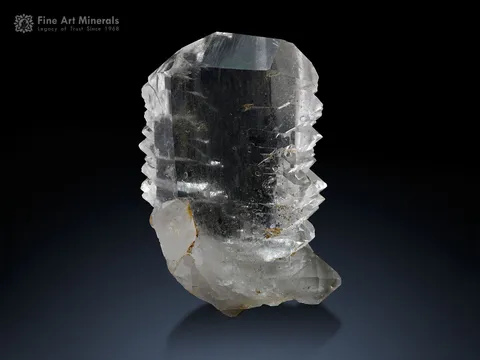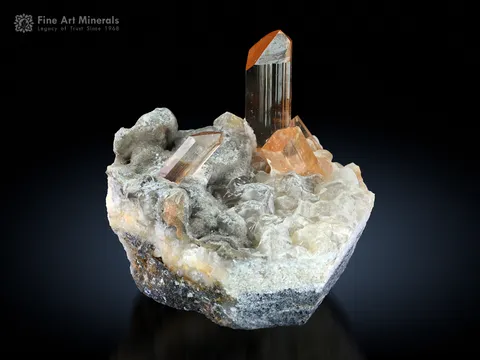
Ghundao Hill, Pakistan — a carbonate-vein locality yielding pink to violet-pink topaz in calcite-quartz veins, prized for glassy crystals and collector appeal.
Key facts
Ghundao hill is one of those deceptively small localities whose reputation far exceeds its footprint. Rising abruptly from the agricultural plain near Katlang in Mardan District, Khyber Pakhtunkhwa, the hill became known to the gem world for natural pink to violet-pink topaz—material that is not pegmatite-hosted in the usual Pakistani sense, but lodged in calcite-quartz-white mica veins cutting deformed carbonate rocks. For collectors, that setting is part of the magic: the best Ghundao crystals are not simply loose cutting rough, but sharp, glassy orthorhombic prisms in or on pale calcite-rich matrix, often with a color range from champagne and sherry through delicate pink to rare cyclamen-purple tones.
The locality’s importance rests on both beauty and petrogenesis. Early descriptions treated the occurrence as an unusual hydrothermal or pneumatolytic topaz deposit in calcareous rocks; later isotope, K/Ar and fluid-inclusion work argued for low-temperature formation, around 230°C, during an Eocene Himalayan tectonothermal event rather than from a late granitic pegmatite fluid. In practical collector language, Ghundao is a carbonate-vein imperial-topaz locality: a structurally controlled system of calcite and quartz veins, saddle-reef-like openings, breccia zones, and muscovite-rich clayey seams that occasionally yielded gemmy topaz crystals with a chromium-related pink color.
Regional View
Country View
Historically, Ghundao changed how collectors thought about Pakistani topaz. Pakistan was already famous for pegmatitic aquamarine, tourmaline and other northern-area minerals, but Ghundao supplied a different kind of prize: pink topaz in recrystallized limestone, with enough transparency and color to interest gem cutters and enough form and matrix aesthetics to excite mineral collectors. The early government and gemological reports recorded mostly small crystals, with fine pink crystals generally up to about 3 cm; specimen literature and major collections later documented rarer larger matrix pieces, including showy crystals in the 4–6 cm class that command particular attention because the matrix style is scarce.

Photo: Wikimedia Commons
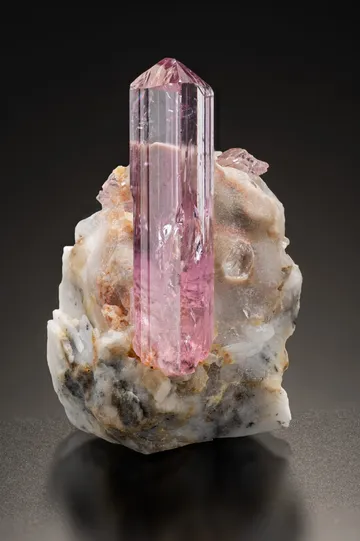
The classic Ghundao specimen has a very recognizable look: a lustrous, vertically striated prism, commonly somewhat flattened, with chisel-like topaz terminations, basal cleavage traces or internal veils, and a body color that may concentrate toward the upper portion of the crystal. Matrix pieces are far rarer than loose crystals, because much of the topaz was encased in calcite, recovered from blasted vein rock, or cleaved during extraction and preparation. A top Ghundao specimen is therefore judged not just by color but by completeness, transparency, undamaged termination, lack of cleavage interruption, and the naturalness of its attachment to the host carbonate-quartz vein material.

Photo: Wikimedia Commons
Search for specimens: View all specimens from Ghundao hill, Pakistan
Ghundao hill lies near the village of Ghundao, north to north-northeast of Katlang in Mardan District. Published coordinates place the topaz-bearing hill close to 34°24′N, 72°06′E, and modern locality databases give 34.39922, 72.10215. The hill is small—reported at roughly 340 by 275 m at its base—and rises about 80 m above the surrounding plain. One neighboring hill about a kilometer away was noted in early work as barren of topaz, which underscores the sharply localized nature of the mineralization.
The host rocks are recrystallized gray limestones, calcareous schists or shales, phyllitic layers and autoclastic limestone breccias assigned in older literature to the Lower Swat-Buner Schistose Group, with later regional usage relating the rocks to the Alpurai Group and Kashala Formation. Early gemological field reports divided the hill into three main lithologic units: light gray thick-bedded autoclastic limestone; darker crystalline limestone with algal structures, quartz, mica and altered pyrite; and thin-bedded limestone with calcareous shale, the gray color partly related to fine bituminous inclusions. Algal structures and gastropod fossils were part of the evidence used to support a Silurian-Devonian age for the carbonate sequence.
Structurally, Ghundao is a compact but intensely deformed carbonate hill. The strata are tilted steeply to nearly vertical, folded into a small anticlinorium, and cut by faults and drag folds. The productive veins are not broad pegmatites. They are calcite and quartz veins in carbonate rock, of two principal styles: short, irregular, fine-grained calcite veins a few centimeters wide and less than a meter long, and larger, coarser calcite veins that may reach about 2 m in width and several meters in length along fault planes parallel to the fold axes. The topaz is chiefly associated with the larger vein type, where coarse calcite is accompanied by milky quartz, green muscovite, green talc and limonitized clay-like material.
The ore body, in specimen terms, is the topaz-bearing calcite-quartz vein system rather than a continuous ore seam. The best descriptions emphasize structural control: topaz forms in saddle-reef-like zones within muscovite-rich clayey accumulations and in stockworks of calcite and quartz veins. Many crystals were completely embedded in calcite; others protruded into small vugs or crevices, and some were found loose in breccia debris. Quartz is a persistent companion, and collectors should think of Ghundao topaz as a vein-and-breccia mineral, locally pockety, commonly calcite-encased, and only exceptionally preserved as matrix-mounted display crystals.
Mining history begins with local discovery in the early 1970s. Gemological accounts say topaz was first discovered at Ghundao in the fall of 1972 by local residents, who dug crystals secretly and carried them to the Peshawar market. A 1987 National Assembly record states that pink topaz was first discovered on “Ghaundao hillock” in 1973 by locals; the difference reflects the way early finds, reporting and government attention overlapped. The West Pakistan Industrial Development Corporation investigated the hill in January 1973 through its Mineral Development Cell in Peshawar. Prospecting rights then passed through WPIDC and Pakistan Mineral Development Corporation channels before the Gemstone Corporation of Pakistan became the significant operator.
Systematic mining began under the Gemstone Corporation of Pakistan in 1981, with geological work supervised in part by A. H. Kazmi, one of the authors of the 1986 Gems & Gemology study. The workings described in that period were open cuts—trench-like incisions blasted into known topaz-bearing calcite veins. Miners used hand tools and pneumatic drills, placing low-strength explosive charges with unusual care because topaz is easily cleaved even though it is hard. Promising pieces of calcite were then broken by hammer so that enclosed crystals could be freed. By February 1983, three open cuts had been driven into the hillside, the largest approaching the summit, and about 15 miners were working the deposit; daily production was small enough to be carried by hand to a depot in Ghundao village.
Production figures vary by reporting period. The 1986 Gems & Gemology article recorded 72,076 carats of gem-quality pink topaz up to November 1984 and noted annual production then in the 20,000–30,000 carat range. A Pakistani parliamentary answer recorded 246,596 carats of pink topaz extracted by GEMCP from July 1981 through December 1986, with a conservative value of Rs. 6.127 million. A Geological Survey of Pakistan compilation later reported that GEMCP extracted about 0.54 million carats of rough pink topaz from Katlang between 1981 and 1992, and that GEMCP ran the Katlang pink topaz mines until it was disbanded in 1994.
After the government-company period, later lease and auction history becomes less specimen-focused and less consistently documented. A Geological Survey of Pakistan summary states that there were two known Katlang-area deposits, Ghundao and Shamozai; that the Ghundao deposit was auctioned for a ten-year term after GEMCP but the lease was cancelled when the auction money was not deposited; and that Shamozai was later auctioned and made operational in the early 2000s. The same source characterizes the mining methods as primitive, with dynamite, crowbars, hammers and portable drilling machines. For collectors, this history explains the persistent condition problems: much of the material entered the market as cleaved crystals, repaired matrix pieces, loose crystals, or gem rough rather than pristine pocket specimens.
Collecting access today should be treated as restricted, local and permission-dependent. Ghundao is not a public rockhounding locality in the North American sense; it is a mined hill in a village and agricultural setting, with small-scale workings, local community control and periodic secrecy around productive areas. Recent field accounts describe permission as difficult, mine visits as dependent on local introductions, and some underground workings as sealed because of unauthorized night entry. Mindat’s current locality notes report that the veins are almost exhausted and that mining restarted in October 2025, but without significant finds at that stage while access deeper into the mine was being cleared. In the collector market, occasional new pieces appear, but the supply of truly fine matrix specimens remains thin and sporadic.
The most famous finds remain the early 1980s production and subsequent small pulses of well-colored crystals. Early gemological literature emphasizes crystals up to about 3 cm, with colorless, tan and reddish-brown topaz more common than the prized deep pink. Dealer and collection records show that exceptional matrix pieces exist: transparent, well-terminated pink to purple-pink crystals perched on calcite-quartz matrix, sometimes with one major crystal and a smaller associated crystal. These are the specimens that define Ghundao for advanced collectors—compact, high-color, highly lustrous topaz, ideally on original matrix and with minimal cleavage damage.
Topaz from Ghundao hill occurs as transparent to subtransparent prismatic orthorhombic crystals in calcite-quartz-white mica veins cutting recrystallized limestone, with colors ranging from colorless and very pale beige through tan, reddish brown and champagne to pink, violet-pink and rare cyclamen-purple; the finest pieces are sharply terminated, vertically striated, glassy and gemmy, either protruding from calcite-lined openings or perched on pale matrix. Published early work recorded most crystals as under about 2.5–3 cm, with larger examples unusual, although later specimen records include exceptional matrix crystals in the 4–6 cm class. Good Ghundao topaz is separated from ordinary material by natural chromium-related pink color, strong luster, intact termination, good transparency, freedom from basal cleavage breaks and convincing original matrix attachment; most loose or cleaved crystals, and many colorless to brownish pieces, lack the aesthetic force of a true matrix pink.
Other documented minerals from Ghundao are modest in number but important for understanding the deposit. Calcite is the main vein and enclosing mineral, while quartz is the most common collector-visible associate and may occur as transparent crystals with topaz or as milky vein material. Muscovite or mica-group material and talc occur in greenish seams and clayey accumulations that were closely associated with topaz mineralization. Pyrite is reported as altered crystals in the darker limestone unit, and locality lists also record albite, dolomite, epidote, fluorapatite and garnet-group minerals. Ghundao is not known for a suite of type-locality minerals; its mineralogical distinction lies instead in an unusually chromium-colored topaz assemblage hosted by carbonate veins rather than by granitic pegmatite.
The main authenticity issue is locality and color. “Katlang topaz” is often used broadly in the trade, and material may be labelled Katlang, Ghundao, Mardan, or simply Pakistan. For fine pink to violet-pink specimens, the precise Ghundao attribution matters: true Ghundao material is historically tied to the small carbonate-vein hill near Katlang, whereas Pakistan also produces topaz from pegmatite districts farther north. Colorless, champagne, orange-brown and peach topaz from Pakistan can be attractive, but it should not automatically be accepted as Ghundao pink topaz without provenance, matrix context or credible documentation.
Treatment is a serious consideration. The prized Ghundao pink color is attributed to trace chromium and was reported as stable in sunlight tests, including a 65-day exposure to hot Peshawar summer sun in Jan’s 1979 account. By contrast, GIA-published experiments on Katlang colorless, tan and reddish-brown topaz showed that irradiation and heat can alter colors, producing orange-brown, pale pink or colorless results depending on treatment sequence and temperature. Modern field and trade reports continue to warn that some pink topaz sold through Pakistani markets may be treated material from other origins. For high-value stones, seek a reputable gemological report or strong provenance, especially if the piece is a loose gem or unusually saturated without matrix.
Condition is the other decisive factor. Topaz has Mohs hardness 8, but it has perfect basal cleavage and poor toughness relative to its hardness. Ghundao crystals commonly show cleavage cracks, internal fissures, healed fractures, broken bases or damaged terminations, partly because many were embedded in calcite and recovered by blasting and hammering vein rock. A small, complete, lustrous pink crystal can be far more desirable than a larger cleaved one. Matrix specimens deserve extra scrutiny: contact repairs, reattachments to calcite matrix and restorations are documented in the market, and some repairs may be acceptable if disclosed, but they materially affect value.
Fluorescence can be useful but should not be treated as a stand-alone origin test. The Fluorescent Mineral Society database documents a Katlang pink topaz crystal fluorescing red under longwave 365 nm UV, pink under midwave 305 nm, and bluish white to white under shortwave 255 nm, with longwave red emission attributed to chromium activation. Fluorescence is therefore a pleasing diagnostic clue for chromium-bearing material, but it does not replace spectroscopy, gemological testing or provenance.
Market availability is limited and uneven. Loose crystals and small repaired or cleaved pieces appear periodically; fine, undamaged matrix specimens are genuinely scarce. The strongest collector demand is for saturated pink to violet-pink crystals on matrix, especially with a clean upright presentation and no repair through the main crystal. Old collection provenance—particularly pieces traceable to the early 1980s production or to named collections—adds confidence and often price strength. Recent reports indicate renewed work at the hill, but not a steady stream of major new finds, so the best historical pieces remain the benchmark.
The discovery story has the flavor of a mineral rush in miniature. In the fall of 1972, local residents at Ghundao began digging the new pink crystals in secret and carrying them down to the Peshawar market. The stones were attractive enough, and unusual enough, that the government soon noticed. By January 1973 the Mineral Development Cell of the West Pakistan Industrial Development Corporation was studying the hill; by the early 1980s the Gemstone Corporation of Pakistan had turned a once-hidden local dig into a systematic government-supervised mine.
When Edward Gübelin visited in February 1983 with Dr. A. H. Kazmi, Ghundao was still a very small operation by mining standards. Three open cuts had been blasted into the side of the hill, the largest nearly reaching the summit, and only about 15 miners were working. The daily production was so slight it could be carried by hand to the village depot. Yet from those modest trenches came one of the world’s most recognizable pink topaz localities, a place where the desirable output was counted not in tons of ore but in handfuls of fragile, cleavage-prone crystals.
The physical work was both simple and delicate. Miners drilled and blasted the known calcite veins, then searched the broken rock. GIA’s field photographs described miners on heaps of blasted limestone and calcite, breaking promising pieces with hammers in hopes of finding crystals still hidden inside. That last step is easy to picture: a pale lump of calcite, a careful blow, another, and then either a flash of pink glass or the disappointment of a cleaved fragment. Ghundao’s finest specimens are beautiful partly because their survival was unlikely.
A recent field account by Origin Gems captures the modern mood around the hill: less a public mine than a place reached through conversation, patience and permission. Their team arrived without dependable contacts, found help through a local mechanic, and eventually gained access to the sought-after “parallel mine” on top of Ghundao hill. They described the climb as slippery, over soft slate debris, with the hill rising out of flat farmland; they also noted marine fossils in the rock walls, a reminder that the gem-bearing hill is built from ancient carbonate sediments rather than from the pegmatites most collectors associate with Pakistan.
That same visit gives a vivid sense of present-day small-scale mining. A miner drilled holes for dynamite, the team withdrew, and after the blasts—rendered in their account as “VOOM VOOM VOOM”—the miners returned to comb the rubble. The account also records a sealed deeper underground mine, said locally to have been closed because outsiders were sneaking in at night, stealing production or leaving the workings disturbed. Such details explain why serious collectors should respect locality access: Ghundao specimens are not abstract commodities, but the product of a village hill, local relationships and controlled working ground.
Edward J. Gübelin, Giorgio Graziani and A. H. Kazmi, “Pink Topaz from Pakistan,” Gems & Gemology, Vol. 22, No. 3, 1986, pp. 140–151 — The classic English-language gemological and field account of Ghundao, covering location, geology, mining, production, inclusions, chemistry and treatment experiments.
M. Qasim Jan, “Topaz occurrence in Mardan, north-west Pakistan,” Mineralogical Magazine, Vol. 43, No. 325, 1979, pp. 175–176 — Early mineralogical description of the Katlang/Ghundao topaz occurrence, including colorless, purple and pink crystals in calcite veins with quartz.
G. Morteani and A. Voropaev, “The pink topaz-bearing calcite, quartz, white mica veins from Ghundao Hill (North West Frontier Province, Pakistan): K/Ar age, stable isotope and REE data,” Mineralogy and Petrology, Vol. 89, 2007, pp. 31–44 — The key modern genetic study arguing for low-temperature Eocene tectonothermal crystallization rather than a simple late-granite pegmatite model.
W. H. Spengler, “The Katlang pink topaz mine, North West Frontier Province, Pakistan,” Journal of Gemmology, Vol. 19, No. 8, 1985, pp. 664–671 — Important contemporary mine account cited by later GIA and gemological literature.
National Assembly of Pakistan, Questions and Answers, 15 February 1987 — Government production record noting discovery by locals, GEMCP systematic mining from July 1981, and 246,596 carats extracted through December 1986.
Geological Survey of Pakistan, “Gems and Gemmology in Pakistan,” 2010 — Pakistani survey compilation summarizing Katlang pink topaz mining history, post-GEMCP leasing, primitive mining methods and reported 1981–1992 production.
Mindat photo gallery for Katlang and Ghundao hill — Includes notable specimen records such as a Gene Meieran collection matrix topaz with a 4.6 cm crystal, as well as public gallery documentation of rare Katlang matrix material.
Wikimedia Commons, “Topaz-den07-22a.jpg” — Rob Lavinsky photograph of a miniature Ghundao pink topaz from the 1982–1983 finds, formerly in the Dr. Eugene Meieran collection.
Wikimedia Commons, “Topaz-37841.jpg” — Rob Lavinsky photograph of a rare purple-lavender Katlang topaz on matrix, noted in the file record as a Mindat Photo of the Day in 2006.
“Rare Pink Topaz Gems Mining,” Folkmarket Gems Minerals, YouTube — Short field-style video described as exploring the Katlang topaz mines in Mardan, Pakistan.
“Pretty Little Gem, Mr. Jeffery Bergman on Pink Topaz Hunt Trip in Katlang, Mardan, Pakistan,” Pretty Little Gem, YouTube — Video highlights from a pink topaz hunt trip in Katlang with Jeffrey Bergman and Muhammad Ayub.
“In Search of Pink Fire: A Journey to the Katlang Pink Topaz Mines,” Origin Gems — Photo-rich field expedition account with images of Ghundao hill, mine access, drilling, miners’ huts and local context.
Fluorescent Mineral Society FMDB: “Topaz from Katlang, Pakistan” — UV fluorescence documentation for a Katlang pink topaz crystal, including longwave, midwave and shortwave responses and emission notes.
Mindat: Ghundao hill, Katlang, Mardan District, Khyber Pakhtunkhwa Province, Pakistan — Best locality database page for coordinates, mineral list, references and current locality notes.
Gems & Gemology: “Pink Topaz from Pakistan,” Fall 1986 — Essential source for the historical mine visit, geology, production figures, chemistry and treatment experiments.
Mineralogical Magazine reference: Jan 1979, “Topaz occurrence in Mardan, north-west Pakistan” — Concise early scientific description of the topaz-bearing calcite veins near Katlang.
Technical University of Munich publication page: Morteani & Voropaev 2007 — Abstract and bibliographic details for the modern isotope and K/Ar study of the Ghundao vein system.
National Assembly of Pakistan PDF, 15 February 1987 — Government record of early discovery, GEMCP operation and official extraction figures through 1986.
Fluorescent Mineral Society FMDB: Topaz from Katlang — Useful specialist reference for fluorescence behavior of chromium-bearing Katlang pink topaz.
Origin Gems: “In Search of Pink Fire” — Modern field narrative with photographs and access observations from Ghundao hill and nearby Katlang-area workings.
Gemmology.dev: Katlang Pink Topaz, Pakistan — Gemological overview of chromium-colored Katlang topaz, including color, stability and distinguishing features.
Wikimedia Commons: Topaz-den07-22a.jpg — Freely licensed image and specimen note for a classic Ghundao pink topaz.