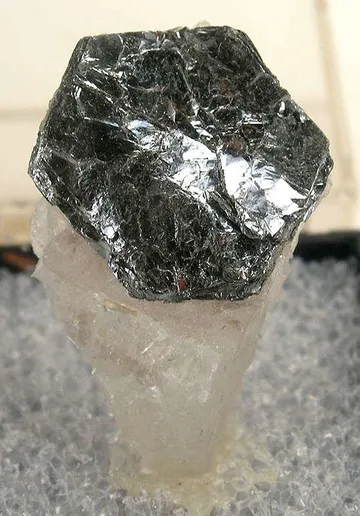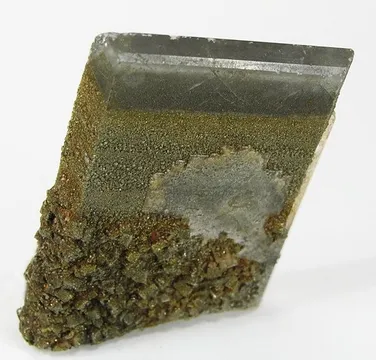
Yates Mine, Canada - classic Grenville locality yielding fluorapatite crystals with calcite, purple fluorite, and diopside; prized for sculptural forms and his…
Key facts
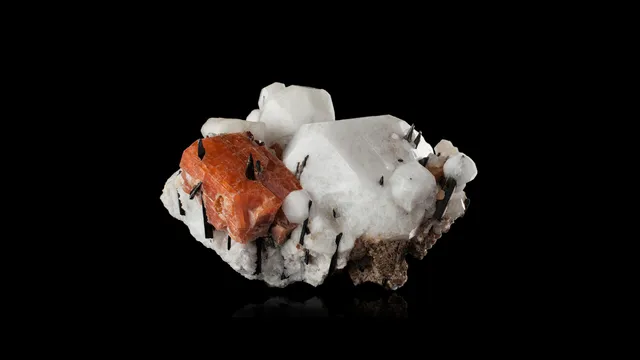
Yates Mine, near Otter Lake in Pontiac County, Québec, is one of the classic Canadian localities where the specimen, the mining story, and the geology all converge in a way collectors can recognize at a glance. Its most familiar pieces are doubly terminated to blunt-ended prismatic fluorapatite crystals, olive-green to brownish red or dark green, sitting in orange, pink, salmon, peach, or cream calcite, commonly with purple fluorite and dark diopside-group silicates. The color combination is unmistakably Grenville: warm carbonate, green phosphate, purple fluorite, black-green pyroxene, white scapolite, and mica all packed into coarse calcite-rich bodies that were long described as skarns or vein-dikes.
The locality’s importance is not merely decorative. Yates was explored as a uranium-thorium prospect during the 1950s, after earlier small-scale work for phlogopite and fluorite, and its zones preserve a complicated assemblage of uranium-, thorium-, rare-earth-, fluorine-, phosphate-, carbonate-, and calc-silicate minerals. Modern work on inclusions in Yates fluorapatite has pushed the interpretation beyond the old “skarn” label: the orange-pink calcite bodies and associated fluorapatite have become part of the discussion of marble anatexis and crustally derived silicocarbonatitic melts in the Grenville Province. For collectors, that means a good Yates apatite is not just a handsome cabinet piece; it is a visible fragment of an unusual high-grade metamorphic and melt-related system.
Regional View
Country View
The best Yates specimens have a sculptural simplicity: a single, well-defined hexagonal crystal rising cleanly from contrasting calcite, or several aligned crystals emerging from the carbonate like dark green keels. In older collections these are often labelled simply “apatite,” but well-documented material is typically fluorapatite. The most prized examples preserve sharp terminations, natural attachment, good contrast against calcite, and minimal bruising along crystal edges. The largest published and photographed examples are imposing by apatite standards, including crystals measured in tens of centimetres.

Photo: Didier Descouens, Wikimedia Commons
Search for specimens: View all specimens from Yates Mine, Canada
Yates Mine is in the Otter Lake area of Pontiac RCM, Outaouais, Québec, northwest of Shawville and north of Otter Lake village. The coordinates generally cited for the locality refer to the Matte Zone, the most specimen-famous of the mineralized zones. Historical descriptions place the workings in Huddersfield Township and record the principal zones as Matte, Camp, Lake, Bélanger, Bélisle, and Cliff. The property should therefore be thought of as a set of related showings and workings rather than as one simple underground mine.
The rocks belong to the Grenville Province, in a district of paragneiss, marble, calc-silicate rock, gneiss, pegmatite, and later intrusives. Older reports described parts of the deposit as calc-silicate skarn, pyroxenite, recrystallized limestone, and calcite-fluorite-apatite bands. The Matte Zone, the heart of the best-known specimen material, was described in a 1999 assessment as a calc-silicate skarn or vein-dike in conformable contact with biotite gneiss, pinching and swelling to about 5 m true width and traceable for about 200 m northwestward on Lot 17, Range V. Its core was described as coarse-grained orange to white calcite, purple fluorite, and euhedral green apatite crystals up to 50 cm long, with metasomatized country-rock blocks of scapolite, pyroxene, and microcline rimmed by coarser calc-silicate minerals.
The Matte Zone is the source of the classic collector look: orange to salmon calcite carrying green to brown-green fluorapatite, purple fluorite, dark diopside-group crystals, scapolite, phlogopite, and accessory radioactive and rare-earth minerals. A 1979 property examination recorded trenches exposing a calcite marble and fluorite band several feet thick over roughly 700 ft of strike; the marble ranged from cream to salmon, fluorite occurred as parallel bands, shreds, and clusters of purple crystals, and apatite plus mafic minerals were noted as shattered porphyroblasts. Modern mineralogical work on Yates fluorapatite describes orange to pink calcite dikes enclosing euhedral prisms of fluorapatite and interprets melt inclusions in the fluorapatite as evidence for silicocarbonatitic melt derived from marble anatexis, modified by interaction with enclosing gneisses.
Historically, the district was first worked for non-radioactive commodities. In 1906–1907 the Calumet Mica Company, and later A.G. Martin of Ottawa, worked small pits for phlogopite and fluorite; the deepest early pits were reported at about 20 ft. Twin Valley Prospecting Syndicate returned in 1943–1944 and produced 18 tons of fluorite. The uranium story began in the early 1950s when J.M. “Jimmy” Yates found radioactive uranothorite in the old mica workings. Yates Uranium Mines Inc. was organized, and from 1953 to 1956 the company explored the property with stripping, trenching, drilling, and underground work. Reports variously record a 300 ft to 500 ft adit under the Matte Zone, two open cuts, extensive diamond drilling, and a mining camp.
The mid-century exploration campaign was substantial even though Yates did not become a major uranium producer. Groundstar’s 1976 summary states that Yates Uranium Mines Limited completed about 10,000 ft of diamond drilling in 105 holes, a 500 ft adit, 68,000 sq ft of stripping, 47,000 cu ft of trenching in overburden, and 8,000 cu ft of rock trenching during 1954–1955. The same review reported five radioactive zones over about a mile of strike and noted that fluorite and apatite mineralization was largely associated with the Matte Zone. Historical reserve figures were repeatedly cited in company-era documents, but later work questioned whether they could be confirmed because early grades relied heavily on instrument readings and the structure was not well understood.
Groundstar Resources explored the old Yates concession again in the 1970s, stripping along the Matte–North trend and drilling the Matte and Camp zones. Their work confirmed the presence of radioactivity, fluorite, and apatite, but did not substantiate the earlier tonnage and grade estimates. A 1999 assessment by Darryl B. MacFarlane and Jerry Van Velthuizen shifted the focus toward specimen and decorative-stone potential: the report specifically noted that many Matte Zone minerals occur as relatively large euhedral crystals, and that the orange calcite, purple fluorite, green apatite, white scapolite, and black pyroxene made unusually attractive material.
Collectors should treat access as private and permission-based. The mine has been reported as reclaimed, and past discussion noted bulldozing of parts of the site, especially away from the Matte collecting area. More recent locality information records the mine as open on a collect-for-a-fee basis by the owner in the Otter Lake area, and a 2025 Ottawa Valley Mineral Club field-trip listing treated Yates as an RSVP, fee-based collecting locality. In practical terms, one should not assume casual open access: verify permission before visiting, expect fee collecting, and remember that radioactive minerals are part of the assemblage.
The best collecting history belongs to the Matte Zone. Specimens from this zone are the pieces most likely to carry coherent apatite crystals in salmon to orange calcite, purple fluorite, black-green diopside, white scapolite, and occasional accessory allanite, thorianite, thorite, uranothorite, zircon, titanite, molybdenite, and zeolites. Loose and broken crystals are common, while undamaged matrix pieces with a naturally attached, free-standing fluorapatite crystal are much scarcer. Camp and Bélanger material tends to be more important for calc-silicate and radioactive-mineral interest than for the classic purple-fluorite-and-apatite display style, although all old labels should be evaluated cautiously because “Yates Mine” on a specimen may refer to a property suite rather than one precisely documented pocket.
Calcite is not a mere background mineral at Yates; it is the visual and genetic stage on which the locality’s best specimens were built. In the Matte Zone it occurs as coarse orange, salmon-pink, peach, cream, and white carbonate, locally forming the matrix for green to brown-green fluorapatite, purple fluorite, dark diopside-group prisms, scapolite, phlogopite, and radioactive accessories. Older reports describe cream-to-salmon calcite marble, coarse orange-to-white calcite in the Matte Zone core, and calcite-rich rock whose color deepened and grain size coarsened where the marble was structurally disturbed and recrystallized. Collectable calcite-only specimens are less celebrated than apatite-on-calcite pieces, but the best Yates calcite matrix is critical: fresh salmon color, solid support, good contrast, and natural crystal attachments separate desirable pieces from ordinary broken carbonate chunks, while acid etching, bruised surfaces, and glue lines around apatite attachments sharply reduce confidence.
Fluorapatite is the emblematic Yates mineral, occurring chiefly as well-formed hexagonal prisms in calcite-rich Matte Zone material, commonly olive-green, dark green, brownish green, or visually red-brown where internal hues combine. Published examples include doubly terminated crystals in calcite and crystals measured from a few centimetres to several tens of centimetres, with the Matte Zone report noting euhedral green apatite up to 50 cm and a Wikimedia-documented specimen showing a 32 cm crystal. Typical associations are salmon to orange calcite, purple fluorite, dark diopside or other pyroxene-group minerals, scapolite, phlogopite, microcline, titanite, allanite, molybdenite, and radioactive thorium-uranium minerals. A strong Yates fluorapatite specimen has a distinct, natural-looking crystal attachment, sharp or complete terminations, attractive contrast against calcite, and limited edge chipping; matrix pieces with one dominant, isolated crystal are especially desirable because many crystals detach from calcite or are encountered as broken prisms.
“Apatite” on a Yates label is usually collector shorthand rather than a precise modern species name, and it is worth preserving that historical wording while cataloguing well-documented pieces as fluorapatite when appropriate. The classic Yates apatite habit is a stout to elongate hexagonal prism, often doubly terminated or partly enclosed in orange, pink, salmon, or cream calcite, with purple fluorite and dark calc-silicate minerals providing the most attractive associations. Older and modern descriptions alike emphasize crystals in calcite-rich material rather than loose gemmy apatite; Yates crystals are valued for size, locality character, and matrix contrast more than transparency. Good “apatite” pieces from here show complete form, clean color separation from the calcite, convincing undisturbed matrix contact, and a label trail that acknowledges the Otter Lake/Yates uranium prospect context, while vague “Canada apatite” labels need scrutiny because superficially similar Grenville apatite-calcite specimens occur elsewhere in Québec and Ontario.
Beyond calcite and fluorapatite, Yates has a broad Grenville calc-silicate and radioactive-mineral suite. Documented minerals include actinolite, albite including oligoclase and peristerite, allanite-(Ce), andradite, augite, biotite, cerite-(CeCa), chabazite-Ca, chalcopyrite, diopside, ferriallanite-(Ce), fluorite including stink-fluss, hedenbergite and ferrosalite, hematite, heulandite-Ca, microcline, molybdenite, monazite-(Ce), norbergite, parisite-(Ce), phlogopite, pyrite, quartz, scapolite, stilbite-Ca, synchysite-(Ce), thorianite, thorite including uranothorite, titanite, tremolite, uraninite, uranophane, and zircon. Among these, allanite-(Ce), thorianite, thorite/uranothorite, uranium minerals, rare-earth carbonates and silicates, titanite, molybdenite, scapolite, and deep purple fluorite give the locality much of its systematic appeal. Some older or casual identifications require caution: julgoldite-(Fe3+) has been refined to andradite in later work, and ferrosilite is treated as an erroneous literature entry for the locality.
Yates specimens are instantly recognizable, but they are not immune to the usual problems of classic locality material. The most important condition issue is the contact between apatite and calcite. Fluorapatite is harder than calcite, but the attachment can be fragile, and commercial examples have explicitly been documented with suspected reattachment visible under ultraviolet light as a bright glue line around the apatite-calcite junction. Whenever a Yates apatite appears dramatically perched on calcite, inspect the base of the crystal under magnification and UV, look for continuous natural calcite contact, and be wary of adhesive residue, unnatural gaps, or a fluorescent halo at the join.
Mislabelling is common in two forms. First, older “apatite” labels are normal and usually historically acceptable, but a modern catalogue should note fluorapatite where the piece is documented as such. Second, pyroxene-group minerals, allanite-(Ce), dark titanite, thorianite, uranothorite, and altered or coated crystals can be confused, especially in black-green prismatic material from the calc-silicate zones. Allanite may form blades, pyroxenes at Yates range from green to pitch black, and some radioactive minerals are small, dark, and not reliably identifiable by appearance alone. For valuable systematic pieces, analytical confirmation is preferable to confident visual naming.
Radioactivity is a real handling consideration. Yates is a uranium-thorium prospect, not merely an apatite locality, and thorianite, thorite, uranothorite, uraninite, uranophane, and allanite-(Ce) are all reported from the property. Most apatite-on-calcite display specimens are not necessarily highly active, but matrix pieces with dark heavy accessory minerals should be checked with a reliable meter, stored with ventilation, and kept away from prolonged close personal exposure. Do not grind, saw, or acid-clean radioactive matrix without appropriate precautions; dust from thorium- and uranium-bearing minerals is a greater concern than an intact labelled cabinet specimen.
Calcite care is straightforward but often ignored. Avoid acids, vinegar, strong household cleaners, and ultrasonic cleaning. Orange and salmon calcite can be etched or dulled quickly, and the vibration of an ultrasonic bath can loosen a repaired or naturally weak apatite attachment. Clean gently with water, a soft brush, and patience; leave stubborn iron or clay films alone unless you know exactly what they are and have tested a small inconspicuous area.
Market availability is moderate rather than abundant. Small and mid-sized apatite-in-calcite pieces circulate from old collections, club material, and occasional field collecting, and inexpensive broken examples are not rare. Fine cabinet pieces with a large, sharp, naturally attached, doubly terminated fluorapatite crystal on attractive salmon calcite are much scarcer and draw serious locality-collector interest. Recent public auction records show the spread clearly: ordinary cabinet examples can sell in the low hundreds or below, while large, showy, classic matrix fluorapatites with good provenance have reached several hundred dollars. Specimen quality is highly sensitive to repair, termination damage, contrast, and whether the crystal is isolated and aesthetically positioned.
The Yates story began, in collector terms, as an old-fashioned Grenville resource patch: small pits in the bush, mica and fluorite rather than uranium, and a landscape of marble, gneiss, and calc-silicate rock. In 1906 and 1907 the Calumet Mica Company worked the area, followed by A.G. Martin of Ottawa. The old pits were modest, the deepest only about 20 ft, but they opened enough rock to reveal the unusual mineral mixture that later made the locality famous. Twin Valley Prospecting Syndicate came back during 1943–1944 for fluorite and produced 18 tons, a small industrial footnote now overshadowed by the apatite specimens that collectors associate with the name.
The decisive turn came when J.M. Yates found uranothorite in the old mica workings during the early 1950s. The discovery landed in the uranium-boom years, when modest radioactive showings could suddenly attract capital, machinery, surveyors, and drilling. By 1954 the property was no longer just a scatter of pits: Yates Uranium Mines Limited had become the company name, and the ground was being treated as a serious uranium-thorium prospect. The zones acquired names—Matte, Camp, Lake, Bélanger, Bélisle, Cliff—and those names still matter because “Yates Mine” specimens do not all come from one mineralogical setting.
The 1954–1955 campaign was surprisingly large for a locality best known today to mineral collectors. A later Groundstar review counted about 10,000 ft of diamond drilling in 105 holes, a 500 ft adit, 68,000 sq ft of stripping, 47,000 cu ft of trenching through overburden, 8,000 cu ft of rock trenching, mapping, scintillometer work, living quarters, office facilities, mine buildings, and even a small pilot mill. A 1956 appraisal described a camp large enough to house and feed 30 men. The collector can still see the residue of that ambition in old reports: the Matte Zone was chased underground, the Camp Zone stripped, and radioactive beds were projected and calculated even though later work found the structure more complex and the early grade estimates difficult to confirm.
The most vivid specimen chapter is the Matte Zone itself. Reports describe the zone not as a narrow little vein but as a body with enough scale and color to command attention: orange to white calcite, purple fluorite, and green apatite crystals in the same rock, with blocks of altered country rock floating in calcite and rimmed by coarse calc-silicate minerals. In one assessment, the apatite crystals were recorded up to 50 cm long. Groundstar’s geologist wrote that coarse fluorite and apatite, sometimes two to three feet in length, occurred in recrystallized limestone ranging from snow white through pink to deep orange. That is the kind of line collectors remember, because it describes exactly why Yates material looks so unlike ordinary apatite specimens.
The post-uranium life of Yates is almost as interesting. By the late 1990s, the old mining story had become a specimen story. In 1997 and 1998, claim work on the Matte Zone was directed toward exposing, trenching, and evaluating the site for mineral specimens and decorative rock. A backhoe stripped parts of the zone, the old lot line was re-established against the 1955 survey, and roughly five tons of sample were removed for market evaluation in August 1998. The report’s language is unusually frank for specimen collectors: it notes that many minerals occur as relatively large euhedral crystals and that the orange calcite, purple fluorite, green apatite, white scapolite, and black pyroxene made an attractive decorative rock. Few localities have their cabinet-specimen aesthetics described so plainly in an assessment report.
One of the strangest Yates stories happened not in a trench but under a microscope. A dark green fluorapatite crystal from the Yates uranium mine, 31.16 mm long and weighing 99.21 ct, cracked across its length and exposed hidden inclusions. Raman analysis identified two brownish orange calcite spheres inside the apatite, the larger 5.74 mm across; on that larger sphere sat a pair of tiny deep purple fluorite crystals that looked like “eyes.” Elise A. Skalwold and John I. Koivula wrote the episode up for Gems & Gemology under the memorable title “Apatite ‘Piñata’,” because the broken crystal revealed an unexpected internal prize. In a locality already famous for green apatite, orange calcite, and purple fluorite on the outside, the same color pairing was found locked inside the apatite itself.
Field collectors in the modern era have added their own small chapter. A 2019 Mindat discussion captured the confusion and charm of the place: a collector returned from Yates with a dark, altered-looking crystal and wondered if it might be uraninite. Responses quickly moved through pyroxene and allanite possibilities, with one expert noting that Yates pyroxenes range from green to pitch black and that allanite blades may exceed 10 cm. The collector then reported that the Camp Zone had apparently been bulldozed but that the owner permitted visits to the Matte Zone for a fee; he found apatite crystals in varied sizes, abundant diopside, a few poor thorianites, small scapolite, and “a ton of deeply purple fluorite.” It is a very Yates ending: a field day that begins with a mystery black crystal and ends with green apatite, purple fluorite, and radioactive-mineral caution all in the same breath.
Leavitt, Duane L. (1981). “Minerals of the Yates Uranium Mine, Pontiac County, Quebec.” The Mineralogical Record, 12(6), 359–363. The classic collector-oriented article on the locality, cited widely for the Yates uranium mine assemblage.
Leavitt, Duane L. (1981). Mindat reference record for “Minerals of the Yates Uranium Mine, Pontiac County, Quebec.” Useful bibliographic record tying the article to reported Yates minerals including allanite-(Ce), apatite, calcite, diopside, fluorapatite, molybdenite, and quartz.
Sabina, Ann P. Rocks and Minerals for the Collector: Ottawa to North Bay and Huntsville, Ontario; Gatineau (Hull) to Waltham and Témiscaming, Quebec. Geological Survey of Canada. Contains road-log and locality descriptions for Yates, including the Matte and Camp zones, mineral list, and a Geological Survey of Canada specimen photograph of apatite in calcite.
MacFarlane, Darryl B. (1999). Assessment Report for Mining Claim #5174799, Lot 17, Range 5, Huddersfield Township, Pontiac County, Quebec. Québec GM 56663. Important for the late-1990s specimen/decorative-stone evaluation of the Matte Zone, including access notes, geology, stripping, trenching, and the report of green apatite crystals up to 50 cm.
McCannell, J.D. (1976). Summary Report, Exploration Work, Groundstar Resources Limited, Huddersfield Township, Quebec. Québec GM 32537. Reviews the 1954–1955 Yates Uranium Mines work, Groundstar’s 1970s exploration, and the difficulty of confirming historical uranium-fluorite-apatite estimates.
Janes, R.H. (1979). Yates Uranium Property, Huddersfield Township, P.Q. Québec GM 58937. A concise property examination describing the Matte and Bélanger prospects, marble-fluorite-apatite mineralization, uranium-thorium values, and the geological thinking of the late 1970s.
Schumann, Dirk; Martin, Robert F.; Fuchs, Sebastian H.J.; de Fourestier, Jeffrey D.E. (2019). “Silicocarbonatitic Melt Inclusions in Fluorapatite from the Yates Prospect, Otter Lake, Québec: Evidence of Marble Anatexis in the Central Metasedimentary Belt of the Grenville Province.” The Canadian Mineralogist, 57(5), 583–604. Key modern paper interpreting Yates fluorapatite inclusions and calcite dikes as evidence for a silicocarbonatitic melt origin rather than a simple skarn association.
Schumann, Dirk; Martin, Robert F.; and coauthors (2017). “Silicocarbonatite melt inclusions in fluorapatite from Otter Lake (Quebec): Evidence of carbonate melts in the Central Metasedimentary Belt of the Grenville Province.” GAC-MAC Kingston 2017 abstract. Conference abstract emphasizing Otter Lake/Yates as the best-known occurrence and noting well-formed doubly terminated fluorapatite crystals reaching about 30 cm.
“Varicolored Marble in the Central Metasedimentary Belt, Grenville Supergroup. II. Petrogenetic Insight from Apatite.” The Canadian Journal of Mineralogy and Petrology, 63(3), 223–247, 2025. Recent review of fluorapatite and phlogopite deposits in varicolored marble, including Yates among four key occurrences in western Québec and eastern Ontario.
Skalwold, Elise A.; Koivula, John I. (2015). “Apatite ‘Piñata.’” Gems & Gemology, Summer 2015. Short but memorable inclusion note on a Yates fluorapatite crystal containing orange calcite spheres and tiny purple fluorite crystals.
Wikimedia Commons: File “Apatite Canada.jpg.” Documented photograph by Didier Descouens of a 32 cm doubly terminated fluorapatite crystal in calcite from Yates Mine.
Mindat: Yates Mine, Otter Lake, Pontiac RCM, Outaouais, Québec, Canada The essential locality page for coordinates, alternate names, access status, commodity history, and the current mineral list.
Mindat: Fluorapatite from Yates Mine Species-specific entry showing fluorapatite’s significance at the locality and its common photo-based associations.
Mindat forum: “Yates Mine Identification Help” Useful field-collector discussion covering modern collecting, Matte Zone access, and identification pitfalls involving pyroxene, allanite, thorianite, scapolite, and fluorite.
Geological Survey of Canada: Rocks and Minerals for the Collector — Ottawa to North Bay and Huntsville; Gatineau to Waltham and Témiscaming Best free government guide for collectors, with road-log detail and Yates locality notes.
Québec GM 56663: Assessment Report for Mining Claim #5174799 Valuable for the Matte Zone’s specimen potential, 1997–1998 work, and detailed geology.
Québec GM 32537: Groundstar Resources Summary Report Primary source for historical exploration scale, drilling, stripping, adit work, and later reassessment.
Québec GM 58937: Yates Uranium Property Concise field examination of the Matte and Bélanger prospects and their uranium-thorium-fluorite-apatite context.
The Canadian Mineralogist abstract record: Silicocarbonatitic melt inclusions in fluorapatite from the Yates prospect Accessible summary of the modern interpretation of Yates fluorapatite inclusions and carbonate melt origin.
Gems & Gemology: “Apatite ‘Piñata’” A short gemological note showing how Yates apatite can preserve remarkable calcite and fluorite inclusions.
Wikimedia Commons: Apatite Canada.jpg High-resolution open-license photograph of a major Yates fluorapatite in calcite.
Mineralogical Record back issue, Vol. 12 No. 6, 1981 Source for Duane L. Leavitt’s classic Yates article.
Mineral Auctions: 2025 Yates fluorapatite on calcite auction example Useful market reference documenting repair concerns, provenance, and recent pricing for a showy Yates matrix piece.
Mineral Auctions: 2025 large Yates fluorapatite on calcite auction example Recent public sale record for a large cabinet Yates fluorapatite specimen.