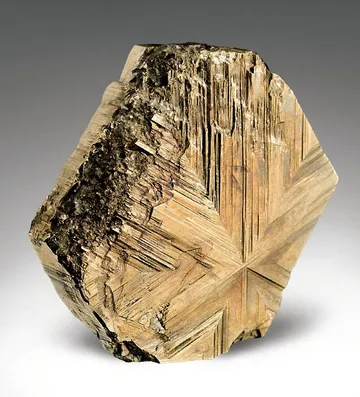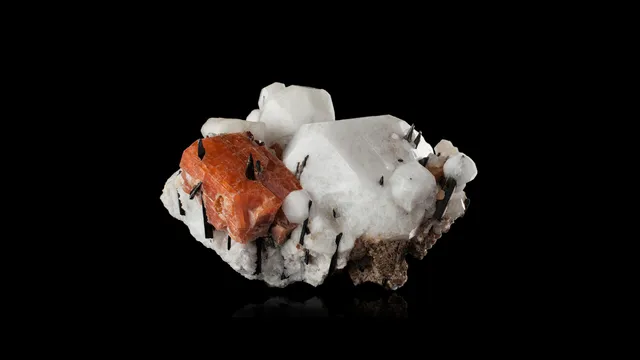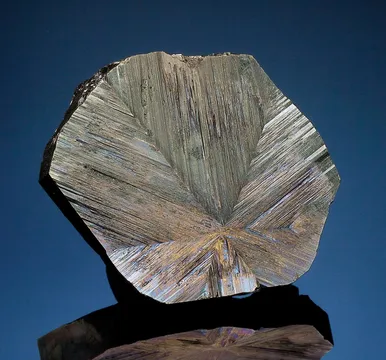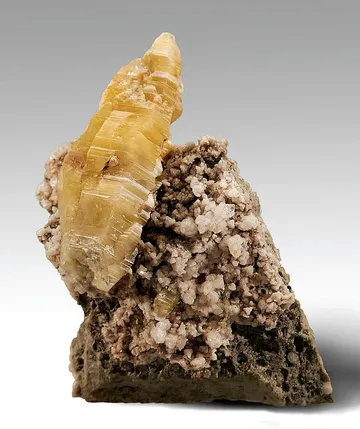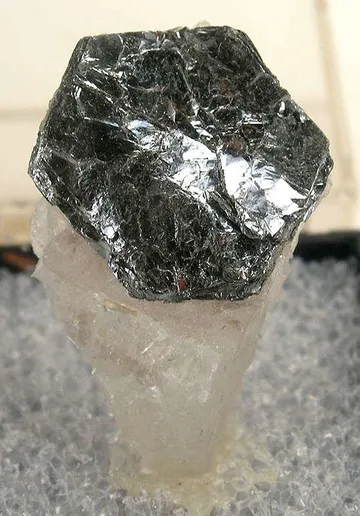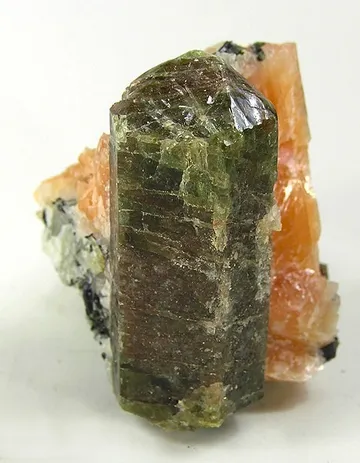
Niobec mine, Canada — Saint-Honoré carbonatite locality famed for cabinet baryte crystals: broad, tabular bars with pyrite and occasional fluorite or calcite.
Key facts
Niobec is the collector face of one of Canada’s most important carbonatite systems: the Saint-Honoré alkaline complex near Saguenay, Québec. Industrially, the mine is known for niobium—chiefly in fine-grained pyrochlore-group minerals and columbite dispersed through carbonatite—but to mineral collectors its name means something more tactile and displayable: broad, heavy, grey to smoky translucent barite/baryte crystals, often dusted with sparkling pyrite and, in the best combinations, accompanied by fluorite or calcite. These are not the delicate bladed sprays familiar from many hydrothermal vein districts. Niobec barite is typically stout, tabular to thick-prismatic, with chisel-like terminations and a distinctly architectural look, the crystal faces often made dramatic by metallic golden sulfide overgrowths.
The geology explains the odd pairing of a world-class niobium orebody and cabinet-quality barium sulfate crystals. The mine sits in the southeastern part of the Saint-Honoré alkaline complex, an oval, largely concealed intrusion with a carbonatite core and associated alkaline silicate rocks. Carbonatite here is not a curiosity in a thin vein; it is the host to a long-lived underground mining operation. The niobium ore is mostly a fine-grained, disseminated mineralization problem for miners and metallurgists, while the collector specimens came from open spaces—vugs and pockets, especially in limestone at carbonatite contacts—where barium-rich fluids had room to build crystals large enough to survive as specimens.
Regional View
Country View
Niobec also matters historically. The carbonatite complex was found in 1967 during SOQUEM work connected with radiometric surveying, and by 1976 the mine was in commercial production. In 1994, installation of a converter allowed production of ferroniobium on site, making Niobec not merely a mine but a vertically integrated niobium operation. For collectors, that long mining history is a mixed blessing: it created the access through which barite pockets were encountered, but it also means the locality is an active industrial mine, not a collecting ground. The classic specimens on the market are therefore finite survivors of specific underground encounters rather than pieces one can reasonably expect to self-collect today.

Photo: Wikimedia Commons

Photo: Wikimedia Commons
Search for specimens: View all specimens from Niobec mine, Canada
Niobec is an underground niobium mine at Saint-Honoré in the Saguenay–Lac-Saint-Jean region of Québec, northwest of Saguenay/Chicoutimi. The mine works the Saint-Honoré carbonatite, part of a polyphase alkaline complex intruded into older Grenville Province rocks and now largely hidden below Paleozoic cover. In plan the complex is oval to ring-like, with carbonatite occupying the core and alkaline silicate rocks—syenite, feldspathoidal syenite, ijolite and urtite—around it. The carbonatite itself is compositionally zoned, with calcite-rich carbonatite toward the outside, dolomite- and ankerite-bearing magnesiocarbonatite inward, and a more evolved iron-rich carbonatite in the center.
The niobium ore is not a coarse specimen assemblage. Its important ore minerals occur as small disseminated grains, commonly only a fraction of a millimetre across, scattered through the carbonatite and especially tied to facies rich in apatite, magnetite and biotite or phlogopite. Older mining and metallurgical descriptions refer to sodium- and iron-enriched pyrochlores and columbite; more recent work identifies the principal niobium minerals in terms such as fluorcalciopyrochlore and columbite-(Fe). The ore lenses are subvertical and irregular, with substantial strike length and depth continuity, and the deposit remains open at depth in technical descriptions.
For collectors, the most important specimen environment is distinct from the main disseminated niobium ore. Barite with calcite and fluorite is documented from vugs and pockets in Trenton limestone at contacts with the carbonatite. That setting produced the large, grey, translucent tabular crystals for which the locality is famous. Pyrite is a frequent visual companion, often as a glittering preferential coating on barite faces or matrix. Fluorite is much less common as a collector association and tends to give Niobec combination pieces extra desirability, especially when small cubes are visible rather than merely reported on the label.
The mine’s industrial chronology is unusually well documented. SOQUEM discovered the carbonatite complex in 1967 while carrying out radiometric exploration. Detailed follow-up work defined niobium-bearing zones and a rare-earth-element zone. In 1974, after extensive metallurgical testing, pilot-plant work and market evaluation, Copperfields Mining Corporation and SOQUEM formed Niobec Inc. to develop a 1,500-ton-per-day mine and mill under Teck management. Construction was completed in early 1976, and commercial concentrate production began that year. Ferroniobium production followed in December 1994 after the converter was installed. Cambior, Teck, Mazarin/Sequoia, IAMGOLD and finally Magris form the main ownership chain; Magris acquired Niobec from IAMGOLD in January 2015. Today the operation is part of Magris Performance Materials and remains an active niobium producer.
Access for collecting should be considered closed. Niobec is an active underground industrial mine with controlled entry, surface infrastructure, tailings facilities, safety systems and community monitoring. Specimens in collections and on the market derive from historical underground finds, from pieces preserved by miners and collectors, and from dealer circulation. The mine’s continued activity does not translate into practical collector access, and any fresh specimen production depends entirely on whether pockets are encountered, recognized, saved and legally released from mine operations.
The best-known specimen finds are the barite pockets. The largest documented crystals reached exceptional size for the species at this locality—tabular crystals to about 40 cm, with individual pieces reportedly weighing up to about 20 kg. Most collector pieces are much smaller: thumbnails to cabinet specimens showing one or a few tabular grey crystals, commonly with pyrite and sometimes fluorite. The strongest examples have complete chisel terminations, translucency, high lustre, balanced proportions and sharp contrast between glassy grey barite and brassy pyrite. More ordinary pieces are heavy fragments, contacted crystals, dull cleavages, or barite plates without a clean termination or attractive sulfide accent.
At Niobec, barite is the American-spelled face of the same BaSO4 species that made the mine famous among collectors: thick tabular to prismatic grey crystals, commonly translucent, often chisel-terminated, and locally large enough to move from cabinet scale into true museum-cabinet territory. The documented maximum—crystals to about 40 cm and roughly 20 kg—sets the locality apart from many Canadian barite occurrences, but most market specimens are small cabinet pieces showing single blades or intergrown groups with pyrite, calcite and occasional fluorite. The classic occurrence is not the disseminated niobium ore itself but vugs and pockets in Trenton limestone along carbonatite contacts. Good Niobec barite has crisp edges, glassy translucency, minimal bruising on the broad faces, and a bright pyrite dusting that emphasizes rather than obscures the grey crystal; ordinary pieces tend to be contacted, cleaved, dull, or visually heavy without a clean termination.
Baryte from Niobec is best understood as a classic collector spelling attached to one of Québec’s most recognizable carbonatite-contact specimen styles. The typical specimen is a lustrous grey tabular crystal or blade, sometimes complete all around, with beveled or chisel-like termination geometry and scattered golden pyrite microcrystals on selected faces; fluorite-bearing pieces, when present, are substantially more distinctive because fluorite pockets at Niobec are uncommon in collector circulation. Sizes range from thumbnail and miniature crystals through robust cabinet plates, with the locality’s upper-end pieces reaching dramatically larger dimensions than most available examples. Associations of baryte with pyrite, fluorite, calcite and rare chalcopyrite make the best pieces immediately placeable, especially when the baryte remains translucent rather than clouded and when the pyrite forms a sparkling accent instead of a muddy coating.
Beyond barite/baryte, Niobec is mineralogically important for the carbonatite assemblage rather than for showy crystals of many species. The ore suite includes pyrochlore-group minerals and columbite-(Fe), with apatite, magnetite, hematite, biotite or phlogopite, chlorite, pyrite, pyrrhotite, ilmenite, rutile, zircon, sphalerite, fluorite and calcite. The rare-earth zone and related research literature document bastnäsite-(Ce), synchysite-(Ce), parisite, monazite-(Ce), xenotime and allanite-group material, with barite repeatedly appearing in the REE-bearing assemblages. Halite is one of the more surprising documented minerals: in deep mine samples it occurs as crystals and aggregates within dolomitic carbonatite and as daughter phases in melt inclusions, tying Niobec to the broader question of chlorine-rich carbonatite melts. Nahcolite is also recorded from the mine. Niobec is not best known as a type locality for named collector species; its importance lies instead in the combination of a producing niobium carbonatite, a studied REE zone, and a small but memorable output of large barite crystals.
Niobec specimens should be judged first as barite specimens and second as locality specimens. A genuine Niobec barite has the locality’s expected heft, grey to smoky translucent color, tabular or thick-bladed habit, and common pyrite association. Labels reading “barite” and “baryte” are not a locality distinction; they are spelling variants for BaSO4. On EarthWonders they appear under separate guide headings, but in the mineralogical literature and in older labels the names refer to the same species.
The most common condition issue is edge and face damage. Niobec crystals can be broad, heavy and brittle, with large cleavage-prone faces; bruised terminations, abraded corners and repaired-looking cleavage surfaces should be inspected closely under angled light. Pyrite dustings can also make condition harder to read, because sparkling sulfide hides minor abrasions but also emphasizes any fresh chips as pale interruptions. Fluorite, where present, is usually subordinate and should be checked for broken cube corners and for whether it is actually part of the Niobec association rather than an assumption added from the label.
Documented fakes or systematic treatments are not a notable issue for this locality in the standard collector record. The more realistic problems are vague old labels, spelling confusion, and over-attribution of ordinary grey barite to Niobec because the locality has a recognizable reputation. A strong label chain matters, especially for isolated single crystals without pyrite, fluorite or matrix. Conversely, a sharply formed grey tabular barite with preferential pyrite coating and old Québec/Chicoutimi/Niobec labeling is a convincing and desirable package.
From a market standpoint, Niobec barite is available but not common in quantity. Miniatures and small cabinets appear periodically from older collections and dealer inventories; large, complete, translucent crystals with pyrite and fluorite are much less frequent. The best pieces compete on aesthetics with classic barites from far better-supplied districts, but their appeal is different: a Niobec specimen is also a physical witness to a major niobium carbonatite mine, and that geological context gives even modest examples a stronger locality value than their size alone might suggest.
The Niobec story begins with a useful irony: the great niobium deposit was found during a uranium search. In the autumn of 1967, SOQUEM’s radiometric survey work over the Saint-Honoré area led not to the expected uranium story but to a concealed carbonatite complex. Follow-up exploration revealed two niobium-bearing formations and a rare-earth-element zone. The deposit was not rushed into production. Before the mine decision, the project passed through 700 benchmark tests, 11 months of pilot-plant operation and a global market study. Only then, in 1974, did the partners commit to a 1,500-ton-per-day mine and mill. By early 1976 the mine was built, on schedule and within budget, and a new Canadian niobium producer entered the market.
One of Niobec’s most memorable industrial images is not underground at all but in the converter. The mine began by producing concentrates, but from December 1994 it could make ferroniobium on site. In the aluminothermic conversion process, a batch of raw materials—pyrochlore concentrate with aluminum, iron oxide, quick lime and sodium nitrate—was charged into a reaction vessel and ignited. The technical description is wonderfully blunt: once the reaction is ignited, it cannot be stopped. In roughly five minutes the material liquefies at about 2,200°C; over the following seven to eight minutes alloy and slag separate. The slag can go back underground, while the ferroniobium ingot is sampled, stored, crushed and prepared for customers. For collectors accustomed to thinking of Niobec as grey barite on a shelf, that furnace-scale transformation is a reminder that the same carbonatite also fed a high-temperature metallurgical system.
The specimen story is quieter and more precarious. The niobium minerals that pay the bills are mostly microscopic, so the collector treasures at Niobec depended on miners intersecting open pockets at the right contact zones and on someone recognizing that a heavy grey crystal plate was worth saving. A classic small example documented from the locality shows a complete translucent tabular barite blade, only 4.8 x 3.4 x 1.1 cm, sharpened by a beveled termination and dusted with golden pyrite microcrystals; small fluorite cubes sit to one side beneath the pyrite. That is Niobec in miniature: a carbonatite mine where the economic mineralization is almost invisible to the naked eye, yet the accessory barium sulfate can crystallize into a precise, displayable object.