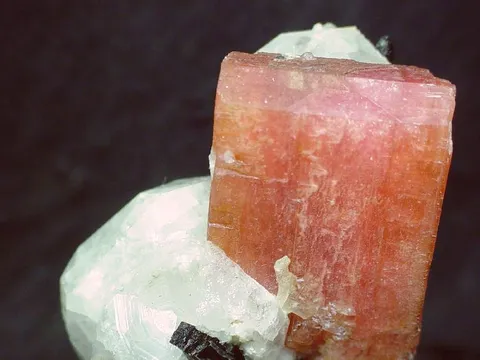
Carrière Poudrette, Canada - Mont Saint-Hilaire's famed quarry yielding world-class serandite, natrolite, and rare eudialyte; a type-locality prized by collect…
Key facts
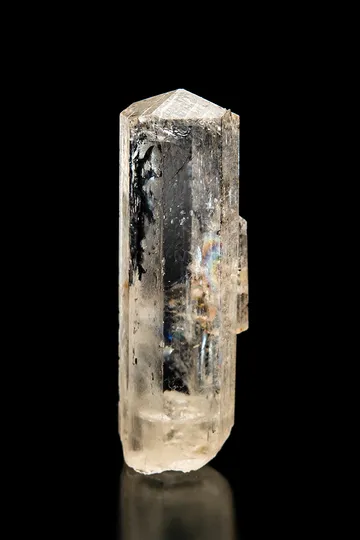
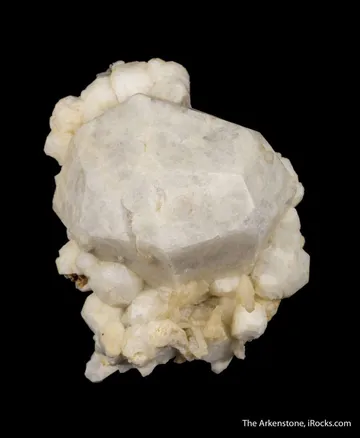
Carrière Poudrette is the collector’s name that still carries the magic of Mont Saint-Hilaire: a working aggregate quarry cut into the East Hill Suite of one of the great alkaline complexes of the world. In specimen language, “Poudrette” means salmon-red serandite on white analcime, black aegirine needles lacing pale feldspar, glassy natrolite prisms, blue-and-white carletonite, yellow leucophanite, pink sodalite varieties, eudialyte-group rarities, REE carbonates, Be minerals, and a long succession of species so unusual that many are still best understood by reference to this one quarry. The locality’s importance is not built on ore, but on late-stage alkaline mineralization: pegmatites, hydrothermal bodies, miarolitic cavities, igneous breccias, hornfels, marble xenoliths, and hyperalkaline sodalite xenoliths, each contributing its own chemical niche.
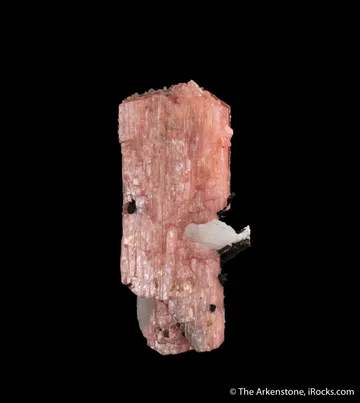
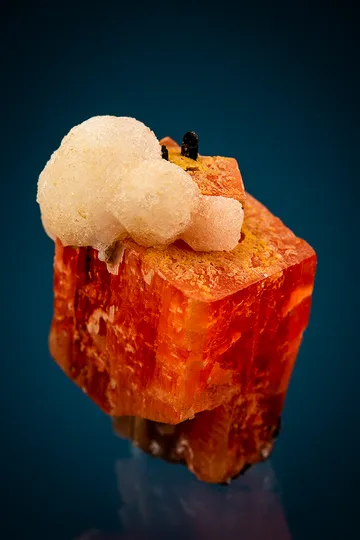
For collectors, the quarry matters on two levels at once. It has produced world-class display specimens—especially serandite, natrolite, analcime, catapleiite, carletonite, rhodochrosite, eudialyte, leucophanite, and aegirine—and it has also been a type-locality engine, repeatedly yielding minerals that demanded new names, new structure work, and new paragenetic thinking. The best specimens have an instantly recognizable Mont Saint-Hilaire look: crisp crystals in high contrast, often against snow-white analcime or feldspar, with black aegirine giving the piece a graphic architecture. Fine serandite, in particular, is more than “pink mineral on matrix”; the great examples are sculptural, lustrous, richly colored from salmon to orange-red, undamaged along cleavage-prone edges, and balanced with the pale, alkaline-cavity minerals that made the quarry famous.
Regional View
Country View
Mont Saint-Hilaire lies in Québec’s Montérégie, roughly 40 kilometers east of Montréal, near the Richelieu River. The hill itself is a small, steep monadnock, but the mineral locality is concentrated in a remarkably compact quarry exposure on the northeastern side of the mountain. Modern geoheritage summaries treat Mont Saint-Hilaire as one of the preeminent single-site mineral localities on Earth, with hundreds of known species and dozens of type-locality minerals. That count has changed as taxonomy and new descriptions have advanced, but the meaning for collectors has remained constant: a small quarry exposed an unusually complete chemical laboratory of alkaline-rock mineralogy.

Photo: Wikimedia Commons
Search for specimens: View all specimens from Carrière Poudrette, Canada
The locality is the Poudrette quarry, also encountered on labels and in literature as De-Mix, Demix, Uni-Mix, Desourdy, Carrière Mont Saint-Hilaire, or simply MSH. Those names reflect the quarry’s operating history rather than separate mineralogical worlds. Older specimens may legitimately carry any of these names, especially if collected before the modern quarry footprint and naming conventions stabilized. In contemporary commercial usage the operation is Carrière Mont-St-Hilaire inc., but collectors and mineralogists still commonly use “Poudrette” because it is the name attached to the classic specimens and the bulk of the scientific literature.
Geologically, the quarry exposes the northern end of the East Hill Suite of the Mont Saint-Hilaire alkaline complex. The larger intrusion belongs to the Monteregian Hills petrographic province, a chain of Cretaceous alkaline intrusions across southern Québec. At Mont Saint-Hilaire, older gabbroic rocks occupy much of the western part of the mountain, while the collector-famous eastern part is dominated by peralkaline nepheline-sodalite syenitic rocks, porphyries, breccias, and related late-stage bodies. The surrounding country rocks are Ordovician calcareous shale, siltstone, and limestone, locally metamorphosed to hornfels near the intrusion.
The quarry is not an ore deposit in the usual mining sense. It is an aggregate quarry exploiting hard syenite and hornfels, and the “mineralization” prized by collectors occurs in pockets, vugs, pegmatites, xenoliths, and alteration zones exposed incidentally by quarrying. Dense gray nepheline syenite is volumetrically important, with feldspar, nepheline, sodalite, and aegirine as major constituents. Coarse, sodalite-rich syenites and igneous breccias add further complexity, while large blocks of hornfels and marble became reaction vessels for unusual assemblages. The chemistry is rich in sodium, manganese, zirconium, titanium, niobium, beryllium, volatiles, carbonate components, halogens, and rare-earth elements—precisely the ingredients that make alkaline complexes so productive in rare species.
The principal specimen environments are unusually varied. Syenitic pegmatites supplied many of the large and attractive specimens, with perthitic microcline, albite, aegirine, nepheline, analcime, kentbrooksite, kupletskite, catapleiite, serandite, rhodochrosite, arfvedsonite, and polylithionite among the characteristic minerals. Larger pegmatites contain crystal-lined pockets in their cores, and some pockets were filled with loose or compact masses of serandite, natrolite, polylithionite, and associated species. Carbonate-rich pegmatites in the eastern part of the quarry carry microcline, albite, siderite, calcite, rutile, zircon, quartz, synchysite-(Ce), pyrite, and sphalerite. Hydrothermal veins and segregations, though less common, produced distinctive assemblages such as coarse natrolite with behoite or sodalite with dawsonite.
Miarolitic cavities in porphyritic nepheline syenite are generally small—commonly only a few centimeters across—but they are important for rare species. Their linings may be analcime, calcite, feldspar, biotite-series mica, natrolite, paranatrolite, or gonnardite, supporting millimeter-scale crystals of aegirine, ilmenite, pyrophanite, zircon, fluorapatite, pyrrhotite, donnayite-(Y), burbankite, sodalite, ewaldite, and rarities such as barylite, wöhlerite, hiortdahlite, bonshtedtite, bradleyite, khomyakovite, and manganokhomyakovite. Some of these cavities even held pressurized fluid that escaped audibly when opened, a reminder that a specimen pocket can be both a crystal cavity and a sealed geochemical capsule.
The sodalite xenoliths are among the quarry’s most distinctive environments. Concentrated near the large hornfels block in the southern part of the quarry and exposed especially during quarrying from the early 1980s into the early 1990s, they range from small angular fragments to bodies two meters across. They are exceptionally alkaline and can be dominated by coarse sodalite, with analcime and microcline as important constituents. Fresh sodalite from these xenoliths can show strong orange fluorescence under ultraviolet light and photochromic fading from violet toward gray or white on exposure to sunlight. These xenoliths yielded a suite of highly unusual sodium-rich minerals, including several type-locality species.
Hornfels and marble xenoliths are equally important, though different in character. Marble xenoliths, commonly white to pale green and locally several meters across, contain cavities lined by calcite and diopside-related assemblages and have produced rare silicates and carbonates. Hornfels fissures and altered blocks yielded calcite, siderite, dolomite, strontianite, quartz, feldspar, rutile, anatase, fluorite, fluorapatite, gmelinite-Na, pyrite, pyrrhotite, sphalerite, molybdenite, chalcopyrite, gypsum, beryllium minerals such as eudidymite, epididymite and beryllonite, and notably large cordylite-(Ce). Breccia cavities, usually lined by albite or microcline and seldom exceeding a decimeter, produced excellent micromount material and rare species such as leucosphenite, lorenzenite, narsarsukite, labuntsovite-Mn, stillwellite-(Ce), joaquinite-(Ce), kainosite-(Y), monteregianite-(Y), and manganokukisvumite.
Commercial quarrying exposed the mineralogical system that earlier surface collecting could never have revealed. Scientific attention accelerated after quarrying opened the intrusion in the 1960s, and by the 1970s and 1980s Mont Saint-Hilaire had become one of the essential names in rare-mineral collecting. The adjacent Demix operation ceased and was sold to the Poudrette family in 1994, after which its ground formed part of the central and western sides of the Poudrette quarry. In late 2007 the Poudrette family was no longer involved, and the quarry’s current operating name became Carrière Mont Saint-Hilaire. The modern operation produces aggregate, not mineral specimens as a primary product; present quarry information describes syenite and hornfels as the principal commercial rocks.
Access today is tightly controlled. The quarry is active industrial property, and general independent collecting should not be assumed. Current quarry information indicates that visits and collecting are organized in association with the Club de Minéralogie de Montréal, with limited annual access for club members under supervision and safety rules. The club’s own excursion information notes special procedures for Mont Saint-Hilaire outings, including a lottery system for ranking places. For collectors, this is why older material, estate specimens, and well-provenanced dealer pieces remain so important: the great open-access era of frequent quarry collecting is gone.
Several finds have entered collector lore. The great serandite finds of 1973, 1981, and 1988 produced the aesthetic crystals that made the species the visual emblem of Mont Saint-Hilaire, with specimens up to about 20 centimeters long. The Poudrette pegmatite, the largest known pegmatite body in the quarry, became a named reference point for rare phosphate-carbonate and beryllium-carbonate species. Sodalite xenoliths exposed between 1982 and 1992 yielded dense suites of hyperalkaline rarities. Later, individual pockets could still surprise: in August 2002, a collector working an altered pegmatite recovered giant smoky quartz, microcline, rhodochrosite, and gemmy green sphalerite crystals unusually large for the locality.
Serandite is the signature display mineral of the Poudrette quarry: salmon-pink to orange-red, rose-red, deep orange, and more rarely pale or darkened, forming prismatic, tabular, blocky, bladed, acicular, radiating, and fibrous habits in alkaline pegmatitic and sodalite-xenolith environments. The important finds of 1973, 1981, and 1988 produced the most coveted specimens, including crystals and groups approaching 20 centimeters; the best examples are lustrous, saturated, sharp-edged, and complete, rather than merely large. Classic associations include white analcime, natrolite, albite, microcline, black aegirine, polylithionite, leucophanite, rhodochrosite, manganoneptunite, behoite, fluorite, calcite, ancylite, astrophyllite, birnessite, and pyrochlore. Good Poudrette serandite is judged by color, luster, isolation and balance on matrix, lack of bruising along perfect cleavage directions, and the contrast that only Mont Saint-Hilaire matrix can provide; ordinary pieces may be massive, dull, partially altered, contact-damaged, or compositionally better described as schizolite without analytical support.
Beyond serandite, Carrière Poudrette is a type-locality powerhouse. Poudretteite, named for the Poudrette family, occurs as very rare colorless to pale pink hexagonal crystals and etched barrel-shaped prisms. Carletonite is one of the great blue-and-white collector rarities of the quarry, while catapleiite, eudialyte-group species, leucophanite, natrolite, analcime, aegirine, rhodochrosite, polylithionite, and sodalite varieties define much of the locality’s aesthetic range. Type-locality and near-signature rarities documented from Mont Saint-Hilaire and its Poudrette workings include abenakiite-(Ce), gaultite, griceite, rouvilleite, silinaite, nalipoite, martinite, khomyakovite, manganokhomyakovite, hilairite, gaidonnayite, lemoynite, niveolanite, peatite-(Y), ramikite-(Y), horváthite-(Y), lukechangite-(Ce), thomasclarkite-(Y), johnsenite-(Ce), reederite-(Y), monteregianite-(Y), and manganokukisvumite. Many of these are micromount or analytical minerals rather than cabinet-display species, but that is exactly the quarry’s genius: it satisfies both the aesthetic collector and the species specialist.
The main authenticity issue with Carrière Poudrette specimens is not a well-documented treatment industry, but accurate identification, locality precision, and condition disclosure. Labels reading Poudrette, Demix, De-Mix, Uni-Mix, Desourdy, Rouville County, Mont St-Hilaire, MSH, or Carrière Mont Saint-Hilaire can all be historically plausible, but the label should make sense for the age of the specimen and the minerals present. A strong old label is valuable here because much of the best material entered collections before the 2007 ownership change and before modern access restrictions.
Serandite needs particular care. It belongs to the pectolite-schizolite-serandite series, and salmon-pink Mont Saint-Hilaire material historically sold as serandite may in some cases be closer to schizolite unless analyzed. Conversely, some specimens that look visually plain may be important because they represent real serandite, a serandite-bearing association, or a legitimate pseudomorph after serandite. Pseudomorphs and replacements are part of the locality’s story, but they should be described honestly: birnessite or other manganese alteration products after serandite are not the same market category as fresh, lustrous serandite crystals.
Condition is central to valuation. Serandite has perfect cleavage and is brittle, so broken terminations, cleaved faces, bruised edges, and repaired crystals are common enough that a fine undamaged piece commands a meaningful premium. Analcime can be chipped at corners, aegirine needles are easily broken, natrolite sprays can be flattened or incomplete, and micromount rarities may be present only as tiny crystals on a busy matrix. Older Poudrette pieces were often trimmed from blast rubble; minor peripheral contacts are normal, but major central repairs or concealed breaks should be disclosed.
Fluorescence and light sensitivity deserve attention. Sodalite from sodalite xenoliths can fluoresce strong orange under ultraviolet light, and photochromic sodalite varieties may fade in color with exposure to sunlight. Store vivid violet or pink sodalite-rich pieces away from prolonged direct light, and avoid washing delicate sodium-rich or potentially water-sensitive assemblages unless the species are known and stable. Some rare minerals from the quarry are best treated as analytical specimens: keep them dry, avoid acids, avoid ultrasonic cleaning, and preserve labels and collection history with the specimen.
Market availability is bifurcated. Small analcime, aegirine, natrolite, sodalite, microcline, and mixed MSH pieces still circulate, but top serandite, fine carletonite, important type-locality rarities, and old-pocket specimens with meaningful provenance are increasingly estate-driven. The Canadian Museum of Nature’s acquisition of the Gilles Haineault Mont Saint-Hilaire Collection—more than 8,000 pieces, with over 1,000 top specimens recognized as Canadian cultural property—underscores what collectors have long known: the best material from this quarry is no longer simply “available if you wait for the next trip.”
One of the most evocative modern collecting stories from Poudrette began unpromisingly on a sunny Sunday in August 2002. Daniel Comtois went to the quarry with his father, Roland, during a season he considered poor for good finds. The recent hornfels-bearing work had produced little more than millimeter smoky quartz and altered dolomite, and a blast in syenite had exposed only solid rock. Comtois parked by an old wall of altered pegmatite, met J. Pierre Beckerich and his son, and heard the practical verdict every field collector knows: there was probably nothing worth finding.
He decided to dig anyway. The pegmatite was dark brown and crumbly—he called it “rotten”—and at first it yielded only open, decayed cavities with tiny pyrite cubes. Then the wall began to give up signs of life: donnayite crystals one to two millimeters across, rutile around a millimeter, minor microcline, and small pink rhodochrosite. From the bottom of the pegmatite he finally removed a specimen with a pink rhodochrosite crystal about 3 x 2.8 centimeters, partly coated with micro-siderite, perched on a 2.5-centimeter pseudomorph “stick” sprinkled with millimeter donnayite. It was enough to turn a day of exercise into a hunt.
The serious pocket was hidden behind boulders. Comtois saw that the wall above looked unstable and spent about two hours securing the upper edge before using a long metal pole to move the blocks. Behind them was an opening nearly one meter wide but only about 7 to 15 centimeters high, oriented upward like a mouth. He and his father began emptying it by hand, pulling out broken microcline and reaching through sharp crystals that cut at their fingers. Gloves would have protected them, but gloves would also have taken away the tactile sense needed to feel crystals in the cavity.
Then the pocket delivered the kind of moment collectors relive for decades. Comtois struck his own hand with the sledgehammer, his father laughed, took over, and soon called him back. Between broken pieces was a double-terminated smoky quartz crystal about 19 centimeters long and 9 centimeters wide. “What a monster!” was the immediate reaction. Comtois ran for the camera before removing it, wanting proof before the piece left the pocket. He also remembered a very Mont Saint-Hilaire concern: smoky quartz warmed too suddenly in hot sun can fracture violently, so the crystal was wrapped in newspaper and stored under the truck seat.
The pocket was not finished. More quartz came out—single crystals, complex twins, skeletal forms, and pieces he likened to cathedrals with windows. Some carried rutile, microcline, calcite, and donnayite. At what seemed to be the bottom, an even larger quartz-and-microcline specimen began to move. It was too heavy and awkward to pull directly, so father and son used two wooden sticks as rails, sliding the piece out like a stubborn load on improvised tracks. The specimen measured about 24 centimeters across the base, with three quartz clusters arranged around a central mass of microcline.
Finally came the sphalerite. Microcline plates up to about 13 x 13 centimeters emerged from the pocket, and among them Comtois noticed a dark, heavy object. In sunlight it proved to be a clear, gem-quality green sphalerite crystal, damage-free despite the broken matrix around it. Several sphalerites came from the cavity, including a tetrahedral crystal about 9 x 9 x 8 centimeters. The day that began with “nothing to be found” ended with giant quartz, microcline, rhodochrosite, and sphalerite riding home under and above the truck seats.
The larger collecting story at Poudrette is also a story of access. For decades, the Poudrette family and Demix allowed serious collectors into an active industrial quarry, a privilege that helped build both private collections and museum science. László Horváth, one of the central figures in the locality’s mineralogical history, later wrote from the perspective of someone who had collected there since 1971: many collectors came only once or twice a year, but some regulars could collect nearly every weekend in the old days. He emphasized how fortunate the community had been that thousands of visiting collectors from around the world passed through without a fatal or permanently quarry-closing accident. That history explains the tone collectors use for Poudrette today: gratitude, longing, and a keen awareness that access to an active quarry was always a fragile gift.
Horváth, L., Gault, R. A., Pfenninger-Horváth, E., and Poirier, G. 2019. Mont Saint-Hilaire: History, Geology, Mineralogy. The Canadian Mineralogist, Special Publication 14. Mineralogical Association of Canada. The definitive modern monograph on the history, geology, paragenesis, and mineral species of Mont Saint-Hilaire.
Normand, C., and Tarassoff, P. 2006. Mineralogy and Geology of the Poudrette Quarry, Mont Saint-Hilaire, Québec. Geological Association of Canada–Mineralogical Association of Canada Joint Annual Meeting, Field Trip 4A Guidebook. A compact but highly useful field-trip synthesis of quarry geology, mineral environments, and references.
Horváth, L., and Gault, R. A. 1990. “The Mineralogy of Mont Saint-Hilaire, Quebec.” The Mineralogical Record, 21(4), 281–359. The classic collector-mineralogical treatment, issued in a landmark Mont Saint-Hilaire special issue.
Van Velthuizen, J. 1990. “A Hornfels Unit in the Poudrette Quarry.” The Mineralogical Record, 21(4), 361–362, 368. A focused note on one of the quarry’s important mineral-forming environments.
Chao, G. Y., Van Velthuizen, J., and Conlon, R. P. 1990. “Mont Saint-Hilaire Unknowns.” The Mineralogical Record, 21(4), 363–368. A historically important snapshot of the quarry’s still-unresolved and potentially new mineral material.
Chao, G. Y. 1971. “Carletonite, KNa4Ca4Si8O18(CO3)4(F,OH)·H2O, a new mineral from Mount St. Hilaire, Quebec.” American Mineralogist, 56, 1855–1866. The original description of carletonite, one of the most famous Mont Saint-Hilaire collector species.
Grice, J. D., Rowe, R., Poirier, G., and Pratt, A. 1987. “Poudretteite, KNa2B3Si12O30, a new member of the osumilite group from Mont Saint-Hilaire, Quebec, and its crystal structure.” The Canadian Mineralogist, 25, 763–766. The type description of poudretteite, named for the quarry-operating Poudrette family.
McDonald, A. M., Back, M. E., Gault, R. A., and Horváth, L. 2013. “Peatite-(Y) and Ramikite-(Y), two new Na-Li-Y±Zr phosphate-carbonate minerals from the Poudrette pegmatite, Mont Saint-Hilaire, Quebec.” The Canadian Mineralogist, 51(4), 569–596. A modern example of the Poudrette pegmatite continuing to yield new mineral species.
Cooper, M. A., Hawthorne, F. C., Ball, N. A., and others. 2008. “Niveolanite, the first natural beryllium carbonate, a new mineral species from Mont Saint-Hilaire, Quebec, Canada.” The Canadian Mineralogist, 46, 1343–1354. Description of niveolanite from the Poudrette pegmatite.
Wight, Q. 2019. “The Where of Mineral Names: Poudretteite, Poudrette Quarry, Mont Saint-Hilaire, La Vallée-du-Richelieu Regional County Municipality, Montérégie, Québec, Canada.” Rocks & Minerals, 94(4), 376–379. A locality-name and mineral-name article centered on poudretteite and the quarry.
Canadian Museum of Nature. “Mont Saint-Hilaire at CMN: At the Heart of Canada’s Mineral Collection.” Museum account of the Gilles Haineault Mont Saint-Hilaire Collection and its national significance.
“Mont Saint-Hilaire—A Canadian Mineral Hotspot” — Canadian Museum of Nature Museum video on the quarry’s history, geology, and major specimens, including serandite, catapleiite, and remondite.
“Mineral Diversity at Mont Saint-Hilaire” — Canadian Museum of Nature Paula Piilonen discusses why Mont Saint-Hilaire is one of Canada’s most mineralogically diverse localities.
“Donnayite-(Y) with Calcite from Poudrette Quarry, Mont Saint-Hilaire, Canada” — Fabre Minerals Short specimen video showing a high-quality type-locality donnayite-(Y) example from Poudrette.
Mindat — Poudrette quarry locality page The most comprehensive online locality record, including the modern name, synonym history, access notes, species list, and references.
Mindat — Serandite from Poudrette quarry Useful for habits, colors, photo-based associations, and the species’ world-class status at the quarry.
IUGS Geoheritage — Mineral site of Mont Saint-Hilaire Concise geoheritage overview with setting, species counts, type-locality significance, and geological references.
Mont Saint-Hilaire mineral descriptions Long-running locality mineral resource with species descriptions, photos, and type-locality notes.
Sérandite — Mont Saint-Hilaire mineral description Locality-specific serandite summary noting the major 1973, 1981, and 1988 finds.
Poudretteite — Mont Saint-Hilaire mineral description Locality page for the quarry’s namesake mineral, with habit, rarity, associations, and references.
Carrière Mont-St-Hilaire inc. — official quarry site Current operator information for the active aggregate quarry.
Club de Minéralogie de Montréal — mineral excursions Current club information for field trips, including Mont Saint-Hilaire excursion procedures.
Canadian Rockhound — “Outstanding Giant Quartz and Sphalerite from Mont Saint-Hilaire, Québec” A vivid collecting account of the August 2002 quartz, microcline, rhodochrosite, and sphalerite pocket.
Mineralogical Record — Mont Saint-Hilaire special issue, July–August 1990 Ordering page for the classic issue containing the landmark Mont Saint-Hilaire mineralogy articles.
Mineralogical Association of Canada — Mont Saint-Hilaire: History, Geology, Mineralogy Publisher page for the definitive 2019 monograph.