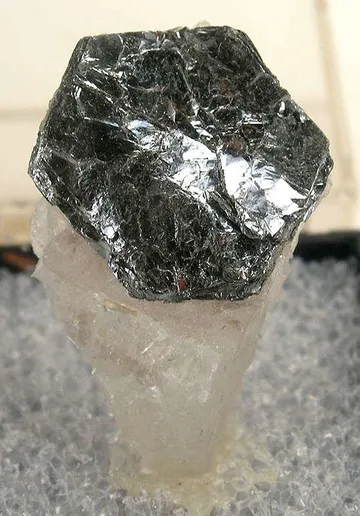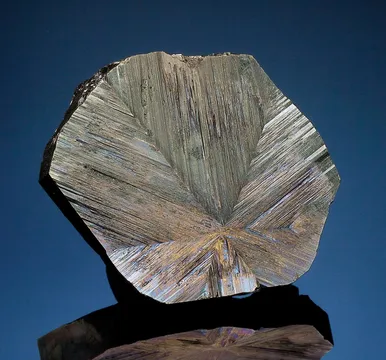
Chibougamau, Canada - cubanite locality famed for Henderson No. 2, with brassy, razor-edged crystals on calcite; prized for display quality and rarity.
Key facts
Chibougamau is one of the great Canadian names for crystallized sulphides. To the mining geologist it is a long-lived copper-gold camp on the northeast side of the Abitibi Greenstone Belt, where Archean volcanic rocks, the layered Lac Doré Complex, and the Chibougamau tonalitic to trondhjemitic pluton are cut by mineralized shear corridors, veins, and porphyry-style systems. To the collector, however, “Chibougamau” usually means one thing first: the Henderson No. 2 mine cubanites—brassy, metallic, razor-edged, striated twins and pseudohexagonal trillings, often perched in white calcite or scattered over dark sulphide matrix.
The best Chibougamau specimens have a look that is instantly recognizable. The cubanite is not merely a massive ore mineral here; it occurs as discrete crystals, commonly cyclically twinned, with broad reflective faces crossed by tight striations. On the finest pieces, the sulphide crystals sit proud of the matrix, their bronze-yellow lustre set against milky to translucent calcite and darker pyrite-rich rock. A good thumbnail may show one complete “maple leaf” or V-twin; a good miniature may carry several crystals; a great matrix piece is the kind of Canadian classic that can anchor an entire sulphide suite.
Regional View
Country View
The fame of Chibougamau cubanite rests especially on Henderson No. 2, a copper-gold mine in altered anorthosite where late calcite-lined shears and open fractures allowed cubanite to crystallize in free space. That geological accident is the essential collector’s fact: many copper deposits contain cubanite, but very few give it room to form sharp, lustrous crystals of display quality. Henderson No. 2 did, and the results entered the specimen market in the 1970s and 1980s as some of the world’s finest crystallized examples of the species.

Photo: Wikimedia Commons
Search for specimens: View all specimens from Chibougamau, Canada
The Chibougamau mining camp lies in the northeastern Abitibi Greenstone Belt of the Superior Province. Its bedrock framework is Archean: volcanic and sedimentary rocks of the Roy Group, mafic intrusive rocks of the Cummings Group, the stratiform layered Lac Doré Complex, and the central Chibougamau pluton. The Lac Doré Complex is especially important for the historic copper-gold mines; it is dominated by meta-anorthosite, with lesser metagabbro, anorthositic gabbro, pyroxenite, peridotitic units, and magnetite-rich Fe-Ti-V horizons. Regional metamorphism is generally greenschist facies, but the mining camp is structurally complex, with folding, faulting, and long-lived shear corridors controlling much of the ore.
The district is not a single deposit but a camp-scale cluster of mineralization styles. Chibougamau includes shear- and fracture-controlled Cu-Au sulphide veins, lode-gold veins, porphyry Cu-Au and Cu-Mo systems, volcanogenic massive sulphide mineralization, Fe-Ti-V magnetite-rich layers, and subordinate Ni-Cu-PGE showings associated with mafic-ultramafic rocks. The classic Henderson-Portage trend belongs to the Cu-Au sulphide vein family. In these better-grade tectonic corridors, ore lenses commonly contain pyrite and chalcopyrite with pyrrhotite, traces of sphalerite and galena, and a chlorite-rich gangue with quartz and carbonate. In specimen terms, that means a collector should expect sulphide-rich, dense pieces rather than open alpine-style vugs: the pockets that mattered were narrow late shears and fractures within a working copper-gold mine.
Mining at Chibougamau developed after the early twentieth-century discoveries of copper and gold, but the camp became a sustained producer only after roads and rail access reached the region in the early 1950s. The town of Chibougamau was established in 1952, and from the mid-1950s onward a string of mines operated around Lac Doré and Lac Chibougamau. Company names changed repeatedly: Campbell Chibougamau Mines became part of the Copper Rand–Patino–Northgate–Westminer–MSV–Resources Campbell succession, with later exploration and redevelopment interests held by groups including Globex, Chibougamau Independent Mines, C-Bay, Doré Copper, and others. From 1955 to 2008 the Chibougamau camp produced roughly 55 million tonnes of ore containing close to 995,000 tonnes of copper, 120 tonnes of gold, 102 tonnes of silver, and 72,000 tonnes of zinc.
Henderson No. 2 is the collector’s focal point within that broader mining story. The mine exploited copper-gold mineralization in anorthosite. The cubanite-producing environment consisted of late-stage calcite-lined shears and related open fractures in altered anorthosite, with faults parallel to and cutting the main ore zone. The mineral suite recorded from those open shears includes cubanite, calcite, pyrite, sphalerite, and siderite, with pyrrhotite and quartz also observed on specimens. That is why the better Henderson pieces often combine white calcite, dark sulphide matrix, and sharp brassy cubanite rather than the more massive, intergrown cubanite one expects in ordinary copper sulphide ore.
The earliest Henderson No. 2 cubanite specimens were reportedly discovered during Campbell Chibougamau mining operations in 1974 and were at first mistaken for pyrite. Examination at Laval University identified them as twinned cubanite, transforming what might have been treated as curious ore into a world-class specimen occurrence. André Lévesque’s 1983 Mineralogical Record article brought the occurrence to the serious collecting public; later accounts note that although the mine was reported closed in 1982, it reopened in 1984 and closed again in 1989, with additional specimens recovered during that later operating interval.
Collecting access today should be understood as effectively closed for normal field collectors. Henderson No. 2 is an old underground mine, and the notable specimen-producing zones were underground working areas, not an accessible public collecting site. The Lac Chibougamau properties remain part of an active exploration and redevelopment landscape, with claims, lake access, old workings, private or corporate tenure, and permitting considerations. Chibougamau specimens now reach collectors almost entirely through old collections, dealer inventories, and occasional deaccessions rather than fresh field collecting.
Chibougamau cubanite is the locality’s signature mineral and one of the benchmark occurrences for the species worldwide. The classic material comes from Henderson No. 2, where cubanite crystallized in calcite-lined shears and open fractures within altered anorthosite; habits include fine needles, orthorhombic prisms, V-twins, and especially flat cyclic trillings or pseudohexagonal “sixlings,” most commonly in the 1–2 cm range and reported to about 3 cm, with later specimen literature noting exceptional crystals up to roughly 4 cm. The colour is brassy yellow to bronze with a highly reflective metallic lustre, and the best crystals show crisp edges, complete outlines, strong parallel or radiating striations, and contrast against white calcite or dark pyrite-rich matrix. Ordinary pieces are partial, contacted, embedded, or chipped; the desirable ones are complete, lustrous, sharply twinned, and display the distinctive star-like geometry without needing explanation.
Calcite at Chibougamau is important less as a standalone display mineral than as the stage on which the great cubanites perform. At Henderson No. 2 it lines the late shears that carried euhedral cubanite, forming white to translucent, glassy rhombs, lenticular crystals, and massive to drusy carbonate patches on sulphide matrix; Mindat photo associations strongly tie the calcite to cubanite, with pyrite appearing as a lesser companion. The best calcite-bearing pieces preserve the natural pocket relationship: sharp brassy cubanite sitting on or partly nestled in white calcite, rather than a loose sulphide crystal detached from its geological context. Some Chibougamau calcite matrices have been reported fluorescent, especially under shortwave ultraviolet, but the collector value remains overwhelmingly tied to freshness, contrast, lack of bruising, and undisturbed association with cubanite.
Beyond cubanite and calcite, Chibougamau is a broad ore-mineral district. Documented species include chalcopyrite, pyrite, pyrrhotite, sphalerite, galena, bornite, chalcocite, acanthite, arsenopyrite, molybdenite, magnetite, native copper, native gold, native bismuth, quartz, siderite, ankerite, albite, actinolite, chlorite-group minerals, chamosite, muscovite, sericite, fuchsite, epidote-group minerals, apatite, and titaniferous silicates in the wider camp. These species reflect the camp’s range of Cu-Au veins, porphyry-style mineralization, VMS systems such as Lemoine, and Fe-Ti-V layers in the Lac Doré Complex. For cabinet collectors, however, most of these are geological context rather than marketplace staples; the mineralogical trophy from Chibougamau remains crystallized cubanite.
Chibougamau cubanite should be bought as a locality-specific classic, not as a generic sulphide. The label should ideally specify Henderson No. 2 mine, Chibougamau, Québec, Canada; broader “Chibougamau” labels are common, but Henderson No. 2 is the essential provenance for the famous twinned crystals. Old labels from Canadian dealers, Don Doell, Lévesque-era material, Tucson acquisitions from the 1980s, or established collections add real value.
The main authenticity issue is misidentification, not a well-documented epidemic of fakes. Cubanite can be confused with chalcopyrite, pyrite, pyrrhotite, or millerite depending on habit and lighting. The Henderson habit helps: flat, striated, brassy V-twins and cyclic trillings on calcite or sulphide matrix are highly characteristic. Cubanite is magnetic, and a loose crystal may respond to a magnet, but that test is treacherous on matrix because pyrrhotite and magnetite can also be present in sulphide ores. Serious purchases of unusual habits, off-locality material, or expensive loose crystals merit analytical confirmation or impeccable provenance.
Condition matters enormously. Cubanite is not a hard, forgiving mineral, and Chibougamau crystals often show small edge nicks, contact points, or bruising. A little peripheral wear is common, especially on older specimens and loose thumbnails, but damage across the display face sharply reduces desirability. Look for intact terminations, clean twinning outlines, bright lustre, and uninterrupted striation patterns. A repaired or reattached crystal would be a serious disclosure issue; a carefully mounted loose thumbnail on acrylic is normal in the market and not itself a problem.
Be cautious with overly clean loose crystals that have lost all context. Some specimens occur naturally as individual crystals or detached crystals, but a cubanite sitting on original calcite or sulphide matrix carries more geological and aesthetic information. Calcite association is also useful when evaluating possible acid work: natural lenticular or rhombohedral calcite preserved around the cubanite argues for an undisturbed pocket surface, whereas stripped crystals may have less locality character even if the cubanite itself is genuine.
Fluorescence is a minor bonus, not a primary buying criterion. Some Henderson calcite matrices have been reported fluorescent, particularly under shortwave UV, but the cubanite is opaque and metallic. Handle specimens as delicate sulphides: avoid unnecessary washing, acids, ultrasonic cleaning, high humidity, and repeated handling of exposed crystal edges. Store in a stable, dry cabinet, and keep labels with the specimen.
Availability is limited. Henderson No. 2 is closed and inaccessible to ordinary collectors, so the market is fed by old collections and occasional dealer stock. Small loose twinned crystals appear from time to time; attractive thumbnails are scarcer; matrix miniatures with sharp cubanite on calcite are genuinely desirable; rich cabinet-sized matrix specimens are rare and expensive. Because most major Canadian and institutional sulphide suites want a Chibougamau cubanite, good pieces are absorbed quickly when priced sensibly.
The most famous Chibougamau collecting story begins as a mistake. In 1974, during mining operations at Henderson No. 2, brassy metallic crystals came out of the underground workings and were reportedly thought at first to be pyrite. That was a reasonable first glance in a copper-gold mine: bright sulphides in a sulphide orebody do not automatically announce themselves as a collector’s prize. But the crystals were odd—twinned, striated, geometrically distinctive—and examination at the Geological Museum of Laval University showed that they were cubanite. A mine specimen that might have disappeared into ore became, instead, one of the defining Canadian mineral discoveries of the late twentieth century.
The setting was not romantic in the usual field-collecting sense. These were not crystals weathering from an alpine cleft into a talus slope; they were hidden inside an operating underground mine. The ore occurred in shear zones and subsidiary fractures in altered anorthosite, with numerous faults parallel to and cutting the main ore zone. In a few of those shears, calcite lined open spaces and cubanite had room to grow as euhedral twins. That slight openness in an otherwise sulphide-rich copper-gold environment made all the difference. Massive cubanite is easily overlooked; sharp cubanite crystals are a different matter entirely.
By the time Lévesque’s 1983 article appeared, Henderson No. 2 had already acquired a reputation among serious collectors. The mine was reported closed in 1982, but the story did not end there: it reopened in 1984 and closed again in 1989, and additional specimens were recovered during that later period. That second window helps explain why Chibougamau cubanites are rare but not mythical. Enough material escaped the mine to seed Canadian collections, dealer stocks, and later auctions, yet not enough to make rich matrix pieces routine.
Individual specimens carry their own fragments of mine history. One documented piece was recovered from the 1600 Level of Henderson No. 2 around 1980: a brassy, striated, terminated cubanite crystal about 1 cm across on calcite matrix. That level notation is the sort of detail collectors should cherish. It places the specimen back underground, in the working geometry of a mine rather than the abstractions of a regional label. Another recorded Chibougamau piece shows a 2 cm “maple leaf” cubanite on a 4 x 6 cm matrix, an apt nickname for a Canadian classic whose twinned geometry seems almost emblematic once you have seen it.
There is also a market trail. One thumbnail, 1.7 x 1.0 x 0.5 cm, was acquired from Don Doell of Toronto at the Tucson Show in 1988 and later recorded as ex Kay Robertson Collection. The note attached to that specimen matters because Don Doell handled many Henderson cubanites and was described as a direct source from the miner. In a locality where the mine itself is closed and the best pieces are decades old, such provenance is not decorative; it is part of the specimen.