A collector's guide to Xianghualing Mine, China: its geology, mining history and notable minerals, illustrated with the 220 specimens documented from this locality on EarthWonders.
Key facts
Xianghualing is one of the great modern names in Chinese specimen mineralogy because it is both a serious ore deposit and a prolific cabinet-specimen locality. The mine lies in the Xianghualing Sn-polymetallic ore field of Linwu County, Chenzhou, Hunan, in the Nanling metallogenic belt of South China. To an economic geologist it is a skarn-type Sn-Pb-Zn system related to Late Jurassic granitic intrusions; to collectors it is the source of transparent sea-green to apple-green fluorite, fluorite-calcite combinations, pale to saturated green botryoidal gibbsite, large lustrous calcite, quartz pseudomorphs after calcite, and a remarkable suite of Li-Be-Sn-B-F minerals that includes type-locality species. The best fluorites have a lucid, watery transparency, strong luster, crisp cubic to octahedral or cuboctahedral form, and internal phantoms that can make a single crystal look like a mineralogical cutaway drawing.
Regional View
Country View
The collector character of Xianghualing is inseparable from its geology. Highly evolved granites such as the Laiziling and Jianfengling bodies invaded Devonian carbonate rocks and older clastic sequences, driving skarn formation and later hydrothermal mineralization rich in fluorine, boron, lithium, beryllium, tin, tungsten, lead, zinc, and indium. That unusual chemistry explains why the mine can produce ordinary-looking green fluorite one moment and, in the next mineralogical register, species such as hsianghualite, liberite, balipholite, zinconigerite-2N1S, and mengxianminite.

Photo: Wikimedia Commons

Photo: Wikimedia Commons
Specimens from Xianghualing cover a wide range of quality. At the common end are pale green fluorite plates, cleaved or bruised crystals, and inexpensive fluorite-calcite miniatures. At the top end are glassy cubes with beveling and phantoms, old blue octahedral fluorites from the famous “Blue Pocket,” green fluorite octahedrons perched on an earlier fluorite generation, calcites with fluorescent flattened rhombohedral or scalenohedral habit, and the much more unusual gibbsite pieces whose waxy green botryoids look almost like prehnite until their softness and botryoidal crust habit give them away.
Search for specimens: View all specimens from Xianghualing Mine, China
Xianghualing Mine is in the Xianghualing Sn-polymetallic ore field, Linwu County, Chenzhou Prefecture-level City, Hunan Province, China, at roughly 25°27′30″N, 112°34′01″E. The main mine entrance has also been reported slightly north of the principal locality coordinate. The district lies about 25 km north of Linwu and roughly 70 km southwest of Chenzhou. In the mineral trade the names Xianghualing, Hsianghualing, Xianghuapu, Maiwan, Chashan, and related district names are often encountered, and older labels may use a broader “Xianghualing mining district” attribution rather than a single shaft or working.
The deposit is a skarn-type Sn-Pb-Zn system. Published locality summaries give an estimated 134,000 tonnes of contained tin metal and 178,000 tonnes of contained lead-zinc metal for the Xianghualing skarn-type deposit. The exploited commodities include tin, lead, zinc, and tantalum, while geological studies describe a far broader Sn-W-Pb-Zn-Be-Li-Nb-Ta-F-B mineralizing system.
The regional host stratigraphy includes dominant Middle to Upper Devonian limestone and dolomite, with Carboniferous carbonate and clastic rocks, Permian quartz sandstone and shale, Jurassic-Cretaceous sandstone and shale, and Quaternary sediments. The ore field is cut by several fault sets, with NE-trending structures particularly important as fluid conduits and ore-hosting structures. The intrusive rocks include the Laiziling and Jianfengling granites and smaller granitic bodies. The Laiziling pluton is a medium- to coarse-grained two-mica granite; Jianfengling is a coarse-grained biotite granite. These small, highly fractionated A-type granites are crucial to the story: despite modest surface areas, they are genetically tied to large-scale Sn-W polymetallic mineralization.
At Xianghualing, the main skarn is developed in the exocontact zone between the Laiziling granitic pluton and Middle-Upper Devonian carbonate rocks of the Qiziqiao Formation. Published descriptions of the Laiziling vertical zonation move upward from protolithionite granite through leucogranite, albite granite, greisen, massive quartz, and a pegmatoid stockscheider zone. This is precisely the kind of evolved, volatile-rich granitic environment in which Li, Be, Sn, W, Rb, Nb, Ta, F, and B become concentrated enough to produce both ore and exotic mineral species.
The mineralization is commonly described in stages. Early prograde and retrograde skarn stages were followed by a cassiterite-magnetite-arsenopyrite-topaz-quartz stage and then by a later sphalerite-galena-pyrite-chalcopyrite-quartz-calcite stage. The retrograde stage marks the beginning of tin deposition, but the principal tin event is the cassiterite-rich stage. From a collector’s perspective, the later hydrothermal stages are particularly important because they gave rise to many of the open-space fluorite, calcite, and quartz specimens that entered the international market.
The mining history is long. Silver was reportedly mined and smelted in the Xianghualing area about 400 years ago, while documented geological reconnaissance began in 1915. A more detailed pre-1949 investigation of tin and arsenic mineralization followed in 1945. After 1949 a nationalized Xianghualing Mine was established, and major state-led prospecting and exploration work followed through the 1950s to 1970s. A 1962 Hunan Geological Survey regional map and associated reports laid much of the groundwork for later study, and subsequent work identified W, Sn, Pb, Zn, Nb, Ta, Be, and rare-earth-element mineralized localities in the ore field.
Modern industrial activity is represented by Xianghualing Tin Industry Co., Ltd., established in August 2002 and formerly known as the state-owned Xianghualing Tin Mine. Public company descriptions place it in Xianghua Town, Linwu County, operating over a 20.89 km2 mining area, with tin, lead, and zinc concentrates as core products. Reported annual capacities are 1,100 tonnes of tin concentrate and 600 tonnes of lead and zinc concentrates.
Collecting access today should be regarded as industrial, restricted, and indirect. Xianghualing is not a casual fee-collecting locality; specimens reach collectors through mine production, local buyers, Chinese dealers, international mineral shows, and dealer networks. Fresh material continues to appear intermittently, but individual pockets can be one-time events. The best early fluorite finds of the late 1990s and early 2000s are already old classics; later green cuboctahedral and gibbsite pieces have had their own periods of availability. Fine specimens are therefore best evaluated not simply as “from Xianghualing,” but by pocket style, generation, condition, and label precision.
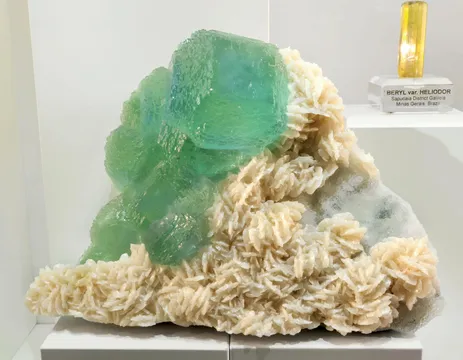
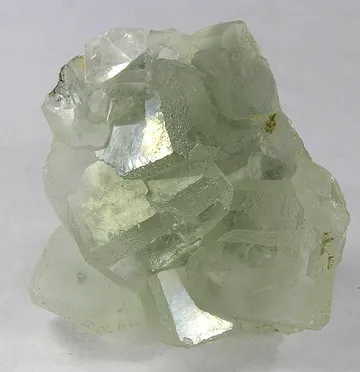
Fluorite is the collector flagship of Xianghualing, and the mine has produced several recognizable styles: glassy pale green to intense apple-green cubes, beveled cubes, cuboctahedrons, octahedrons, and green octahedrons perched on an earlier purple-gray fluorite generation. Many good crystals fall in the 2-5 cm range, while cabinet specimens can reach 20-30 cm overall and exceptional individual crystals are substantially larger. Associated minerals include calcite, quartz, pyrite, arsenopyrite, sphalerite, and locally cassiterite or other skarn minerals. The best pieces are not merely green; they are transparent, lustrous, damage-free on display faces, and show either strong internal phantoms, sculptural three-dimensional placement, or a balanced contrast with white calcite or snow-white quartz. Ordinary pieces tend to be pale, cleaved, crowded, or dull, whereas top Xianghualing fluorite has the clean “wet glass” look that made the locality famous.
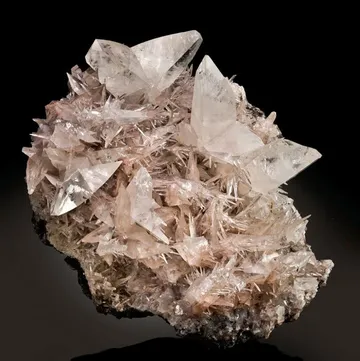
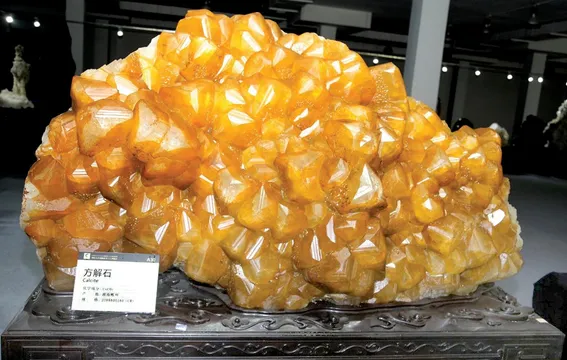
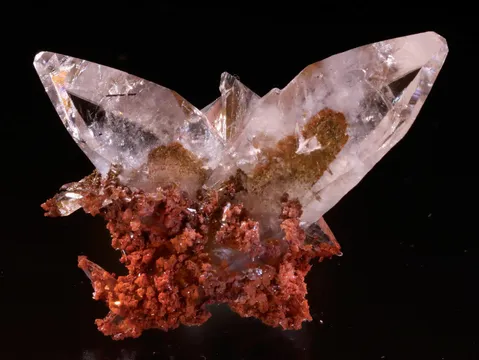
Calcite from Xianghualing is most familiar as the bright white to colorless contrast mineral on green fluorite, but the locality also produced stand-alone calcites and striking calcite-dominant combinations. Habits include flattened lenticular or “poker-chip” rhombohedral crystals, compressed scalenohedra, interpenetrant flattened rhombohedral groups, pagoda-like aggregates, and larger white to creamy scalenohedral specimens; documented examples range from thumbnail accents to cabinet pieces, with a recent photographed calcite specimen measuring 350 x 150 x 200 mm. Calcite may sit as delicate white plates over fluorite, form sharp compressed crystals on gemmy cuboctahedral fluorite, or appear in pseudomorph relationships where fluorite or quartz preserves earlier calcite forms. The most desirable examples have sharp edges, bright luster, translucency, attractive crystal stacking, and little bruising along thin rims; long-wave pink to red fluorescence has been reported on some Xianghualing calcites and can be an attractive bonus rather than the main criterion.
Xianghualing gibbsite is one of the more surprising modern Chinese specimen styles: green to gray-green, translucent, lustrous, botryoidal crusts and rounded aggregates lining vugs, coating thin matrix crusts, or sitting on delicate boxwork septa. Reported botryoids commonly measure about 0.3-0.7 cm across, with better vugs showing aggregates to about 1.0-1.5 cm; cabinet specimens are usually appreciated for coverage, color, translucency, and undamaged botryoidal surfaces rather than for large individual crystals. Some pieces show white gibbsite over green gibbsite, and gibbsite with the rare aluminum hydroxide polymorph doyleite is documented. The finest pieces have a waxy to vitreous luster, fresh apple-green color, three-dimensional vug presentation, and minimal rubbing on the rounded surfaces; dull, chalky, thin, or limonite-stained crusts are much less desirable.
Quartz at Xianghualing is most collectible when it participates in the fluorite-calcite story rather than as isolated quartz crystals. It commonly occurs as snow-white drusy quartz on green fluorite, as sparkly quartz matrix, and in recent pseudomorphs after calcite scalenohedra, where broken examples reveal hollow quartz shells preserving the shape of former calcite crystals. Noteworthy specimens show white quartz after calcite richly encrusting translucent sea-green fluorite, or tiny frosted quartz spikes selectively coating fluorite octahedrons while leaving other faces exposed. The best examples have a strong textural contrast between sugary quartz and glassy fluorite, clear pseudomorph form, balanced composition, and intact hollow points; ordinary quartz-bearing pieces are less compelling when the quartz is simply a dull crust that masks the fluorite.
Beyond the four collector staples, Xianghualing is a genuinely important mineralogical locality. Type-locality minerals recorded for the mine include balipholite, hsianghualite Ca3Li2Be3(SiO4)3F2, liberite Li2Be(SiO4), and zinconigerite-2N1S; the broader Xianghualing skarn and ore field have also yielded ferrotaaffeite-2N’2S, mengxianminite, zinconigerite-6N6S, and chukochenite. The mine’s documented species list includes cassiterite, scheelite, wolframite-group minerals, topaz, fluorite var. chlorophane, arsenopyrite, galena, sphalerite, chalcopyrite, pyrite, pyrrhotite, bismuthinite, boulangerite, canfieldite, dyscrasite, stromeyerite, chondrodite, fluoborite, hambergite, bertrandite, behoite, bromellite, chrysoberyl, euclase, phenakite, thortveitite, grossular, vesuvianite, diopside, tremolite, actinolite, phlogopite, zinnwaldite, albite, and zircon. For collectors of rare Be-Li-Sn-B-F minerals, Xianghualing is far more than a fluorite locality.
Xianghualing labels require attention. In the market, “Xianghualing Mine,” “Xianghualing mining district,” “Xianghualing Sn-polymetallic ore field,” and “Xianghuapu Mine” are sometimes used interchangeably, even though Xianghuapu is a sublocality in the same ore field and not identical to the Xianghualing Mine sensu stricto. Older Chinese labels may also use Hsianghualing. This is not merely pedantry: the late-1990s blue octahedral fluorites, green cuboctahedral material, gibbsite vug specimens, and quartz-after-calcite pseudomorphs may have different mine or district-level provenances. A serious collector should preserve every old label and record exactly what it says.
Mislabelling is a real concern for Chinese fluorite generally. Green, transparent fluorites from other Chinese localities can be offered as Xianghualing because the name is desirable and familiar. De’an fluorite, Yaogangxian-area fluorite, Fujian fluorite, Shizhuyuan fluorite, and other Chinese pieces can overlap in color and habit. True Xianghualing attribution is strongest when supported by an old dealer label, a recognized collection pedigree, a distinctive association such as the classic flattened calcite or quartz-after-calcite habit, or documented provenance from reputable dealers who handled the finds at the time.
Treatment and color questions matter most for blue fluorite. Natural blue fluorite is possible from Xianghualing, and the historic Blue Pocket material is well known, but modern saturated blue or oddly uniform blue pieces from China deserve caution because irradiation is a known issue in the fluorite trade. Green Xianghualing fluorite is widespread enough that treatment suspicion is generally lower, but unusually intense color should still be evaluated alongside provenance, luster, crystal habit, and price.
Condition is often the dividing line between merely attractive and high-end Xianghualing fluorite. Cubes and octahedrons cleave easily, and beveled corners, exposed edges, and projecting octahedral points are vulnerable. Minor edge nicks are common, especially on older pieces removed from vugs or plates, but distracting cleaves through a principal face sharply reduce value. Transparent fluorite also magnifies internal bruising, clay residue, and repairs, so inspection with side lighting is worthwhile.
Calcite associations add beauty but also fragility. Lenticular and poker-chip calcites can chip along their thin rims; scalenohedral points can be bruised; and late calcite coatings may conceal fluorite damage underneath. Fluorescent calcite should be tested with care using a reputable UV lamp, but avoid overheating delicate combinations or overhandling chalky surfaces.
Gibbsite requires especially gentle handling. It is soft, much softer than fluorite and quartz, and the attractive rounded surfaces can abrade or dull if rubbed. Green gibbsite crusts on thin boxwork matrix may be lightweight and surprisingly fragile. Avoid ultrasonic cleaning, acids, aggressive brushing, or prolonged soaking. A dry air bulb, soft artist’s brush used sparingly, and stable display environment are safer than “cleaning” a piece into mediocrity.
On availability, Xianghualing remains present in the market but unevenly. Small green fluorites and fluorite-calcite combinations are regularly available. Top transparent green fluorite with strong phantoms, old blue octahedral material, pristine cabinet calcites, and gibbsite vugs are much less common. Gibbsite has appeared in small modern batches, often through major dealers, and prices scale strongly with color, coverage, luster, and vug aesthetics. The best fluorites are already treated by many collectors as modern Chinese classics.
The Blue Pocket is the Xianghualing story collectors still repeat. One exceptional specimen, sold by Heritage Auctions in 2008, was described as an aggregate of large powder-blue fluorite octahedrons with velvety luster and colorless poker-chip calcites along the edges. The fluorite crystals measured 2 5/8 inches on edge, and the full specimen measured 4 1/2 x 9 7/8 x 6 inches. It came to market through Daniel Junior and sold on September 28, 2008 for $95,600. That result fixed the old blue Xianghualing fluorites in the upper tier of Chinese mineral collecting and explains why any convincing old-label blue specimen from the mine is examined with unusual interest.
Another memorable Xianghualing moment came from the green octahedral fluorite find that reached the market before March 2010. A specimen now illustrated on Wikimedia Commons shows large bright green octahedrons sitting on an earlier generation of purple-gray fluorite. The description notes that the find was one of the most exciting of the previous year, then vanished quickly: no more material had come out, and there was no indication that it would. The largest crystal on that small-cabinet specimen was over 5 cm, with several top crystals about 3.5 cm. The piece captures what makes Xianghualing pocket collecting so compelling: the mine may be industrial and long-lived, but the aesthetic pockets are brief, discrete events.
The gibbsite finds tell a quieter but equally collector-specific story. These were not big flashy crystals but soft, waxy, translucent green botryoids lining vugs and boxwork. Some specimens show aggregates only a few millimeters across; better examples reach 1.0-1.5 cm across in protected cavities. The look was distinctive enough that general mineral references compared the best green Xianghualing gibbsite to prehnite, even though its chemistry and handling requirements are entirely different. For a species that is usually collected as bauxite-related crusts, Xianghualing gave gibbsite a rare moment as a display mineral.