A collector's guide to Xianghuapu Mine, China: its geology, mining history and notable minerals, illustrated with the 116 specimens documented from this locality on EarthWonders.
Key facts
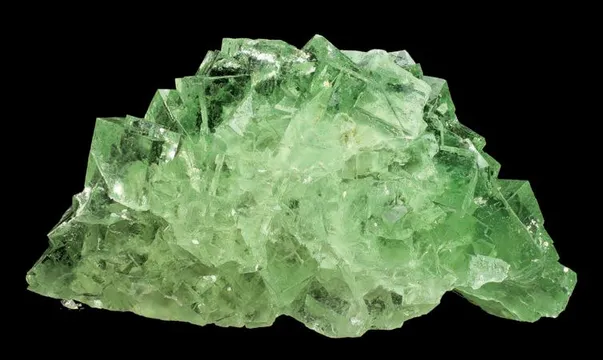
Xianghuapu is one of the defining Chinese fluorite localities of the modern collecting era: a tin-tungsten-polymetallic mine in the Xianghualing ore field of southern Hunan, where highly evolved Jurassic granites, carbonate host rocks, fault zones, skarn, greisen, and hydrothermal veins combined to produce an unusually rich F-Li-Be-Sn-W-Pb-Zn mineral system. Collectors know it above all for pale sea-green to lime-green fluorite: exceptionally glassy cubes and cube-octahedron combinations, often with beveled or stepped edges, perched on white quartz, flattened calcite, or darker matrix. The best examples have a cool, watery transparency that seems almost out of place beside the rugged tungsten and base-metal geology that formed them.
Regional View
Country View
The mine is also important because it sits in the same broader Xianghualing rare-metal environment that made the district famous among mineralogists for Be-, Li-, Sn-, W-, Nb-, and Ta-bearing mineralization. Xianghuapu itself is documented as a beryllium and tungsten-fluorite-scheelite locality, and its specimen output connects the collector’s cabinet directly with a serious ore-forming system: fluorite, quartz, calcite, scheelite, cassiterite, sulfides, skarn silicates, micas, and rare Be minerals all belong to the story.

Photo: Rob Lavinsky, iRocks.com via Wikimedia Commons
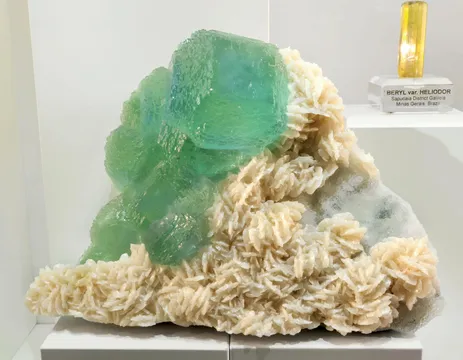
The visual signature is remarkably consistent at high grade: transparent green fluorite cubes, commonly several centimeters across, with frosted or stepped edge growth and highly lustrous cube faces. Good plates show the crystals elevated rather than crowded, often with snowy quartz or pale calcite creating contrast; exceptional plates preserve the pocket-wall aesthetics without bruising along the exposed crystal faces.
Search for specimens: View all specimens from Xianghuapu Mine, China
Xianghuapu Mine, historically also circulated on labels as Maiwan Mine, is in the Xianghualing Sn-polymetallic ore field of Linwu County, Chenzhou, Hunan Province. The locality lies in the Nanling metallogenic belt of South China, a region famous for Jurassic granite-related tin, tungsten, molybdenum, bismuth, fluorine, lithium, beryllium, niobium, tantalum, lead, and zinc mineralization. The mine is recorded near 25° 10′ 59″ N, 112° 34′ 59″ E, about 25 km northwest of Lanshan and in the broader Linwu–Chenzhou mining region.
Geologically, Xianghuapu belongs to the highly evolved Xianghualing granite-related system. The ore field contains the Laiziling, Tongtianmiao, and Jianfengling granitic bodies, with the Jianfengling stock especially tied to the Xianghuapu area. These granites intruded a layered sedimentary package that includes Cambrian slate and metasandstone, Devonian sandstone, shale, limestone, argillaceous limestone, dolomite, Carboniferous carbonate and clastic rocks, and younger cover rocks. Faults trending northwest, east-west, and north-northeast were important structural controls, providing pathways and traps for mineralizing fluids.
The Xianghuapu deposit has been described as a rare fluorite-scheelite-type tungsten deposit. Work on the deposit recognized five principal orebodies, numbered I, II, III, III′, and 301. Orebodies I and II were fluorite-scheelite ores dominated by fluorite, quartz, calcite, and scheelite, with massive, banded, vein, and disseminated textures. Orebodies III and III′ were mixed ores containing fluorite, quartz, calcite, scheelite, galena, and sphalerite, while the 301 orebody was richer in galena-sphalerite assemblages with pyrite, chalcopyrite, arsenopyrite, fluorite, quartz, and calcite. The orebodies were hosted by Devonian and Carboniferous limestone and dolomite adjacent to granitic intrusion and were localized along fault footwalls and fault gouge, especially in fractured zones.
The hydrothermal paragenesis reported for the tungsten-fluorite mineralization begins with fluorite + quartz + scheelite + calcite, is followed by a sulfide stage of sphalerite + galena + quartz, and closes with later calcite + quartz + fluorite + scheelite. This sequence is visible in the best specimen material: early clear-to-green fluorite and white quartz form the structural framework, sulfides appear locally, and later calcite can overgrow or accent the fluorite plates.
Mining and exploration history is partly industrial and partly specimen-driven. Geological exploration of the Xianghuapu deposit was active by the 1970s, and the deposit was mined for scheelite for decades. Academic descriptions report scheelite concentrate production on the order of 240–290 tonnes per year, with concentrate containing roughly 80–90 wt. % scheelite, as well as additional galena-sphalerite ore associated with the fluorite-scheelite bodies. Western collectors began seeing Xianghuapu in quantity during the early years of the 21st century, when the pale green fluorites became one of the most recognizable new Chinese mineral styles on the international market.
Access today should be treated as industrial, not recreational. A 2025 Hunan provincial development approval identified Hunan Jianfeng Mining Co., Ltd. as the project unit for the Linwu County Xianghuapu lithium-tungsten-tantalum-niobium polymetallic mining and processing project at Xianghuapu Shenkengli, Huatang Township. The approved project includes open-pit and underground mining components, an expanded processing plant, and products including lepidolite concentrate, tantalum-niobium rough concentrate, tungsten concentrate, lead-zinc concentrate, and fluorite concentrate. That modern operating context means collectors should assume no casual collecting access, no safe dump collecting, and no underground entry without formal permission from the mine and authorities.
Specimen finds appear to have come from mining and quarrying rather than hobby collecting. The classic green fluorites are associated with working mine faces and pockets exposed during ore extraction. Older market pieces and museum-quality examples show cabinet-size plates with fluorite crystals to about 2–5 cm on edge, commonly on quartz and calcite; smaller cabinet and miniature specimens remain available, but undamaged, balanced plates from the early production period are increasingly selective purchases.
Fluorite is the mineral that made Xianghuapu famous to collectors: pale sea-green, mint-green, lime-green, and locally nearly colorless cubes, commonly transparent to water-clear internally, with lustrous cube faces and distinctive beveled, frosted, stepped, or dodecahedrally modified edges. Specimens range from thumbnails and miniatures to large cabinet plates; individual crystals around 2–3 cm are common on good small cabinet pieces, and exceptional cabinet plates have carried crystals approaching 5 cm. The finest pieces are not merely green cubes, but architectural compositions: gem fluorite raised on white microcrystalline quartz, compressed “poker-chip” or platy calcite, or darker matrix, with minimal edge bruising and no cloudy internal zones except where attractive color zoning or frosted rim growth enhances the form.
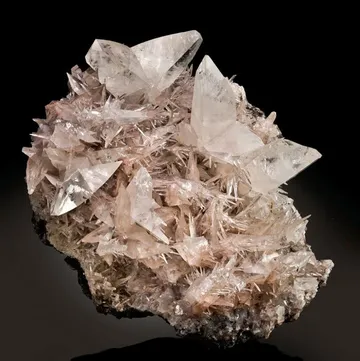
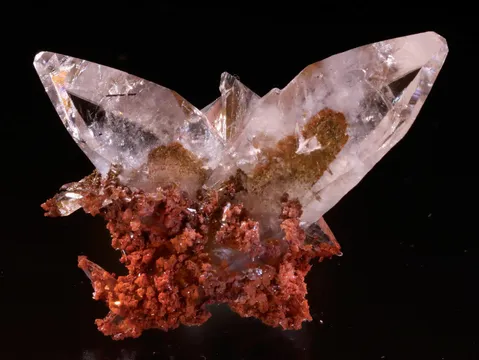
Calcite from Xianghuapu is most familiar as a pale, colorless to white associate on fluorite plates, forming flattened rhombohedral, platy, compressed disc-like, hexagonal, scalenohedral, or “poker-chip” crystals. It can be a minor accent of tiny bright crystals on green fluorite, but some specimens show calcite as a major display mineral, including colorless platy crystals several centimeters across and exceptional calcite crystals reported to roughly 8–11 cm on matrix. Good Xianghuapu calcite pieces are judged by balance and transparency: the calcite should sharpen the contrast with the green fluorite rather than bury it, and the best combinations retain clean, lustrous calcite edges without the micro-chipping and bruising that often affect these delicate flattened crystals.
Quartz at Xianghuapu is usually a matrix and paragenetic partner rather than the main showpiece, but it is central to the locality’s best aesthetics and ore story. It occurs as snowy microcrystalline coatings, white to colorless drusy crusts, small points, and quartz-rich matrix supporting green fluorite, calcite, and locally scheelite; in the ore, quartz is one of the principal minerals in both the fluorite-scheelite stage and later mineralizing events. The best collector pieces use quartz as a bright stage for the fluorite—clean white druse under isolated glassy cubes, or delicate quartz needles and microcrystals that frame the green fluorite without making the plate look chalky or abraded.
Beyond fluorite, calcite, and quartz, Xianghuapu is documented for a compact but important suite: scheelite, cassiterite, galena, sphalerite, pyrite, chalcopyrite, molybdenite, stannite, beryl, chrysoberyl, hsianghualite, magnesiotaaffeite-2N’2S, phenakite, sellaite, topaz, vesuvianite, diopside, chondrodite, magnetite, garnet-group minerals, chlorite-group minerals, muscovite or sericite, protolithionite, lepidolite, zinnwaldite, tourmaline, and feldspar-group minerals. The type-locality fame for hsianghualite and liberite belongs to the nearby Xianghualing Mine within the same ore field rather than to Xianghuapu itself, but Xianghuapu is part of the same remarkable F-Li-Be rare-metal district and has documented occurrences of hsianghualite and other rare Be-bearing species that make the locality more than a single-mineral fluorite source.
Xianghuapu fluorite is heavily represented on the market, but top specimens are far less common than the number of labels suggests. Ordinary pieces are pale green cleaved chunks or matrix fragments with edge bruising; good pieces are sharp, transparent, well-composed cubes on quartz or calcite; excellent pieces combine water-clear interiors, saturated but delicate green color, beveled or stepped morphology, intact exposed faces, and an undamaged pocket plate.
Condition is the first issue to check. Fluorite from Xianghuapu cleaves readily, and many crystals show peripheral damage where the specimen was removed from the pocket wall. That damage is not automatically disqualifying if it is confined to the underside or back, but chips on the front cube edges, bruised corners, frosted impact scars, or repaired crystals should be priced accordingly. Calcite associations add beauty but also fragility; flattened calcites commonly show edge nicks or broken rims.
Color and treatment deserve attention. Xianghuapu is naturally famous for pale to medium green fluorite, but material attributed to Xianghuapu and nearby Hunan fluorite localities has been discussed in the collecting literature and fraud forums in connection with artificial irradiation, especially specimens with suspiciously intense blue to emerald-green color or smoky quartz produced by treatment. This does not mean Xianghuapu green fluorite is suspect as a class; rather, strong color, unnatural-looking smoky quartz, odd provenance stories, or old “Russian” labels attached to Hunan-style fluorite should prompt careful examination.
Mislabelling is common at two levels. First, Xianghuapu and Xianghualing are often blurred on labels, with “Xianghualing” sometimes used broadly for the district and “Xianghuapu” used for specific fluorite production. Second, the historical name “Maiwan Mine” appears on Western labels, although Chinese geological usage does not consistently recognize a separate Maiwan deposit. Serious collectors should keep the full hierarchical locality when possible: Xianghuapu Mine, Xianghualing Sn-polymetallic ore field, Linwu County, Chenzhou, Hunan, China.
Fluorescence is not a reliable authenticity test here. Many Chinese fluorites, including reported Xianghuapu examples, show weak or no visible UV response, and lack of fluorescence alone should not raise suspicion. Scheelite, when present, may fluoresce under shortwave UV, but the usual collector fluorite plates should be evaluated primarily by morphology, association, condition, and provenance rather than glow.
Market availability remains good in 2026, especially for thumbnails, miniatures, and small cabinet fluorites, but high-end, undamaged, early-production plates are increasingly treated as modern Chinese classics. Recent auction and dealer records show specimens spanning modest three-figure pieces to several-thousand-dollar examples, with premium prices attached to large, transparent, well-isolated cubes, strong composition, documented provenance, and intact calcite or quartz associations.