






A collector's guide to Leiping Mine, China: its geology, mining history and notable minerals, illustrated with the 63 specimens documented from this locality on EarthWonders.
Key facts
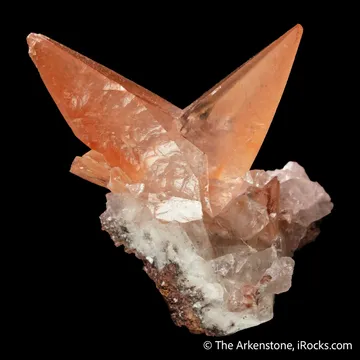
Leiping Mine belongs to the modern Chinese specimen story: a southern Hunan polymetallic mining locality whose economic importance lies in base-metal and iron-bearing mineralization, but whose collector fame rests overwhelmingly on calcite. In serious mineral cabinets the name “Leiping” evokes sharp, lustrous calcite crystals tinted and internally painted by hematite and iron oxides—transparent pyramidal forms with reddish phantoms, brick-red to orange scalenohedral sprays, and the celebrated V-shaped “butterfly” or “fishtail” twins most closely associated with Mine No. 884 in the Leiping area.
The locality sits in Guiyang County, Chenzhou, within southern Hunan’s intensely mineralized non-ferrous belt. The broader district is part of the Nanling polymetallic province, a region known to economic geologists for tungsten, tin, lead, zinc, copper, molybdenum, iron and related hydrothermal-skarn systems, and to collectors for a remarkable late-twentieth- and early-twenty-first-century wave of Chinese specimens. Leiping’s calcites fit that setting well: they are open-space hydrothermal gangue minerals from an iron-bearing environment, with hematite and iron oxides incorporated as inclusions, phantoms, dustings, or matrix coatings during successive growth episodes.
The best specimens are not simply “red calcite.” They are architectural pieces. A fine Leiping calcite has crisp geometry, glassy luster, clean three-dimensional composition, and internal structure visible through the crystal—hematite veils, star-like phantoms, or red cores enclosed by later clear calcite. Some pieces are small and jewel-like; others are cabinet plates with chunky crystals several centimeters across. The locality’s finest work has the unmistakable look of a finished modern classic: delicate enough to demand careful handling, but visually strong enough to hold a case beside older European and American calcite localities.
Regional View
Country View
The Leiping name needs careful handling because collector usage and database usage do not always align perfectly. Mindat treats Leiping Mine, Mine No. 884, New First of May Mine, and Xinxin Mine as separate entries within the Leiping area of Guiyang County. Specimen labels, especially older dealer labels, often use “Leiping Mine” more broadly for material from the Leiping mining district. For calcite collectors, this matters most with the V-shaped twins: those are especially linked in the literature and specimen records to Mine No. 884, even though they are frequently encountered under the broader Leiping name.

Photo: Wikimedia Commons

Photo: Wikimedia Commons
Search for specimens: View all specimens from Leiping Mine, China
Leiping Mine is recorded at Leiping, Guiyang County, Chenzhou, Hunan Province, China. The locality position given in major mineral databases is estimated rather than surveyed to a public mine collar, and the practical collector locality is best understood as part of a Leiping-area mining district rather than a single easily visitable collecting site. In the immediate collector hierarchy, the important names to separate are Leiping Mine, Mine No. 884, New First of May Mine, and Xinxin Mine, all in the Leiping area.
The named Leiping Mine has a compact verified mineral list: calcite, hematite, quartz, and smithsonite. The broader Leiping area adds arsenopyrite, beudantite, fluorite, galena, pyrite, sphalerite, and manganese-bearing calcite through the neighboring or related workings. Mine No. 884 is especially important for calcite and hematite, while Xinxin Mine is the Leiping-area source most often tied to manganese-bearing calcite and sphalerite.
Geologically, Leiping lies in southern Hunan’s non-ferrous metallogenic country, where carbonate-hosted hydrothermal replacement, vein, skarn, and polymetallic systems are widespread. The Leiping calcites themselves are specimen-stage carbonate growths in open cavities and veins, not ore minerals. Their significance is tied to the way late carbonate fluids crystallized in available space while iron oxides and hematite were incorporated in pulses. That growth history produced the internal red phantoms, smoky-brown zones, pale clear overgrowths, and hematite-rich matrices that define the locality’s best specimens.
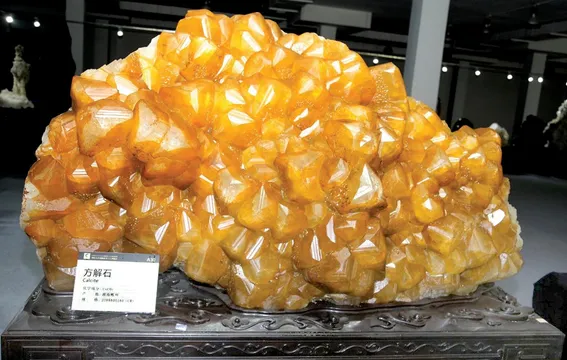
Chinese sources describing Chenzhou calcite identify the Guiyang Leiping non-ferrous mining area as one of the principal sources of ornamental calcite in the region. They describe a broad range of Leiping calcite crystal forms—square-looking rhombohedral forms, columnar crystals, pyramidal forms, nailhead-like habits, and dogtooth habits—and a color range including jujube-red, pink, beige-yellow, milky white, and brown. Among the forms specifically singled out as good quality are red blocky calcite, red columnar calcite clusters, and yellow transparent nailhead calcite.
The most famous specimen-producing period was the late 1990s into the early 2000s. Mine No. 884 produced the V-shaped calcite twins that became one of the iconic Chinese calcite styles of that era. Around the same period, Leiping-area finds supplied spiky scalenohedral groups, transparent to translucent rhombohedral groups with hematite phantoms, pyramidal crystals on matrix, and large plates of chunky calcite. Dealer archives and public image records consistently show that by the 2010s and 2020s the best pieces were already largely moving as older stock or collection specimens rather than as a continuous fresh supply.
Mine-scale ownership and operator history are less clearly published in the collector literature than the specimen record. Administrative Chinese documents confirm active and legacy mining infrastructure in the Leiping mining area, including references to the Qinglan-area 884 concentrator tailings facility in Yongchong Village and to heavy-metal remediation projects in the Leiping mining district. Those records are useful for understanding that Leiping is a real industrial mining district with environmental and safety controls, not a public collecting ground.
Collecting access should be regarded as closed, controlled, or permission-only. This is not a North American-style public dump locality. Specimens reach collectors through dealers, Chinese market channels, older private collections, auction houses, and collection dispersals. Labels should be preserved carefully, especially when they specify Mine No. 884, Xinxin Mine, or another sublocality rather than the broader “Leiping Mine” designation.
Notable documented pieces show the scale of the best finds. A public Wikimedia Commons record documents a 29 x 18 x 6.5 cm Leiping calcite plate with broad chunky crystals, visible internal phantoms, and terminations up to 3 cm across. A Heritage Auctions specimen from the Dan Kennedy Collection measured 28 x 16 x 8 cm, with calcite crystals reaching 4.1 cm across, dense rust-red hematite phantoms, and orange shortwave fluorescence on the side faces. A Mindat specimen record documents a 22.2 x 14.1 x 9.6 cm Leiping calcite described as unusually transparent for the find, with visible internal phantoms and sharp symmetrical pyramidal terminations. These are large, serious cabinet specimens, not simply attractive small examples.
Calcite from Leiping Mine ranges from miniature twins to large cabinet plates, but the defining collector habits are V-shaped twins, scalenohedral “spike” groups, nailhead and rhombohedral crystals, and broad pyramidal crystals with visible hematite phantoms. Colors run from colorless and glassy through smoky gray, honey, pink, brown, brick-red, and vivid orange-red, with the red tones usually produced by hematite or iron-oxide inclusions rather than by the calcite itself. Good pieces are sharp, lustrous, transparent enough to reveal internal growth, and compositionally clean; ordinary examples may be merely iron-stained, contacted, or chipped. The strongest Leiping calcites combine natural contrast—clear calcite against red hematite, or transparent wings over rusty included matrix—with crisp terminations and a balanced three-dimensional silhouette.
Other minerals documented from the named Leiping Mine are hematite, quartz, and smithsonite. Hematite is the most important associate because it is responsible for much of the locality’s red internal color, appearing as inclusions, phantoms, stains, or iron-rich matrix rather than usually as the main display mineral. Quartz is recorded for the named mine and appears in the Leiping photo record, including calcite-quartz associations. Smithsonite is listed for Leiping Mine, but it is not the mineral that built the locality’s international reputation. In the broader Leiping area, the list expands to arsenopyrite, beudantite, fluorite, galena, pyrite, sphalerite, and manganese-bearing calcite, with New First of May Mine and Xinxin Mine supplying some of these records. No verified type-locality mineral is documented for Leiping Mine in the sources reviewed.
The biggest authenticity issue with Leiping specimens is not usually whether the calcite is natural, but whether the locality label is precise. “Leiping Mine” is commonly used in the trade as a district label, while Mine No. 884 and Xinxin Mine have their own identities. A V-shaped “butterfly” twin labeled simply Leiping may well be Mine No. 884 material, but a careful collector should preserve the original wording and not upgrade the label without evidence.
Color alone is not enough for attribution. Many Chinese localities produce reddish, orange, brown, or “chocolate” calcites. A convincing Leiping piece should match the known habits: sharp butterfly twins, brick-red to orange scalenohedra, transparent pyramidal or nailhead crystals, stepped rhombohedral groups, or chunky cabinet plates with hematite phantoms. Strong provenance—old dealer labels, collection labels, auction records, Mindat minID records, or publication history—adds real value.
There is no documented need to assume that vivid Leiping calcite has been dyed. Hematite and iron-oxide coloration is intrinsic to the locality’s best-known material. Still, calcite is a common target for cleaning, enhancement, repair, and misrepresentation in the broader mineral market. Inspect red specimens under magnification for color concentrated unnaturally in cracks, powdery loose pigment, surface films, glued crystal bases, or color that appears only on broken porous areas. A light iron-oxide dusting or earthy red residue can be natural, but it should be evaluated in context.
Condition is critical. Calcite has perfect rhombohedral cleavage and a Mohs hardness of only 3, so Leiping’s sharp tips, thin twins, and projecting scalenohedra bruise easily. Common issues include chipped terminations, cleaved edges, contacted side faces, repaired twins, trimmed matrix, and sawed backs. These do not automatically make a specimen undesirable—many excellent Chinese cabinet specimens were trimmed for display—but disclosure and price should match the condition.
Fluorescence is specimen-specific and worth checking, not guaranteed. Some Leiping calcite has been documented with orange to red fluorescence under shortwave and midwave ultraviolet light, and at least one large Dan Kennedy Collection specimen showed especially vivid orange shortwave response on side faces. If fluorescence matters to you, ask for the exact lamp wavelength and photographs of the specific specimen rather than relying on locality reputation.
Market availability remains healthy for modest examples but tight for top quality. Small to small-cabinet Leiping calcites still appear from established dealers and auction archives, often as older stock or collection pieces. Excellent V-twins, large undamaged plates, and specimens with strong provenance are much scarcer. Recent documented public prices span from low hundreds of dollars for smaller or less perfect auction pieces to four-figure sums for strong cabinet examples; a 28 x 16 x 8 cm Dan Kennedy Collection Leiping calcite sold at Heritage Auctions on October 8, 2025 for $4,000. Fine old-label twins, unusually transparent phantomed plates, and large aesthetic Mine No. 884 pieces should be treated as modern Chinese classics rather than common decorative calcite.
Leiping’s best story is the suddenness with which it entered the modern calcite canon. Around the turn of the millennium, while Chinese mineral specimens were transforming the international market, Mine No. 884 produced sharp calcites that did not look quite like anything else. Dealers and collectors described them as V-twins, fishtails, and butterfly twins—terms that sound casual until one sees a good piece: two translucent wings opening from an iron-tinted matrix, sometimes with a partial X-form below, sometimes perched among dozens of needle-like calcite spikes.
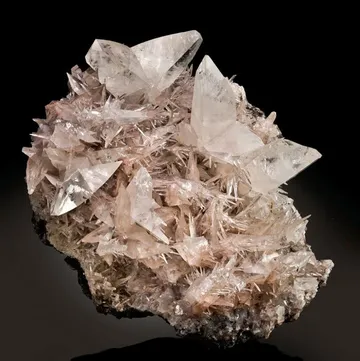
One public specimen record captures the excitement of that find with unusual clarity. The piece measured 8.3 x 5.4 x 4.3 cm, and among a field of razor-sharp calcite spikes sat a pristine twinned calcite only 2 cm from tip to tip. It came from the Dr. Stephen Smale Collection. The description called the Mine No. 884 discovery “the most famous single calcite find of the modern era in China.” That phrase has endured because it is not just promotional language; it records how collectors experienced the material when it first appeared. China was producing world-class pyromorphite, fluorite, scheelite, stibnite, and quartz at the same time, yet these little calcite twins still managed to establish an instantly recognizable identity.
The large-plate finds tell a different Leiping story. A 29 x 18 x 6.5 cm specimen photographed for the public record shows that Leiping was not merely a thumbnail locality. It is a broad wall of chunky, smoky, phantomed calcite, with flashing symmetrical pyramidal terminations and some tips reaching 3 cm across. The description calls the crystals “instantly recognizable,” which is exactly the point: good Leiping does not depend on a single habit. Whether as a butterfly twin or a broad pyramidal plate, the locality announces itself through sharp geometry, hematite architecture, and a particular smoky-red internal glow.
The later market history has become part of the locality’s narrative. A cabinet specimen from the Dan Kennedy Collection sold at Heritage Auctions on October 8, 2025 measured 28 x 16 x 8 cm. Its calcite crystals reached 4.1 cm across, and dense rust-red hematite phantoms filled the interiors. The auction description noted orange shortwave fluorescence and minor scuffing on a few terminations. That combination—strong provenance, documented size, UV response, and honestly noted condition—is precisely how top Leiping specimens are now evaluated. They are no longer simply “new Chinese calcites”; they are named classics being judged by survival, labels, and quality.
Stephen Smale’s name appears repeatedly in the Leiping afterlife. A 2024 auction specimen from his collection measured 11.7 x 8.2 x 3.7 cm and carried a sharp, translucent butterfly-twinned group over reddish hematite-included crystals. The description noted that the twin was not just two wings: one crystal projected downward, making a partial X-form. That is a collector’s detail, and a revealing one. At Leiping, small changes in architecture—how open the V is, whether the twin is balanced, whether the hematite enhances rather than muddies the form—separate a merely pleasant example from one that holds attention for years.
Scovil, Jeffrey A. “A Mineral Excursion to China: 2004.” Rocks & Minerals, 80(1), 12–22. DOI: 10.3200/RMIN.80.1.12-22 — Important contemporary account of the early-2000s Chinese specimen scene; Mindat cites it for Mine No. 884 calcite and hematite.
Mindat reference record for Scovil, J.A. (2005): Rocks & Minerals 80(1), 12–22 — Useful index of the mineral-locality records tied to Scovil’s China article, including Mine No. 884 calcite and hematite.
Mindat: Leiping Mine, Leiping, Guiyang Co., Chenzhou, Hunan, China — Core mineralogical locality record for the named Leiping Mine, including the verified mineral list of calcite, hematite, quartz, and smithsonite.
Mindat: Mine No. 884, Leiping, Guiyang Co., Chenzhou, Hunan, China — Key record for the sublocality that produced most of the V-shaped calcite twins attributed to Leiping.
Mindat: Calcite from Leiping Mine — Occurrence record for calcite at the named Leiping Mine, with associated-mineral data dominated by hematite.
Mindat specimen CET-P9A: Calcite from Leiping Mine — Public specimen record for a 22.2 x 14.1 x 9.6 cm Leiping calcite with unusually transparent crystals, internal phantoms, glassy luster, and pyramidal terminations.
Mindat specimen 9KP-Q72: Calcite from Leiping Mine — Public specimen record for a 28 x 16 x 8 cm Dan Kennedy Collection calcite with rust-red hematite phantoms and orange shortwave fluorescence.
EarthWonders specimen record: Calcite, Mine No. 884, Hunan, China — Documented 5 cm calcite twin, twinned on (1011), colored by hematite, with Rob Lavinsky and Jeff Scovil provenance details and a Mineralogical Record publication note.
Wikimedia Commons file: Calcite-198043.jpg — Publicly documented 29 x 18 x 6.5 cm Leiping calcite plate showing large chunky crystals, pyramidal tips, and internal phantoms.
Wikimedia Commons file: Calcite-226310.jpg — Publicly documented Mine No. 884 specimen from the Dr. Stephen Smale Collection, with spiky calcite and a small sharp twin.
Wikimedia Commons file: Calcite-Hematite-228350.jpg — Documented 17.5 x 15.5 x 8.4 cm Leiping calcite with hematite phantoms and unusually transparent crystals.
Crystalline Treasures: The Mineral Heritage of China, Mineralogical Record digital supplement — Broad collector reference on Chinese mineral heritage, including southern Hunan localities and Leiping in the context of China’s modern specimen output.
“JHG1513 Calcite, Leiping Mine, China” — Crystal Classics — Short Vimeo specimen video documenting a Leiping calcite offered by Crystal Classics.
“Leiping Calcite Twin” — Fine Minerals International — Dealer media feature on a high-end Leiping calcite twin, emphasizing the locality’s late-1990s impact on calcite collecting.
“Calcite” SKU 74875 — Collector’s Edge Minerals — Dealer specimen page with video tag for a 6.0 x 7.0 x 4.5 cm Leiping Mine butterfly-twinned calcite with hematite inclusions, ex Norm and Roz Pellman Collection.
“Leiping Lizards—Calcite from China” — Fluorescent Mineral Society FMDB — Fluorescence media record for a Leiping calcite showing red shortwave and orange midwave response, with notes on bright manganocalcite matrix.
Wikimedia Commons: Category Leiping Mine — Open image archive containing dozens of Leiping calcite photographs, including Mine No. 884 material, phantomed plates, and calcite-quartz associations.
Mindat: Leiping Mine, Leiping, Guiyang Co., Chenzhou, Hunan, China — Essential locality page for the named Leiping Mine, with hierarchy, coordinates, and mineral list.
Mindat: Leiping, Guiyang Co., Chenzhou, Hunan, China — Broader district page useful for separating Leiping Mine, Mine No. 884, New First of May Mine, and Xinxin Mine records.
Mindat: Mine No. 884, Leiping, Guiyang Co., Chenzhou, Hunan, China — Best starting point for the famous V-shaped calcite twins commonly sold under the broader Leiping name.
Mindat: Calcite from Leiping Mine — Occurrence page with photo count and associated-mineral data for calcite from the named mine.
Mindat: Calcite from Mine No. 884 — Occurrence page for the Mine No. 884 calcites cited to Scovil’s 2005 China article.
Wikimedia Commons: Category Leiping Mine — Convenient visual reference for the range of Leiping calcite habits and labels.
Heritage Auctions: Calcite, Leiping Mine, Dan Kennedy Collection — Auction record for a large phantomed calcite with documented price, dimensions, provenance, condition note, and fluorescence description.
MineralAuctions: Calcite twin with hematite inclusions, Mine No. 884 — Useful market example of a cabinet-size butterfly twin from the Dr. Stephen Smale Collection.
MineralAuctions: Hematite-tinted calcite, Mine No. 884 — Good reference for the spiky late-1990s Mine No. 884 style with small V-twins.
Collector’s Edge Minerals: Calcite SKU 74875 — Dealer record for a high-quality Leiping butterfly-twinned calcite with hematite contrast and Pellman provenance.
Fluorescent Mineral Society FMDB: Leiping Lizards—Calcite from China — Specific fluorescence record for Leiping calcite under shortwave and midwave ultraviolet light.
Chinese reference: Chenzhou calcite overview — Chinese-language overview describing Chenzhou calcite sources, including Leiping’s crystal habits and color range.
Hunan emergency-management PDF: tailings facilities including the Qinglan 884 concentrator tailings pond — Administrative source confirming industrial mining infrastructure tied to the 884 operation in the Leiping/Qinglan area.

.jpg)

