A collector's guide to Laohuan Mine, China: its geology, mining history and notable minerals, illustrated with the 88 specimens documented from this locality on EarthWonders.
Key facts
Laohuan is one of those rare specimen localities whose importance grew not merely from beauty, but from a correction of the mineral record. For years, many of the blue plumbogummite-after-pyromorphite specimens moving through the market were sold as Daoping or Yangshuo material, because those neighboring Guangxi lead-zinc mines were already famous names to collectors. The better-documented locality is now understood to be Laohuan: a small, artisanal cluster of adits and excavations on Laohu Hill in Gongcheng County, Guilin, Guangxi, where low-grade lead-zinc-silver-barite workings gave way to specimen mining once the local miners realized that crystals were the valuable product.
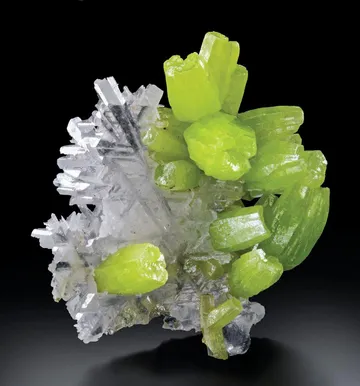
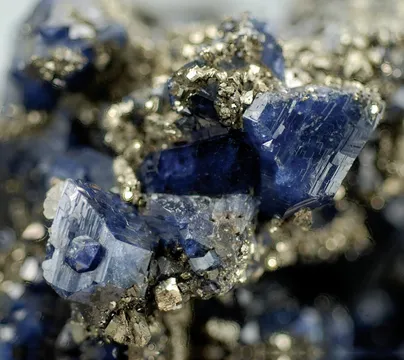
The deposit is best thought of as an oxidized lead-zone occurrence, not a large modern mine in the usual industrial sense. Its classic assemblage is simple but visually extraordinary: yellow to yellow-green pyromorphite, pale to vivid blue or blue-gray plumbogummite, white quartz, and baryte, with the most admired specimens showing plumbogummite coating, perimorphing, or replacing pyromorphite. The best Laohuan pieces have the theatrical color contrast collectors remember at a glance: lustrous green or yellow hexagonal pyromorphite prisms emerging from, or preserved beneath, rounded sky-blue plumbogummite crusts and botryoidal “balls.” In top examples, the plumbogummite is not a dull crust but a translucent, silky to glassy blue skin over sharp inherited crystal forms, sometimes with unaltered pyromorphite still visible at the tips or in broken cross-sections.
Regional View
Country View
Laohuan matters historically because it separated a distinct specimen occurrence from the broader Daoping-Yangshuo collecting district. The locality’s name itself is part of the story: Laohu means “tiger,” and the workings have been described under variants such as Laohu Hill, Laohuan, Laohuyan, and an unnamed baryte mine. That naming drift is not trivial for collectors. A fine blue plumbogummite pseudomorph bought years ago with a Yangshuo label may, on present evidence, belong under Laohuan instead; conversely, ordinary green pyromorphite without plumbogummite may still be more plausibly Daoping or Yangshuo unless it has stronger documentation.
Search for specimens:
Laohuan Mine is in Gongcheng County, Guilin, Guangxi Zhuang Autonomous Region, southern China, on the slopes of Laohu Hill in the Haiyang Mountain area east of Guilin. The occurrence is not a single neatly bounded industrial mine but a group of small artisanal adits, pits, and excavations. Older labels and some collector discussions refer to it as an unnamed baryte mine, Laohu Hill, Laohuyan, or simply “Guilin, Guangxi,” and the uncertainty of those names is one reason the locality has been unusually troublesome in collections.
The ore setting is a low-grade lead-zinc-silver-barite occurrence with an oxidized lead zone. Primary ore minerals are not the collecting story here; the collectible suite formed during oxidation and supergene alteration. Pyromorphite crystallized first as lead chlorophosphate in cavities and fractures. Later acidic, phosphate-bearing alteration produced plumbogummite, PbAl3(PO4)(PO3OH)(OH)6, which coated, perimorphed, and locally replaced the pyromorphite. This sequence is the key to reading Laohuan specimens: green or yellow pyromorphite cores, terminations, or remnant patches can be enclosed by blue-gray plumbogummite, and broken or backlit areas may reveal the earlier crystal inside the later shell.
The physical mining history is modest but important. The workings were originally opened for lead, zinc, silver, and baryte, but commercial ore mining was abandoned after the ore proved too low-grade to sustain ordinary production. Once specimen-quality pyromorphite and plumbogummite were recognized, local miners shifted the value proposition from ore to crystals. That makes Laohuan unusual in China: a small locality operated intermittently for specimens rather than as a large ore mine with specimens recovered as a sideline.
Collector production appears to have been episodic. The locality has been known for good plumbogummite and pyromorphite since about 2003, with substantial market recognition developing through the 2000s and early 2010s. Fresh lots appeared in collector channels at the 2012 Tucson Show, and larger, better pieces were reported at the 2014 Sainte-Marie-aux-Mines show. The main tunnel area has been described as mined out or largely exhausted, though other excavations on the hill have produced smaller or different-habit examples and could, in principle, still yield pockets. Modern access should be treated as private, hazardous, and locally controlled; this is not a casual collecting locality, and specimens are obtained through dealers, old collections, or occasional Chinese supply rather than by visiting collectors.
The finds that made Laohuan famous are not merely “blue crust on green crystals.” The best pockets produced sculptural groups of pyromorphite prisms, some several centimeters long, partly to wholly converted to plumbogummite. Other pieces show rounded botryoidal plumbogummite lining pocket surfaces over quartz-rich matrix, with residual yellow-green pyromorphite visible underneath. Cabinet-size examples exist, including published pieces in the 9 to 14 cm range, but most market pieces are thumbnails, miniatures, and small cabinets. Their value rises sharply when the inherited pyromorphite crystal form is sharp, the blue is strong, the plumbogummite surface is lustrous rather than chalky, and the piece preserves a natural contrast between blue alteration and green or yellow original pyromorphite.
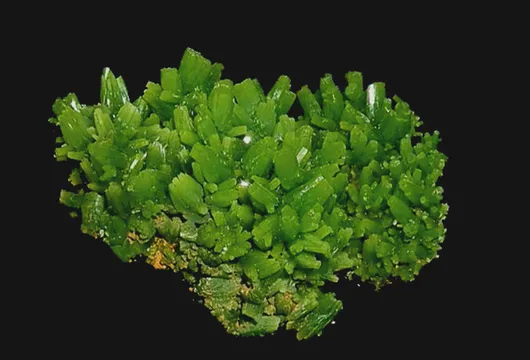
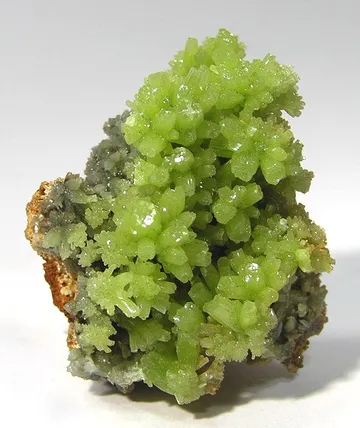
Laohuan pyromorphite is most important not as isolated, textbook green pyromorphite, but as the earlier generation preserved inside or beneath plumbogummite. It occurs as yellow, yellow-green, medium-green, and neon-green hexagonal prisms, commonly in clusters and sprays, with crystals on documented specimens reaching roughly 0.7 to 0.8 cm in many small pieces and several centimeters in larger pseudomorph groups. The classic association is blue to blue-gray plumbogummite on or after pyromorphite, sometimes with quartz matrix; on the finest examples, pyromorphite remains visible at crystal tips, along broken surfaces, or as bright green needles emerging from blue botryoidal plumbogummite. Good Laohuan pyromorphite pieces are judged by the sharpness of the inherited or surviving hexagonal form, the amount of intact green/yellow crystal still visible, the aesthetic contrast with plumbogummite, and the absence of bruising on the terminations; ordinary pieces are more massive, chalky, or so thoroughly coated that the pyromorphite story becomes hard to read.
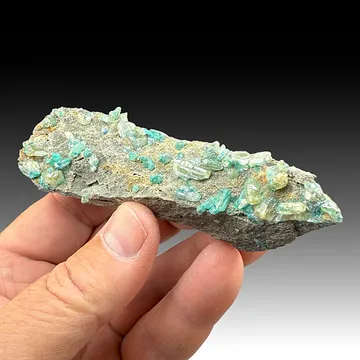
Laohuan is the Chinese locality by which serious collectors now define blue plumbogummite after pyromorphite. The mineral appears as pale sky-blue, blue-green, blue-gray, and locally deeper blue crusts, botryoidal aggregates, rounded spheres, stalactitic forms, perimorphs, and true or partial pseudomorphs after pyromorphite prisms. Documented specimens range from small thumbnails only a few centimeters across to cabinet pieces over 10 cm, with individual botryoidal “balls” described up to several millimeters across and inherited pyromorphite prisms in larger examples reaching multi-centimeter scale. It is typically associated with yellow to green pyromorphite and, less prominently, white quartz; the finest examples combine strong blue color, lustrous or translucent botryoidal surfaces, crisp pyromorphite morphology, visible remnant pyromorphite, and minimal contact bruising. Dull gray crusts, abraded balls, and incomplete, visually confusing replacements are commoner and much less desirable.
Quartz at Laohuan is a supporting actor rather than the trophy species, but it matters because it forms part of the matrix and pocket architecture of the plumbogummite-pyromorphite specimens. It is documented as white quartz associated with plumbogummite and pyromorphite, commonly appearing as host-rock matrix or pale fracture/pocket filling beneath the showier lead phosphates. Collector-grade Laohuan quartz specimens are therefore judged less as quartz crystals in their own right than as matrix pieces that give stability, contrast, and geological context to blue plumbogummite and yellow-green pyromorphite; a quartz matrix with undamaged botryoidal plumbogummite across the display face and remnant pyromorphite on the reverse is far more desirable than a nondescript quartz fragment with sparse phosphate coating.
The formally documented Mindat mineral list for Laohuan is short: baryte, plumbogummite, pyromorphite, and quartz. Collector literature discussing the Laohuan occurrence has also mentioned cerussite, minor malachite, and sparse wulfenite from the broader set of small workings, but these are not the minerals that established the locality’s reputation. No type-locality mineral is attached to Laohuan in the standard locality references; its significance rests instead on quality and locality correction, especially the reassignment of many famous blue Chinese plumbogummite specimens away from Daoping or Yangshuo and toward Laohuan.
The main authenticity issue for Laohuan is mislabelling. The blue plumbogummite-on/after-pyromorphite material was long sold under Daoping, Yangshuo, Lingchuan, or vague “Guilin, Guangxi” labels. For older specimens, a corrected Laohuan attribution can be more credible than an original Yangshuo or Daoping label if the piece is the distinctive blue plumbogummite pseudomorph/perimorph style. Conversely, a simple green pyromorphite with no blue plumbogummite should not automatically be moved to Laohuan merely because it is from Guangxi; Daoping and Yangshuo are genuine pyromorphite producers.
No well-documented, locality-specific artificial fakes dominate the literature in the way that mislabelled material does, but collectors should still examine surface quality carefully. Plumbogummite can be botryoidal, silky, and slightly translucent, but it can also be delicate and easily bruised. Look for rubbed high points on blue balls, chipped pyromorphite terminations, broken stalactitic projections, and repaired clusters. Very bright blue color alone is not enough; the premium is paid for sharp inherited pyromorphite form, pleasing color contrast, intact display surfaces, and credible provenance.
Fluorescence is a useful bonus and, in some specimens, a diagnostic pleasure. Laohuan plumbogummite has been documented fluorescing blue under longwave UV and green under midwave and shortwave UV, with the green response attributed to uranyl activation in published fluorescence work. Pyromorphite on these pieces may fluoresce yellow to orange, especially under midwave or shortwave UV. At least one studied specimen showed low but measurable radioactivity associated with the uranyl-activated fluorescence, so collectors should treat the material with normal lead-mineral hygiene: do not lick or grind it, wash hands after handling, keep dust out of the display environment, and store fragile pieces where blue crusts and pyromorphite tips cannot be abraded.
Availability is uneven. Small to modest Laohuan specimens appear regularly enough that a patient collector can buy one, but top pieces are not common. Large, undamaged, strongly blue pseudomorph groups with visible green/yellow pyromorphite and old collection or publication history are significantly scarcer than the number of small market pieces might suggest. Labels from recognized dealers, old Arkenstone or Fabre material, Mindat photo records, Mineralogical Record publication references, and documented collection provenance all add confidence.
For years, the collector world had a problem hiding in plain sight: beautiful blue Chinese plumbogummite specimens were everywhere, but the locality on the label was often wrong. Daoping and Yangshuo already had the glamour; they were the names associated with Guangxi pyromorphite, and so the blue pseudomorphs traveled under those names. The correction began to crystallize publicly when Berthold Ottens’ 2014 Lapis article argued that the plumbogummite specimens on the open market—usually on white quartz and/or yellow pyromorphite, sometimes pseudomorphing the latter—came from an unnamed baryte mine on Laohu Hill, not from Daoping, Lingchuan, or Yangshuo. A Mindat discussion that followed captured the collector’s dilemma perfectly: “Is it time to correct my label?” For many fine specimens, the answer became yes.
The naming confusion had its own miniature comedy. In one Mindat exchange, a participant wondered whether “Laohu Hill” might be the same as Laohe Hill. The reply was briskly geographic: no—the two places were about 1,100 kilometers apart. Later, a Chinese contributor added a more precise local name: 老虎岩, Laohuyan, “the Tiger Rock,” and gave a fuller form of the locality as an unnamed baryte mine at Laohuyan, Xiling Township, Gongcheng County, Guilin, Guangxi. That kind of correction is not romantic in the field-collecting sense, but it is exactly the sort of paper-trail moment that changes collection labels, catalog entries, auction descriptions, and ultimately the historical identity of a mineral occurrence.
Laohuan’s specimens also have a show history. Freshly collected lots were reported at Tucson in 2012, where several dealers had plumbogummite on yellow mimetite/pyromorphite from the locality. By the 2014 Sainte-Marie-aux-Mines show, larger and better pieces were circulating, including specimens with underlying crystals to about 5 cm and some complete pseudomorphic replacements by plumbogummite. That progression—from puzzling Chinese blue material to named, discussed, and internationally traded locality classic—happened in barely more than a decade.
One of the more memorable turns in the story is that Laohuan became important after ordinary ore mining had already failed to make it important. The low-grade lead-zinc-silver-barite occurrence was not a great commercial orebody. Its real value emerged only when local miners realized that crystal pockets could pay better than ore. The Mineralogical Record’s account emphasizes how unusual that is in China, where most specimen localities are tied to industrial mining. At Laohuan, the mountain was pocked by small adits and holes worked specifically for crystals, and the most productive original area was eventually described as mined out or suspended, with other openings on the hill still holding the possibility—never the guarantee—of another pocket.