A collector's guide to Wanni glacier - Scherbadung area, Switzerland: its geology, mining history and notable minerals, illustrated with the 78 specimens documented from this locality on EarthWonders.
Key facts
The Wanni glacier - Scherbadung area is one of the great high-Alpine rare-mineral localities of the Binntal, set on the Swiss side of Monte Cervandone, the border summit better known in German-speaking Valais as Scherbadung. For collectors its importance is not a matter of bulk production, but of chemistry: arsenic-rich Alpine fissures and pegmatitic bodies in the Monte Leone nappe have yielded a suite of exceedingly uncommon arsenites, arsenates, REE minerals, titanium oxides and classic fissure minerals. The locality is the type or co-type locality for celebrated rarities including cafarsite, asbecasite, cervandonite-(Ce) and gasparite-(La), and it remains a benchmark name on labels for serious systematic collections.
The geological setting is unusually favorable for rare-species collectors. Alpine quartz fissures cut two-mica leucocratic gneisses and associated pegmatitic dikes; late hydrothermal fluids rich in arsenic interacted with Be-, B-, F-, Y-, Nb-, Ta-, REE-, Th- and U-bearing accessory phases. The result is not a simple “quartz pocket” locality, but a chemically specialized fissure environment in which smoky quartz, albite, adularia, chlorite, hematite, rutile, anatase and fluorite may sit beside minerals that most collectors will never encounter outside a reference collection.
The finest specimens have a distinctly Alpine look: dark-brown to nearly black cafarsite crystals with rough but sharp cubic, octahedral and dodecahedral forms set on pale gneiss, smoky quartz or quartz-feldspar matrix; lemon-yellow asbecasite rhombohedra at millimetric scale; black, lustrous cervandonite-(Ce) rosettes and saddle-like aggregates; pinkish to yellowish fluorite sparingly associated with cafarsite; and miniature to micromount-size rare-earth minerals best appreciated under magnification. The locality rewards patience and magnification more than cabinet-size drama, but the best cafarsites and associated rarities are among the most distinctive Alpine systematic specimens available.
Regional View
Country View

Photo: Rob Lavinsky, iRocks.com / Wikimedia Commons

Search for specimens: View all specimens from Wanni glacier - Scherbadung area, Switzerland
Wanni glacier - Scherbadung lies in the Binn municipality of the Goms district, Valais, in the high country above the Kriegalp or Chriegalp valley. The summit of Scherbadung/Monte Cervandone rises on the Swiss-Italian border, and mineral records are often split between the Swiss Wanni glacier - Scherbadung side and the Italian Monte Cervandone–Devero side. For accurate labeling, that distinction matters: specimens from the Swiss Wanni glacier area should not be casually relabeled “Devero,” and Italian-side material should not be folded into Wanni unless the provenance is genuinely known.
The specimen-producing geology is best understood as an Alpine fissure and pegmatitic-dike system in the Monte Leone nappe rather than as an ore mine. The host rocks are fine-grained two-mica leucocratic gneisses and orthogneisses. Pegmatitic dikes, locally decimetric in thickness, contain coarse quartz, K-feldspar and mica, and are cut by later quartz veins and open clefts. These fissures provided the cavities in which smoky quartz, albite, adularia, chlorite, hematite, rutile, anatase and fluorite crystallized, while the chemically unusual arsenic-rich fluids and the pegmatitic source chemistry supplied the ingredients for the rare Be-, Ti-, REE-, Nb-, Y- and As-bearing species.
There are no conventional ore bodies here in the mining sense, and no mine operators or production periods to summarize. The “production” has been the work of Strahler—Alpine crystal hunters—who followed clefts in gneiss, talus and glacially exposed rock. The mineralization is nevertheless ore-like in chemistry: copper, arsenic, lead, iron and vanadium secondaries occur with the rarer beryllium, titanium, niobium, yttrium and rare-earth-element phases. The assemblage is zoned at a scale meaningful to a collector’s hand specimen: one cleft may be dominated by cafarsite and quartz, another by asbecasite and chlorite, another by REE carbonates or tiny arsenates. At lower levels of the Wanni glacier, a more recently recognized REE-mineralized quartz-feldspar nodule occurrence resembles the Ritter Pass mineralization but is smaller and so far less species-rich.
Historically, the area sits within the broader Binntal tradition of specimen hunting. During the second half of the nineteenth century, scientists and collectors increasingly came to the valley, buying minerals from local people and helping establish Binntal’s reputation as a world locality for rare species. In the Wanni glacier - Scherbadung area, the decisive modern scientific moment came in the 1960s, when Stefan Graeser’s work led to the description of asbecasite and cafarsite as new species from the southern Binntal/Monte Cervandone setting. Subsequent decades added cervandonite-(Ce), gasparite-(Ce), gasparite-(La) and a long list of associated rarities, turning the locality into a reference point for Alpine arsenite and REE mineralogy.
Collecting access today must be treated seriously. Since January 1, 2025, mineral collecting on the territory of the municipality of Binn requires a Strahlerpatent, and collectors should check the current municipal rules before planning field work. The area is steep, high, seasonally snow-covered and partly glacial or periglacial terrain; even where collecting is legally allowed, responsible practice means respecting active claims or occupied clefts, avoiding damage to the landscape, and recognizing that the Italian side lies under different rules, including restrictions within the Alpe Veglia–Devero nature-park context.
The notable finds that built the locality’s reputation are not mass finds but pocket-by-pocket discoveries: cafarsite on gneiss and quartz, asbecasite on cleft faces in orthogneiss, cervandonite-(Ce) east and west of the Cervandone ridge, fluorite sparingly associated with cafarsite, and REE-carbonate/arsenate assemblages in quartz-feldspar material near the glacier. Fine labels should preserve the old locality names when known—Wannigletscher, Scherbadung, Cherbadung, Pizzo Cervandone, Kriegalp or Chriegalp—because those terms often encode whether a specimen came from the Swiss or Italian side of the mountain.
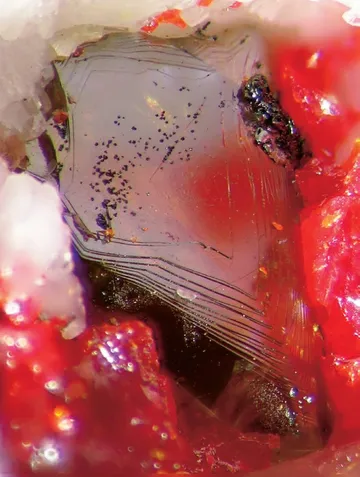
Cafarsite is the emblematic Wanni glacier - Scherbadung mineral: dark brown to nearly black, internally deep red in thin splinters, and typically occurring as well-shaped but somewhat rough-faced crystals on gneiss, quartz or smoky quartz with chlorite, hematite, magnetite, asbecasite and other arsenic-bearing species. Classic crystals show cubic, octahedral, dodecahedral and related forms, with older descriptions giving crystals to about 3 cm and collector records from the broader Cervandone/Scherbadung belt noting exceptional larger pieces; most obtainable examples are far smaller, and a sharp 5–10 mm crystal on attractive pale matrix is already a desirable specimen. Good Wanni cafarsite is judged by form, isolation, lack of heavy oxidation, contrast against quartz or chlorite, and firm provenance to the Swiss type-locality area; ordinary pieces are crowded, dull, broken, or so altered that the cafarsite form survives only as brown crusts or replacement material.
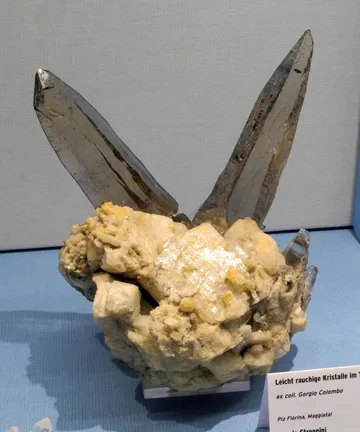
Quartz from Wanni glacier - Scherbadung is important less as a stand-alone Swiss Alpine quartz locality than as the structural and aesthetic stage for the rare species: clear to smoky crystals line fissures in the gneiss and pegmatitic dikes, and small quartz crystals commonly accompany cafarsite, chlorite, albite/adularia, hematite, fluorite and REE minerals. In the best specimens, quartz provides bright relief against dark cafarsite or black cervandonite-(Ce), while smoky quartz can intensify the Alpine character of the piece. Collector-quality quartz here is therefore judged by association and context—clean fissure crystals carrying cafarsite or rare arsenates outrank ordinary loose quartz, and matrix pieces that preserve the original cleft surface are far more meaningful than anonymous quartz fragments.
Asbecasite from Wanni glacier - Scherbadung is a type-locality species and one of the defining microscopic prizes of the locality, occurring as yellow to lemon-yellow rhombohedral crystals on cleft faces in orthogneiss of the Monte Leone nappe. Published descriptions give crystals up to about 5 mm, though many collector specimens show sub-millimetric to a few-millimetre crystals, commonly with chlorite, cafarsite, quartz, adularia, clinochlore and tourmaline. The best pieces show transparent, lustrous, sharply outlined yellow rhombohedra with minimal crowding and clear association; lesser pieces may be rich but granular, partly hidden in chlorite, or require analytical confirmation because small yellow-brown grains from this chemically complex assemblage can be visually misleading.
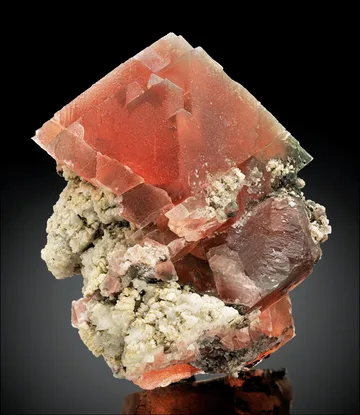
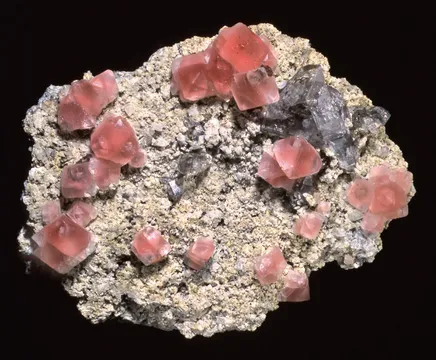
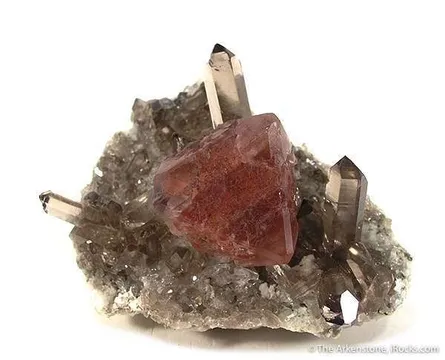
Fluorite is a scarce but highly appealing accessory at Wanni glacier - Scherbadung, known in the Cervandone/Scherbadung fissure assemblage with cafarsite and other Alpine-cleft minerals rather than as large standalone fluorite specimens. The most desirable examples are small, translucent pinkish, yellowish or pale fluorite crystals or crystal fragments in direct association with cafarsite, quartz and gneiss matrix; a modest centimetre-scale field of view can be more significant here than a larger but association-free fluorite from a common locality. Condition and provenance are critical: good pieces show recognizable fluorite crystal form or color, sit naturally in the fissure association, and are not confused with fluorites from better-known Binntal or Devero localities nearby.
Cervandonite-(Ce), named for the Cervandone/Scherbadung mountain, is a co-type rarity from the Swiss and Italian sides of the ridge and occurs in two-mica gneiss fissures as black, lustrous, saddle-like to rosette aggregates, with published type material reaching about 4 mm in diameter. Wanni glacier specimens are generally miniature or micromount material in which small black aggregates stand out against pale Alpine matrix; associations may include quartz, hematite and other arsenic- and REE-bearing phases from the same fissure environment. Fine pieces are those with crisp, lustrous rosettes or saddle forms that can be visually distinguished without ambiguity; ordinary pieces may look like anonymous black oxide specks unless the label, association and analytical history are strong.
Anatase from the Wanni glacier - Scherbadung area belongs to the titanium-rich Alpine fissure story of the Cervandone/Binntal border country, where niobian anatase, rutile, titanite and related Ti-Nb phases occur with quartz, hematite and rare arsenic-bearing minerals. Specimens are typically small, lustrous crystals or microcrystals rather than large cabinet anatase, and the most collectable examples show sharp blue-black to black crystals on quartz, gneiss or hematite-bearing matrix, ideally with a known Wanni provenance rather than a vague “Binntal” label. Good pieces offer crisp form and association; lesser examples are easy to overlook or confuse with other dark oxides unless the crystal habit is clear or analysis has been done.
Synchysite-(Ce) at Wanni glacier - Scherbadung is part of the REE-carbonate/arsenate subsystem, especially in the Wanni glacier REE-mineralization and in related Alpine fissure material near the Cervandone ridge. It is significant both as a rare-earth carbonate in its own right and because alteration relationships with gasparite-group arsenates are documented from the Cervandone/Wanni setting; specimens may present as small yellowish to brownish crystals or aggregates with quartz, albite, titanite and other REE-bearing phases. The best collector pieces are not merely “synchysite present” micromounts, but specimens with recognizable crystals, good contrast, and ideally analytical confirmation, since small REE carbonates and arsenates from this district can be visually similar.
Beyond these headline species, Wanni glacier - Scherbadung has documented an impressive rare-mineral suite for such a compact high-Alpine setting. Type- or co-type-locality minerals include asbecasite, cafarsite, cervandonite-(Ce) and gasparite-(La), while gasparite-(Ce), agardite-(Y), chernovite-(Y), crichtonite/senaite-series material, fetiasite, fergusonite-(Y), aeschynite-(Y), euxenite-(Y), uranopolycrase, thorite, tilasite, titanite, zircon, rutile including niobian rutile, hematite, calcite, cerussite, azurite, malachite, brochantite, antlerite, linarite, cyanotrichite, chalcophyllite and zeunerite reflect the chemically diverse Cu-As-Pb-Fe-REE-Ti-Nb environment. Several of these occur as microscopic or analytically demanding phases, so the locality is particularly attractive to collectors who value labels, paragenesis and confirmed identifications as much as hand-specimen beauty.
Wanni glacier - Scherbadung specimens demand careful labeling and, for rarities, caution in identification. “Monte Cervandone,” “Scherbadung,” “Cherbadung,” “Wannigletscher,” “Wanni Glacier,” “Binntal” and “Devero” are often used imprecisely in the market, but Swiss-side and Italian-side material are not interchangeable. Old labels may also use historic names or broad regional wording. For important cafarsite, asbecasite, cervandonite-(Ce), gasparite, synchysite-(Ce), chernovite-(Y), crichtonite/senaite-series or niobian anatase specimens, provenance and analytical confidence matter strongly.
The most common authenticity problem is not deliberate fakery so much as overconfident visual identification. Dark cafarsite can be confused with hematite, crichtonite/senaite-series oxides, magnetite-like grains or other black-brown fissure minerals; altered cafarsite may be coated or replaced by green secondary arsenates such as agardite-(Y) or mixite-like material. Asbecasite is usually small and yellow, and small yellow grains in a complex Alpine fissure association should not be accepted on appearance alone unless the specimen comes with a strong provenance or analytical history. Cervandonite-(Ce) can resemble anonymous black rosettes or oxides to the unaided eye.
Condition issues are typical of high-Alpine fissure specimens: crystals may be naturally rough-faced, etched, oxidized, chlorite-coated or broken by frost and movement in clefts. Cafarsite commonly shows brown oxidation on edges or faces, and some specimens are more interesting scientifically than beautiful aesthetically. Matrix pieces with intact gneiss, quartz and chlorite are preferable to loose crystals, but friable matrix should be handled gently. Fluorite, where present, may be small and edge-worn; quartz and feldspar matrices can be prone to bruising at exposed points.
Handling considerations are real for a subset of the suite. The locality includes Th- and U-bearing minerals such as thorite, uranopolycrase and zeunerite, and some REE phases may contain thorium. Ordinary display specimens of cafarsite or asbecasite are not a special hazard when handled sensibly, but micromounts or rich specimens containing known radioactive species should be stored with labels intact, kept out of children’s reach, not abraded or cleaned aggressively, and checked with appropriate instruments if the assemblage is uncertain. Arsenic-bearing minerals should not be ground, acid-cleaned casually, or handled in ways that generate dust.
Market availability is limited but not nonexistent. Cafarsite appears regularly enough that a patient collector can find Wanni or Cervandone/Scherbadung specimens, though sharp, aesthetic, matrix pieces with crystals over several millimetres command a premium. Asbecasite, cervandonite-(Ce), gasparite and synchysite-(Ce) from the locality are far scarcer and often trade as micromounts or small systematic specimens. The best pieces combine four things: precise Swiss-side provenance, visible diagnostic crystals, attractive Alpine matrix, and documented association.
One of the most repeated stories from the Cervandone/Scherbadung district belongs to Anton Imhof of Binn. In the summer of 1965, on the Italian southeast side of Scherbadung—strictly the Monte Cervandone side—he found cafarsite crystals exceeding 3 cm on an edge and reaching weights up to 48 grams. That is an astonishing scale for a mineral many collectors know only as millimetric black-brown crystals on gneiss. The find also captures the cross-border character of the mountain: the same ridge that gives Swiss labels “Scherbadung” gives Italian labels “Cervandone,” and the mineralogical story runs across both sides even when precise locality names must remain separate.
Another memorable episode is quieter but deeply satisfying to collectors of historical specimens. Weathered cafarsite crystals with quartz and hematite preserved in the Carl Bosch collection predated formal recognition of the species by many decades; the penciled identification on the old label interpreted the material as pseudomorphs after pyrite. That misidentification is entirely understandable: dark, rough, roughly equant crystals on pale Alpine matrix could easily look like replaced pyrite before the arsenite chemistry of the Wanni/Cervandone area was understood. Seen today, such old-label specimens are doubly important—mineralogically as cafarsite and historically as evidence that the locality was yielding new-species material long before anyone knew what it was.
The modern collecting culture of Binntal gives the locality another layer of meaning. Strahlen—the search for Alpine crystals and minerals—was recognized by the canton of Valais as a living tradition in 2024, and the Binntal park literature ties that tradition to a very long human relationship with crystals: Stone Age hunters using crystals for tools, Celtic deposits of rock crystal, nineteenth-century scientists and collectors entering the valley, and local mountain families earning money from mineral finds. Wanni glacier - Scherbadung is one of the places where that culture meets cutting-edge mineralogy: a steep, difficult Alpine landscape where local field knowledge supplied the specimens that crystallographers and mineralogists turned into new species.