Wah Wah Mountains, USA: source of gem-quality red beryl at the Ruby Violet mines; prized for vivid color, sharp hexagonal prisms, and cabinet specimens.
Key facts
The Wah Wah Mountains of western Utah occupy a special place in American mineral collecting because one small volcanic system on the range’s eastern flank produced the world’s only long-lived commercial source of gem-quality red beryl. The collector locality is centered on the Ruby Violet claims, also known historically as the Violet claims, Harris mine, Ruby-Violet mine, and Red Emerald mine, in Beaver County west-southwest of Milford. Unlike the pegmatite beryls familiar from Maine, California, Pakistan, or Brazil, Wah Wah red beryl formed in a fluorine-rich topaz rhyolite, principally along cooling fractures where late magmatic vapor, heated groundwater, and altered volcanic glass created an unusually narrow chemical window for Be3Al2Si6O18 colored raspberry to purplish red by manganese.
For specimen collectors, the importance of the Wah Wah Mountains is not simply that red beryl is rare; it is that the locality produced genuine cabinet-quality mineral specimens with intense color, recognizable hexagonal form, and pale volcanic matrix. The best pieces show sharp, lustrous, prismatic crystals standing from cream, gray, or buff rhyolite, sometimes singly and sometimes in tight clusters. Many crystals are small, but the visual impact of even a 5–15 mm crystal can be outsized when the color is saturated and the crystal is perched cleanly on contrasting rhyolite. Fine specimens combine three things that are seldom seen together here: strong raspberry-red color, complete prism-and-pinacoid form, and undamaged exposure from the host rock.
Regional View
Country View
Geologically, the locality belongs to the eastern Basin and Range Province, where Paleozoic and Mesozoic sedimentary rocks were later broken, intruded, overlain by Oligocene and Miocene volcanic rocks, and tilted during extension. The red beryl-bearing rhyolite is part of the Blawn Wash volcanic assemblage and is intimately tied to the same southwestern Utah volcanic architecture that produced alunite, fluorite, uranium, iron, lead-zinc-silver occurrences, and other small but mineralogically interesting deposits around Blawn Mountain, Pine Grove, Wah Wah Summit, and adjacent districts.
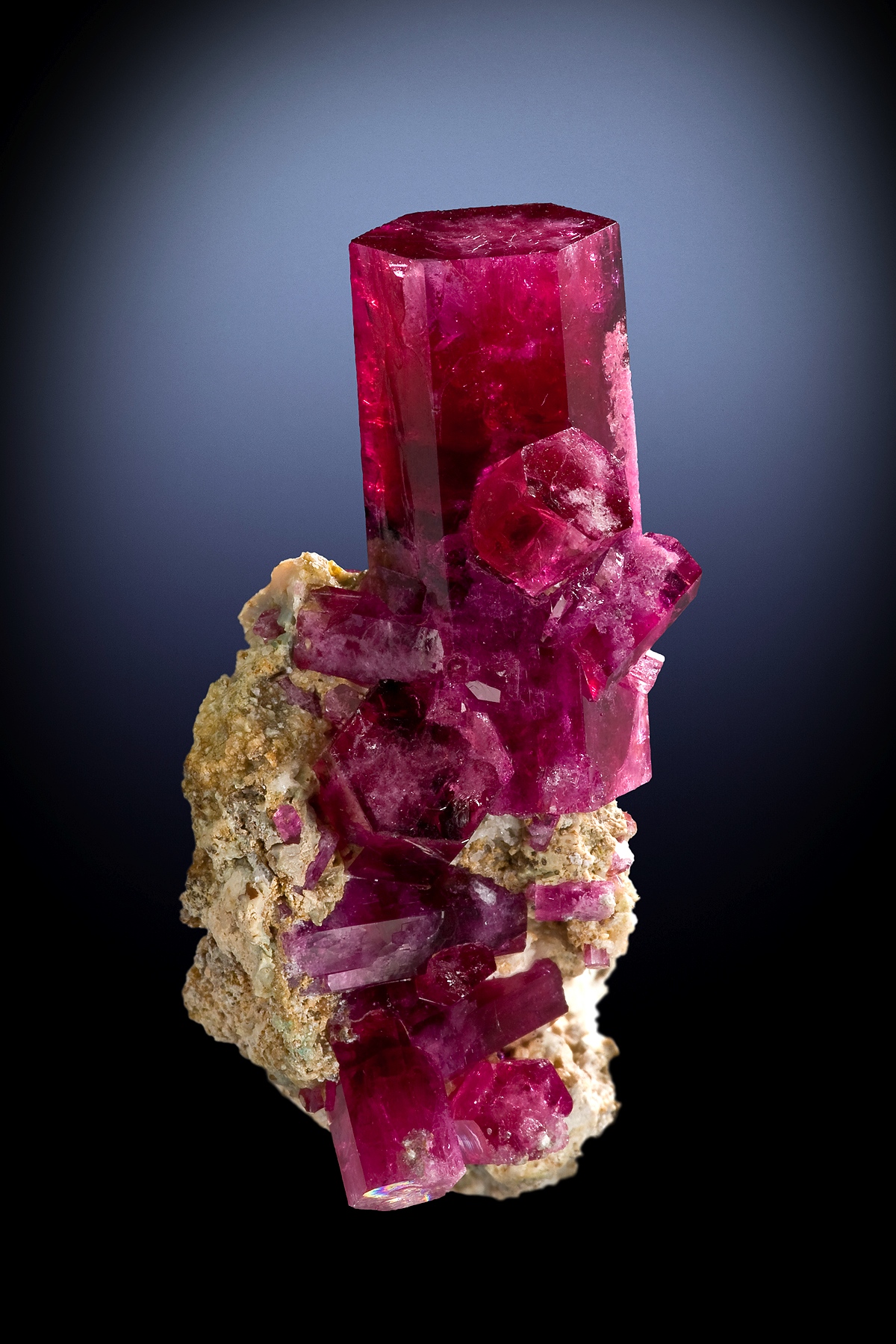
Photo: Wikimedia Commons
Historically, the range sits at the intersection of two collecting identities. To gemologists it is the red beryl locality: a mine studied by GIA, Kennecott Exploration, academic geologists, and Utah collectors because it turned an obscure red beryl occurrence into a commercial gem and specimen source. To field collectors it is part of the broader western Utah desert-mineral province: remote roads, volcanic ridges, fluorite-uranium prospects, skarny iron showings, and the long tradition of carefully labeled Utah thumbnails and matrix specimens.
Search for specimens: View all specimens from Wah Wah Mountains, USA
The collector locality most closely associated with the Wah Wah Mountains is the Ruby Violet red beryl deposit on the eastern flank of the southern range, roughly 25 miles west-southwest of Milford, Utah. The mine area lies in pale, flow-banded, porphyritic topaz rhyolite with alkali feldspar, quartz, minor biotite, volcanic glass, and local clay alteration. The red beryl does not belong to a pegmatite or a conventional hydrothermal vein system; it is a volcanic vapor-phase and fracture-controlled beryllium occurrence. The key productive structures are discontinuous, near-vertical fractures produced as the rhyolite cooled and contracted. Many are clay-filled, locally kaolinitic, smectitic, yellow-brown, or dark stained, and some carry the red beryl with silica phases and manganese-iron oxides.
The red beryl-bearing rhyolite is exposed across several square kilometers, but the productive portion is much smaller. GIA’s review of the deposit described red beryl over an area about 900 by 1,900 meters, with the more mineralized exposed zone occupying a long, narrow belt on the order of 50 by 850 meters. Within individual productive fractures, red beryl may occur in dense local concentrations that continue vertically for meters and horizontally for tens of meters; yet nearby fractures can be barren, and even the same fracture can change abruptly from promising to sterile. This erratic distribution is why the mine has always been a difficult source for both gem rough and display specimens.
The best-known mineral assemblage of the Ruby Violet claims includes red beryl, bixbyite-(Mn), hematite, silica minerals including quartz, cristobalite and tridymite, feldspar, clay minerals, and rare topaz. Earlier descriptions emphasized minor bixbyite as the most obvious associated mineral, while later work placed the red beryl mostly along or near clay-filled fractures rather than in the open lithophysal cavities that produce topaz and garnet at some other Utah rhyolite localities. In hand specimen, this matters: the classic Wah Wah matrix is compact, fine-grained rhyolite, commonly pale gray, cream, or buff, not a coarse pegmatitic matrix and not the open topaz-pocket style that collectors associate with the Thomas Range.
Lamar Hodges of Fillmore discovered the Wah Wah red beryl occurrence in 1958 while prospecting unsuccessfully for uranium. The Hodges family worked the claims, then known as Violet Claims 1–8, and early mining developed the deposit to depths of roughly 20 meters. The Harris family acquired the property in 1976 and became the principal source of commercial red beryl for both faceting and mineral specimens. From 1976 to 1994, the deposit reportedly yielded about 0.5 carat of facetable red beryl per ton of ore, with at least 2,000 tons extracted annually during that period. Most gem-quality material recovered in that era came from the lower pit, where red beryl-bearing fractures occurred every few meters.
In March 1994, Kennecott Exploration Company entered into a lease with the Harris family and carried out the most intensive technical evaluation of the deposit. Kennecott mapped, drilled, bulk sampled, drove underground workings, and tested mechanized recovery. The company recovered nearly 13,000 feet of core from 56 drill holes and, during an underground bulk-sampling program begun in November 1995, removed nearly 11,000 tonnes of rock from almost 600 meters of tunnels. The program established a much clearer picture of fracture controls and ore grade, but a planned large-scale recovery route—quarrying rhyolite, crushing it, and chemically dissolving host rock by a caustic-fusion method—proved uneconomic compared with hand picking crystals from crushed ore. A trial crushing plant near Cedar City could process about 10 tons of ore per hour, after which material was hand picked and sorted into non-gem, near-gem, and gem categories.
After Kennecott’s colored-gemstone initiative ended in 1996, Utah-based Gemstone Mining Inc. took up the project in 1997, acquiring Kennecott’s produced material, data, and processing plant and later working the deposit by open-pit methods under the Red Emerald mine name. The project defaulted in 2001 after a missed payment to the Harris family. Mining and production ceased, the Bureau of Land Management became involved on behalf of the owners, and reclamation began in August 2001: pits were filled, waste rock removed, surfaces restored, topsoil replaced, seeding completed, and structures removed. The Harris family subsequently regained ownership, and more recent owner material has described the property as preserved after decades of mining and exploration, with any future transfer or development handled privately.
The broader Wah Wah Mountains locality includes more than the red beryl mine. The Pine Grove district on the west side of the range includes the Wah Wah lead-zinc-silver-gold mine, also called the Tasso mine, with galena, sphalerite, pyrite, chalcopyrite, cerussite, smithsonite, hematite, quartz, native silver, and minor native gold reported from carbonate, quartzite, and shale host rocks. The Wah Wah Summit district contains small iron prospects related to Oligocene intrusive rocks in Cambrian carbonates, while the Blawn Mountain area to the south and southeast is known for alunite, kaolinite, fluorite, uranium minerals, iron oxides, and related volcanic alteration. These occurrences explain why older collections sometimes carry broad “Wah Wah Mountains” labels for species that did not come from the Ruby Violet claims themselves.
Collecting access today must be treated carefully. The Ruby Violet mine is a private mineral property and historically has been gated; collecting there requires permission from the land and mineral-rights holders. Much of the range is administered by the Bureau of Land Management, and parts of the Wah Wah Mountains are within wilderness study areas where surface disturbance, claim status, vehicle use, and collecting rules require current verification before any field visit. Serious collectors should assume that mine workings, pits, altered ground, and historic claims are not open casual collecting sites, and that old “self-collected” red beryl labels deserve the same scrutiny as the crystals themselves.
Beryl from the Wah Wah Mountains means, above all, red beryl: raspberry, crimson, red to purplish-red Be3Al2Si6O18 in small but intensely colored hexagonal prisms from the Ruby Violet claims. Crystals usually show simple prism faces capped by flat, and less commonly stepped, basal pinacoids; many are elongated parallel to the c-axis, commonly with length-to-width ratios around 4:1 or greater. Published studies report crystals up to more than 2 cm wide and about 5 cm long, but most gem-quality crystals are under 1 cm, and display-quality matrix specimens are prized less for size alone than for complete form, color saturation, luster, and the way the crystal emerges cleanly from pale rhyolite. Associations include clay-altered topaz rhyolite, bixbyite-(Mn), hematite, quartz, cristobalite, tridymite, feldspar, kaolinite-smectite alteration, and rare topaz. Good Wah Wah beryl pieces should look unmistakably volcanic: sharp red prisms on compact rhyolite, not loose red chips, not pegmatitic matrix, and not vague pink mineralization smeared through rock.
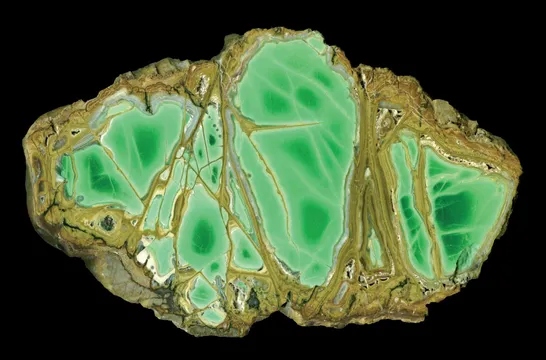
Variscite attributed to the Wah Wah Mountains is far less central to the locality’s published identity than red beryl, and collectors should distinguish broad regional “Wah Wah Mountains” labels from Utah’s classic variscite districts such as Clay Canyon/Fairfield and Lucin. When Wah Wah-labeled variscite appears in collector or marketplace circulation, it is best judged as a compact hydrated aluminum phosphate material rather than as a crystal-specimen suite from the Ruby Violet red beryl mine: expect opaque to slightly translucent green masses, seams, nodular patches, or cuttable fragments rather than open, isolated crystals. The best pieces are those with strong, even apple- to bluish-green color, pleasing webbing or contrast against pale to dark matrix, and an old or precise label trail; ordinary pieces are pale, chalky, fractured, or ambiguously labeled “Utah variscite” without evidence tying them to the Wah Wah Mountains proper.
Other documented minerals from the Wah Wah Mountains and its sublocalities reflect several distinct geological environments rather than a single pocket assemblage. At the Ruby Violet claims, the important rarities are bixbyite-(Mn), red beryl, hematite, ilmenite, silica polymorphs, feldspar, clay minerals, and rare topaz in rhyolite. In the Pine Grove district, the Wah Wah mine adds a base-metal suite of galena, sphalerite, pyrite, chalcopyrite, cerussite, smithsonite, quartz, hematite, native silver, native gold, and limonite after sulfides. The Blawn Mountain and related altered volcanic areas add alunite, kaolinite, fluorite, autunite and metatorbernite in the broader region, while Wah Wah Summit skarn and contact prospects account for green grossular and garnet-group material in carbonate rocks. No major IMA mineral species is famous as a Wah Wah Mountains type-locality mineral in the way that red beryl is famous as a gem variety here; the range’s mineralogical stature rests instead on being the definitive commercial source of gem red beryl.
The first authenticity issue with Wah Wah Mountains specimens is locality precision. “Wah Wah Mountains” is a legitimate regional label, but it covers multiple districts, mines, prospects, and geological settings. A red beryl specimen should ideally be labeled Ruby Violet claims, Violet claims, Harris mine, Ruby-Violet mine, or Red Emerald mine; a base-metal specimen should specify the Wah Wah mine/Tasso mine or Pine Grove district; a fluorite-uranium specimen may belong to the Blawn Mountain or Staats/Monarch area; and green garnet or iron material may relate to Wah Wah Summit prospects. Broad labels are common in the trade, but broad labels should not be allowed to turn an ordinary western Utah mineral into a Ruby Violet red beryl specimen by implication.
For red beryl, confusion with other red stones is less common in matrix specimens than in loose gems, because the classic habit and rhyolite matrix are distinctive. However, loose crystals, broken fragments, and faceted stones require more care. Hydrothermal synthetic red beryl became commercially available in the 1990s and can be separated from natural Wah Wah material by crystal morphology, inclusions, internal features, spectra, and chemistry. Natural red beryl from the Wah Wah Mountains is characteristically fractured and included; many stones contain solid, fluid, or fluid-and-gas inclusions, healed “fingerprint” fractures, color zoning, quartz and feldspar inclusions, and black hematite or bixbyite grains. A perfectly clean, saturated, unusually large red stone with a vague Wah Wah claim is a gemological red flag until tested.
Treatments are part of the red beryl market. Published GIA work reports that red beryl is not normally treated by heating or irradiation, but fractured crystals and faceted stones have commonly been clarity enhanced with colorless substances, including paraffin wax, Opticon, cedarwood oil, Canada balsam, and epoxy resin fillers such as Gematrat. For mineral specimens, this means buyers should ask whether a crystal has been oiled, waxed, resin-filled, glued, stabilized, or repaired, especially if the piece shows a glossy surface in fractures or suspiciously improved transparency. Fine matrix crystals are so valuable that trimming, repair, and fracture filling must be assumed possible until disproven.
Condition is the decisive grading factor. Wah Wah red beryl crystals are often partly embedded, fractured, etched, rehealed, or broken from the rhyolite during recovery. Because many crystals formed along clay-filled fractures, extraction can leave missing contacts, bruised terminations, clay skins, or tiny chips on prism edges. A crystal with a complete flat termination, undamaged prism faces, saturated color at the exposed end, and attractive placement on rhyolite is far more desirable than a larger but broken or buried crystal. Doubly terminated crystals, intergrown groups, and specimens with multiple well-positioned crystals are exceptional.
Fluorescence should not be oversold. GIA’s work notes lack of ultraviolet fluorescence in red beryl, so fluorescence in associated crusts or matrix should not be used as proof of red beryl itself. Radioactive accessory minerals are documented in the broader Wah Wah and Blawn Mountain region, particularly uranium minerals such as autunite and metatorbernite at certain sublocalities, so specimens from those prospects should be handled and stored with the normal precautions used for uranium minerals. Red beryl specimens themselves are generally collected, displayed, and stored as delicate gem crystals on matrix: protect them from abrasion, avoid aggressive cleaning, and do not soak matrix pieces in solvents without knowing whether any filling or stabilizing material is present.
Market availability remains limited. Small loose crystals and included faceted stones appear periodically, but fine matrix specimens are genuinely scarce and have long been absorbed into advanced private collections. The largest and most aesthetic Wah Wah specimens are famous enough to have individual collecting histories. Modern offerings should be evaluated on color, crystal completeness, matrix authenticity, label specificity, treatment disclosure, and whether the price reflects a common chip, a thumbnail with one exposed crystal, or a true display specimen from one of the most important American gem-mineral localities.
In 1958, Lamar Hodges was not looking for a world-class gemstone. He was prospecting for uranium in the Wah Wah Mountains, part of the same mid-century western search pattern that scattered Geiger counters, claim posts, and small pits across Utah’s volcanic desert. The uranium hunt failed, but the fractured rhyolite gave up red beryl—small, vivid crystals unlike the familiar green, blue, golden, or colorless beryls of pegmatites. That accident is part of the charm of the locality: the definitive commercial source of gem red beryl began as a wrong-target discovery in a lonely volcanic range west of Milford.
The early mine was not an elegant underground jewel box. It was rhyolite, clay-filled fractures, pockets of promise, and a great deal of barren rock. The Hodges family worked the original Violet Claims 1–8, and later the Harris family pushed the deposit deeper, ultimately developing it to about 20 meters below the surface. Recovery was slow and tactile. Productive fractures were exposed with blasting and equipment, but the crystals themselves still had to be found by hand. The lower pit became the heart of production because red beryl-bearing fractures appeared there every few meters; even so, the reported yield from 1976 to 1994 was only about 0.5 carat of facetable material per ton of ore.
The 1990s brought a remarkable corporate experiment to a locality that had largely been a family-run source. Kennecott Exploration took a lease in March 1994 and treated the Ruby Violet deposit as a problem to be solved with mapping, drilling, underground bulk sampling, and process engineering. The numbers are striking: 56 drill holes, nearly 13,000 feet of core, almost 600 meters of tunnels, and about 11,000 tonnes of rock removed during the bulk-sampling program. Kennecott even developed a proprietary caustic-fusion technique with Lakefield Research in Ontario to dissolve rhyolite and liberate the red beryl crystals. It worked technically, but not economically. The romance of the red beryl mine kept returning to the same stubborn fact: the crystals were too rare, too irregularly distributed, and too valuable as intact specimens to behave like an ordinary ore mineral.
The processing plant near Cedar City had its own almost cinematic image: crushed pale rhyolite moving along a conveyor through a recovery room while workers hand-picked red crystals from the stream. Material was sorted into non-gem, near-gem, and gem categories; the better concentrate was cleaned, re-sorted by gemologists, and eventually faceted in Thailand, with some melee-size material cut in Bogotá. Then the corporate initiative ended. Internal restructuring at RTZ, Kennecott’s parent company, shut down the colored-gemstone program at the end of 1996, leaving the Ruby Violet mine as one of those rare deposits where sophisticated engineering proved the geology but did not create an easy mining business.
The next chapter was more turbulent. Gemstone Mining Inc. took over the large-scale dream in 1997, purchased Kennecott’s cut and uncut material and data, and worked the deposit under the marketable Red Emerald name. By December 1998 the option agreement had been restructured and open-pit mining began. In June 2001 a scheduled payment was missed; the contract defaulted; mining and production stopped. Reclamation followed in August 2001, and the site was physically softened back into the landscape—pits filled, waste rock hauled away, surfaces restored, topsoil replaced, seed spread, and structures removed. For collectors, that reclamation is one reason old labels and mine-era provenance matter so much: many of the productive surfaces that once yielded specimens were deliberately buried.
One Wah Wah specimen has become almost mythic in collector literature: a small-cabinet red beryl from the Harris Claim, 6 x 2.7 x 2.6 cm, with a dominant crystal described as 2 inches long. It was mined and sold directly to F. John Barlow in the early 1990s, and the Wikimedia Commons description, drawn from the iRocks/Mindat record, calls it “one of the finest and most unique American mineral specimens in existence.” Whether one accepts every superlative or not, the story captures the locality’s collector psychology perfectly. Barlow assembled a core suite of 14 remarkable red beryl specimens and made the Wah Wah Mountains a pursuit in which a single crystal on rhyolite could become a landmark American specimen.