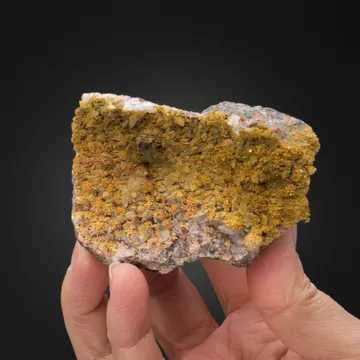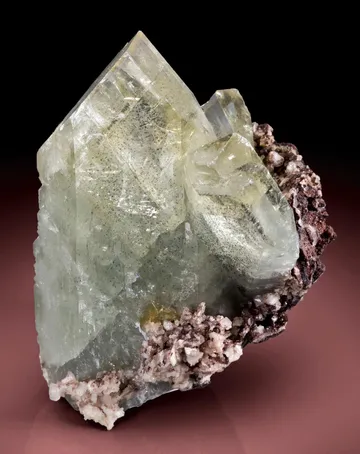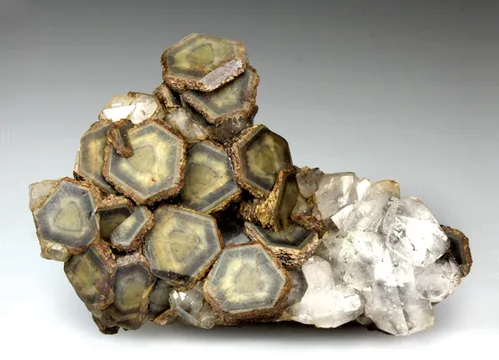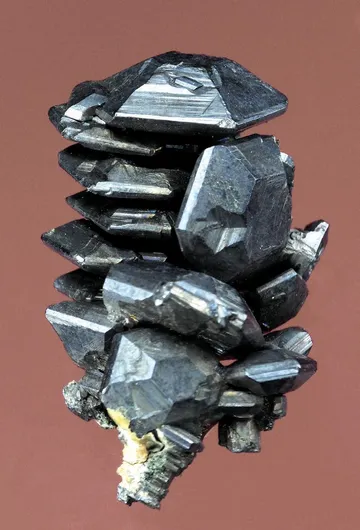
Virtuous Lady Mine, UK — classic British locality famed for siderite epimorphs (boxes, Lady's Slippers) and copper-tin-iron minerals, a magnet for collectors.
Key facts
Virtuous Lady Mine is one of the classic British specimen localities: a small West Devon copper-tin-iron mine whose fame among collectors rests far less on tonnage than on the extraordinary carbonate epimorphs it yielded. It lies in Buckland Monachorum parish, on the south side of the River Tavy close to the confluence with the Walkham, in the wooded, steep-sided country just south of Tavistock. The mineralization belongs to the Tavistock–Dartmoor borderland of hydrothermal lodes cutting altered slaty country rock, the miners’ “killas,” in the broad metalliferous province of Cornwall and Devon.
Collectors know Virtuous Lady above all for siderite: not merely ordinary brown rhombohedra, but curved, lustrous, disc-like, scaly, botryoidal, and epimorphic forms that are instantly recognizable. The best pieces combine chocolate-brown siderite with milky to iron-stained quartz, brassy pyrite, chalcopyrite, arsenopyrite, and the peculiar hollow casts historically called “boxes” and “Lady’s Slippers.” The “boxes” are siderite casts after cubic fluorite, often with quartz and chalcopyrite crystallized inside the empty space. The “Lady’s Slippers” are long, flattened, tapering hollow epimorphs, usually interpreted as siderite after baryte, though anhydrite or another sulphate precursor has also been discussed. In British pseudomorph collecting, few localities have produced forms as eccentric, sculptural, and historically resonant.
Regional View
Country View
Historically, the mine was a copper producer with subordinate tin and iron minerals, worked intermittently over a long period and finally closed in the later nineteenth century. Its place in mineralogical literature was secured by Arthur Russell’s 1913 paper, which treated the locality not as a mere name on an old label but as a specimen-producing mine with a coherent suite, paragenesis, and set of unmistakable habits. Russell’s plates recorded capped quartz, mispickel, marcasite, siderite on quartz, siderite after fluorite, and the celebrated siderite after baryte forms in specimens up to cabinet size.
The finest Virtuous Lady specimens have an old-collection presence: warm brown siderite against pale quartz, hollow carbonate shells with ragged open interiors, pyrite dusting on curved blades, and the occasional “box” where the geometry of a vanished fluorite cube still dictates the whole specimen. Even small examples can be important if they show the locality’s diagnostic habits cleanly. A good thumbnail with crisp fish-scale siderite or a miniature with an undamaged hollow epimorph may be more desirable than a larger, structureless mass.
Search for specimens: View all specimens from Virtuous Lady Mine, UK
Virtuous Lady Mine is situated in Buckland Monachorum, West Devon, at about SX473698, on the south side of the River Tavy where the valley bends westward below Double Waters. The workings and dumps are spread across a moderate area rather than concentrated in one tidy mine yard. The older evidence is concentrated toward the western end of the site, near the craggy ground below Tavy Cottage, while shafts, adits, dressing floors, wheelpits, spoil heaps, and leat features occur across the slope and riverside ground.
The deposit is a hydrothermal vein system in killas, the metamorphosed slaty country rock so characteristic of the Cornubian mining field. The principal economic ores were copper minerals, with tin and iron also recorded. Chalcopyrite was the main copper ore, accompanied by pyrite, arsenopyrite, lollingite, cassiterite, fluorite, quartz, siderite, dolomite, and later secondary copper and iron species. Old accounts also drew attention to the unusual occurrence of copper in nearly horizontal “floors” at Virtuous Lady, rather than solely in steep fissure lodes, making the mine a useful historical example in discussions of Westcountry vein structure.
The gangue and open-space mineralization explain the collector appeal. Quartz formed as massive vein quartz, vug linings, crystals, and the distinctive capped quartz variety. Siderite developed on quartz, in scaly and disc-like aggregates, in curved-faced crystals, and as epimorphs around earlier minerals that were later removed. The fluorite precursor of the “box” epimorphs is inferred from the cubic form and the small mosaic-like impressions preserved inside some casts. The “Lady’s Slipper” form records a bladed precursor, traditionally baryte, though the absence of baryte on the modern dumps and the possibility of anhydrite have kept the identification open in specialist discussion.
The mine’s history is unusually layered. Traditions connect the name with Queen Elizabeth I and sometimes place the opening in the late sixteenth century, but firm documentary evidence is much safer from the early eighteenth century onward; Kahlmeter recorded the mine as established by 1724, and it appeared on Donn’s 1765 map of Devon. Lysons recorded it as abandoned by 1807, and later sources show intermittent renewed working from the 1820s through the nineteenth century. The main documented productive periods include 1825–1833, 1856, and 1870–1875, with final closure generally placed in the later 1870s.
Production figures reported for those documented periods give 4,320 tons of copper ore averaging about 7.5 percent copper, plus 6 tons of black tin in 1871–1872. By 1870, some workings were reported to have reached 120 feet, or about 36.5 metres, and the workforce numbered up to 43 people. The mine was at times worked in association with Wheal Bedford on the north side of the river, and surface features suggest a complex water-powered arrangement: crusher house, dressing floors, wheelpits, leats, capstan pit, shafts, and adits. Ore was crushed at the mine but not smelted there; accounts describe it being carried out by packhorse toward Orestocks and then by horse-drawn wagons to Morwellham, from which it was shipped to South Wales for smelting.
For collectors, the most important find period was the early nineteenth century, especially the 1832–1833 discoveries of “Lady’s Slipper” siderite epimorphs, which were found in some profusion and often near the “box” epimorphs. These specimens entered old British collections early, and many surviving examples have Victorian or later dealer labels. Russell’s 1913 paper drew heavily on such old material, including specimens in his own collection, and fixed the vocabulary by which the locality is still understood.
Collecting access today should be treated cautiously. The mine lies within Dartmoor National Park, and the remains include historic industrial archaeology as well as open or capped mine hazards. Underground access is not casual collecting access; the Devon & Cornwall Underground Council lists Virtuous Lady as requiring permission through DCUC. Surface spoil has produced modern finds of quartz, pyrite, goethite, dolomite, gypsum, brochantite, probable cyanotrichite, covellite, and small siderite-bearing vug material, but the classic epimorphs are historic underground specimens, not a realistic modern dump target.
Siderite is the signature mineral of Virtuous Lady Mine, occurring as dark to warm brown crystals and aggregates on quartz, as curved-faced and disc-like forms, as “fish-scale” overlapping plates, and most famously as hollow epimorphs after earlier fluorite and bladed sulphate crystals. Good specimens range from thumbnails with crisp 2–3 mm scaly siderite in quartz vugs to cabinet-size classics, including Russell’s figured examples: disc-like siderite on quartz at 14 x 9 cm, siderite-bearing quartz and mispickel groups at 18.9 x 6 cm, “box” epimorphs after fluorite around 7–9 cm, and large bladed “Lady’s Slipper” epimorphs up to 26 x 10 cm. The most desirable pieces show the locality habit unmistakably: a clean hollow cast, lustrous brown carbonate surfaces, undamaged edges, visible open interiors, pyrite dusting, or contrasting quartz and chalcopyrite. Ordinary pieces are massive brown siderite on vein quartz; fine Virtuous Lady pieces tell the paragenetic story at a glance.
Quartz from Virtuous Lady is far more than a background gangue mineral: it forms milky to iron-stained crystals and vein masses, lines vugs in killas-hosted quartz, occupies the interiors of siderite “box” epimorphs after fluorite, and occurs in the famed capped quartz habit for which the mine is an old British source. Capped quartz specimens consist of separable growth zones, commonly divided by thin films of clay or altered material; Russell figured a capped quartz specimen with detached cap at 18 x 8 cm, while modern gallery examples from the locality include hand-size pieces around 6 cm across and old specimens collected before about 1870. The best quartz pieces here are those with a clearly detachable cap, sculptural architecture, or sharp white quartz crystallized inside a siderite cast; plain massive quartz from the dumps is much less significant unless it carries siderite, pyrite, arsenopyrite, chalcopyrite, or other locality-characteristic associations.
In the Virtuous Lady collecting tradition, “barite” chiefly appears as the inferred vanished precursor of the “Lady’s Slipper” siderite epimorphs rather than as abundant surviving BaSO4 crystals. Dealers and older labels often catalogue these as siderite after barite, using the American spelling, because the elongated, flattened, bladed form was historically interpreted as a cast after baryte; Russell accepted barytes as the probable original mineral, while later writers have noted that anhydrite could mimic the morphology and that baryte has not been found on the modern spoil heaps. A worthwhile “barite” specimen from this locality, therefore, is usually a genuine siderite epimorph preserving the bladed barite/baryte morphology: thin, tapering, hollow, sometimes open along one flat side, and commonly dusted with pyrite. Damage, artificial trimming, or vague “after barite” labelling without the slipper form greatly reduces both confidence and collector value.
Baryte is the British spelling most often encountered in UK descriptions of Virtuous Lady “Lady’s Slipper” material, and it refers to the same bladed sulphate precursor traditionally invoked for the siderite epimorphs. The classic form is not a loose tabular baryte crystal but a siderite shell that preserves the lost baryte habit: flattened, elongate, hollow, tapering, sometimes doubly terminated, and sometimes encrusted or sprinkled with small pyrite crystals. Russell’s plate list included groups of parallel chalybite pseudomorphs after barytes, intergrown examples, open hollow interiors, and specimens ranging from roughly 9 cm to 26 cm. The best baryte-attributed Virtuous Lady pieces are those with an old label, an undistorted slipper outline, thin hollow walls, visible epimorphic slots, and pyrite or quartz association; ambiguous blades without provenance should be treated carefully, because the precursor identification remains mineralogically debated and the locality’s value lies in the historic epimorph rather than in preserved baryte.
Other documented minerals from Virtuous Lady include anatase, apatite group minerals, arsenopyrite, brochantite, brookite, cassiterite, chalcopyrite, chlorite group minerals, covellite, dolomite, fluorite, goethite, gypsum, lollingite, monazite group minerals, pyrite, scorodite, and probable or questioned childrenite and cyanotrichite. No accepted type-locality species defines the mine; its classic status is instead based on morphology, pseudomorphism, and old-collection specimen quality. Among the lesser species, anatase and brookite are of historical interest, arsenopyrite and lollingite tie the suite to the mine’s arsenide-bearing vein assemblage, and the questioned childrenite occurrence is notable because older British Museum material once labelled Virtuous Lady was later shown to be from George and Charlotte Mine, while tiny childrenite crystals were nevertheless identified on a probable Virtuous Lady “Lady’s Slipper” specimen.
Virtuous Lady specimens require close attention to labels, morphology, and condition. The locality is famous enough that vague old “Devon siderite” or “Tavistock chalybite” labels can be tempting to upgrade, but not every brown siderite on quartz from West Devon is Virtuous Lady. The safest attributions combine an old label with one of the locality’s diagnostic habits: fish-scale siderite, capped quartz, a siderite “box” after fluorite, or a “Lady’s Slipper” epimorph.
Mislabelling is a documented issue for at least some species. Childrenite is the clearest cautionary example: British Museum specimens once labelled from Virtuous Lady were shown to be from George and Charlotte Mine, though a tiny occurrence on a likely Virtuous Lady slipper specimen keeps the locality record plausible but not straightforward. For collectors, that means rare-species claims from this mine deserve more skepticism than siderite, quartz, pyrite, chalcopyrite, arsenopyrite, and the familiar epimorph habits.
The “after baryte” label on Lady’s Slippers should also be read intelligently. It is a traditional and widely used interpretation, not always proof that preserved baryte is present. Some modern discussion has raised anhydrite as a possible precursor, and the lack of baryte on the dumps complicates the matter. The specimen itself is still collectable as a Virtuous Lady siderite epimorph; the caveat concerns the identity of the vanished mineral.
Condition is central. Siderite epimorphs are hollow, thin-walled, and easily chipped along edges and openings. Many Lady’s Slippers are detached from matrix, and matrix specimens are scarcer. Box epimorphs should be checked for broken cube edges, repaired walls, filled interiors, glued quartz, or losses hidden by mounts. Capped quartz is often naturally separable, but detached caps and damaged inner terminations are common; a cap that still sits cleanly and naturally with the lower crystal is much preferred.
Pyrite from the mine can be stable, and some old specimens have survived for decades without deterioration, but any pyrite-rich piece should still be kept dry and monitored. Avoid humid cabinets, cellulose-based storage materials, and long exposure to damp air. Arsenopyrite- and lollingite-bearing material should be handled sensibly: wash hands after handling, avoid grinding or trimming indoors, and do not generate dust. Fluorescence is not the point of Virtuous Lady specimens; form, provenance, and paragenesis are.
On the market, ordinary siderite on quartz from Virtuous Lady appears occasionally, especially as miniatures and small cabinet pieces. Capped quartz is much scarcer. True Lady’s Slippers and box epimorphs are rare, old-collection objects; fine examples are usually already in major British collections, museums, or long-held private suites. When they appear for sale, prices reflect not only aesthetics but also the specimen’s place in the canon of British pseudomorphs.
The name itself has always carried a story. Local tradition ascribes “Virtuous Lady” to Queen Elizabeth I, and later writers repeated the idea that the mine was named in her honour. The documentary record is less romantic: secure evidence reaches the early eighteenth century, not the Tudor court. Still, the legend has stuck because the name fits the locality so uncannily. A mine hidden in oak woods above the Tavy, producing hollow slippers and fairy-like boxes of siderite, almost invites folklore.
Arthur Russell gave the mine its lasting mineralogical voice. On 12 November 1912 he presented “An account of the minerals found in the Virtuous Lady Mine, near Tavistock” to the Mineralogical Society, supported by a fine series of specimens. The published paper followed in 1913 with three plates, partly paid for by Russell himself. Those plates are still one of the great visual records of a British locality: capped quartz with the cap detached, mispickel partly coated with chalybite, fan-shaped marcasite on pyrite cubes, box epimorphs after fluorite, and the slipper-like siderite forms after barytes. Russell preserved not just the mineral names but the old miners’ vocabulary: “boxes” for the cubic casts and “slippers” for the bladed ones.
The underground mine had its own domestic strangeness. One main adit is associated with the old mine captain’s riverside house, and local folklore says a trap door in the floor gave access to the workings. The more believable detail is even better: from inside the workings, a dog barking in the property above could be heard clearly. It is a perfect Virtuous Lady image — a nineteenth-century mine passing almost under household life, the mineralized stopes and adits close enough to transmit the ordinary sounds of a home.
The mine’s surface remains tell a hard industrial story beside the collector romance. Ore was crushed on site but not smelted there. It left the valley by packhorse to Orestocks, then by horse-drawn wagon to Morwellham, and finally by water to South Wales for smelting. The wooded calm of the present riverbank hides a working landscape of shafts, wheelpits, dressing floors, leats, launders, reservoirs, and capstans. In 1870, workings reached about 120 feet and employed up to 43 people; the picturesque valley was also a machine for raising, crushing, and exporting copper ore.
There are twentieth-century memories too. Tavy Cottage, formerly associated with the mine, is remembered by locals in connection with Mrs Peggy Oxenford, who lived there in the 1970s and reportedly took visitors underground. One later recollection describes a 1976 school visit in which she showed remaining malachite in store-house walls, a crystal chamber lined with large quartz crystals, clear flooded shafts, and dry workings above water level. The same memory notes pyrite crystals found on the riverside heaps. It is a glimpse of Virtuous Lady at the edge of living memory: not yet entirely sealed away as literature and labels, but still a place where a knowledgeable resident could lead visitors into the old workings.
Arthur Russell, “An account of the minerals found in the Virtuous Lady Mine, near Tavistock,” Mineralogical Magazine and Journal of the Mineralogical Society, Vol. 17, Issue 78, December 1913, pp. 1–14 — the foundational locality paper, with plates of capped quartz, mispickel, marcasite, siderite on quartz, and siderite epimorphs after fluorite and barytes.
Arthur Russell, “An account of the minerals found in the Virtuous Lady Mine, near Tavistock,” PDF copy via RRUFF / Mineralogical Magazine archive — useful when accessible as a scan of the original article and plate explanations.
R. S. W. Braithwaite and B. V. Cooper, “Childrenite in South-West England,” Mineralogical Magazine, Vol. 46, Issue 338, 1982, pp. 119–126 — important for the questioned childrenite record and the correction of older Virtuous Lady labels.
Warington W. Smyth, Trenham Reeks, and F. W. Rudler, A Catalogue of the Mineral Collections in the Museum of Practical Geology, 1864 — later descriptive guide text discusses the Virtuous Lady “boxes” as examples of pseudomorphism, with carbonate of iron deposited on cubic fluorite and quartz/chalcopyrite crystallizing later inside the hollow casts.
J. H. Collins, A Handbook to the Mineralogy of Cornwall and Devon, 1871 — an early regional mineralogical listing, recording Virtuous Lady as a copper mine with anatase, brookite?, chalcopyrite, chalybite, chlorite, fluor, marcasite, mispickel, pyrites, and titanite.
D. and S. Lysons, Magna Britannia, Vol. VI: Devonshire, 1822 — includes the early record of capped quartz near Tavistock and in Virtuous Lady Mine.
Journal of the Russell Society, 2009, discussion of slipper epimorphs and capped quartz — valuable modern discussion of Virtuous Lady “Lady’s Slipper” epimorphs, the baryte versus anhydrite question, and comparable epimorphic processes.
Geological Curator, Vol. 7, No. 1 — records a Newcastle University / Great North Museum “Lady’s Slipper” specimen from Virtuous Lady, specimen NEWUM:3964, about 19 cm long.
Lizzie Burns / Natural History Museum mineral collection presentation, “Highlights and History of the Mineral Collection” — includes “The Box,” the Natural History Museum siderite epimorph after fluorite from Virtuous Lady, with cube edges about 9 cm, and discusses large “Lady’s Slipper” material.
Mindat: Virtuous Lady Mine, Buckland Monachorum, West Devon, Devon, England, UK — the most useful consolidated locality page, with coordinates, modern mineral list, brief history, and photo references.
Mindat gallery: Virtuous Lady Mine — specimen photographs showing siderite, Lady’s Slipper epimorphs, capped quartz, pyrite, anatase, and other locality material.
Heritage Gateway: Virtuous Lady Copper Mine, HER Number MDV5458 — historic-environment record for the mine, including archaeological summary, location, monument types, and source list.
Dartmoor Explorations: Virtuous Lady Mine — detailed field-style account of the visible mine remains, shafts, dressing floors, wheelpits, leat system, and modern landscape context.
Mining in Devon Database: Virtuous Lady Mine — concise production and commodity summary, including copper ore and black tin figures.
Devon & Cornwall Underground Council: Mine Access — current-style access reference indicating that Virtuous Lady underground access requires permission through DCUC.
Mindat: Capped Quartz gallery — includes Virtuous Lady capped quartz examples and explains the detachable cap habit.
Mindat: Lady’s Slipper occurrence record — occurrence page for the Virtuous Lady siderite variety “Lady’s Slipper.”
Mindat: Childrenite from Virtuous Lady Mine — useful cautionary record on the questioned childrenite occurrence and mislabelled British Museum material.
Mindat article: “Best Pseudomorphs & Replacements R to Z” — places Virtuous Lady siderite after baryte and siderite after fluorite among notable pseudomorph classics.
Crystal Classics news article featuring Virtuous Lady specimens — dealer perspective on the market desirability of Lady’s Slipper epimorphs, box epimorphs, and quartz from the mine.
Crystal Classics specimen archive: Siderite epimorph after baryte, Virtuous Lady Mine — example of a high-end labelled Lady’s Slipper specimen and modern catalogue language.