A collector's guide to Veracruz, Mexico: its geology, mining history and notable minerals, illustrated with the 192 specimens documented from this locality on EarthWonders.
Key facts
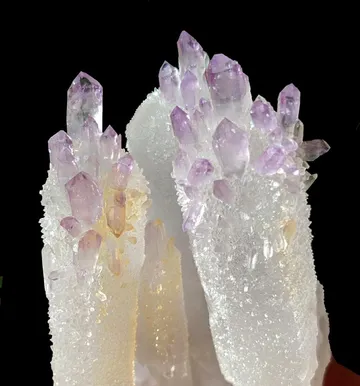
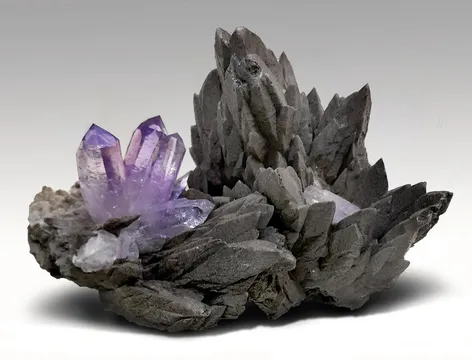
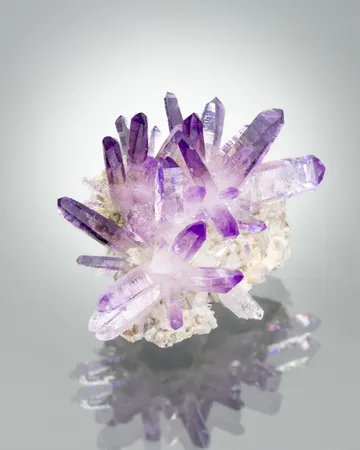
For mineral collectors, “Veracruz” means above all the elegant amethyst of the Piedra Parada–Las Vigas district: slender, glassy quartz prisms rising in lilac-to-violet sprays from pale drusy quartz, green epidote-rich matrix, or dark volcanic rock. The classic specimens are not the massive geode plates that define many Brazilian and Uruguayan amethyst fields; they are airy, architectural clusters—often sceptered, color-zoned, and transparent enough that the purple seems suspended inside the crystal rather than painted on it. Good examples have become a standard of comparison for aesthetic amethyst worldwide.
The collecting locality is best understood as part of the mountainous Tatatila–Las Minas–Las Vigas region of central Veracruz, on the eastern side of Mexico’s high volcanic country. The amethyst most familiar in the trade comes from small workings around Piedra Parada in Tatatila Municipality, commonly sold under the older and looser trade name “Las Vigas.” Geological descriptions differ in emphasis because the area contains both andesite-hosted amethyst fissures and the broader Las Minas–Tatatila skarn and ore system. The practical collector’s picture is clear: silica-rich hydrothermal fluids exploited fissures, cavities, and open spaces in volcanic and contact-metasomatic rocks, leaving room for quartz to grow as long, lustrous prisms rather than as compact geode linings.
Regional View
Country View
The history of the locality is unusually tied to specimen collecting rather than large-scale gemstone cutting. Loose amethyst had been known locally before the modern collecting boom, but serious development began when Alfonso Ontiveros recognized the material’s international potential in the 1960s and traced it to veins and pockets near Piedra Parada. Production remained small and hand-worked at first; later, drilling and more organized specimen mining brought larger lots into the American and European markets. By the 1980s and 1990s, Veracruz amethyst had become a staple of fine mineral shows, with the best plates and starbursts entering serious quartz and Mexican-mineral collections.
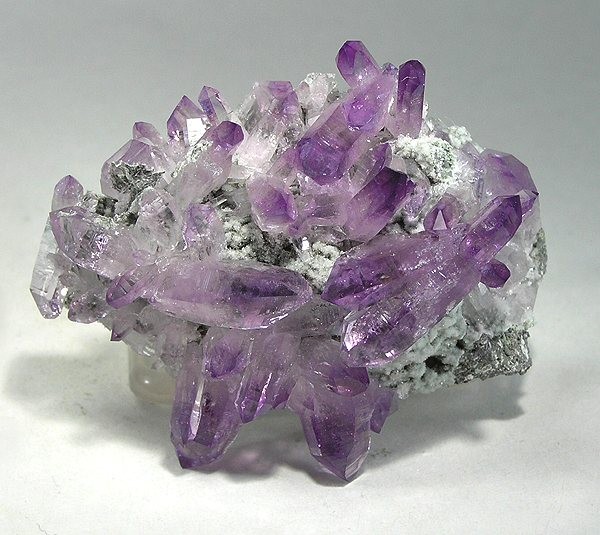
Photo: Wikimedia Commons
The best Veracruz pieces are judged less by darkness alone than by life: sharp terminations, brilliance, transparency, balanced spray or “flower” composition, undamaged tips, and purple zoning concentrated attractively toward the terminations or as internal phantoms. The locality also rewards close study beyond amethyst. The same district has produced andradite-group garnets including demantoid and topazolite, epidote associations, calcite, baryte, laumontite and other zeolites, smoky quartz, and feldspar-bearing pocket material from related intrusive or pegmatitic zones.
Search for specimens: View all specimens from Veracruz, Mexico
The specimen-producing district lies in the mountainous interior of Veracruz around Piedra Parada, Tatatila Municipality, north of Las Vigas de Ramírez and northwest of Xalapa. Although dealer labels have long used “Las Vigas,” Las Vigas is chiefly the market town and distribution point; the most precise classic label for many specimens is Piedra Parada, Tatatila Municipality, Veracruz, Mexico, with Cerro de la Concordia used for some garnet- and amethyst-bearing material nearby. Older labels may read “Vera Cruz,” “Las Vigas,” “Las Vigas de Ramirez,” “Piedras Parado,” or even incorrect Mexican states, and all such labels deserve scrutiny against the specimen style and provenance.
The amethyst workings are small, irregular, and discontinuous rather than a single industrial mine. Mexican geological mapping describes small rudimentary exploitations of cuarzo amatista around Piedra Parada, with crystals enclosed in an andesitic package mapped as Tpl A-Da. The quartz formed where hydrothermal solutions filled fissures and cavities in the andesite. This is why the finest specimens show free-grown crystals, open-space terminations, and delicate sprays rather than heavy massive quartz. The pockets can produce pale to medium violet amethyst, colorless quartz, smoky quartz, and drusy quartz bases; the best pieces carry strong terminal color or internal phantom zoning without losing transparency.
At the broader district scale, the amethyst locality sits near the Tatatila–Las Minas mineral belt, an important skarn and IOCG-related system in central Veracruz. The Las Minas area contains gold-copper-magnetite skarn mineralization, polymetallic veins, and intrusive contacts involving older carbonate rocks and younger igneous bodies. Mines and prospects reported in the district include El Rubí, El Polvorín, El Carmen, Cinco Señores, Boquillas, Santa Cruz, El Dorado, and related zones, with mineralization involving magnetite, hematite, chalcopyrite, bornite, pyrite, gold, silver, lead, zinc, and copper minerals. This ore geology is not the reason collectors buy Veracruz amethyst, but it explains the district’s mineral diversity and the presence of garnet-rich skarns, epidote, calcite, baryte, and later zeolite-bearing assemblages.
Historically, the amethyst trade moved from local surface collection to hand mining and then to more active small-scale specimen extraction. Alfonso Ontiveros, a miner and collector from Querétaro, is credited with recognizing the significance of the loose crystals and developing the source for the American market in the late 1960s. By the early 1980s, outside buyers and miners had begun leasing, financing, or buying directly from local producers, and pneumatic drills, generators, explosives, and improved trails changed both production and access. Even at its most productive, however, Veracruz amethyst remained a pocket-mining story: small groups of miners pursuing open spaces in steep, difficult country, not a uniform quarry or mechanized ore operation.
Production has been intermittent for decades. Mexican geological reports noted that there were no reliable production records because extraction was sporadic and rudimentary, even while some lots commanded substantial prices in European markets, especially Germany. Dealer and collector accounts describe strong production through the 1980s, a rush tied partly to the metaphysical quartz market, and a later shift toward selective buying as mid-grade loose crystals became less desirable. Modern material still appears, but the best older specimens—with saturated purple, undamaged tips, balanced matrix, and documented early provenance—are markedly more desirable than ordinary small pale sprays.
Access today should be treated as private, local, and permission-based. The workings are distributed across ejido and privately held land, with some active or inactive workings changing status as pockets are found or exhausted. The terrain is steep, humid in season, and locally hazardous, and active mines may involve narrow openings, poor ventilation, loose rock, explosives residue, and improvised supports. Collectors should not assume that a locality name on a label implies public collecting access. The ethical route is to buy from miners, established Mexican dealers, or reputable international dealers who preserve exact locality and provenance.
Several named or recognizable sources recur in specimen descriptions. Piedra Parada is the central locality name; Cerro de la Concordia is important for amethyst, demantoid, and topazolite associations; La Cascada appears in field accounts as a producing claim near a waterfall; and “Las Vigas” remains the commercial umbrella under which many of these pieces were exported. Old specimens with epidote-rich matrix, sceptered crystals, doubly terminated crystals, and grape-jelly purple zoning are especially prized because they record the most classic period of the locality.
Veracruz amethyst from Piedra Parada is famous for elongated, transparent quartz prisms in open sprays, flower-like clusters, and occasional scepters, with color ranging from pale lilac and lavender to strong violet and deeper “grape jelly” purple concentrated near terminations or in phantom zones. Typical crystals are small to miniature in scale, commonly a few centimeters long, with exceptional examples reported to about 10 cm and rare older claims of still larger crystals; complete cabinet-size plates are much scarcer than individual loose crystals. The most characteristic associations are drusy colorless quartz, epidote-rich green matrix, dark andesite, calcite, and local garnet-skarn material. Fine pieces stand apart by having lustrous glassy faces, undamaged points, enough matrix to frame the crystals without overwhelming them, and a lively three-dimensional spray rather than a flat mat of pale or contacted crystals.
Quartz at Veracruz is not limited to violet amethyst: colorless to milky quartz forms sparkling druses beneath amethyst sprays, clear rock-crystal prisms and doubly terminated crystals occur in some pockets, smoky quartz has been reported from related pegmatitic or intrusive zones, and fenster-like and sceptered habits are part of the locality’s appeal. The quartz grew in fissures, clefts, vugs, and pocket spaces rather than as massive vein quartz alone, so the best non-amethyst pieces are judged by the same standards as the amethyst—sharpness, transparency, luster, complete terminations, and sculptural growth. Collectors should watch for quartz plates with amethyst zoning only in parts of the crystals, because these transitional pieces show the growth history of the pocket especially well and are more locality-specific than ordinary clear quartz.
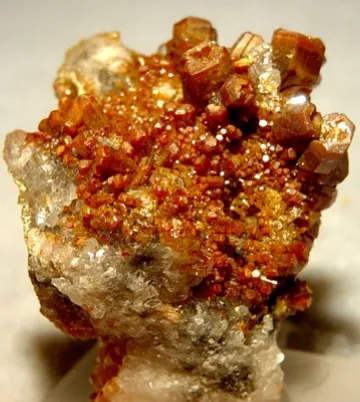
Beyond quartz, the Veracruz district has produced a notable suite tied to skarn, hydrothermal, and pocket-stage mineralization. Andradite occurs in several collector varieties, including demantoid and topazolite from the Las Vigas skarn deposits around Cerro de la Concordia and Piedra Parada; the topazolite discovery was significant enough to be reported in Gems & Gemology as the first fine topazolite crystals documented from Mexico. Epidote is a classic association with older amethyst specimens and can form the green matrix that makes purple sprays stand out dramatically. Calcite, baryte, laumontite, heulandite-Ca, clinoptilolite-K, stellerite, stilbite-Na, analcime, orthoclase, albite, titanite, hematite, lepidocrocite, and other skarn or zeolite-pocket species round out the documented assemblage, while the nearby Las Minas ore system adds magnetite, hematite, chalcopyrite, bornite, pyrite, and other ore minerals to the regional picture.
The most common locality issue is not outright fakery but imprecise labeling. “Las Vigas” is deeply entrenched in the trade and remains understandable historically, yet many serious collectors now prefer “Piedra Parada, Tatatila Municipality, Veracruz, Mexico” when the provenance supports it. Specimens labeled only “Veracruz” may be perfectly legitimate, but they should not command the same premium as pieces with a specific mine, claim, village, or old collection history. “Cerro de la Concordia” labels are especially worth preserving on garnet-bearing and some amethyst specimens.
Condition is critical. Veracruz amethyst crystals are long, slender, and exposed, so tip bruises, rehealed-looking contacts, chipped prism edges, and missing side crystals are common. The best clusters often look almost too delicate for their matrix; inspect every termination under magnification and rotate the piece against a light background to detect cleaves, repaired crystals, or points hidden by strategic mounting. Minor peripheral contacts are normal on matrix pieces, but a prominent central crystal with a damaged termination loses much of the locality’s appeal.
Color should be evaluated in daylight or neutral LED light. Many average Veracruz specimens are pale lavender; fine examples show stronger violet zoning without becoming cloudy. A pale but water-clear, perfectly composed spray can be more desirable than a darker, duller, damaged cluster. Internal phantoms, scepters, and doubly terminated crystals are premium features when natural and undamaged. Orange-brown hematite inclusions occur in the crystals and should not automatically be treated as flaws if transparency and aesthetics remain strong.
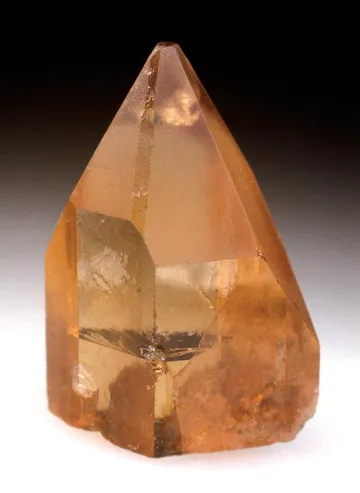
Heat treatment is familiar in the wider amethyst trade, especially where amethyst is altered to citrine-like colors for jewelry, but the Veracruz specimen market is primarily about natural crystal form and locality aesthetics. Suspiciously uniform color, unnatural yellow-orange “citrine” labels from the locality, glued-on points, or clusters assembled on matrix should be examined carefully. A good Veracruz specimen should make geological sense: crystals should emerge from the matrix or quartz base coherently, with matching luster, growth direction, and contact relationships.
Fluorescence is not normally a buying criterion for Veracruz amethyst. Associated calcite may respond under ultraviolet light on some pieces, and some garnet reports note inert behavior, but collectors should not expect fluorescence to authenticate the locality. Handling concerns are mostly mechanical: avoid ultrasonic cleaning, protect points from vibration, and use a soft brush or air blower rather than scrubbing matrix. Clay, iron oxide, and fragile zeolite coatings can be part of the specimen’s history; over-cleaning can make a once-characterful piece look stripped.
Market availability remains broad but uneven. Small loose crystals and modest pale clusters are common enough that most collectors can own an example. Choice matrix specimens, sharply sceptered groups, old epidote-associated plates, high-saturation cabinet pieces, and specimens with strong pre-1990s provenance are far less common and increasingly competitive. The finest pieces combine the three things Veracruz does better than almost anywhere else: delicacy, transparency, and unmistakable violet architecture.
The modern story of Veracruz amethyst begins with an image as simple as a local resident’s handful of purple crystals. Loose specimens had long been picked up around Piedra Parada, but in the 1960s Alfonso Ontiveros saw more than curiosities in them. Ontiveros, a mineral man from Querétaro, bought what local people had and went looking for the source in the eroded canyons above the villages. He traced the crystals to quartz-bearing openings in dark volcanic rock and began extracting intact specimens for the American market. By the late 1960s, the new Mexican amethyst was causing a stir: long, clean, violet crystals from a place almost no foreign collector could point to on a map.
Steve Green’s mining memoirs catch the district at the moment when it was still half secret and half legend. In 1981, during a gem trip to Santa Fe, New Mexico, he encountered Veracruz amethyst not in a museum but in a holistic massage and aroma-therapy shop, with incense burning and silk images of Buddha hanging on the walls. He knew Mexico from childhood, had family in Mexico City, and decided the trip to Las Vigas de Ramírez was possible. What he found was a town serving as a gateway between the central plateau and steep country dropping toward the Gulf: buses and trucks in the centro, cheese, wood, marble, milk, livestock, coffee, and mountain supplies moving through, and just a few savvy families quietly handling the purple crystals that outsiders were beginning to prize.
Green remembered that in those days the average wage in the region could be $3 a day or less, while one good amethyst pocket might produce thousands of dollars in specimens. The asymmetry explains much of the locality’s early trade. Miners could not wait in town for occasional foreign buyers, and there were no telephones, only the telegraph office. Families from the mountains left lots in Las Vigas on trust with local sellers, and word moved slowly by letter or mouth. A few excellent parcels launched collecting reputations: Green wrote of “hundreds of very aesthetic flowers on green epidote,” cabinet pieces that went to Marco Schreier, and a separate lot of the best grape-jelly-colored crystals he had seen, sold to Ken and Betty Roberts.
The route to Piedra Parada itself could be its own expedition. Before roads improved, Green described the trail from Las Vigas as an eight-hour walk of 28 km through 80-foot pines, impassable to vehicles and leading into high Tierra Fría. Piedra Parada was then a village with no electricity, no communications, and no motor vehicles, a place he described as living between the 19th and 20th centuries. Miners and farmers worked fields perched on mountain ledges, and strangers were rare enough that women and children might retreat indoors and close doors and shutters when outsiders arrived.
The garnet story took Green even deeper. In 1983 he was shown sparkly brown-to-green crystals on matrix from the same sierras, later identified as andradite, including demantoid. At that time, classic demantoid sources were associated in dealers’ minds with the Soviet Union, so Mexican demantoid suggested a remarkable opportunity. Green and Chris Boyd set out with a Pionjar drill, a case of dynamite, two mules, a sack of beans, and three local men for two-week treks. To reach the demantoid locality beyond Piedra Parada, they had to descend roughly 8,000 feet into the barrancas, cross tropical rivers, and climb about 2,000 feet up the far side into warmer banana-and-coffee country. In a straight line it may have been only five or six miles; on foot it was about 20 miles of punishing terrain.
At La Concordia, the skarn was hard and resistant, and blasting on steep slopes sent hundred-pound rocks tearing through forest for thousands of feet toward the river below. The party recovered a few pockets of loose demantoid and the famous green “bowls,” specimens composed of transparent demantoid crystals. Green estimated that only five or six of those bowls were found. One reportedly passed through Buzz Gray and Tony Kampf to the Los Angeles County museum collection, while another went to John Barlow and later reappeared through Brian Lees. The material was beautiful and mineralogically important, but it never became the steady business that amethyst did.
The amethyst miners Green passed on those treks worked in the upper third of the high mountains, around the 8,000- to 10,000-foot range. Two to four men might attack a small remote face with breaker bars, sledgehammers, picks, chisels, and, when available, dynamite. If no powered drill was available, blast holes were made by hand; a one-inch hole two feet deep in solid rock meant hammer and chisel work. If the pocket justified it, the miners open-pitted until the vertical face became too dangerous, then drove narrow tunnels or abandoned the spot. Stories of collapses and deaths circulated through the district, and the practical limits of equipment and terrain determined which pockets could be pursued.
Mark Kielbaso’s later field account shows another side of the trade: the social ritual of arriving in Piedra Parada to buy. On the way from Mexico City toward Las Vigas via Puebla, his party stopped at roadside food tables where soups, stuffed meats, and coagulated venison blood were on the menu. In the village, the promising sign was not a mine portal but locals setting up multiple tables to display amethyst. Specimens came out in quantity, visitors examined pieces under the high-elevation sun, and locals offered coffee. Kielbaso noted Piedra Parada’s elevation at about 2,400 meters, roughly 7,500 feet, a detail any bald collector who has burned under mountain sun would remember.
The negotiation itself became performance. After tables were covered with amethyst and the buyer’s eye had settled on a lot, playing cards entered the bargain. Kielbaso lost the hand and had to pay the local price, joking afterward that he hated cards and that the locals offered “medical help” for a shocked gringo. Then came the practical work: waiting in Xalapa for a wire transfer because that was the nearest town with a bank, packing the purchased pieces for shipment, and suffering the collector’s eternal frustration—being offered another deep-purple lot immediately after the first had been paid for and sent away.
The 2021 portrait of Piedra Parada shows continuity rather than nostalgia. José Trujillo Hernández stood on a hill at the edge of town and swept his arm across the north side of the mountain, explaining that the mines ran in an arc there, too numerous and changeable to count precisely. He and his brother Juan Abram, two of 16 children, mined and sold crystals while also doing construction, raising animals and crops, and working on local infrastructure. Homes had tables with tablecloths and crystals ready for visitors, plus crates prepared for wholesale buyers. The mine entrances had candles and small offerings for safety, plastic tubing carried air into deeper workings, and scooters or dirt bikes moved miners and supplies along the roads.
The same account captured the next generation learning the trade in miniature. Children had crystals in pockets and boxes, ready when visitors came through. An older cousin coached a younger one to ask 50 pesos. The younger cousin answered “200,” and everyone laughed. It was a small joke, but it carried the whole locality in it: family, bargaining, mineral aesthetics, and the knowledge that purple quartz from a mountain village in Veracruz could travel to dealers, collectors, gem shows, and cabinets around the world.