A collector's guide to San Bartolo mine, Charcas, Mexico: its geology, mining history and notable minerals, illustrated with the 21 specimens documented from this locality on EarthWonders.
Key facts
San Bartolo is the compact but surprisingly important name inside the larger Charcas mining district of northern San Luis Potosí: an active polymetallic underground operation on the edge of one of Mexico’s great carbonate-replacement and skarn camps. The district began as a colonial silver camp and evolved into a modern Ag-Pb-Zn-Cu producer, but collectors know Charcas for a very different reason: the boron-rich gangue and late hydrothermal cavities that have yielded danburite, datolite, nifontovite, calcite, quartz, and—most recently for San Bartolo—some of the world’s most desirable crystallized borcarite. In an orebody better known to engineers as massive sulfide replacement mineralization and vein fill, the best collector pieces from San Bartolo are small, vivid, and unmistakable: glassy turquoise to blue-green borcarite crystals, often on dark matrix, with a freshness and definition that older borcarite localities rarely approach.
Regional View
Country View
Geologically, San Bartolo sits within the Charcas intrusive-and-carbonate system, where Eocene intrusive rocks and dikes interacted with Mesozoic limestone, shale, sandstone, and older metasedimentary rocks. The result is a district-scale assemblage in which economic sulfides—sphalerite, galena, chalcopyrite, pyrite, silver-bearing minerals, and related species—share space with a remarkable Ca-B metasomatic suite. That boron signature is what gives Charcas its collector personality: danburite and datolite made the district famous long before San Bartolo borcarite entered the fine-mineral market, and the newer borcarite finds show that the system is still capable of producing surprises from active workings.

Photo: Quebul Fine Minerals
The mine is not a public collecting locality in the old rockhound sense. It is part of an active industrial complex, and collector specimens have historically been a by-product of mining rather than the purpose of mining. That matters to collectors: pockets are not opened on a planned collecting schedule, labels may preserve only the mine or district name, and the finest pieces tend to appear in small bursts through miners, local contacts, and specialist dealers rather than as steady commercial production.
Search for specimens: View all specimens from San Bartolo mine, Charcas, Mexico
San Bartolo belongs to the Charcas mining complex, northwest of the town of Charcas and roughly 110 kilometers north of the city of San Luis Potosí. The broader mine property lies on the Central Mesa of Mexico within the Sierra Madre metallogenic province, at an elevation of about 2,150 to 2,200 meters in a semiarid highland setting. The modern Charcas complex is composed of three underground mines—San Bartolo, Rey-Reina, and La Aurora—and a flotation plant producing zinc, lead, and copper concentrates with significant silver.
The deposit is best described as a Tertiary polymetallic skarn and carbonate-replacement system, with mineralization hosted mainly in Jurassic-Cretaceous carbonate rocks and, more locally, in Late Triassic shales and sandstones. In the carbonate units, mineralization forms veins and mantos; in the siliciclastic units, it is more commonly fracture controlled. The Charcas intrusive complex, including monzogranite, granodiorite, granite, and related dikes, supplied heat and fluids into a folded and faulted sedimentary package. Replacement bodies at San Bartolo can be irregular to tabular, exploiting favorable bedding planes, faults, intrusive contacts, and breccia zones.
For the collector, the essential geological point is that Charcas is not merely a sulfide mine that happens to yield pretty gangue. It is a boron-bearing metasomatic system. Datolite and danburite record that Ca-B enrichment beautifully, and borcarite adds a rarer borate-carbonate expression to the same general story. The economic mineralization is dominated by sphalerite, galena, chalcopyrite, pyrite, and silver minerals, while the specimen-forming gangue includes calcite, quartz, danburite, datolite, and rarer borates. Cinnabar is also recorded from San Bartolo, including a notable 1960 find mentioned in modern locality summaries.
Structurally, the district is organized around multiple vein and replacement trends rather than a single simple lode. The Leones and Santa Isabel vein systems are historic names in the camp, and the San Bartolo replacement body is one of the important mineralized areas in the modern operation. Technical reports describe the San Bartolo replacement-and-vein system as laterally extensive, with mineralization open at depth and explored by underground drilling. For specimen collectors, this helps explain why pockets can appear unexpectedly in active development headings: the mine is still a working three-dimensional ore system, not a long-abandoned dump locality.
Mining history at Charcas reaches deep into the sixteenth century. The district was first worked for silver, with Leones and Santa Isabel among the early exploited veins. In the twentieth century, Metalúrgica Nacional and American Smelting and Refining Company acquired exploitation rights connected with the Tiro General operation in 1911; Asarco gained full ownership in 1924 and brought a processing plant into operation in 1925. In 1978 the operation became Industrial Minera México S.A. de C.V. Today the Charcas complex is operated within the Grupo México/Southern Copper corporate structure through IMMSA.
San Bartolo itself is described in modern locality records as one of the smaller mines in the district, adjacent to the General Shaft, whose operation is given as 1926 to 1983. That proximity to the older Tiro General infrastructure is important for labels: older and less precise specimens may be labelled Charcas, Tiro General, San Bartolo, or simply “Charcas, San Luis Potosí,” depending on who collected them and when. Modern borcarite pieces, by contrast, are commonly offered specifically as San Bartolo mine material.
Collecting access today is essentially closed to casual collectors. This is an active underground mine with industrial safety controls, corporate access restrictions, and no general collecting program. Specimens reach the market as incidental recoveries from mining and development work, not from recreational collecting. Charcas danburite has long been sold by miners to local buyers and collectors as a secondary activity, and the newer borcarite material appears to have followed that same informal-to-specialist market path: small numbers of pieces, rapid dealer circulation, and strong competition for clean crystals.
Borcarite from San Bartolo is the mineral that has pushed this small mine name into the front rank of modern rarity collecting. The best pieces show sharp, lustrous, transparent to translucent tabular or bladed crystals in sea-blue, turquoise-blue, bottle-green, and blue-green tones, commonly on matrix and sometimes contrasting strongly against dark oxide-coated surfaces. Published mineral data for borcarite describes euhedral crystals generally only to about 5 mm, but San Bartolo specimens offered by specialist dealers include sharp crystals around 6 mm and exceptional examples reported to 1.5 to 1.8 cm, making the locality unusually important for crystallized material. Fine pieces are judged less by overall specimen size than by crystal definition, saturation of color, freedom from bruising on the thin edges, and whether the crystals stand visibly on matrix rather than forming only granular crusts; ordinary pieces may still be rare, but top pieces have a vivid gemmy glow and sculptural separation that make them immediately recognizable as San Bartolo.
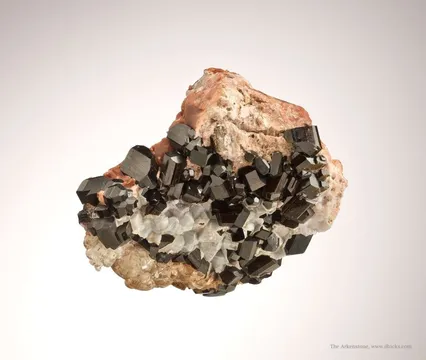
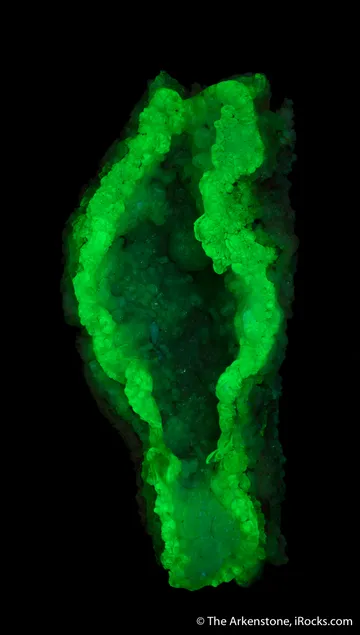
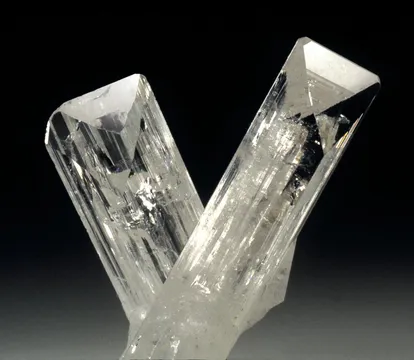
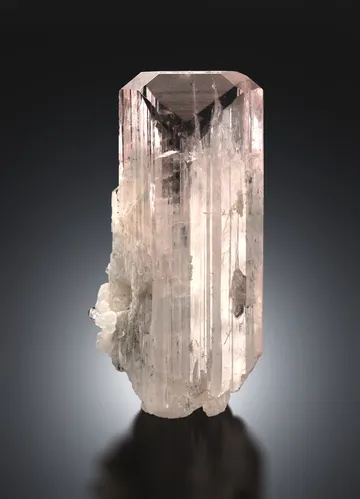
Other minerals documented specifically from San Bartolo include calcite, cinnabar, danburite, datolite including bakerite, nifontovite, pyrite, quartz including rock crystal and citrine, and sphalerite. The mine is not known as a type locality for a valid mineral species, but its rarities make it far more than a one-mineral occurrence. Nifontovite connects San Bartolo to the wider Charcas reputation for unusual calcium borates, datolite and danburite anchor it in the district’s Ca-B metasomatic assemblage, and cinnabar gives the mine an additional collectible thread distinct from the better-known clear to pale danburite and quartz specimens of the district.
San Bartolo borcarite is a recent-market rarity with a small but real collector supply. Pieces seen through reputable dealers are generally thumbnails to small miniatures; most are valued for the individual crystal quality rather than matrix size. Strong color, glassy luster, isolated blades, and undamaged edges are the premium features. Because borcarite has perfect cleavages and only moderate hardness, exposed crystals can show small contacts, bruised edges, or cleaved tips; those condition issues matter greatly on a species where individual crystals may be only millimeters across.
A useful label caution is the similarity of the names borcarite and boracite. They are different minerals. Borcarite is Ca4MgB4O6(OH)6(CO3)2, a borate-carbonate; boracite is a magnesium borate chloride. Some online specimen descriptions have repeated the erroneous phrase “borate-chloride” for San Bartolo borcarite, so serious collectors should rely on the species name, the correct formula, and—where necessary—analytical confirmation rather than copied dealer text. The vivid blue-green color alone is not enough to distinguish borcarite from unrelated blue-green borates or copper minerals in a mixed lot.
No prominent tradition of manufactured fakes or systematic treatments is associated with San Bartolo borcarite in the collector literature or reputable dealer records. The main risks are more ordinary: incomplete locality labels, district-level labels being upgraded too confidently to a specific mine, confusion between Charcas sub-localities, and damage hidden by photography. For expensive pieces, ask whether the specimen is on matrix or off matrix, whether there are repaired blades, and whether the identification was confirmed analytically or rests on a trusted find history.
Cinnabar from San Bartolo should be handled with the usual respect due a mercury sulfide mineral: keep it out of reach of children, do not abrade it, wash hands after handling, and avoid generating dust. Danburite and quartz are physically tougher than borcarite, but Charcas crystals commonly have prominent terminations and can be edge-bruised from mine recovery. Nifontovite and other rare borates should be kept dry, stable, and away from unnecessary cleaning experiments; do not assume that an acid bath safe for quartz or calcite will be safe for rare borate assemblages.
Market availability is uneven. The best San Bartolo borcarites have appeared in small numbers through international fine-mineral dealers, and many listed examples sell quickly. Modest thumbnails and small miniatures can appear at approachable prices relative to the rarity of the species, but the finest pieces—especially those with large, clean, well-separated blue crystals—belong in a much narrower market. For collectors building a Charcas suite, San Bartolo borcarite now deserves a place beside classic district danburite, poker-chip calcite, datolite, quartz, and nifontovite.
The Charcas story begins in the oldest pattern of Mexican mining history: silver first, settlement next, and then centuries of reinvention underground. Early accounts credit Juan de Oñate with the discovery of silver in the sixteenth century and the opening of a mine named San Cristóbal in honor of his father, don Cristóbal de Oñate. The first settlement was not a polished mining town but a frontier cluster built around extraction: mine workings, a few houses, a prison, a foundry, and a Franciscan monastery. It stood in Guachichil territory, and the new village did not last. It was burned, then rebuilt in 1584 at the site of present-day Charcas, a hard beginning for a district that would keep producing ore for more than four centuries.
San Bartolo also carries one of the darkest human stories in San Luis Potosí mining history. On the night of October 5, 1978, at the 10:30 p.m. shift change, fourteen miners boarded the two-level cage that was to bring them back to the surface through the San Bartolo shaft. A steel pin—reported as two and a half inches in diameter—failed on the hoist drum, and the cage dropped from Level 9 to Level 19. Three men survived: the mechanic Félix Ocampo, Prisciliano Valerio Zamarripa, and the engineer J. Jesús Araiza Aranda. The dead were remembered by name in later accounts: Mariano Lucio Bracamontes, Alfonso Carranza, Martín Moreno Pardo, Rodolfo Zul, J. Merced Flores Huerta, Pascual Briseño Méndez, Julián López Hernández, J. Santos Teniente, Amado Pachuca Galván, the brothers Luis and Margarito Flores Olivares, Secundino Palafox Saucedo, Leopoldo Moreno, and Ramón Tovar Morales.
The village response shows how completely the mine and town were bound together. Families heard the news through the night, rescue work unfolded under impossible emotional pressure, and the number of dead overwhelmed the ordinary funeral arrangements available in Charcas. The community used the local Club de Leones hall for a common funeral, and the mining families continued to mark the anniversary with Mass, flowers, and visits to the cemetery. For collectors, it is a sobering reminder that the bright mineral specimens from Charcas came from a living industrial world, not from an abstract locality name.
Modern San Bartolo has its own quieter field rhythm. Specimens are not recovered by weekend collectors tapping on dumps; they come out incidentally from a working mine whose purpose is ore. A pocket can be a fleeting event in the path of production, noticed by miners before the heading advances or the material is moved. That is why a recent discovery of blue-green borcarite could appear almost abruptly in the dealer world: a small mine in a famous district, a rare mineral usually seen as modest crusts or small crystals, and suddenly sharp turquoise blades that made specialists look twice.