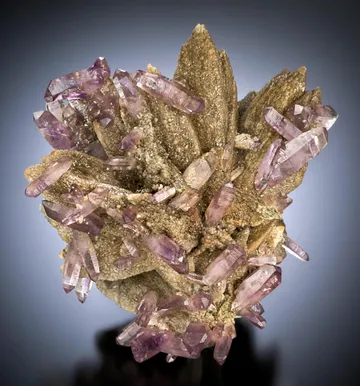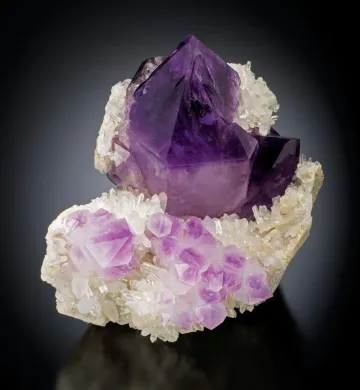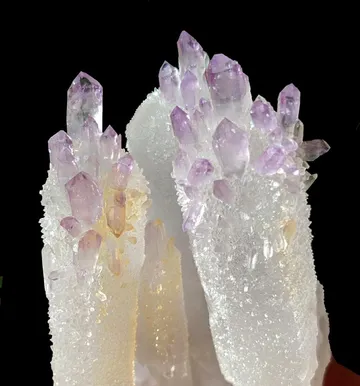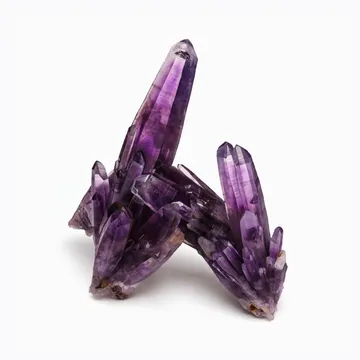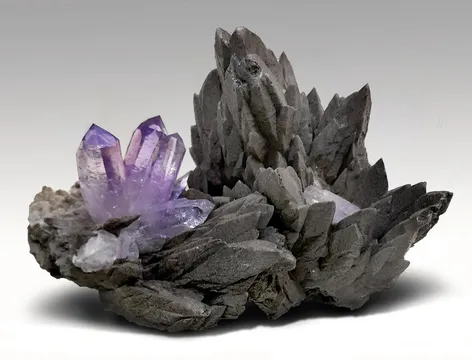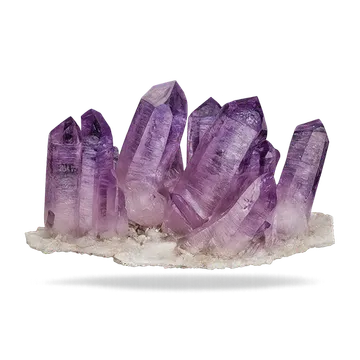
Veracruz amethyst is one of the few amethysts that serious collectors can often recognize at arm’s length. Its appeal is not based on the massive, dark geode architecture of Brazil or Uruguay, nor on the saturated, stout crystal groups of Guerrero. The classic Veracruz look is airy: slender, glassy quartz prisms, lilac to violet, often with the strongest purple gathered in the terminations, rising singly or in bouquets from a gray volcanic matrix dusted with smaller quartz and, in the best combinations, green epidote.
Key facts
Veracruz amethyst is one of the few amethysts that serious collectors can often recognize at arm’s length. Its appeal is not based on the massive, dark geode architecture of Brazil or Uruguay, nor on the saturated, stout crystal groups of Guerrero. The classic Veracruz look is airy: slender, glassy quartz prisms, lilac to violet, often with the strongest purple gathered in the terminations, rising singly or in bouquets from a gray volcanic matrix dusted with smaller quartz and, in the best combinations, green epidote.
The name “Veracruz amethyst” is collector shorthand. Specimens were long sold as “Las Vigas” amethyst because Las Vigas de Ramírez was the town and trading point through which much of the material passed. The actual classic source is around Piedra Parada, in Tatatila Municipality, north of Las Vigas. That distinction matters. A label reading “Las Vigas” is historically understandable, but a modern, precise label should read Piedra Parada, Tatatila Municipality, Veracruz, Mexico, or should at least mention Piedra Parada together with the old Las Vigas trade name.

Photo: Wikimedia Commons
Geologically, these specimens are products of silica-bearing fluids in volcanic rock. The host is andesite, and the amethyst occurs in vugs, clefts, gas cavities, and narrow veins rather than as thick geode linings. This is why the crystals are typically isolated, upright, and beautifully exposed. The best pieces look as though the quartz had room to grow into open space, forming sharp hexagonal prisms, sometimes doubly terminated, sometimes sceptered, often with milky or colorless lower portions and a blush of purple at the tips.
Historically, Veracruz amethyst entered the international specimen market in the late 1960s and 1970s, then became a true staple of the mineral-show world through the 1980s and later. It is not rare in the way a one-pocket locality is rare; material has circulated for decades, and attractive pieces still appear regularly. What is scarce is the combination collectors prize most: undamaged glassy crystals, sculptural spacing, rich but natural color, fine matrix, and old provenance from the early years of the locality.

Photo: Wikimedia Commons
Search for specimens: View all amethyst specimens from Veracruz, Mexico
The classic Veracruz amethyst district lies in the high country around Piedra Parada, a small mountain community in Tatatila Municipality, Veracruz. Las Vigas de Ramírez, the better-known name on old labels, functioned historically as the nearby market and distribution point. Many older specimens, especially those sold in the 1970s, 1980s, and 1990s, are labeled simply “Las Vigas, Veracruz,” even when the crystal-bearing ground was closer to Piedra Parada.
The deposit is a volcanic-vug and cleft occurrence in andesite. Amethyst, colorless to milky quartz, calcite, epidote, hematite, lepidocrocite, and zeolite minerals have all been reported from the district. The amethyst is not mined as gem rough in any significant sense; its value is as crystallized specimen material. The crystals grew in open spaces in the andesite, commonly with enough freedom to form long prisms, sharp terminations, and delicate three-dimensional clusters.
Specimens were reportedly picked up as loose surface finds before organized specimen extraction began. In the 1960s, Alfonso Ontiveros, a miner and mineral collector from Querétaro, recognized the commercial importance of the material, purchased available specimens from local residents, and searched the eroded canyons for the source. His work brought the first serious parcels to the American mineral market. In 1980, more mechanized specimen mining with pneumatic drills increased production, and the locality quickly became a classic.
Mining has generally been small-scale, intermittent, and local. The terrain is steep, the pockets can be narrow, and much of the work has been done by local miners rather than by a large formal mining company. Older accounts describe hand tools, small tunnels, open cuts in steep faces, and a strong dependence on local knowledge. More recent accounts describe small crews, family mining, active and inactive workings, improvised ventilation tubing in deeper digs, and household-level selling to visitors and dealers.
Access should not be treated as a casual rockhounding opportunity. The deposits are tied to local families, private claims, community land, and working mines. Collecting without permission is inappropriate and may be unsafe. Serious collectors normally obtain Veracruz amethyst through established dealers, mineral shows, auction houses, or direct relationships with local sellers rather than by attempting independent field collecting.
Notable finds include early 1970s matrix groups with crystals to several centimeters, dramatic cabinet plates of lavender points on dark andesite, clusters with green epidote providing strong color contrast, doubly terminated crystals perched on sparing matrix, sceptered and reverse-sceptered crystals, and rare larger individuals exceeding the usual size range. A few very large crystals and plates are known, but the locality’s fame rests less on size than on elegance, transparency, luster, and composition.
The defining habit is the elongated prismatic quartz crystal. Veracruz crystals are commonly slender, hexagonal, glassy, and sharply terminated. Many show colorless or milky bases with purple concentrated toward the tips. Others are lavender throughout, with internal zoning or subtle phantoms that echo the crystal’s external shape. Doubly terminated crystals are a valued feature, especially when they are naturally balanced on matrix rather than loose.
Color ranges from nearly colorless lavender to fine violet and occasional deeper purple. Unlike darker geode amethyst, the best Veracruz specimens often rely on brilliance rather than saturation. A pale crystal can still be superb if it is transparent, lustrous, undamaged, and aesthetically placed. The most desirable pieces combine gemmy clarity with a crisp purple termination, creating the “blush” effect collectors associate with the locality.
Typical individual crystals are small to modest: many are in the 1–5 cm range, with 2–4 cm crystals common in good cabinet and miniature specimens. Crystals around 6 cm are noteworthy, and crystals approaching or exceeding 8–10 cm are exceptional. Large plates exist, but many of the finest examples are miniatures and small cabinets where each crystal has room and the composition reads cleanly from all sides.
Common forms include upright sprays, divergent V-shaped groups, flowerlike clusters, plates of many small crystals, isolated crystals on matrix, and loose floater clusters. Scepters occur and are particularly collectible. Reverse scepters and skeletal or fenster-like growth features are also seen, though not every marketed “skeletal Veracruz amethyst” is a top specimen by mineral-collector standards.
Associated minerals are part of the locality’s identity. Colorless to milky quartz commonly forms the base or matrix sparkle. Epidote, usually as tiny green crystals or coatings, is a prized association because it contrasts beautifully with the lavender amethyst. Calcite is reported and appears on some combination specimens. Hematite and lepidocrocite can occur as inclusions or accessory iron oxides, contributing orange-brown internal specks or films. Zeolites reported from the broader district include laumontite and other species, though they are less central to the collector image of the locality than quartz and epidote.
Quality is judged first by aesthetics. The ideal Veracruz amethyst has separated, undamaged, lustrous crystals, with good transparency and a natural gradient of purple. Matrix matters: a fine andesite base should support the crystals without overwhelming them, and green epidote can raise a specimen’s visual and locality interest. Damage matters greatly because the crystals are exposed and delicate; even small bruises on a termination can significantly affect value. Old labels, especially from early dealers or noted collections, add desirability because the best early material has a different cachet than ordinary recent stock.
The most common locality issue is labeling. “Las Vigas” is the traditional trade label, but Piedra Parada is the more accurate source for the classic amethyst. A specimen labeled only “Veracruz, Mexico” is not necessarily wrong, but a serious label should preserve as much detail as possible: Piedra Parada, Tatatila Municipality, Veracruz, Mexico; formerly or commonly sold as Las Vigas. Avoid silently replacing an old Las Vigas label, however. Keep the old label with the specimen and add a modern clarification rather than erasing provenance.
Documented concerns specific to this material are less about dyed or synthetic amethyst and more about photography, condition, repair, and locality precision. Veracruz amethyst can look astonishingly vivid in online photographs, and the contrast between pale bodies and purple tips is easy to exaggerate with lighting or saturation. A buyer should ask for images in neutral light, views of all major terminations, and close-ups of the contact between crystals and matrix.
Repairs are plausible on better specimens because the crystals are delicate, exposed, and valuable enough to justify careful restoration. Use a loupe to inspect bases, doubly terminated crystals, and any crystal that appears too perfectly balanced after a likely break point. Look for glossy glue lines, tiny bubbles, mismatched growth striations across a crack, or a crystal that sits at an unnatural angle to the matrix. Repairs are not automatically disqualifying if disclosed and reflected in the price, but undisclosed repairs should be treated seriously.
Condition is often the deciding factor. Veracruz crystals chip at the points and along prism edges; matrix plates may lose small peripheral crystals; epidote coatings can shed; and thin sprays can be fragile in shipping. Do not judge only the largest crystal. A specimen with one perfect focal crystal and many broken surrounding points may be less desirable than a smaller, cleaner group with complete terminations.
Treatment is not a normal selling point for fine Veracruz amethyst specimens. Heat treatment is common in the broader amethyst trade, especially where amethyst is altered toward citrine-like colors, but fine Veracruz material is valued for its natural lilac-to-violet color and crystal form. A Veracruz specimen advertised as heated, coated, aura-treated, dyed, or “enhanced” should be avoided by specimen collectors unless it is being bought purely as a decorative object.
Market availability is broad but uneven. Small, attractive Veracruz specimens remain obtainable, and the locality is familiar enough that many dealers carry examples. Truly fine old matrix pieces, exceptional scepters, highly aesthetic doubly terminated crystals, and richly colored epidote combinations are much less common. The market rewards complete, undamaged, well-spaced specimens far more than bulk plates of pale or crowded crystals.
In Steve Green’s mining memoir, Veracruz amethyst begins not in the mountains but in Santa Fe, New Mexico, in 1981: a holistic massage-and-aroma-therapy rock shop, incense burning, Indian silk images of Buddha on the walls, and a display of well-formed purple crystals. Green had grown up in Mexico City, knew the country, and still had family in the Distrito Federal. Las Vigas seemed reachable, and that first sight of the crystals became the start of years in the Veracruz amethyst trade.
The Las Vigas he found was a highland transit town between the central plateau and the drop toward the Gulf. Green described deep barrancas, high ridges, trucks and buses crowding the centro, and supply trains of mules and donkeys carrying kerosene, batteries, clothes, beans, pots, radios, cookies, candies, refrescos, beer, televisions, and tools into the sierra. In that economy, amethyst had become “like gold in these hills.” The average wage in the area was said to be $3 per day or less, while a good pocket could yield thousands of dollars in specimens.
The early business ran on trust. In 1981, Green found only a few families selling amethyst in Las Vigas. Mountain relatives brought lots into town and left them with trusted sellers because the miners had livestock, crops, houses, and families to tend. There were no telephones, only a local telegraph office. Buyers arrived irregularly; communication moved by word of mouth or letter. Fine specimens passed through a small, personal network long before the locality became common knowledge.
Some of Green’s best early parcels sound like the kind of lots collectors dream about decades later: hundreds of cabinet-sized “flowers” on green epidote sold to Marco Schreier, and a parcel of “grape jelly” colored crystals sold to Ken and Betty Roberts. He remembered pieces being photographed for magazines, some making it to the cover of The Mineralogical Record, and others being sold in Room 212 at the Desert Inn or at the Munich Mineralientage.
The backcountry travel was severe. Before roads were built, the trail from Las Vigas to Piedra Parada took eight hours on foot and covered about 28 km. It wound through 80-foot pines and led to a village that, in Green’s memory, had no electricity, no communications, and no motor vehicles. The amethyst deposits lay in the upper part of the mountains, in the 8,000- to 10,000-foot range. Two to four men might work a small deposit on a steep face with breaker bars, sledgehammers, picks, and chisels. If dynamite was available, blast holes might still be made by hand: a 1-inch hole, 2 feet deep, hammered into solid rock with chisel and hammer.
Green’s memoir also preserves the rough edge of the trade. He heard of deaths from tunnel collapses. Mines could be worked as open cuts until the face became too dangerous, then abandoned or driven into narrow tunnels. Drills and dynamite were scarce and valuable; lending a drill could help secure future amethyst. Weather could shut everything down for months, with fog, heavy clouds, and torrential rains making the mountains impassable during the rainy season. Army campaigns into the area added another complication, especially where explosives or paperwork might bring trouble.
The district was not only an amethyst story. Green and Chris Boyd also pursued demantoid and andradite garnet in the same rugged country. One expedition involved a Pionjar drill, a case of dynamite, two mules, a sack of beans, and three local Mexicans on two-week treks into the hills. To reach La Concordia, they descended about 8,000 feet into barrancas, crossed tropical rivers, and climbed about 2,000 feet up the other side. In a straight line the destination was perhaps five or six miles away; on foot it was about 20 miles through steep terrain with coral snakes and small spotted cats. Those garnet stories sit beside the amethyst history because they show the same landscape that produced the purple quartz: steep, mineralized, remote, and controlled by local knowledge.
Mark Kielbaso’s later field account captures a more transactional but still intimate phase of the Veracruz trade. Traveling from Mexico City toward Las Vigas via Puebla with Ruben Avila and Gilberto Gurrola, he stopped at roadside food tables where the menu included soups, stuffed meats, and coagulated venison blood. In Piedra Parada, locals began setting up multiple tables for amethyst—always a good sign to a dealer. Soon the little village had specimens spread out for inspection.
The buying scene was social as much as commercial. Kielbaso described locals offering coffee so he could get out of the intense sun at roughly 2,400 meters, or about 7,500 feet. A particular lot came from La Cascada, a claim just to the right of a waterfall. Negotiation even involved playing cards; Kielbaso lost the hand and had to pay the sellers’ price, joking that the locals offered “medical help” for a shocked gringo. The closest town with a bank was Xalapa, where the buyers waited a couple of days for a wire transfer before the amethyst was paid for, packed, and crated for shipment.
A 2021 report from Piedra Parada shows the locality still living with crystals in everyday view. José Trujillo Hernandez, a miner and lifelong resident, stood on a hill at the edge of town and swept his arm across the horizon. He said one could see “probably 10,000 kilometers,” a collector’s exaggeration perhaps, but an honest expression of the view. He and his brother Juan Abram, two of 16 children, shared steep family land with their relatives. Like other homes in town, theirs had tables with tablecloths and amethyst laid out by shape, size, and shade, plus crates already packed for wholesale.
That same account describes active mines with small altars at their entrances, candles and offerings placed for the safety of the miners and in exchange for the crystals taken from within. Flexible plastic tubing ran into deeper workings to circulate air. Crews were usually around seven people. On private land, proceeds might be split after a cut of about 10 percent to the owner. Work could run from morning to night and sometimes into the early hours if a mine was producing well; a crew might also work for weeks with little to show.
The hazards remain real. Uri Juan Landa said his father mined for 30 years with only hand tools and a headlamp, getting a generator only in his final year of mining. More modern miners use power tools and explosives, and some caves still smell of smoke and sulfur after new channels are opened. The local stories include injuries, including a young man blinded by an explosion near Piedra Parada. Landa summed up the miner’s fatalism with a grim joke: it is exciting to find minerals, but one is always worried about collapse; better to be crushed than trapped.
The same modern story closes with children learning the trade. Miners’ kids had small stashes of crystals ready when visitors passed through: one boy pulled specimens from his pocket, another kept them in a small box. An older cousin whispered to a younger one, “Charge them 50.” The younger countered, “200,” and everyone laughed. In Piedra Parada, the amethyst trade is not an abstraction. It is tables in front of houses, scooters carrying miners and supplies, crates packed for foreign dealers, children practicing prices, and men returning from the mines at night to greet neighbors.