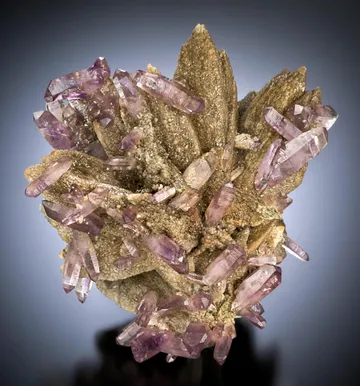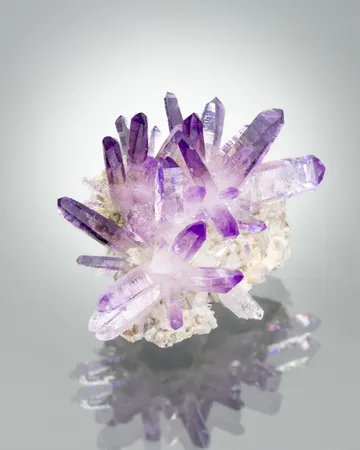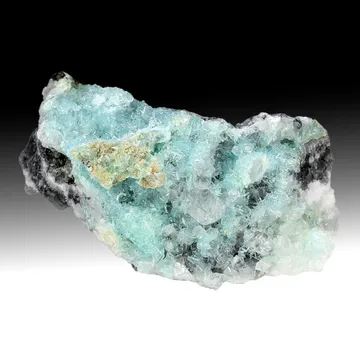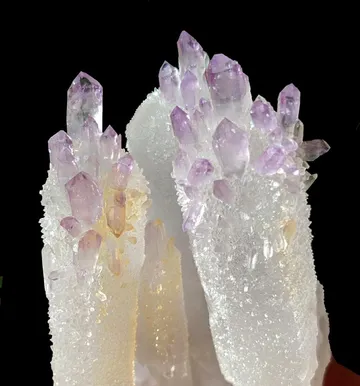
Piedra Parada, Mexico - source of Veracruz amethyst; high-mountain pockets yield open lilac to purple quartz with phantoms and scepters against matrix.
Key facts
Piedra Parada is the true source behind much of the material long traded as “Las Vigas” or “Veracruz” amethyst: a high mountain amethyst district in the municipality of Tatatila, Veracruz, north of Las Vigas de Ramírez and northwest of Xalapa. For collectors, its importance rests on an unmistakable style of quartz growth. The best specimens are not squat geode plates; they are open, airy groups of elongated, glassy prisms, commonly pale at the base and saturated lilac to royal purple at the terminations, with phantoms, scepters, windowy growth, fluid inclusions, and orange-brown iron-oxide inclusions adding internal architecture. The most characteristic matrix pieces set these purple crystals against dark andesite, drusy quartz, white zeolite or carbonate coatings, and the locality’s particularly diagnostic green epidote.
Geologically, the classic amethyst pockets occur in vesicular andesite: hard volcanic rock whose gas cavities, clefts, vugs, and narrow tabular openings were later mineralized by silica-rich fluids. The broader Tatatila–Las Minas region is more complex than the amethyst trade name suggests, lying within a Miocene mineralized district that also includes skarn and ore systems, garnets, pegmatitic zones with feldspar and smoky quartz, zeolites, copper minerals, and iron oxides. Piedra Parada therefore sits at a collector’s crossroads: it is famous worldwide for a single aesthetic—Veracruz amethyst—yet it belongs to a district capable of producing andradite, demantoid, topazolite, barite, laumontite, analcime, titanite, and other species that point to a far richer mineralizing history.
The historical arc is equally important. Loose amethyst had been picked from the hills for years before Alfonso Ontiveros, a miner and mineral collector from Querétaro, recognized its specimen potential in the 1960s and began tracing the material to its source in the eroded volcanic country around Piedra Parada. By the late 1960s and especially through the 1970s and 1980s, fine material was entering the American and European collector markets. The name “Las Vigas” became fixed in dealer vocabulary because Las Vigas de Ramírez was the commercial gateway, but serious locality work has steadily corrected the label to Piedra Parada, Tatatila, Veracruz.
Regional View
Country View
The best Piedra Parada specimens have a refined delicacy that makes them instantly recognizable across a room. Crystals may be only a few centimeters long, but they commonly stand apart from the matrix with an elegance rare in amethyst. Superb pieces balance transparency, high luster, strong terminal color, complete terminations, and an undisturbed composition; lesser examples may have the same locality look but lack depth of color, have bruised tips, or sit too densely packed to show the crystal form.
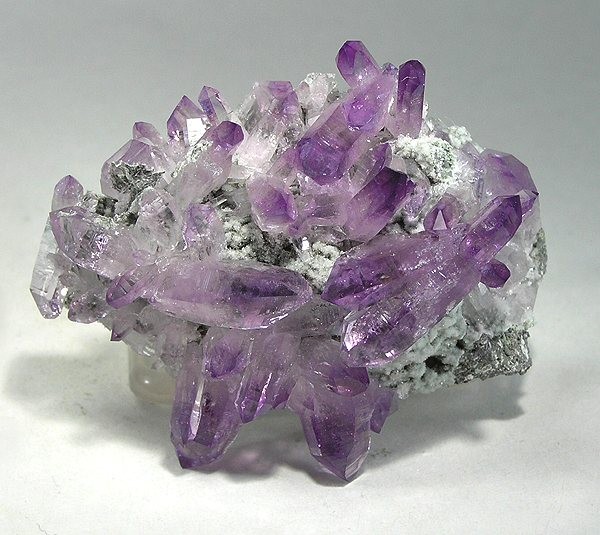
Photo: Wikimedia Commons

Photo: Wikimedia Commons
Search for specimens: View all specimens from Piedra Parada, Mexico
Piedra Parada is a village locality in Tatatila Municipality, Veracruz, with the important amethyst-producing ground lying around the village and nearby named workings such as La Cascada, La Loma, Torrecellas, El Bordo, and the Cerro de la Concordia area. The trade still often labels the material “Las Vigas,” because Las Vigas de Ramírez was historically the nearest market town and shipping point, but the classic source is the Piedra Parada area itself. Older labels may also use “Piedras Parado,” “Las Vigas,” “Vera Cruz,” or the former municipal name Profesor Rafael Ramírez; for a modern collection label, Piedra Parada, Tatatila Municipality, Veracruz, Mexico is the more precise form.
The amethyst deposit is essentially a volcanic-vug and vein-pocket occurrence in tough, dark andesite. The crystals are found in gas cavities, irregular tabular structures, clefts, vugs, and narrow openings in the andesite rather than in large basalt geodes. Some accounts describe the main amethyst zone as following the northern slope and ridge system near Piedra Parada for several kilometers, with productive levels exposed in andesite cliffs and small adits. At La Cascada, collectors’ accounts describe three amethyst-producing levels separated by only a few meters vertically, with the better cavities in lower levels and smaller cavities in upper levels.
The specimen paragenesis is dominated by quartz, from colorless rock crystal through amethyst, with hematite or lepidocrocite inclusions contributing orange-brown specks or wisps in some crystals. Epidote is the most celebrated accessory, forming green microcrystalline to sparkling crusts on matrix and giving many pieces their classic purple-on-green contrast. Calcite, aragonite, barite, laumontite, analcime, heulandite-Ca, clinoptilolite-K, stilbite-Na, stellerite, albite, orthoclase, titanite, gypsum, and iron oxides have also been documented from the locality or immediate sublocalities.
The broader district is not merely an amethyst field. The Tatatila–Las Minas area includes skarn and ore mineralization related to Miocene intrusive activity, with copper, gold, iron, garnet, calcite, and other skarn-associated minerals. Cerro de la Concordia, treated as a sublocality of the Piedra Parada region in mineralogical references, is especially important for garnet, including andradite, demantoid, and topazolite. Pegmatitic or intrusive-related material reported in the region has produced plates of orthoclase and albite with smoky quartz crystals, some overgrown or studded with zeolites.
Mining has always been small-scale compared with industrial metal mining. Early surface collecting led to more systematic specimen extraction after Alfonso Ontiveros recognized the locality’s potential in the 1960s. In 1980, an American specimen miner and dealer reportedly leased ground and used pneumatic drills, increasing production and helping move Veracruz amethyst firmly into the international collector market. Since then, production has been decentralized: local families and small crews work private or community-held ground, opening small pits, cliff-face workings, and adits when a promising zone is found.
The best collecting stories revolve around pockets rather than mines in the industrial sense. Individual finds have produced sprays of 5–7 cm gem crystals, deep purple “grape jelly” pieces, large scepters, colorless to smoky crystals with purple caps, and dramatic matrix specimens on green epidote. La Cascada is known for dark purple amethyst on andesite matrix, La Loma for deep purple amethyst on green epidote, Torrecellas for clear amethyst and combinations with white, leafy barite, and El Bordo for high-quality floaters and matrix groups. Some reported scepters reach around 12 cm, while older Mineralogical Record indexing records exceptional Piedra Parada-area crystals up to 20 cm.
Access today should be treated as a private-mining and local-contact matter, not a casual public collecting opportunity. The workings are on steep mountain ground, many on private land, some historically on federal or community land, and the productive areas are actively controlled by local families, landholders, or miners. Serious collectors generally acquire material through miners, local dealers, Mexican dealers, or established international specimen dealers rather than attempting independent collecting. The physical setting is steep, tunnel work is dangerous, and permission is essential.
Piedra Parada amethyst is prized for slender, highly lustrous, transparent to translucent prisms whose color commonly intensifies toward the terminations, ranging from nearly colorless or pale lavender bases to lilac, violet, and deep purple caps; crystals are commonly 2–5 cm, with fine 5–7 cm groups and rarer larger scepters reported, and the best pieces show complete, separated crystals on matrix rather than crowded geode-like crusts. Associations are a major part of the locality aesthetic: green epidote on andesite or quartz matrix is the classic pairing, while barite, calcite, zeolitic coatings, hematite or lepidocrocite inclusions, and drusy colorless quartz appear on selected specimens. Top-quality Piedra Parada pieces combine glassy luster, undamaged tips, strong terminal color, sculptural spacing, and enough matrix contrast to make the crystals read as individual forms; ordinary examples may still be attractive but are pale, crowded, broken at the tips, or lack the purple-on-green or purple-on-white contrast that collectors expect from the locality.
Quartz from Piedra Parada includes far more than the purple variety, though amethyst dominates the collector market: colorless rock crystal forms drusy bases, small clear points, scepter stems, and associated crystals beneath or beside amethyst, while smoky quartz and fenster-style growth have been recorded from the broader Piedra Parada area and pegmatitic zones. The locality’s non-amethyst quartz is most interesting when it documents growth sequence—pale or colorless early quartz beneath later purple caps, doubly terminated crystals, skeletal windows, fluid inclusions, or sceptered forms in which a later generation overgrew an earlier prism. Fine quartz specimens here are judged less by sheer size than by clarity, termination quality, and the way the crystal architecture explains the amethyst habit: the best pieces show clean colorless-to-purple transition, sharp faces, phantoms, windowy growth, or a well-balanced cluster on andesite, epidote, barite, calcite, or zeolite matrix.
Epidote at Piedra Parada is usually not collected as large freestanding crystals but as the green, fine-grained to microcrystalline matrix that makes many Veracruz amethyst specimens instantly identifiable. It appears as pistachio-green to darker olive or green-black sparkling coatings on andesite or quartz-rich matrix, commonly under or around amethyst sprays, and its contrast with lilac-to-purple quartz is one of the locality’s signature visual effects. The best epidote-bearing specimens are those in which the epidote is fresh, visible, and compositionally useful rather than merely a dull green smear: bright microcrystalline coatings, complete amethyst crystals rising cleanly from the green surface, and intact matrix all elevate a Piedra Parada piece, especially from finds described around La Loma and other north-slope workings where purple amethyst on green epidote is particularly admired.
Calcite is a documented accessory in the Piedra Parada assemblage and is most familiar to collectors as white to brownish carbonate matrix or as associated scalenohedral, brushy, or coating material with amethyst and quartz. Older locality discussions record brushy scalenohedrons to roughly 10 cm in the amethyst association, while modern specimen descriptions also note amethyst on calcite or aragonite layers, calcite with white fluorescence under short-wave UV, and calcite fluorescence on some quartz-amethyst pieces. Good calcite-associated specimens from Piedra Parada are valued when the carbonate enhances rather than obscures the quartz: sharp amethyst points perched on pale calcite, contrasting white carbonate and green epidote, or dissolved-and-replaced textures can be interesting, while massive, powdery, bruised, or overly etched carbonate tends to lower display quality unless the amethyst itself is exceptional.
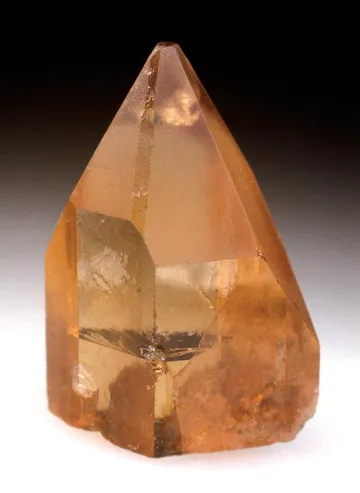
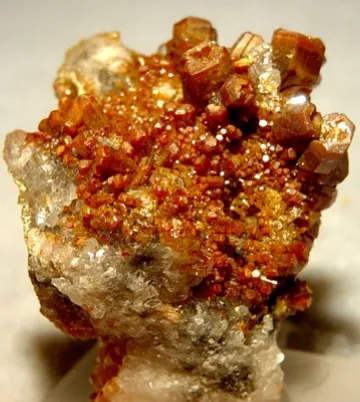
Other documented minerals from Piedra Parada and its immediate sublocalities include hematite and lepidocrocite as iron-oxide or oxyhydroxide inclusions and coatings; barite, including thin white crystals in some amethyst pockets; laumontite, analcime, heulandite-Ca, clinoptilolite-K, stilbite-Na, and stellerite in the zeolite suite; aragonite and gypsum among later cavity minerals; albite and orthoclase with smoky quartz in pegmatitic material; titanite to small crystals; and copper-related species such as chrysocolla and clinoclase. The important rarity suite is garnet from the skarn side of the district, particularly andradite, demantoid, and topazolite from the Cerro de la Concordia/Piedra Parada area; topazolite from these Veracruz skarns was reported in 2014 as the first fine topazolite discovery in Mexico, with yellow to yellow-brown crystals in the 1.5–2.5 cm range.
The most common label issue is locality precision. “Las Vigas amethyst” is an entrenched market name, but much of the classic material is properly from Piedra Parada in Tatatila Municipality, not from the town or municipality of Las Vigas de Ramírez itself. Older labels may be historically understandable, and a period label reading “Las Vigas” should not be dismissed, but a modern catalog entry should preserve both names when possible: Piedra Parada, Tatatila Municipality, Veracruz, Mexico, formerly or traditionally sold as Las Vigas amethyst.
Condition matters intensely. The locality’s long, exposed crystals are prone to small tip bruises, edge chatter, and broken side crystals, especially where sprays project beyond the matrix. Many fine examples look delicate because they are delicate: crystal-to-crystal contacts and friable matrix can be fragile, and some dealer descriptions note reinforcement of weak contacts with adhesive. That is not automatically a defect if disclosed and structurally sensible, but collectors should examine base joins, repaired crystals, and matrix stabilization under magnification and good light.
Color expectations should be realistic. Piedra Parada amethyst is often lighter, brighter, and more transparent than massive geode amethyst from Brazil or Uruguay. The finest pieces may have deep purple terminations, but the classic look is frequently a graduated body color with the strongest purple near the tips. Overly dark, uniformly saturated purple crystals without the usual glassy transparency and elongated habit deserve closer scrutiny, especially if the label claims Veracruz but the specimen resembles common geode material.
Treatments are not a major theme for intact Piedra Parada matrix specimens in the serious mineral trade, but quartz color manipulation is common in the broader gem and decorative market. Heat treatment of amethyst to citrine is well known for gem material; “aura” coatings and dyed decorative quartz also circulate in metaphysical channels. For collectible Piedra Parada specimens, avoid coated iridescent surfaces, unnatural color concentration, or polished and glued decorative assemblies unless they are explicitly sold as altered objects.
UV response is usually a side note rather than the reason to own these specimens. The quartz itself is not collected for fluorescence, but associated calcite or carbonate layers may show short-wave or weak long-wave fluorescence on some pieces. Handle zeolite- and calcite-associated specimens carefully: laumontite can dehydrate and become chalky or friable, calcite is acid-sensitive and softer than quartz, and iron-oxide coatings or inclusions should not be cleaned aggressively.
Market availability is broad but uneven. Small single crystals and miniature clusters remain common enough that almost every mineral show or online marketplace seems to have Veracruz amethyst somewhere on offer. Fine old matrix pieces, sharply sceptered crystals, deep purple floaters, large undamaged sprays, Japan-law twins, and specimens with vivid epidote contrast are much scarcer and command strong collector prices. The locality is classic enough that provenance matters: ex-collection pieces from older 1970s–1990s shipments, specimens referenced to known finds such as La Cascada, La Loma, Torrecellas, or El Bordo, and pieces photographed in publications or dealer archives carry extra weight.
The most persistent story at Piedra Parada is not of a single mine, but of a trade name slowly being corrected. For decades, collectors asked for “Las Vigas” amethyst because Las Vigas de Ramírez was the market town on the road system, the place where dealers could sleep, buy, wire money, and arrange transport. The amethyst itself came from the high country around Piedra Parada. That distinction mattered little to early trade labels, but it matters to serious locality collectors today. The village name—“Standing Rock”—became the anchor for a whole family of specimens whose look was too distinctive to stay anonymous.
Steve Green’s account of entering the trade in the early 1980s reads like the origin story of the modern Veracruz amethyst market. His first encounter was in Santa Fe, New Mexico, in 1981, inside a holistic rock shop heavy with incense and silk images of Buddha. The crystals were enough to send him south. Las Vigas, he wrote, was then a rough transit point between the central plateau and the steep drop toward the Gulf, serving mountain families who brought cheese, wood, marble, milk, livestock, and other goods down from the sierra. Supply trains of mules and donkeys carried kerosene, batteries, beans, radios, candy, beer, televisions, and tools back into the roadless country. In that economy, amethyst was “like gold in these hills”: local wages might be only a few U.S. dollars a day, while a good pocket could yield thousands of dollars in specimens.
The Ontiveros family stands at the beginning of the commercial story. Alfonso Ontiveros of Querétaro traveled through Mexico developing mineral specimen deposits and selling material through family connections in the United States. By the time Green arrived, there were only a few families in Las Vigas selling amethyst. Mountain relatives brought lots down and left them on trust; there were no telephones, only the telegraph office, and communication moved by letter or word of mouth. Many miners did not know the international value of their crystals. They had fields, livestock, houses, and families in the mountains, and could not wait in town for the occasional foreign buyer.
Green remembered some of the great early parcels vividly: hundreds of cabinet-size “flowers” on green epidote, a lot of the best “grape jelly” crystals he had ever seen, and specimens that later appeared in magazines and on covers. Those lots helped move Piedra Parada from remote mountain production into the serious specimen market, passing through rooms at the old Desert Inn in Tucson and through European shows such as Munich. The metaphysical boom of the mid-1980s added fuel, increasing demand for loose crystals and encouraging more search for pockets. Serious collectors may have scoffed at the New Age market, but it helped finance exploration that exposed fine specimens.
The field reality behind those specimens was severe. Before roads were improved, Green described an eight-hour, 28 km walk from Las Vigas to Piedra Parada through high pine country, with mules, supplies, hand tools, and very little infrastructure. The town had no electricity, no motor vehicles, and no communications. Miners worked small deposits in vertical mountain faces with breaker bars, sledgehammers, picks, chisels, and sometimes dynamite. Where no drill was available, blast holes could be hammered by hand: a one-inch-wide, two-foot-deep hole in solid rock made with chisel and hammer. Small open cuts became dangerous once the face above steepened; tunnels were sometimes driven, and collapses were part of the risk.
One of Green’s most extraordinary detours from amethyst was the search for Veracruz demantoid and andradite. In 1983 he was shown unusual sparkly crystals from the same sierras. The Soviet Union still existed, and classic demantoid sources were politically and commercially distant, so a Mexican occurrence seemed full of promise. Green and Chris Boyd set out with a Pionjar drill, a case of dynamite, two mules, a sack of beans, and three local men. To reach La Concordia, beyond Piedra Parada, they descended roughly 8,000 feet into barrancas, crossed tropical rivers, and climbed back up through warmer country where bananas and coffee grew. The straight-line distance may have been only five or six miles, but on foot it became around twenty miles of steep terrain, complete with coral snakes and small spotted cats.
At La Concordia they were guided through the domain of Don Justino, whose family worked the mountain slopes. Green wrote of passing small fields of opium poppies tended by Don Justino’s children and of the uneasy protection that came with local favor. Don Justino apparently liked the visitors; he thought Chris Boyd looked like Jesus, and Green’s Spanish helped put him at ease. Once blasting began, Don Justino warned people not to pass below them, because hundred-pound rocks could tear loose and crash thousands of feet through the forest to the river. The skarn was tough, but the pockets yielded loose demantoid crystals and a few strange green “bowls” of garnet. Green estimated that only five or six of these bowls were found; one went through Buzz Gray and Tony Kampf to the Los Angeles County Museum, another to John Barlow, and others to noted collectors including Bill Larson.
Later field accounts add a more documentary view of the actual amethyst localities. Aleksander Rečnik’s 2014 visit, later published in Mineralien-Welt and mirrored online, begins with a specimen seen in Germany in 1992: electric purple amethyst on fine green epidote in a dealer’s shop. Years later, after meeting Mark Kielbaso at the Munich show, Rečnik and his companions traveled from Mexico City toward Puebla and Xalapa, crossing mountain roads high enough that a small rental car felt the altitude. In Las Vigas they found dealers with lots sold by the lot rather than cherry-picked specimen by specimen. One dealer’s basket held around 100 specimens or more; another quoted 50,000 pesos for a lot, while stories circulated of the best lots reaching 300,000 pesos.
The trip then moved to Piedra Parada itself. Local contacts led them to Jose Trujillo Ortega, who had three lots for sale; one was exceptional, with 5–7 cm long prismatic crystals, mostly floaters, good color, and little junk. The purchase was followed with tequila and baked tortillas with salsas—a detail that says as much about the locality trade as any mineral analysis. The most memorable lots were not always the darkest. Rečnik described pale to milky scepters up to 12 cm long, full of fluid inclusions, and a small lot of around 30 smoky, skeletal crystals with rare purple tips that a dealer considered poor color but that a collector valued for diversity.
At La Cascada, the romantic idea of simple alpine pockets gave way to hard volcanic mining. The locality included a legendary waterfall over an andesite cliff, and the workings stood high in the exposed wall. The mines were cut along three amethyst-producing levels, only 3–5 meters apart, with a total vertical zone of roughly 10–15 meters. Rečnik’s titanium strahlstock, useful in Alpine clefts, was almost comic there: picks and crowbars seemed inadequate against massive andesite with no obvious quartz vein to follow. The cavities were scattered vesicles, unpredictable and often blind.
La Loma brought the family scale of the work into focus. The Trujillo family mined amethyst there on land owned by a relative, using expensive diamond drills and legally obtainable weak explosives. Children searched dumps and tunnels for loose points while adults hunted new pockets. Ten-year-old Antonio Trujillo showed his best finds of the day. Around the workings were pits where people had tried their luck even in grassland, but frost exposure in near-surface zones could damage quality. The best pieces from La Loma had the revered association: deep purple amethyst rising from green epidote matrix.
At Torrecellas, reached by a horse trail northeast from the school at the western end of Piedra Parada, the story turned again to the uncertainty of mining. Raul Ortega was preparing to blast in one tunnel and described driving a 15 m tunnel in only 20 days, working from dawn until night. He had recently opened two chollas, or cavities, one of them over a meter long, but it held only a handful of crystals. The site had around 17 tunnels, some more than 100 m long. The locality was known for clear amethyst and white leafy barite, but even there, the rule remained luck: a promising cavity might be empty, and an unpromising seam might pay.
A more recent account from Piedra Parada captures the village as a living mineral economy rather than a closed historical chapter. Homes have tables with cloths and crystals set out for visitors, plus crates packed for wholesale. Mine entrances may have small altars with candles and offerings for safety. Plastic tubing snakes into deeper workings to circulate air. Crews of around seven people share costs for food and supplies, split proceeds, and give a cut—often around 10 percent—to a private landowner where applicable. Work can run from morning into night, or even into the early hours if a mine is producing. Yet a crew can also work for weeks with little to show. The children already know the business: one boy offered a crystal price of 50 pesos; his younger cousin countered at 200, and everyone laughed because he was already learning how to sell.