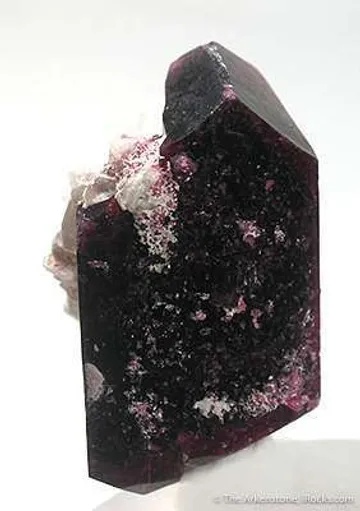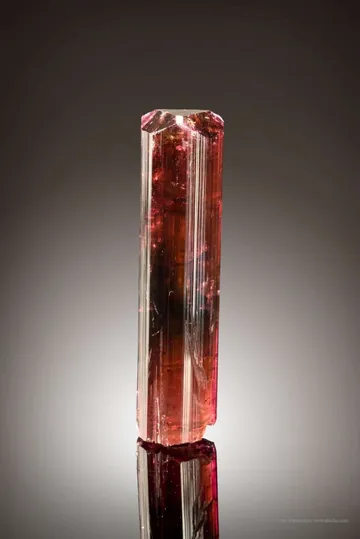
Vakinankaratra, Madagascar — classic pegmatite locality yielding gem tourmalines, liddicoatite, rhodizite, and beryl; diverse crystals prized by collectors.
Key facts
Vakinankaratra is one of the classic collector regions of central Madagascar: a highland province of rare-element pegmatites around Antsirabe, Betafo, Ibity, the Sahatany Valley, Anjanabonoina, and the Manapa–Andrembesoa area. On old labels the region is often simplified to “Antsirabe,” “Betafo,” or “Sahatany,” and that shorthand hides a remarkably varied mineral district. Its fame rests on Li–Cs–Ta pegmatites that produced gem tourmalines, liddicoatite–elbaite specimens, rhodizite–londonite, danburite-subtype borate assemblages, beryl varieties, spodumene, quartz, and radioactive Nb–Ta–Ti oxides such as the historically important “betafite” material from the Betafo area.
The geological setting is the central Madagascar basement, especially the Itremo Group and related highland metamorphic units: gneisses, quartzites, schists, marbles, and Mg-rich calc-silicate rocks cut by highly evolved granitic pegmatite dikes. The most specimen-rich bodies are not great open-pit ore deposits, but narrow, irregular dikes, pockets, and decomposed pegmatite zones where weathering released crystals from feldspar and quartz. The district matters historically because French and Malagasy collectors, miners, and mineralogists have worked these pegmatites for more than a century, and several species or species-defining problems in modern mineralogy are tied to this region: liddicoatite sensu lato from Madagascar’s tourmaline fields, londonite–rhodizite chemistry, schiavinatoite at Antsongombato, bityite at Maharitra, vránaite at Manjaka, and the name betafite from the Betafo district.
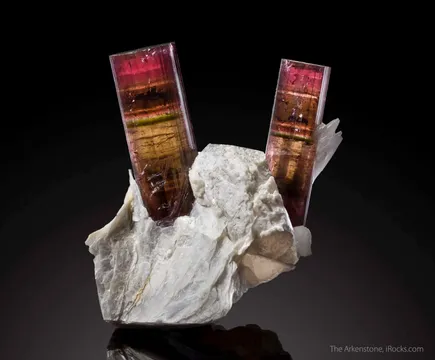
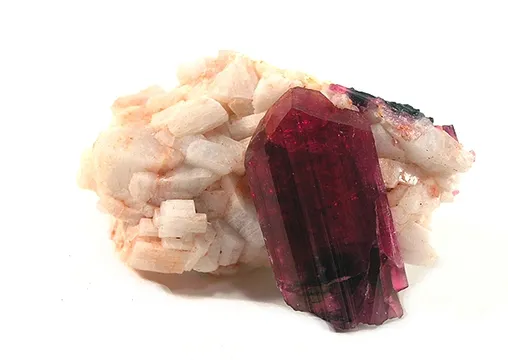
The finest specimens have a look unlike any other pegmatite district. Vakinankaratra liddicoatite and elbaite may show cranberry-red, pink, green, brown, yellow, or complex concentric and trigonal zoning; crystals can be lustrous, sharply striated, and gemmy, but many also carry the battered skins and repaired fractures of old pocket work. Rhodizite–londonite, by contrast, appears as deceptively small but optically lively yellow to greenish yellow dodecahedra, sometimes perched in pale feldspar and quartz with red tourmaline or blue apatite. The best Betafo “betafite” pieces are dense, altered, brown to sandy cubo-octahedral or octahedral pyrochlore-supergroup crystals—less glamorous than the gem pegmatite species, but deeply important historically.
Regional View
Country View


Photo: Wikimedia Commons
Search for specimens: View all specimens from Vakinankaratra, Madagascar
Vakinankaratra should be understood as a mineral province rather than a single pit. The region includes many named pegmatite fields and village-scale workings, with Antsirabe functioning historically as the best-known trade center and with Ibity, Sahanivotry, Ambohimanambola, Mahaiza, and Betafo appearing frequently on labels. Some of these names are true locality names; others are market or collecting-center names where material from nearby workings was brought for sale. That distinction is crucial when judging older specimens, because “Antsirabe” or “Betafo” can mean a precise mine, a district, or simply the place where the specimen entered commerce.
The dominant specimen deposits are rare-element granitic pegmatites of the LCT family, especially elbaite-subtype bodies with local spodumene- and danburite-subtype expressions. In the Sahatany Valley, the pegmatites are emplaced in the Itremo geological domain of central Madagascar, a metamorphic assemblage that includes schists, quartzites, gneisses, marbles, and Mg-rich calc-silicate rocks. At Manjaka, studies describe dikes ranging from thin concordant bodies only a few centimeters thick to thicker, irregular bodies with apophyses; contacts with the host rock can be sharp, and narrow tourmaline-rich reaction rims may appear where pegmatite met calc-silicate wall rock. The mineralogy is strongly boron-rich: albite, quartz, K-feldspar, tourmaline, spodumene, fluorapatite, Cs-rich beryl, columbite–tantalite, rhodizite–londonite, lithiophyllite, and unusual borates or borosilicates are all documented from the field.
Antsongombato, south of Betafo and west of the Sahatany Valley, is the locality that made Vakinankaratra indispensable to collectors of rhodizite–londonite. The deposit is a cluster of LCT pegmatite dikes, described as danburite subtype, worked for red tourmaline and yellow rhodizite–londonite. The mining area lies in dolomitic marble and associated Itremo rocks, and the productive pegmatites are narrow: individual dikes may extend hundreds of meters, but the dike that yielded the most celebrated gem-quality rhodizite–londonite specimens was only about 10–60 cm thick and roughly 400 m long. In other dikes, the same species occurs but in smaller or poorer crystals.
The mining history is layered. French colonists were working tourmaline-bearing pegmatites in the early twentieth century, and Antsongombato was already described in 1910. Red tourmaline was taken from massive quartz cores and, more rarely, miarolitic cavities. The Antsongombato mines and village were apparently abandoned around the early 1930s. A French colonist returned to the deposit in 1964–1965 for rhodizite specimens, and local dealers later reported a short-lived 1978 episode of red-tourmaline mining that ended because of flooding. The modern collector fame of Antsongombato began in 1998, when Federico Pezzotta’s field investigations recognized a promising system of pegmatitic dikes mineralized with red tourmaline and yellow Cs-rich rhodizite, later understood as part of the londonite–rhodizite series. The Malagasy company Pyramide of Antananarivo organized mining there, and from 1999 into 2000 the deposit produced the specimens that introduced many collectors to large, gemmy rhodizite–londonite crystals.
At Manjaka in the Sahatany Valley, the deposit style is different: a boron-rich elbaite-subtype pegmatite system famous scientifically for the Manjaka pegmatite and its exocontact assemblages. The major minerals include albite, quartz, K-feldspar, tourmaline in black, brown, yellow, red, and pink colors, plus subordinate spodumene; accessory minerals include fluorapatite, Cs-rich beryl, columbite–tantalite, rhodizite–londonite, and lithiophyllite. Small pockets with albite and red tourmaline are documented in the thinner dike system, while the larger bodies preserve unusual boron-rich mineralogy that later yielded species-level discoveries such as vránaite.
Anjanabonoina, west-southwest of Antsirabe in the Betafo district, is central to the story of Madagascar liddicoatite and elbaite. It is an aplite–pegmatite field extending roughly a few kilometers, with veins several meters thick in places, many deeply kaolinized or weathered. It produced some of the world’s most recognizable multicolored tourmaline slices and rubellite-colored crystals, and the early twentieth-century literature on Madagascar tourmaline repeatedly returned to its color zoning. The classic “star” patterns in slices cut perpendicular to the c-axis—three red bands intersecting around 120 degrees—became part of the visual identity of Madagascar liddicoatite sensu lato.
The Betafo area also gave mineralogy the name “betafite.” The original material near Ambolotara, west of Betafo, was described historically as masses and octahedra from an area yielding uranium-bearing Nb–Ta–Ti oxides, euxenite-(Y), rutile, zircon, and autunite. Modern pyrochlore-supergroup nomenclature has made many old “betafite” identifications problematic, and today many labels are best read historically unless backed by modern analysis. For collectors, however, the old Betafo-area specimens remain desirable because the name, locality, and morphology are inseparable from the early literature.
Collecting access today is not a casual walk-in proposition. These are small-scale mine workings, private or community-controlled pits, and old concessions in a region where minerals are part of local commerce. Some localities continue to yield occasional specimen material, but the famous productive episodes—especially the Pyramide Antsongombato rhodizite–londonite production—are past events. Serious acquisition usually comes through Malagasy miners and dealers, established international dealers, or older collections; field collecting should be approached only through current landholders, local authorities, and properly permitted operators.
Vakinankaratra is inseparable from liddicoatite in the collector sense, though modern tourmaline nomenclature means that many old “liddicoatite” specimens from Madagascar require analysis and some prove to be elbaite, fluor-liddicoatite, rossmanite, or zoned mixtures. The best material comes from pegmatite fields around Anjanabonoina and the Sahatany Valley, including localities such as Tsarafara and other Ibity-area workings, as lustrous striated prisms, gemmy cranberry-red to pink crystals, dark crystals with red internal flashes, and spectacular color-zoned sections cut across the c-axis. Crystals range from small thumbnail-sized individuals to multi-centimeter specimens and large sliced material; associations include albite, quartz, feldspar, and other tourmalines. Top pieces here are judged by real transparency through the body, intact trigonal terminations, crisp prism faces, strong but natural color zoning, attractive albite–quartz matrix, and credible locality history; ordinary examples are bruised, over-cleaned, poorly terminated, or simply labeled “liddicoatite” without chemical support.
Londonite from Vakinankaratra is principally a collector name encountered in the Antsongombato–Manapa–Betafo rhodizite–londonite assemblage, where the cesium-dominant member can be separated from potassium-dominant rhodizite only by quantitative chemical analysis. At Antsongombato the crystals are pale yellow to greenish yellow, commonly equant modified dodecahedra with dodecahedral, deltoid-dodecahedral, tristetrahedral, tetrahedral, and rarely cubic faces; most crystals are around the centimeter scale or smaller, while exceptional specimens reached 6–7 cm and a reported crystal across the series reached about 7 cm. The admired specimens are sharp, glassy, yellow, and well exposed in feldspar–quartz matrix, ideally with red tourmaline or blue apatite association; loose broken yellow grains, pale pieces lacking form, and specimens sold as “londonite” without analysis are much less desirable and are more responsibly labeled londonite–rhodizite series.
Rhodizite is documented from the Sahatany and Betafo-region pegmatites and is most famous in Vakinankaratra through its solid-solution partnership with londonite at Antsongombato. Visually, the best Vakinankaratra material is yellow to greenish yellow, glassy, equant, and strongly lustrous, forming modified dodecahedra or related isometric habits in pale pegmatite matrix; small crystals and facetable fragments from Manjaka and Antsongombato made Madagascar the principal collector source of gem-quality rhodizite–londonite. Fine pieces are those where the crystal is large for the species, sharply formed, not merely a frozen yellow grain, and aesthetically set with quartz, feldspar, albite, red tourmaline, or apatite. Because rhodizite and londonite cannot be reliably separated by appearance, the best labels either carry analytical data or use the series name.
Elbaite in Vakinankaratra is part of the same long tourmaline tradition that made Madagascar famous: red, pink, green, yellow, brown, and multicolored crystals from the Anjanabonoina and Sahatany pegmatite fields, often intergrown or compositionally zoned with liddicoatitic tourmaline. At Manjaka, elbaite-subtype pegmatites contain pink to red tourmaline that may dominate the thinner dikes and can grow from the contact inward, while black and brown tourmalines are more abundant in some larger bodies. Collector-grade elbaite from here is judged by saturated rubellite color, transparency, good termination, minimal bruising, and matrix context; analytical work matters because attractive Madagascar “rubellite” may be elbaite, fluor-elbaite, fluor-liddicoatite, rossmanite, or zoned combinations rather than a single homogeneous species.
“Tourmaline” is often the most honest field or trade label for Vakinankaratra material when species analysis is absent. The region’s tourmalines occur as black, brown, red, pink, green, yellow, and polychrome crystals in LCT pegmatites and as Mg-rich species in exocontact zones where pegmatite met calc-silicate host rock. Anjanabonoina produced the famous sliced material with complex pyramidal and trigonal color zoning, while Sahatany localities such as Manjaka and Tsarafara produced both cabinet specimens and chemically fascinating tourmalines including elbaite-subtype and contact-zone species. The best collector pieces combine clear species context, strong natural color, undamaged terminations, and an undisturbed matrix; lower-grade material includes polished slices with filled fractures, heavily repaired crystals, or attractive but analytically ambiguous “liddicoatite” labels.
Quartz is both a specimen species and an essential matrix mineral in Vakinankaratra pegmatites. It appears as colorless to smoky crystals in pegmatite cavities and cores, as matrix with liddicoatite, rhodizite, londonite, feldspar, albite, spodumene, and tourmaline, and as a commodity at named workings such as the Ambolo quartz mine near Marososona in the Betafo district. Japan-law twins up to about 6 cm have been recorded from the Ambolo mine, and smoky quartz is documented at Antsongombato and other pegmatites. Fine Vakinankaratra quartz is desirable when it frames rarer species without overwhelming them, shows bright luster and undamaged terminations, or carries a documented habit such as a Japan-law twin; ordinary pieces are abundant, milky, or locality-vague.
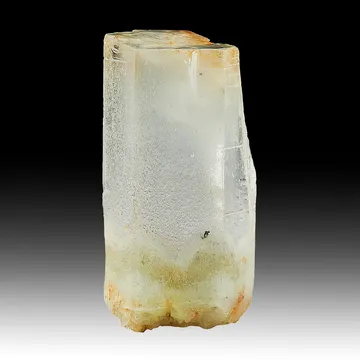
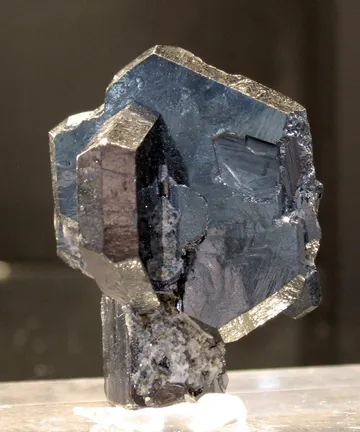
Betafite from Vakinankaratra is historically rooted in the Betafo district, especially Ambolotara west of the town of Betafo, where the name was introduced for uranium-bearing pyrochlore-supergroup material occurring as masses and octahedral crystals. Classic specimens are dense, radioactive, brown, blackish, greenish brown, or superficially yellow altered crystals, often cubo-octahedral to octahedral and commonly metamict or altered; associated district minerals include euxenite-(Y), rutile, zircon, autunite, and other Nb–Ta–Ti oxides. The strongest collector pieces are sharp, old-label examples from the original Betafo-area localities, with measurable crystal form and stable surfaces. Modern nomenclature is a serious issue: many historic “betafite” specimens do not satisfy current species definitions without fresh chemical and structural work, so provenance and analytical caution are part of the appeal rather than an inconvenience.
Other minerals from Vakinankaratra are numerous and often scientifically more important than their market visibility suggests. Antsongombato is the type locality for schiavinatoite, Nb(BO4), occurring with béhierite, danburite, elbaite–liddicoatite-series tourmaline, feldspar, pollucite, quartz, rhodizite, and spodumene. Maharitra in the Sahatany Valley is the type locality for bityite, a Be–Li mica found as small pseudohexagonal or lamellar aggregates associated with altered pegmatite minerals. Manjaka is the type locality for vránaite, Al16B4Si4O38, an unusual borosilicate related to boralsilite and occurring as microscopic aggregates after spodumene. The Sahatany field also documents hambergite, béhierite, danburite, manandonite, dumortierite, boralsilite, Cs-rich beryl, fluorapatite, columbite–tantalite, lithiophyllite, spodumene, and several tourmaline-supergroup species that make the district as important to mineralogy as it is to specimen collecting.
The most important authenticity issue is nomenclature, not outright fakery. Vakinankaratra tourmalines are notoriously difficult to label by sight. Red or multicolored “liddicoatite” may be elbaite, fluor-liddicoatite, rossmanite, or a zoned mixture, and polished slices can cross more than one species field. A serious label should distinguish between a traditional collector name, an analyzed species, and a visual variety such as rubellite. The same caution applies to rhodizite and londonite: unless quantitative chemistry demonstrates cesium dominance or potassium dominance, “londonite–rhodizite series” is the safest and most honest label.
Treatments are documented and should matter to buyers. Near-colorless rhodizite–londonite from Antsongombato has been irradiated with X-rays to produce greenish yellow or yellow color, and both natural-color and irradiated material can fade with prolonged sunlight exposure. Keep fine rhodizite–londonite out of display cases with intense direct light, and be skeptical of unusually saturated yellow faceted stones or small crystals without treatment disclosure. Short-wave UV fluorescence can be yellowish green in rhodizite–londonite, but fluorescence alone does not separate rhodizite from londonite.
Tourmaline condition requires close inspection. Many Madagascar liddicoatite and elbaite crystals came from weathered pegmatites, eluvial diggings, or tight pockets; chips to terminations, contact scars, rehealed fractures, and repairs are common. Polished slices are often stable and beautiful, but fractures may be filled or residues may remain from cutting and waxing processes used to hold fragile pieces during lapidary work. For crystal specimens, look for undisclosed glue at bases, reconstructed terminations, and matrix attachments that seem too convenient.
Radioactive minerals from the Betafo district demand appropriate handling. Historic “betafite,” euxenite-(Y), autunite, and related U-bearing oxides and phosphates should be stored with the ordinary precautions used for radioactive minerals: limit handling, avoid dust, wash hands after contact, keep specimens labeled and boxed, and do not cut, grind, or tumble them. Many “betafite” specimens are metamict and altered; crumbly surfaces, yellow alteration crusts, and powdering are condition problems as well as handling concerns.
Market availability is uneven. Quartz and generalized Madagascar tourmaline remain available, though precise Vakinankaratra mine labels are less common than regional labels. Fine liddicoatite–elbaite crystals from the old classic finds are competitive and increasingly collection-bound. Good rhodizite–londonite from Antsongombato is scarce, especially matrix specimens with sharp yellow crystals over 1 cm, and the best pieces tend to circulate from older dealer stock or established collections. Type-locality microminerals such as vránaite or schiavinatoite are specialist material rather than general-market specimens. Well-crystallized, old-label Betafo “betafite” is also much less common than the abundance of the historical name might suggest.
The modern Antsongombato story has the pace of a short-lived rush. The old French workings were already part of Madagascar’s pegmatite lore by 1910, but the place seems to have slipped from active memory after the early twentieth-century tourmaline mining faded. The mines and even the village were reportedly abandoned around the early 1930s. Decades later, a small amount of rhodizite was cut from Antsongombato rough in the 1960s, including stones up to about 2 carats, but the locality remained mostly a footnote until the late 1990s.
In October 1998, field investigations at Antsongombato recognized a new system of pegmatitic dikes carrying red tourmaline and yellow cesium-rich rhodizite, later treated as part of the londonite–rhodizite series. Mining by Pyramide Co. followed quickly. The scale was still artisanal by industrial standards, but not casual: about 40 miners, organized in groups of eight, dug pits into the mineralized parts of the dike. Barren pegmatite was deliberately left in place to support the excavation. The target dike was narrow enough to seem improbable as the source of a world-class gem mineral—only tens of centimeters thick in places—yet it produced the yellow dodecahedra that caused a stir at the 2000 Tucson shows.
The best Antsongombato production was brief. Most of the gem rough and fine specimens came out between February 1999 and September 2000. Mining penetrated roughly 40 m of the main pegmatite before the operation became impractical: in some areas mineralization ended, in others flooding and collapse made work dangerous, and the unweathered rock at depth was hard enough to make continued digging difficult. By January 2001, Pyramide had ceased activity. The result was a sharply bounded collector episode: a small window of production, several hundred grams of gem-quality rough, more than 300 carats of faceted rhodizite–londonite, and a handful of cabinet specimens good enough for major museums.
One specimen from that episode became a benchmark: a 6.5 cm wide yellow rhodizite–londonite crystal on K-feldspar, albite, and bicolored tourmaline matrix, photographed for the gemological literature from the Pyramide Co. collection. Earlier, a large, pale yellow, vitreous crystal about 7 cm across had entered the collection of the School of Mines in Paris from the 1964–1965 mining. For a species pair that commonly appears to collectors as tiny yellow grains or sub-centimeter crystals, those dimensions are startling; they explain why Antsongombato is remembered not merely as a gem source but as the locality that changed the visual scale of rhodizite–londonite collecting.
The liddicoatite story is older and more visual. In 1890, a large rubellite crystal from the Mount Ibity area reached the National Museum of Natural History in Paris through a colleague of Alfred Grandidier. By 1893, Grandidier had found colored tourmaline in situ in the Betafo region, and by the early 1900s Madagascar’s central highland pegmatites were already important enough for French engineers and mineralogists to describe them in detail. Lacroix’s early work captured what collectors still prize: not simply red tourmaline, but the architecture of color inside the crystals. Some slices showed three red bands meeting at 120 degrees, a trigonal star locked into the cross-section. More than a century later, that pattern remains one of the most recognizable signatures of Madagascar liddicoatite–elbaite material.
Brendan M. Laurs, Federico Pezzotta, William B. Simmons, Alexander U. Falster, and Sam Muhlmeister, “Rhodizite-Londonite from the Antsongombato Pegmatite, Central Madagascar,” Gems & Gemology, 38(4), 326–339, 2002. The essential article on Antsongombato history, geology, mining, production, gemology, fluorescence, irradiation, fading, and specimen morphology.
Dona M. Dirlam, Brendan M. Laurs, Federico Pezzotta, William B. Simmons, and Alexander U. Falster, “Liddicoatite Tourmaline from Anjanabonoina, Madagascar,” Gems & Gemology, 38(1), 28–53, 2002. A major collector and gemological reference for Madagascar liddicoatite–elbaite material, including Anjanabonoina history, zoning, properties, and analytical complications.
Federico Bosi, Bianca Celata, Henrik Skogby, Ulf Hålenius, Giovanni Tempesta, Marco E. Ciriotti, Elena Bittarello, and Alessandro Marengo, “Mn-bearing purplish-red tourmaline from the Anjanabonoina pegmatite, Madagascar,” Mineralogical Magazine, 85, 242–253, 2021. A modern analytical study showing why Madagascar red tourmaline labels require care.
Petr Gadas, Milan Novák, Michaela Vašinová Galiová, and Federico Pezzotta, “Chemical composition of tourmalines from the Manjaka pegmatite and its exocontact, Sahatany Valley, Madagascar,” Journal of Geosciences, 68(3), 185–202, 2023. The best modern geological and chemical treatment of Manjaka tourmalines and the pegmatite–calc-silicate contact setting.
William B. Simmons, Alexander U. Falster, Brendan M. Laurs, Federico Pezzotta, and colleagues, “Londonite, a new mineral species: the Cs-dominant analogue of rhodizite from the Antandrokomby granitic pegmatite, Madagascar,” The Canadian Mineralogist, 39, 747–755, 2001. The species-defining londonite paper; important for Vakinankaratra because Antsongombato material belongs to the same analytically inseparable collector problem.
Francesco Demartin, Valeria Diella, Carlo M. Gramaccioli, and Federico Pezzotta, “Schiavinatoite, (Nb,Ta)BO4, the Nb analogue of behierite,” European Journal of Mineralogy, 13(1), 159–165, 2001. Type-mineral description for schiavinatoite from Antsongombato.
Jan Cempírek, Edward S. Grew, Anthony R. Kampf, Chi Ma, Milan Novák, Petr Gadas, Radek Škoda, Michaela Vašinová-Galiová, Federico Pezzotta, Lee A. Groat, and Sergey V. Krivovichev, “Vránaite, ideally Al16B4Si4O38, a new mineral related to boralsilite, Al16B6Si2O37, from the Manjaka pegmatite, Sahatany Valley, Madagascar,” American Mineralogist, 101, 2108–2117, 2016. Type-species reference for vránaite from Manjaka, with type material in the Natural History Museum of Los Angeles County and the Moravian Museum.
Nadine Ranorosoa, “Étude minéralogique et microthermométrique des pegmatites du champ de la Sahatany, Madagascar,” Ph.D. thesis, Université Paul Sabatier, Toulouse, 1986. A foundational Sahatany pegmatite-field study repeatedly cited in later work on Manjaka and the regional boron-rich assemblages.
Alfred Lacroix, “Minéralogie de Madagascar,” Tome I, Augustin Challamel, Paris, 1922. The classic descriptive baseline for Madagascar minerals, including early records from the central highland pegmatites.
Donald D. Hogarth, pyrochlore-group work culminating in the 1977 redefinition of betafite. Essential background for understanding why old Betafo “betafite” labels are historically important but not always compatible with modern pyrochlore-supergroup species nomenclature.
Mindat: Vakinankaratra, Madagascar — Regional locality page with mineral lists, marketplace-label cautions, and links to sublocalities across the province.
Mindat: Antsongombato gem mine — Key locality page for rhodizite–londonite, red tourmaline, schiavinatoite, mining history, and the Pyramide Co. production.
Mindat: Sahatany Valley — Broad Sahatany Valley page covering the Ibity-area pegmatite field, its mineral list, and type-mineral records.
Mindat: Sahatany Pegmatite Field, Mt Ibity area — Useful entry for the larger pegmatite field and the relationship of the named Sahatany workings.
Mindat: Anjanabonoina pegmatites — Important for liddicoatite–elbaite, morganite, and the classic Madagascar tourmaline story.
Mindat: Ambolotara, Betafo — Original Betafo-area locality for historic “betafite” material and associated uranium-bearing Nb–Ta–Ti minerals.
GIA: Rhodizite-Londonite from the Antsongombato Pegmatite, Central Madagascar — The most important collector-readable source on Antsongombato’s gem and specimen production.
GIA: Liddicoatite Tourmaline from Anjanabonoina, Madagascar — Essential background on Madagascar liddicoatite, color zoning, gemology, and species identification.
Journal of Geosciences: Tourmalines from the Manjaka pegmatite and exocontact — Open-access research on Manjaka geology, tourmaline chemistry, and pegmatite–host-rock interaction.
Cambridge Core: Mn-bearing purplish-red tourmaline from the Anjanabonoina pegmatite — Modern analytical paper useful for understanding why red Madagascar tourmaline requires testing.
Mindat: Vránaite — Type-mineral page for vránaite from Manjaka, including type material information and associated minerals.
Mindat: Betafite of Hogarth 1977 — Best concise explanation of the historical betafite name, Betafo first-recorded locality, and modern nomenclature problem.
Wikimedia Commons: Liddicoatite, Albite, Quartz from Sahatany — Freely licensed photograph showing the classic red tourmaline-on-matrix look of the Sahatany field.
Wikimedia Commons: Rhodizite from the Sahatany Pegmatite Field — Freely licensed photograph of a yellow rhodizite crystal in matrix from the broader Vakinankaratra pegmatite province.