Urad Mine, Colorado — notable locality for rhodochrosite on quartz and purple fluorite; small, colorful specimens with strong collector value.
Key facts
Urad is one of those Colorado localities whose specimen fame is almost a footnote to a much larger geologic story. The mine sits high in the Dailey, or Jones Pass, district near Red Mountain, west of Empire and just east of the Continental Divide, in the same intrusive center that produced the giant Henderson molybdenum deposit below it. Geologically it is a Climax-type porphyry molybdenum system: Oligocene, high-silica rhyolitic intrusions of the Red Mountain complex cutting ancient Silver Plume Granite, with molybdenite concentrated in stockwork veinlets, shear zones, fractures, and altered wall rock. For ore geologists, Urad matters because it was the exposed, shallower, older member of the stacked Urad-Henderson pair; for collectors, it matters because a small quantity of unusually attractive rhodochrosite and fluorite escaped from a mine built for molybdenum.
Regional View
Country View
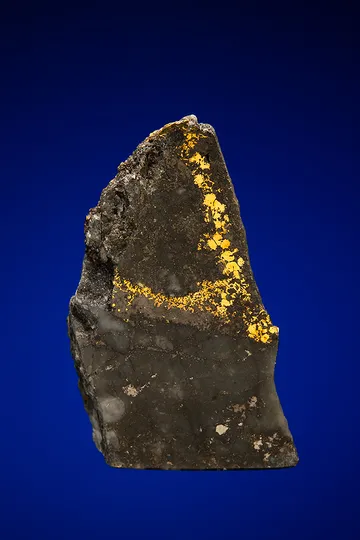
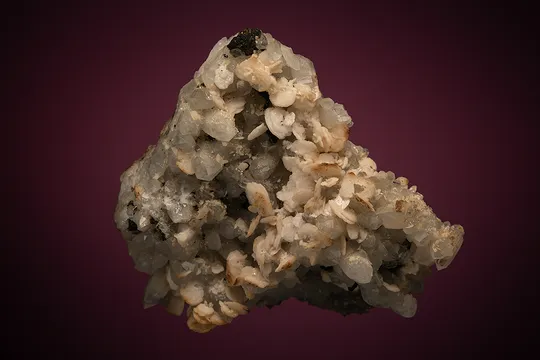
The classic Urad specimen is not a Sweet Home-style scarlet rhombohedron, nor a San Juan comb of pastel carbonate, but a more intimate Front Range combination: rose-red to pastel-pink rhodochrosite rhombs on drusy quartz, purple fluorite, pyrite, and dark sulfides. The best pieces are small but visually rich, with color contrast and real matrix context. A few documented cabinet and miniature pieces show frosted rhodochrosite clusters perched on lavender fluorite-bearing matrix, while other examples are single pink rhodochrosite crystals saved as thumbnails. Because the mine was an industrial molybdenum operation, and because the collecting window was brief, even modest Urad pieces have locality value out of proportion to their size.

Photo: MineralAuctions.com
Search for specimens: View all specimens from Urad Mine, near Empire, Clear Creek County, USA
Urad is recorded in the Dailey Mining District, also called the Jones Pass district, in Clear Creek County, Colorado. Mindat places the mine at approximately 39° 45′ 22″ N, 105° 49′ 35″ W. The setting is the Red Mountain area near the headwaters country of Clear Creek, a high, severe piece of Front Range terrain where nineteenth-century prospecting for precious metals was later overshadowed by twentieth-century molybdenum. In collector labels the locality is commonly simplified to “Urad Mine, near Empire,” “Urad Mine, Berthoud Pass,” or “Urad Mine, Clear Creek County.”
The deposit is a Climax-type porphyry molybdenum deposit. The Urad and Henderson orebodies are related but distinct parts of the same Red Mountain magmatic-hydrothermal system. Urad was the older, shallower, smaller deposit; Henderson is the deeper and much larger orebody discovered beneath and near it. The Red Mountain complex consists of multiple rhyolitic intrusive phases, with the Urad mineralized zone tied to the Square Quartz Porphyry and associated Oligocene rhyolite porphyry bodies intruding the Proterozoic Silver Plume Granite. Regional structure mattered: the system lies near major northeast-trending structures including the Berthoud Pass and Vasquez Pass fault zones, within the western part of the Colorado Mineral Belt.
The Urad orebody was mined chiefly for molybdenite. Early descriptions emphasize high-grade molybdenite localized in shear zones in and around the Red Mountain granite porphyry stock, as well as molybdenite in numerous veinlets and disseminations within the porphyry and in fractured, altered granite around the stock margin. A USGS account describes the ore as an east-trending vein system dipping 45° to 50° north, with replaced wall rock and a network of small branching and intersecting molybdenite veins. Pyrite is common, quartz occurs especially in larger veins, and galena, sphalerite, fluorite, and rhodochrosite are associated with the molybdenite. That late, mixed gangue-sulfide environment is the collector’s part of the Urad story.
Mining began during World War I, when molybdenum became strategically important for hardened steel. The Primos Exploration Company developed and mined the molybdenum orebody from 1914 to 1919. During World War II the property was government-owned and operated under Molybdenum Corporation of America, though published summaries indicate little or no production in that period. AMAX acquired the property in 1963 for $2 million, spent heavily on exploration and development, and restarted Urad production in 1967. The orebody was exhausted in 1974, after roughly 14 million tons of ore at about 0.35 percent MoS2 had been extracted. The exploration that began around Urad led directly to the 1964 discovery of the blind Henderson orebody, which began production in 1976 and remains the better-known operating molybdenum mine of the district.
Specimen production from Urad was never the business of the mine, and that is why the surviving mineral pieces feel scattered, personal, and scarce. Documented collector specimens point to the late Urad period and the immediately post-mining collector network: a Kosnar family specimen of fluorite and rhodochrosite was recorded as self-collected in 1975; other Urad rhodochrosites are described as dating from the 1960s–1970s. The best recorded pieces are miniatures and small cabinets, not large museum monsters: one illustrated 4.3 x 3.0 x 2.7 cm specimen carries a 2.2 cm cluster of frosted rose-red to pastel-pink rhodochrosite rhombs on rhodochrosite, drusy quartz, purple fluorite, sulfides, and brassy pyrite; another 5.5 cm specimen has gemmy reddish-pink rhombs to about 1.2 cm on quartz with pyrite. No widely used pocket names appear in the published collector descriptions, so Urad pieces are best understood as scarce survivors from limited open-space occurrences encountered during the molybdenum-mining years rather than from a famous named pocket sequence.
Access today should be treated as closed for collecting. The old Urad property is part of a heavily industrialized and reclaimed molybdenum-mining landscape associated with Henderson and Climax Molybdenum/Freeport-McMoRan operations. Western Mining History’s MRDS-derived mine pages advise that mine locations in that database should be assumed to be on private property, and Urad’s proximity to active Henderson infrastructure makes casual field collecting inappropriate. Modern collectors should obtain Urad specimens through old collections, documented dealer stock, and carefully labeled estate material rather than by attempting to visit the mine.
Urad rhodochrosite is prized less for large size than for rarity, color, and association. Verified examples range from thumbnail single pink crystals around 1.7 cm to small-cabinet matrix pieces a little over 5 cm across; the finest documented matrix specimens show sharp to frosted rhombs in reddish-pink, rose-red, and pastel-pink tones, sometimes with attractive secondary modifying faces on the rhomb edges. The strongest pieces are on matrix, especially where pink rhodochrosite is set against white drusy quartz, purple fluorite, brassy pyrite, and darker sulfides. Ordinary Urad rhodochrosite may be massive, cleaved, or visually isolated; the desirable pieces show distinct rhombs, good luster or translucency, clean color, and recognizable Urad-style association rather than looking like generic Colorado carbonate.
Fluorite from Urad is best known as a companion mineral with rhodochrosite rather than as a major stand-alone species. Published and photographed examples show purple fluorite in combination with pink rhodochrosite, quartz, pyrite, and mixed sulfides, the fluorite commonly acting as a lavender-to-purple color field in the matrix beneath or beside the carbonate crystals. The old Kosnar specimen, photographed for Mindat, is a classic fluorite-rhodochrosite association, and the illustrated Logan specimen shows purple fluorite as part of the same rich miniature assemblage. Good Urad fluorite pieces are those where the fluorite is visibly part of the composition and locality story; isolated or massive fluorite from the mine has much less collector pull than combinations with rhodochrosite.
Beyond rhodochrosite and fluorite, Urad’s documented mineral list reflects its porphyry-molybdenum setting and evolved, fluorine-rich intrusive environment. Molybdenite is the defining ore mineral, accompanied by pyrite, pyrrhotite, chalcopyrite, galena, sphalerite, quartz, K-feldspar, muscovite or sericite, baryte, beryl, topaz, cassiterite, hübnerite, ferrimolybdite, apatite, garnet-group minerals, and magnetite. For collectors, topaz, hübnerite, cassiterite, and beryl are noteworthy because they fit the highly evolved granite-rhyolite chemistry of the Urad-Henderson system, but fine display specimens of these species from Urad are far less familiar on the market than the rhodochrosite-fluorite combinations.
Urad rhodochrosite is a provenance-sensitive locality collectible. The first question is not “Is it rhodochrosite?” but “Is it really Urad?” Colorado has many rhodochrosite localities, and labels reading only “Clear Creek County,” “Empire,” “Berthoud Pass,” or “Colorado” deserve scrutiny. Urad pieces should be compared with the documented look: small rhombs, commonly pink to rose-red, often associated with quartz, pyrite, sulfides, and purple fluorite. A Sweet Home-style group of large, glassy, intensely red rhombohedra, or a San Juan-style vein specimen, should not be accepted as Urad without strong old-label or collection history.
No well-publicized treatment or systematic fake problem is documented for Urad material, and there is little incentive to manufacture fakes from scratch when the locality’s value depends so heavily on provenance. The more realistic problem is relabeling: unattributed Colorado rhodochrosite, fluorite-rhodochrosite combinations, or Henderson-adjacent material can acquire a more specific Urad label in circulation. Old collection labels, acquisition history, and consistency with 1960s–1970s material are therefore important. Specimens tied to known Colorado collectors or collections, such as Kosnar, Joe Dorris, or the W. S. Logan rhodochrosite collection, carry extra confidence.
Condition matters sharply because Urad specimens are typically small. Rhodochrosite cleaves readily, and published descriptions of otherwise desirable Urad pieces mention small cleaves or minor imperfections on prominent rhombs. A single bruised edge can dominate a thumbnail. Fluorite may be cleaved or contacted, quartz druse can be bruised, and sulfide-rich matrix may shed grains. Pyrite and other sulfides should be kept dry and stable; avoid humid storage and do not wash these specimens aggressively. Rhodochrosite also deserves protection from acids and prolonged strong light, not because Urad material is uniquely fragile, but because its value is tied to preserving delicate color, luster, and sharpness.
Availability is low. MineralAuctions has described Urad specimens of any type as rare, and multiple dealer records emphasize that matrix rhodochrosites from the mine seldom appear. When they do, they are usually thumbnails, miniatures, or small cabinets. A modest but well-labeled Urad rhodochrosite can be more significant in a Colorado suite than a larger, prettier, but common piece from a better-supplied locality. The premium belongs to specimens that combine clear Urad provenance, distinct rhodochrosite crystals, purple fluorite or sulfide association, and undamaged display faces.
The most consequential “specimen” ever noticed at Urad may have been ore out of place. During mapping at the old Urad workings, Climax geologists saw what mining lawyer Stanley Dempsey later called “drag ore”: fragments of mineralized rock that appeared to have been shoved upward along a fault from something deeper. That observation was more than a curiosity. The geologists reasoned that the fragments had been torn from a buried molybdenum deposit below the known Urad orebody. Stew Wallace and his Climax geology group followed the idea with deep diamond drilling, and in 1964 the hidden Henderson orebody was found.
Dempsey’s recollection of the discovery has the intimacy of a room where everyone understood the scale of the moment before the market did. He was in Bob Henderson’s office at Mines Park in Golden with Jack Laing when Wallace, and probably Bruce McKenzie, came in with news of a long, high-grade intercept of molybdenum mineralization. Henderson was gravely ill. Dempsey remembered “a very special feeling in the room,” because the drill hole proved that Henderson’s backing of Wallace had paid off while he was still alive to know it. The discovery would become one of the great molybdenum orebodies of the world, but it began with geological inference from the mined and mapped Urad ground.
The stock market, famously, was less sentimental. Dempsey helped prepare the press release, then flew to Reno after the announcement and went to a brokerage house just to look in the window. He had no money to buy AMAX stock, and as an insider he could not have bought it legally anyway. He simply wanted to see the effect of the announcement. The share price went down. Someone later explained the logic: a deep, world-class molybdenum discovery might be ten or fifteen years from production. The orebody was real; the market wanted patience.
The scale that followed was staggering. Henderson required a land position large enough for three shafts, including one 30 feet in diameter and 3,000 feet deep; a 9.6-mile railroad tunnel through the Continental Divide; and a tailings facility designed around milling hundreds of millions of tons of ore. The Urad claims, already patented over much of the needed ground, became part of a much larger engineering and legal puzzle. This was not a romantic prospector’s adit becoming a collector locality; it was an old molybdenum mine turning into the surface clue and property anchor for a modern underground mining complex.
The environmental story around Urad-Henderson is just as striking. Before the National Environmental Policy Act had fully changed project planning, Dempsey pushed AMAX toward what became known as the “Experiment in Ecology.” Over beers with Roger Hansen of the Colorado Open Space Council, he floated a then-radical idea: what if a major mining company opened its planning process to environmentalists “on a responsible basis”? Hansen’s answer was memorable: “Big companies don’t behave like that.” But AMAX did. Four people from the environmental community—Roger Hansen, Betty Willard, Bob Weiner, and Bob Venuti—joined a long planning dialogue with the company.
One of the best scenes from that process took place on Jones Pass. The group was sprawled on the tundra eating lunch at high altitude with Dick Walker of Public Service Company of Colorado. Dr. Beatrice “Betty” Willard asked why power-line corridors always had to be clear-cut. Walker did not dodge the question. He said he did not know, but he would find out. At the next meeting he returned with engineers and an answer: they did not have to clear-cut. Dempsey later said there is no power-line scar to Urad and Henderson because of Betty’s question and Walker’s response.
Even wildlife passages entered the mine plan. Ecologist Dick Beidleman walked the railroad grade with company people, reading the landscape by bird life and bird calls in ways the engineers had not been trained to see. Later, a biologist worked with the company and environmental participants on elk movement, and underpasses were built so elk could cross beneath the railroad track. In Dempsey’s telling, the lesson was not that mining became impact-free; it was that details changed when people who knew different things walked the same ground together.