






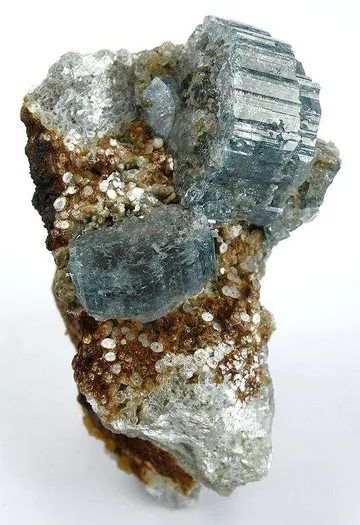
Topsham, Maine - a compact pegmatite district known for beryl varieties, topaz, and rare minerals; prized for graphic pockets and diverse NYF assemblage.
Key facts
Topsham’s mineral fame rests on a narrow, quarry-pocked belt of granitic pegmatites in Sagadahoc County, Maine, just north of Brunswick and the Androscoggin River. To the collector, this is not a one-mine locality but a compact pegmatite district: Fisher, Swamp #1 and #2, Staples, the Consolidated quarries, Standpipe Hill, Yedlin, the Willes workings, Square Pit, Trenton, Havey, and a scattering of smaller prospects. The old workings were opened chiefly for feldspar, mica, and quartz, but they entered collector history for an assemblage that is unmistakably Topsham: beryl in several color varieties, topaz, hydroxylherderite, columbite-tantalite series minerals, monazite-(Ce), ishikawaite, grayite, gahnite, zircon, and, above all, superb crystallized uraninite.
Geologically, the Topsham pegmatites belong to the Brunswick pegmatite field and cut high-grade metamorphic rocks of the Falmouth-Brunswick sequence. They are generally Permian in age, around 275–269 Ma, and they are internally zoned in the familiar Maine pegmatite fashion: coarse graphic feldspar-quartz wall zones, blocky perthite and quartz cores, and intermediate zones where beryl, columbite-tantalite minerals, phosphates, and pockets concentrate. What makes Topsham different from the better-known lithium-rich pegmatites of western Maine is its mixed NYF character: not overwhelmingly enriched in lithium, but unusually good for uranium-, thorium-, niobium-, tantalum-, beryllium-, and rare-earth-bearing accessories.
The best Topsham specimens have a look collectors remember. Fisher Quarry is the classic source of graphic granite, topaz, hydroxylherderite, lepidolite, beryl, and small rare species in pockety albite-rich zones. Standpipe Hill and Yedlin are names to watch for on old labels attached to bismuthinite, monazite, ishikawaite, magnetite, and other rare accessories. Swamp #1, the Trebilcock locality, is the locality that made Topsham internationally famous among collectors of radioactive minerals: jet-black uraninite crystals with metallic to submetallic blue-black luster, sharp cube to cuboctahedral form, and a density in the hand that seems almost unreasonable for their size.
Regional View
Country View
The district’s collecting identity comes from that tension between industry and specimen mineralogy. Topsham was first a feldspar district, feeding ceramic manufacture through the Cathance River mill and railroad connection. Its specimen reputation grew from what feldspar miners and later collectors found along the margins, pockets, dumps, and water-filled cuts: aquamarine in feldspar, topaz and hydroxylherderite from Fisher, radioactive oxides in Swamp and Standpipe Hill material, and rare thumbnail-scale species that reward careful examination more than brute-force quarrying.

Photo: Wikimedia Commons

Photo: Wikimedia Commons
Search for specimens: View all specimens from Topsham, USA
Topsham is a district of granitic pegmatites rather than a single mine. The pegmatites form a roughly mile-wide belt extending northeastward across the town, historically described from the Mount Ararat area toward the Cathance River and Bowdoinham line. The country rocks are quartz-mica schists and gneisses intruded by granitic pegmatite, leucogranite, and related granitic rocks. Later petrologic work grouped the pegmatites into a Northern series and a Standpipe Hill series. The Northern series includes such collector names as Fisher, Square Pit, Trebilcock, Biotite Crystal, and Consolidated, whereas Standpipe Hill and Yedlin represent the more REE-rich southern group.
The pegmatite bodies are typically lenticular and internally zoned. Detailed studies describe coarse graphic perthite-quartz wall zones, large perthite-quartz cores, and intermediate zones with quartz, blocky perthite, muscovite, albite, apatite, garnet, beryl, and columbite-tantalite minerals. In the Fisher Quarry pegmatite, the collector-significant assemblage includes accessory uraninite and gahnite, plus miarolitic zones with lepidolite, topaz, hydroxylherderite, beryl, minor elbaite, and apatite. Fluid-inclusion work on Fisher suggests high-temperature crystallization of the wall and graphic granite zones, followed by cooler miarolitic-cavity quartz growth, a history consistent with its pocket mineralogy and unusually expressive quartz-feldspar textures.
The old commercial ore was feldspar, with quartz and mica secondary in importance. Early government descriptions emphasize that feldspar was the only consistently important commercial product at the Topsham quarries, although clear quartz was saved when marketable and gem tourmaline or aquamarine appeared occasionally. At the G. D. Willes feldspar quarry, then the largest of the Topsham workings, coarse graphic feldspar-quartz was mined on several levels, with the deepest workings reported at about 50 feet. One early account notes a 10-foot-high, 50-foot-long bed of white quartz and an adjacent feldspar mass 15 feet across, a useful reminder of the scale of these pegmatites even when their collectible pockets are small.
Industrial development began in earnest in the late 1860s. The Trenton Flint and Spar Company of Trenton, New Jersey, purchased the Cathance River mill property in 1869 and leased the then-unopened quarries. A mill was built in 1872 to grind feldspar for pottery and ceramic use, and the ground spar was shipped south to Trenton. By the early twentieth century the Cathance mill was described as using water power during high water and steam power as needed, with three chaser mills, four ball mills, and an estimated capacity of about 16 tons of ground spar per day. Ore from the quarries was hauled by team to the mill or to Cathance station on the Maine Central Railroad.
The named Topsham workings each have their own collector personality. Fisher Quarry is the district’s mineralogical showpiece: topaz, hydroxylherderite, beryl, lepidolite, schernikite, columbite-tantalite species, hydroxycalciomicrolite, and striking graphic granite all figure in its history. Swamp #1 and Swamp #2 are excavated in the same pegmatite and are separated by a narrow roadway; Swamp #1 was vastly more productive for uraninite, though both produced comparable crystal quality. Staples Quarry has yielded uraninite with almandine, columbite-(Fe), schoepite, zircon, and monazite-(Ce). Standpipe Hill and Yedlin are especially significant for rare-element and REE minerals, including ishikawaite and important monazite-bearing material; Standpipe Hill is also noted for exceptional bismuthinite. Square Pit is one of the classic aquamarine-bearing localities, and the Trenton and Willes workings preserve the older feldspar-mining side of the district.
Collecting access in Topsham is not something to infer from old guidebooks or old labels. Many of the pegmatite pits are water-filled, seasonally wet, on private land, within conserved land, or associated with residential and preserve trail systems. Maine Geological Survey has specifically cautioned that printed and online collector-guide access information for Maine localities is often out of date and should not be taken as permission. The Cathance River Nature Preserve and associated trails give hikers views of abandoned pegmatite workings, but trail access and collecting permission are separate matters. Serious collectors should treat Topsham as a permission-only district, work through current landowners, local clubs, or established Maine mineral contacts, and assume no collecting right merely because a quarry is visible from a path.
Topsham uraninite is famous for sharp, lustrous black crystals from the Swamp quarries, especially Swamp #1, the Trebilcock locality, with additional occurrences at Staples, Fisher, and nearby Topsham pegmatites. The classic crystals are dense, metallic-looking cubes and cuboctahedrons, commonly thumbnail-sized but known from much larger examples, with the finest historical pieces showing mirror-bright faces, complete form, and natural presentation on albite, microcline, or pegmatite matrix. Matrix pieces are especially prized because many of the old crystals were recovered loose or partly freed from decomposed feldspar; associated minerals may include columbite-(Fe), monazite-(Ce), zircon, almandine, schoepite, and other uranium alteration products. A good Topsham uraninite is not simply “hot” or heavy—it has crisp geometry, glossy blue-black to jet-black faces, minimal bruising on edges and corners, and a trustworthy old label tying it to Swamp #1, Swamp #2, Staples, Fisher, or the broader Trebilcock occurrence.
Other Topsham minerals give the district unusual depth beyond uraninite. Fisher Quarry is the key locality for topaz, hydroxylherderite, beryl varieties including aquamarine, heliodor, and morganite, small elbaite, lepidolite, schernikite, columbite-(Fe), columbite-(Mn), tantalite-(Mn), stibiotantalite, tapiolite-(Fe), hydroxycalciomicrolite, gahnite, and zircon var. cyrtolite. Palache and Gonyer’s 1940 study of microlite and stibiotantalite from Topsham remains one of the district’s important rare-oxide records. Havey is noted for grayite with monazite-(Ce), xenotime-(Y), and zircon. Standpipe Hill and Yedlin are important for REE- and uranium-niobium-bearing oxides including ishikawaite, and for exceptional accessory-mineral assemblages that are far more mineralogically sophisticated than the district’s old feldspar-mine origins suggest. Topsham labels also turn up on almandine, bismuthinite, chrysoberyl, fluorapatite, phenakite, smoky quartz, rose quartz, schorl, torbernite, autunite, metatorbernite, phosphuranylite, uranium-bearing alteration minerals, and a wide range of pegmatite feldspars and micas.
Topsham specimens are label-sensitive. “Topsham, Maine” alone is useful but incomplete; “Swamp #1,” “Trebilcock locality,” “Swamp #2,” “Staples,” “Fisher,” “Standpipe Hill,” “Yedlin,” “Square Pit,” or “Consolidated” materially changes both the mineralogical meaning and the market value. The most common ambiguity is with uraninite: many pieces are labeled simply “Swamp Quarry,” “Swamp No. 1,” “Trebilcock,” or “Topsham,” and older labels may not distinguish Swamp #1 from Swamp #2 or nearby radioactive pegmatites. Good provenance, old Maine labels, ex-Trebilcock associations, or documented collection history are meaningful value factors.
No well-established Topsham-specific fake industry is documented, but misidentification and overbroad labeling are real issues. Dense black columbite-(Fe), ishikawaite, altered uraninite, and other radioactive oxides can be confused by appearance, especially when collected as dark grains or fragments from dumps. “Pitchblende” is often used loosely for Topsham uraninite, but the best locality specimens are crystallized uraninite rather than massive botryoidal pitchblende in the classic vein-ore sense. Collector-grade identifications of rare oxides such as ishikawaite, hydroxycalciomicrolite, stibiotantalite, tantalite, and tapiolite should be treated cautiously unless supported by analysis, a museum-quality old label, or a reliable reference collection.
Condition matters greatly. Topsham uraninite crystals are hard enough to survive handling but are heavy, brittle at edges, and unforgiving when knocked against matrix or other specimens. The finest crystals have sharp corners and intact reflective faces; bruised corners, dull altered skins, or broken attachment points lower desirability. Some crystals show yellow-orange to brown uranium alteration products such as schoepite-type coatings or later phosphates; these can be attractive when natural and stable, but powdery alteration should be kept contained and handled carefully.
Radioactivity is part of the locality’s identity and should be treated with professional respect. Uraninite, monazite-(Ce), ishikawaite, and some associated alteration minerals may contain uranium and/or thorium and can produce measurable gamma radiation as well as radioactive decay products. Store significant specimens away from living spaces, avoid carrying them in pockets, do not grind, saw, or acid-clean them casually, keep friable material in a closed display box, wash hands after handling, and use sensible distance and time limits. Topsham uraninite is often small, but density and activity can be high relative to size.
Fluorescence is not the principal reason to collect Topsham, but uranium secondary minerals may show the responses expected of autunite-group or related species. Any fluorescence observation should be tied to the actual mineral present, not assumed from locality alone. Topaz, beryl, feldspar, and quartz from Fisher and related quarries should be judged more by crystallization, pocket association, color, and condition than by fluorescence.
On the market, classic Swamp #1 uraninite remains the signature Topsham material and is much more available as older collection specimens than as newly collected high-end pieces. Sharp crystals on matrix are scarcer than loose singles, and large mirror-faced examples with reliable labels command strong interest among radioactive-mineral specialists. Fisher Quarry specimens are more diverse: topaz, hydroxylherderite, beryl, lepidolite, graphic granite, and rare microminerals appear periodically, especially from older collections and from documented modern work. Because access and production are irregular, patient buying and careful label scrutiny are usually more productive than hoping to duplicate the old finds in the field.
The great Topsham uraninite story begins not with a mining company but with a thirteen-year-old collector. Around 1958, Clifford “Cliff” Trebilcock, Jr. discovered the uraninite crystals at what collectors now call the Trebilcock locality, Swamp #1 Quarry. The place was obscure, wet, and hidden among the many old pegmatite cuts scattered across north Topsham. That mattered. Topsham had so many pits—large, small, named, half-named, and forgotten—that other collectors could not easily tell where the crystals were coming from. The district itself became camouflage.
After the discovery, the locality was drained and worked for specimens. Trebilcock’s parents joined him in recovering a significant number of crystals, and the material that emerged became the standard by which American pegmatite uraninite crystals are judged. The crystals were not the world’s largest uraninites, but they were astonishingly sharp and abundant for a pegmatite occurrence: glossy black cuboctahedrons, some loose, some on feldspar-rich matrix, many with the mirror-like faces that later writers singled out again and again. In collector language, “Trebilcock” became more than a surname. It became a shorthand for a certain kind of uraninite—compact, heavy, blue-black, geometric, and unmistakably Maine.
The old feldspar side of Topsham has its own visual drama. In 1906, USGS geologist Edson Sunderland Bastin photographed the feldspar mill on the Cathance River at Cathance Station. The mill belonged to the Trenton Flint and Spar Company, the New Jersey ceramic-supply firm that had moved into Topsham in the nineteenth century. The quarries were not romantic gem mines in the modern sense; they were industrial cuts feeding a mill with chasers and ball mills, grinding Maine feldspar into material suitable for pottery. Ore was hauled by team from the quarries to the Cathance operation and then onward by rail. The same feldspar that made Topsham commercially useful also preserved, in small privileged zones, pockets of topaz, hydroxylherderite, aquamarine, and radioactive oxides that would outlast the industrial market in collectors’ cabinets.
At Fisher Quarry, the story shifts from industry to science and pocket hunting. Early descriptions and later studies made Fisher one of the most examined pegmatites in the district. Its graphic granite—quartz locked into feldspar in angular, script-like patterns—was striking enough to be used in classic discussions of pegmatite texture. Fisher’s pockets also drew high-level attention for topaz and hydroxylherderite. Later collectors still prized fragments from the old Fisher pocket material: crystals of hydroxylherderite on muscovite, topaz in albite-rich zones, and small rare oxides that reward microscope work. Even its graphic granite can be a cabinet specimen when cut or broken well, because it carries the district’s geological signature in a single hand sample.
The modern field atmosphere is different. Today, many of the pits are wooded, flooded, or folded into trails, preserves, private holdings, and residential landscapes. A visitor may encounter dark quarry water, mossed-over dumps, warning signs, boardwalks, and the incongruous sound of nearby suburbia rather than the clang and dust of feldspar quarrying. Collectors still speak of radiometers clicking over old dumps and tiny uraninite crystals hiding in weathered pegmatite, but the ethical center of gravity has shifted. Topsham is no longer a place for anonymous digging. It is a district where permission, restraint, and preservation matter as much as locality knowledge.
Edson S. Bastin, 1911, “Geology of the pegmatites and associated rocks of Maine, including feldspar, quartz, mica, and gem deposits,” U.S. Geological Survey Bulletin 445. The foundational government report for Maine pegmatites, including early descriptions of the Topsham feldspar quarries, their products, operators, and geology.
Vincent E. Shainin, 1948, “Economic Geology of Some Pegmatites in Topsham, Maine,” Maine Geological Survey Bulletin 5. A dedicated 32-page study of the Topsham pegmatites, with illustrations and a geologic map; one of the essential primary references for the district.
Carl A. Francis, 1987, “Minerals of the Topsham, Maine, Pegmatite District,” Rocks & Minerals, 62(6), 407–415. The collector-oriented mineralogical overview of the district by the Harvard Mineralogical Museum curator.
Benjamin B. Burbank, 1987 reprint, “Topaz and Herderite at Topsham, Maine,” Rocks & Minerals, 62(6), 434–438. A reissue of the classic 1934 treatment of Topsham topaz and herderite/hydroxylherderite material, especially relevant to Fisher Quarry.
Charles Palache, 1934, “A Topaz Deposit in Topsham, Maine,” American Journal of Science, Series 5, 27(157), 37–48. A key early scientific description of the Fisher Quarry pegmatite and its topaz, blue tourmaline, herderite, and associated minerals, listed in GIA’s historical Maine mineral bibliography.
G. M. Yatsevitch, 1935, “The Crystallography of Herderite from Topsham, Maine,” American Mineralogist, 20(6), 426–437. A crystallographic study of Topsham herderite crystals from Fisher Quarry, also indexed in GIA’s historical reading list.
Charles Palache and F. A. Gonyer, 1940, “Microlite and stibiotantalite from Topsham, Maine,” American Mineralogist, 25(6), 411–417. Important analytical work on Topsham Ta-Nb oxides, cited on modern locality records for Fisher Quarry hydroxycalciomicrolite.
Paul B. Tomascak, Eirik J. Krogstad, and Richard J. Walker, 1996, “U-Pb Monazite Geochronology of Granitic Rocks from Maine: Implications for Late Paleozoic Tectonics in the Northern Appalachians,” Journal of Geology, 104(2). Establishes U-Pb monazite ages for evolved Topsham pegmatites in the 275–269 Ma range.
Paul B. Tomascak, Eirik J. Krogstad, and Richard J. Walker, 1998, Sm-Nd isotope study of approximately 270 Ma Topsham pegmatites, The Canadian Mineralogist, 36. Separates the Topsham pegmatites into Northern and Standpipe Hill isotopic groups and discusses their source relations.
Sarah L. Hanson, William B. Simmons Jr., Alexander U. Falster, Eugene E. Foord, and F. E. Lichte, 1999, “Proposed nomenclature for samarskite-group minerals: new data on ishikawaite and calciosamarskite,” Mineralogical Magazine, 63(1), 27–36. Relevant to the interpretation of ishikawaite and related Nb-Ta-Ti oxides in Maine pegmatites, including Topsham material.
Clara Brennan, Samuel M. Cameron, and Mona-Liza C. Sirbescu, 2016, “Crystallization of the Fisher Quarry Pegmatite, Sagadahoc Co., Maine: Preliminary Insights from Fluid Inclusions,” Second Eugene E. Foord Pegmatite Symposium abstract. A modern petrologic look at Fisher Quarry’s graphic granite, miarolitic cavities, and crystallization conditions.
Woodrow B. Thompson, David L. Joyner, Raymond G. Woodman, and Vandall T. King, “A Collector’s Guide to Maine Mineral Localities,” Maine Geological Survey Bulletin 41. Historically important locality guide, but Maine Geological Survey warns that access information in older editions is not current and should not be relied upon for permission.
Harvard Mineralogical & Geological Museum, radioactive collection FAQ. Notes that the museum’s radioactive collection includes world-famous uraninite crystals from Swamp #1 Quarry, Topsham.
Mindat: Topsham, Sagadahoc County, Maine, USA — The broad district page, useful for the full mineral list and sublocality structure.
Mindat: Swamp #1 Quarry, Cathance River Nature Preserve, Topsham — Essential locality page for the Trebilcock uraninite occurrence.
Mindat: Fisher Quarry, Topsham — The key page for Fisher’s topaz, hydroxylherderite, beryl, graphic granite, rare oxides, and modern specimen records.
Mindat: Standpipe Hill Quarries, Topsham — Useful for Standpipe Hill’s rare-element significance and preservation status.
Mindat: Yedlin Locality, Standpipe Hill Quarries, Topsham — Important for ishikawaite, Nb-Ta-Ti oxide literature, and critical-area context.
Maine Geological Survey: Mineral Collecting in Maine — Current state guidance on mineral collecting and the need to verify access and landowner permission.
Brunswick-Topsham Land Trust: Head of Tide Park — Context for the Cathance River corridor, feldspar-mill history, and conserved-land setting.
Town of Topsham: Head of Tide Park — Local history of the Cathance head-of-tide site, including its sawmill and feldspar-mill phases.
Pegmatites of Southern Maine, ArcGIS StoryMap — Accessible geologic overview of southern Maine pegmatites, including the Cathance River Preserve Heath Trail and Topsham graphic granite.
GIA Historical Reading List: Tourmaline and Other Minerals from Maine — Valuable bibliography for classic Maine pegmatite literature, including Topsham topaz and herderite papers.

_1.jpg)