






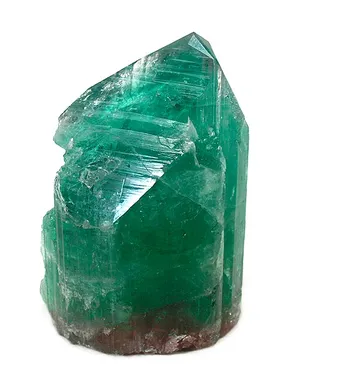
Mount Mica Quarry, Maine — classic pegmatite locality famed for elbaite tourmaline pockets, vivid colors, and its historic and ongoing collecting appeal.
Key facts
Mount Mica Quarry is one of the defining pegmatite localities of North American mineral collecting: a modest wooded hill near Paris Hill in Oxford County, Maine, that became the classic American source of gem tourmaline. Its fame rests on a lithium-cesium-tantalum granitic pegmatite of the Oxford pegmatite field, a pocket-bearing body whose central miarolitic cavities have yielded transparent elbaite in green, pink, blue-green, colorless, bicolored, and watermelon-zoned crystals. For collectors, the name “Mount Mica” carries two meanings at once: it is an historic locality where early American mineralogy and the gem trade intersected, and it is still a modern producer whose pockets have supplied fresh, sharply formed tourmaline specimens in the twenty-first century.
The quarry’s best specimens have the unmistakable look of evolved Maine pegmatite pockets: ribbed, glassy elbaite prisms on pearly cleavelandite or lepidolite; smoky quartz crystals with pocket clay and cookeite; lilac to pink lithium mica; small but deliciously colored rose quartz crystals; and purple fluorapatite adding a phosphate accent to the assemblage. Mount Mica is not a large industrial hole by world standards, but it is a locality where small changes in pegmatite texture matter enormously. Wisps of lepidolite, friable cleavelandite, big muscovite books, rusty cross-fractures, and schorl pointing into the dike have all been practical signs of the cavities that make the quarry famous.
Regional View
Country View
Mount Mica also matters scientifically. It is a reference locality for evolved LCT pegmatite processes in western Maine, has produced multiple tourmaline species from the same pocket system, and is the type locality for several rare minerals. That dual identity—classic gem mine and research-grade pegmatite—explains why old Hamlin-era specimens, Perham-period material, Coromoto Minerals pocket pieces, and even modest collector finds from authorized field trips all carry stronger locality appeal than comparable minerals from a less storied quarry.

Photo: James St. John, via Wikimedia Commons
Search for specimens: View all specimens from Mount Mica Quarry, Paris, USA
Mount Mica is a granitic LCT pegmatite in the Oxford pegmatite field of southwestern Maine, situated near Paris Hill and South Paris in Oxford County. The pegmatite is hosted by metasedimentary rocks of the Central Maine belt and lies within the broader pegmatite province associated with the Sebago magmatic-migmatitic region. Modern mapping and mining observations describe the body as a northeast-striking, southeast-dipping pegmatite exposed for roughly 135 meters along strike, varying from thin near-surface exposures to substantially thicker down-dip portions. It is not an “ore body” in the metallic-mining sense; its economic and scientific value lies in gem pockets, rare-element mineralization, feldspar-quartz-mica pegmatite minerals, and accessory phosphates and oxides.
The internal structure is comparatively simple but highly consequential. The dike has a narrow wall zone, an intermediate zone dominated by quartz and K-feldspar with schorl and muscovite, and a core zone of quartz, microcline, and schorl. The collector minerals concentrate in the more evolved portions: cleavelandite pods, lepidolite masses, spodumene-bearing and pollucite-bearing zones, and open cavities lined or partly filled with quartz, feldspar, cookeite, lithium mica, and tourmaline. The most evolved pockets have produced elbaite as the principal gem tourmaline, with schorl, foitite, and rossmanite documented in the tourmaline paragenesis. Black schorl commonly marks earlier growth along pocket margins or basal crystal portions; elbaite develops as the Fe-poor, Li-Al-rich tourmaline stage; and dark foitite caps on some crystals represent a striking late-stage compositional shift.
Mount Mica’s collecting history begins in the early nineteenth century, with the famous discovery of gem tourmaline by Elijah Hamlin and Ezekiel Holmes usually given as 1820 in the gemological literature, though some accounts specify October 1821. By 1822, red and green tourmalines were being produced by members of the Hamlin family. The locality then passed through long cycles of excitement and quiet: a large pocket opened around 1866 by Ordesser Marion Bowker renewed interest; Augustus and Elijah Hamlin worked the property from the late 1860s into 1890; and the Mount Mica Company era yielded some of the classic nineteenth-century specimens that went to Harvard and Tiffany & Co.
The 1886 pocket found under the direction of Samuel R. Carter and Augustus C. Hamlin is one of the great episodes in American gem-pegmatite history. It produced many green to blue-green tourmalines, including a large crystal about 24 by 5 centimeters that was broken into four pieces. Cutting from that crystal supplied the 34.25-carat center stone of the Hamlin necklace, a celebrated American jewel containing Mount Mica tourmaline and beryl. In the 1890s and early 1900s, Loren B. Merrill and L. Kimball Stone worked the property, using a large derrick in a deep trench and recovering exceptional blue and blue-green tourmalines. A 1904 pocket reportedly yielded more than 75 pounds of tourmaline crystals, including near-colorless nodules and a single multicolored crystal weighing more than 30 pounds.
After California tourmaline entered the international gem market in volume during the early twentieth century, activity at Mount Mica became intermittent. Howard Irish purchased the property in 1926, and United Feldspar Corporation leased it in 1949. Frank Perham’s 1964–1965 work produced green and bicolored tourmalines, including material that cut significant blue-green and green gems. Plumbago Mining Corporation purchased the property in 1973, and in 1979 the large Dagenais pocket—about 4 by 5.5 by 16 meters—required roughly two months to excavate. Sporadic production continued through the late twentieth century.
The modern renaissance began when Coromoto Minerals, operated by Gary and Mary Freeman, acquired the property in 2003 and approached the pegmatite systematically rather than chasing only exposed clues. That program produced 43 pockets in its first two years. Pocket no. 7, opened in May 2004, yielded hundreds of gemmy green tourmaline crystals, many only a few centimeters long but with attractive zoning and some watermelon-style pink cores. Pocket no. 10, opened in June 2004, produced well-formed green and multicolored tourmalines, including a reassembled 19-centimeter color-zoned crystal regarded as one of the finest Mount Mica specimens of the modern era. Pocket no. 28, opened in December 2004, was more than 7 meters long and consisted of three connected chambers; it produced smoky quartz crystals weighing around 20 kilograms, hundreds of bicolored tourmalines, and the top portion of a multicolored elbaite whose recovered pieces showed that the original crystal had been about 54 centimeters long.
Today, Mount Mica remains private and active, and unauthorised collecting is not appropriate. Public-style access is limited to organized, authorized fee field trips, currently associated with Dig Maine Gems during the collecting season rather than open independent digging. Serious collectors should treat all access details as subject to change, confirm directly with the operator before travel, and expect strict tool and safety rules. Fine cabinet specimens from the great pockets are not casual field-trip finds; they typically enter the market through miners, dealers, established collections, or museum deaccession-type channels. Small tourmaline fragments, quartz, feldspar, lepidolite, cookeite, muscovite, garnet, and occasional thumbnail-quality pieces are more realistic outcomes for visitors working permitted material.
Elbaite is the mineral that made Mount Mica famous, and the quarry’s best crystals combine historic pedigree with genuine specimen quality: striated prismatic tourmalines, typically green, blue-green, pink, colorless, bicolored, tricolored, or watermelon-zoned, sometimes on cleavelandite, quartz, cookeite, and lepidolite. Modern pocket production has ranged from small gemmy crystals a few millimeters to a few centimeters long, through fine 5–8 cm bicolored pieces from pocket no. 28, to exceptional large crystals such as the 19 cm pocket no. 10 specimen and the 54 cm original length inferred for the great pocket no. 28 crystal. The top pieces here are not merely transparent; they show strong luster, undamaged terminations, clean color transitions, minimal rehealed fracturing, and attractive matrix balance. Ordinary Mount Mica elbaite is often incomplete, clay-altered, internally feathered, or represented by broken gem rough; great Mount Mica elbaite has the locality’s signature combination of color zoning, sharp form, and documented pocket provenance.
Quartz is both a rock-forming framework mineral at Mount Mica and a pocket mineral of collector interest, occurring as milky to smoky masses, pocket crystals, and matrix for tourmaline, cookeite, feldspar, and lithium mica. In the pegmatite structure it dominates parts of the intermediate and core zones with K-feldspar and schorl, but the showiest collector quartz comes from cavities: smoky “cathedral”-style crystals from the margins of pocket no. 28 reached weights on the order of 20 kg, while smaller quartz crystals and fragments are common in association with cookeite, albite-cleavelandite, lepidolite, and elbaite. Good Mount Mica quartz is judged less by species rarity than by context: smoky color, clean faces, visible pocket origin, and attractive association with tourmaline or cookeite make a piece more desirable than a plain massive quartz fragment from the pegmatite.
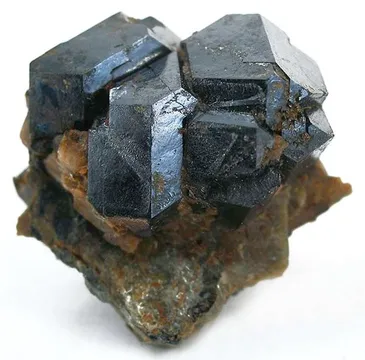
“Tourmaline” at Mount Mica is best understood as both a collector category and a chemically varied group: elbaite is the gem species most collectors seek, but schorl, foitite, and rossmanite have also been documented from the pocket assemblage. Black schorl occurs abundantly in the pegmatite and along pocket margins, while foitite appears as dark flat caps on some colored elbaite crystals and as a late-stage component of the same pocket evolution. Mount Mica tourmaline specimens range from black schorl prisms in pegmatite to bright polychrome gem crystals, with the best examples showing undamaged terminations, glassy luster, strong longitudinal or concentric color zoning, and matrix associations that place them unmistakably in the evolved core-zone pockets. Because “tourmaline” labels can conceal important species differences, high-end Mount Mica pieces benefit from clear documentation as elbaite, foitite-capped elbaite, schorl, or analyzed material.
Mount Mica is a classic locality for crystallized rose quartz, a far rarer collector occurrence than massive rose quartz, and old Maine literature and dealer tradition place Mount Mica among the earliest known sources for true rose quartz crystals. Specimens are typically small, with pink quartz crystals or crystal aggregates on albite, quartz, or pocket matrix rather than large freestanding crystals. The color is generally delicate to moderate pink, and the best pieces show recognizable crystal faces, fresh color, and an old or well-documented Mount Mica attribution; ordinary examples are pale, broken, or difficult to distinguish from common pinkish massive quartz without crystal form and provenance. Association with smoky quartz, albite-cleavelandite, cookeite, or lithium-rich pocket minerals greatly improves both aesthetics and locality confidence.
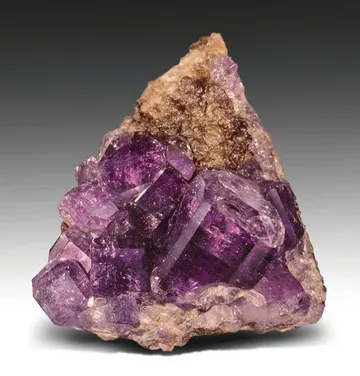
Fluorapatite from Mount Mica is a desirable accessory rather than the quarry’s headline mineral, but collectors prize the locality’s purple to violet apatite crystals because they sit squarely within the same evolved pegmatite environment that produced the tourmaline pockets. It occurs with quartz, albite-cleavelandite, muscovite, lepidolite, and other phosphate-bearing pocket assemblages, commonly as small crystals or crystal groups rather than large cabinet specimens. The better pieces have saturated purple color, distinct hexagonal form, bright luster, and clean contrast against white albite or pale mica; lesser material is granular, pale, or isolated in broken pegmatite. Because Mount Mica fluorapatite is much less abundant on the market than tourmaline or quartz, a small but sharp, well-colored crystal with solid provenance can be more collectible than its size suggests.
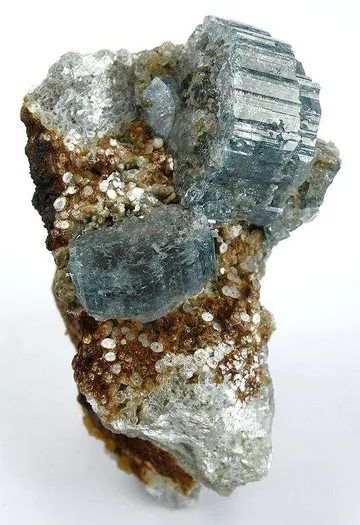
Almandine at Mount Mica belongs to the less glamorous but geologically important pegmatite and contact assemblage, appearing as dark red-brown to reddish garnet in quartz-feldspar-mica matrix and in association with minerals such as albite, quartz, muscovite, and siderite in the rare-mineral paragenesis. It is not a major gem product of the quarry, and most examples are small, embedded, or partly included rather than showy isolated crystals. Good Mount Mica almandine specimens are those in which the garnet is sharp enough, lustrous enough, and sufficiently exposed against pale feldspar or quartz to make the association legible; the value is often in locality completeness and petrogenetic interest rather than dramatic display. For serious collectors, almandine also provides a useful contrast with Mount Mica’s more evolved Li-Cs-rich pocket minerals, marking the broader mineral evolution of the pegmatite system.
Beyond these collector staples, Mount Mica has a notable suite of rare and scientifically important minerals. Cookeite, a lithium chlorite found as platy to micaceous alteration material in pocket assemblages, is a Mount Mica type-locality mineral and a familiar associate of tourmaline and quartz. Kosnarite, KZr2(PO4)3, and mccrillisite, NaCs(Be,Li)Zr2(PO4)4·1-2H2O, are also type-locality minerals tied to Mount Mica’s rare phosphate and zirconium-bearing late-stage evolution. The quarry has additionally produced albite var. cleavelandite, microcline, muscovite, lepidolite, spodumene, pollucite, cassiterite, columbite-group minerals, beryl, montebrasite, eosphorite-childrenite group minerals, siderite, rhodochrosite, and other rare pegmatite accessories. These species explain why Mount Mica is not merely a tourmaline locality but a compact laboratory of evolved Maine pegmatite mineralogy.
Mount Mica specimens are heavily locality-sensitive. A green or pink elbaite is valuable as mineral species; a green or pink elbaite with credible Mount Mica provenance is part of the American gem-pegmatite canon. Old labels, pocket numbers, dealer lineage, and documented collection history matter. For nineteenth-century and early twentieth-century material, labels connected to Hamlin, Harvard, Tiffany-era collections, Merrill and Stone, Perham, or well-known Maine dealers can add serious interpretive and market value. For modern material, references to Coromoto Minerals, pocket numbers, or named mining seasons are especially useful.
The principal authenticity concern is not a documented epidemic of manufactured Mount Mica fakes, but mislabelling and over-optimistic locality assignment. Western Maine has many tourmaline-bearing pegmatites, and loose small fragments from Mount Mica, Newry, Hebron, Greenwood, Buckfield, and other Oxford County localities can resemble one another. “Maine tourmaline” should not be silently upgraded to “Mount Mica.” Likewise, “tourmaline” should not automatically be assumed to mean elbaite; black material may be schorl or foitite, and rare colorless or pale material may require analysis if a species-level claim is important.
Repairs are part of the Mount Mica story and should be evaluated with nuance. Important crystals from the locality have historically been broken, reassembled, or represented by recovered segments from the same pocket. A repaired Mount Mica elbaite can still be significant, but it must be disclosed. Look carefully for glue seams, filled cracks, mismatched luster across breaks, reconstructed terminations, and matrix additions. In pocket specimens, naturally rehealed fractures, feathers, growth zoning, and fluid inclusions are common; these are not the same as repair, but they do affect clarity and price.
Condition issues are typical of lithium pegmatite pockets. Elbaite may have contacted pocket clay, altered pink cores, bruised terminations, contacted bases, or etched and rehealed faces. Lepidolite and cookeite associations are soft and easily bruised. Cleavelandite plates can be cleaved or crushed. Rose quartz crystals are generally small and can be pale; avoid confusing massive pinkish quartz fragments with true crystallized rose quartz. Fluorapatite is more brittle than quartz and tourmaline and should be protected from knocks. Clean specimens conservatively: avoid aggressive acids or ultrasonic cleaning unless you know exactly what all associated minerals are and how repairs, clays, or mica will respond.
Gemological work on modern faceted Mount Mica tourmalines reported untreated samples, and the studied stones were inert to both long-wave and short-wave ultraviolet light. That does not mean every specimen on the market is untreated or unrepaired, but it does mean collectors should be cautious about assuming treatment solely because a Mount Mica stone is bright. In mineral specimens, physical restoration is a more likely concern than heat treatment.
Availability is split. Small fragments, thumbnails, and field-trip material appear regularly enough that Mount Mica is not an impossible locality for collectors. Fine matrix elbaites, strong watermelon crystals, historic Hamlin-era specimens, richly colored purple fluorapatites, crystallized rose quartz, and rare type-locality minerals are a different matter: they are scarce, competed for, and often held long-term in museums or established private collections. The best buying strategy is to privilege provenance, condition, and aesthetics over mere locality name.
The origin story of Mount Mica has been retold for two centuries because it has the exact shape collectors love: two young men on a Maine hillside, a root-torn patch of earth, and a flash of color where no one expected American gems. Published accounts differ on whether the discovery should be dated to 1820 or October 1821, but the central figures remain Elijah Hamlin and Ezekiel Holmes. They were not anonymous prospectors stumbling through wilderness; they were educated young men from the Paris Hill world, interested in mineralogy and alert to the odd ledges around town. One account has the first green crystal catching the eye at the base of an overturned tree. From that small glint came the quarry that would become America’s emblematic gem-tourmaline mine.
The Hamlin family soon became inseparable from the locality. In 1822, Cyrus and Hannibal Hamlin were already producing red and green tourmalines from Mount Mica. By the later nineteenth century, Augustus Choate Hamlin turned the mine into both a collecting enterprise and a story-making machine. The specimens were not just sold; they were described, illustrated, displayed, and inserted into the young American mineral tradition. The best Mount Mica tourmalines went to Harvard and Tiffany & Co., and a hill quarry in western Maine entered the same conversation as European pegmatite classics.
The 1886 pocket remains one of Mount Mica’s great set pieces. Samuel R. Carter, working for the Mount Mica Company, removed part of the rear wall of the pit, going down about 12 feet over an area roughly 12 feet square. For most of that descent the rock gave little encouragement. The memorable exception was a huge black tourmaline about four feet long—an omen, perhaps, but not yet the gem pocket. Then quartz, black tourmaline, and mica appeared, and beneath them lay a cavity about four feet square. Along the sides and bottom, embedded in soft decomposed cookeite, lepidolite, and pocket sediment, were roughly fifty well-defined green to blue-green tourmaline crystals or crystal fragments. One measured about 10 inches long by 2 inches across. It was broken into four pieces, but the pieces fitted together; even in that condition it was transparent enough in part to yield important gems.
That same 1886 production gave rise to the Hamlin necklace, one of the most celebrated American gem jewels associated with a single locality. Augustus C. Hamlin commissioned it after the Carter pocket, and it eventually contained 70 cut stones from Mount Mica with a total weight of 228.12 carats, including pink, blue-green, blue, green, colorless tourmaline, and beryl. A 34.25-carat green tourmaline from the large broken crystal became the center stone. The necklace entered the Harvard Mineralogical Museum in 1934, carrying Mount Mica’s pocket story into one of the country’s great mineral collections.
At the turn of the twentieth century, Mount Mica’s workings took on a more industrial look. Loren B. Merrill and L. Kimball Stone used a large derrick to pull boulders from a deep trench, and old postcard views show the quarry as a place of machinery, stacked rock, and persistent manual effort. Their period yielded exceptional blue tourmalines in 1891. In 1899, they recovered a 411-carat blue-green gem nodule that had been part of a crystal more than 20 centimeters long, and another later nodule of 584 carats entered Harvard’s collection. In 1904 came a pocket with more than 75 pounds of tourmaline crystals, including near-colorless nodules and a single multicolored crystal weighing more than 30 pounds. For a locality whose pockets often reward patience in centimeters, those numbers still sound extravagant.
The mid-twentieth-century revival under Frank Perham adds another distinct chapter. In 1964 and 1965, Perham worked the old Merrill and Stone diggings and produced notable green and bicolored tourmalines. One piece cut an eye-clean 25-carat green stone; another yielded a flawless 59.59-carat blue-green stone. This was not yet the large-scale systematic mining of the Freeman era, but it proved that Mount Mica had not become only a historical locality. The pegmatite still had gem material left.
Then came the Dagenais pocket in 1979 under Plumbago Mining Corporation. At roughly 4 by 5.5 by 16 meters, it was a cavernous feature by Mount Mica standards and required about two months to excavate. The pocket links the older style of Maine gem mining—following luck, memory, and local experience—with the more systematic approach that would come later. It also set up one of the key lessons of Mount Mica: the productive zones are not random decorations in the pegmatite but repeated features that can be traced, inferred, and tested down dip.
The modern renaissance is inseparable from Gary and Mary Freeman and Coromoto Minerals. Beginning in 2003, the Freemans mined the pegmatite systematically, removing the whole dike rather than only obvious pocket signs. In the first two years they found 43 pockets. The first major payoff came in May 2004 with pocket no. 7, which produced hundreds of gemmy green tourmalines, most up to about 3 centimeters long and half a centimeter thick. Many had pink cores, though some of those cores were altered to pink clay. The better unaltered crystals recalled the classic watermelon pieces illustrated in nineteenth-century Mount Mica literature.
In June 2004, pocket no. 10 produced one of the great modern Mount Mica crystals: a broken but reassembled 19-centimeter color-zoned elbaite on matrix with cleavelandite and lepidolite. It is important not because it was perfect, but because it had everything collectors hope for from the locality—size, color zoning, association, and pocket context. That same summer and fall, the miners kept hitting cavities, and by late December they opened pocket no. 28. This was the dramatic one: more than 7 meters long, divided into three connected chambers, with smoky quartz crystals around the edges weighing roughly 20 kilograms. Screening the pocket mud produced hundreds of green-pink and green-colorless bicolored tourmalines, mostly 5–8 centimeters long and under a centimeter thick.
Pocket no. 28 also yielded a remarkable multicolored elbaite segment, 22 centimeters tall, grading reddish pink to orange and capped by a thin black flat termination identified as foitite. Later recovery of additional pieces showed that the complete crystal had originally been about 54 centimeters long. That measurement made it the largest elbaite then known from Maine and possibly the largest from North America. The image of a major elbaite crystal recovered in sections from pocket mud captures Mount Mica beautifully: not a sterile showpiece emerging whole from a display case, but a mineral event reconstructed from broken clues in clay, quartz, mica, and feldspar.
The mine was still producing memorable moments after the first Coromoto publications. On January 3, 2019, a large pocket produced a brilliantly blue-green tourmaline extracted by Mary Freeman, filmed by Brian Pedersen and shared through the Mineralogical Society of America’s Pegmatite Interest Group. It is a modern echo of the Hamlin and Carter stories: people at the same old hill, still reading the pegmatite, still finding color in the dark.
William B. Simmons, Brendan M. Laurs, Alexander U. Falster, John I. Koivula, and Karen L. Webber, “Mt. Mica: A Renaissance in Maine’s Gem Tourmaline Production,” Gems & Gemology, Vol. 41, No. 2, 2005, pp. 150–163 — The essential modern gemological and mining account of Coromoto Minerals’ early Mount Mica production, including pocket nos. 7, 10, and 28, tourmaline chemistry, inclusions, and gem properties.
E. S. Bastin, “Geology of the Pegmatites and Associated Rocks of Maine, Including Feldspar, Quartz, Mica, and Gem Deposits,” U.S. Geological Survey Bulletin 445, 1911 — Classic USGS treatment of Maine pegmatites, including early descriptions and diagrams of Mount Mica’s geologic setting and workings.
Karen L. Webber, Alexander U. Falster, William B. Simmons, and Encarnación Roda-Robles, “Geochemistry, Mineralogy, and Evolution of Li-Al Micas and Feldspars from the Mount Mica Pegmatite, Maine, USA,” The Canadian Mineralogist, Vol. 52, No. 2, 2014, pp. 221–233 — Detailed study of lithium micas and feldspars showing how Cs, Rb, F, Li, and other incompatible elements concentrate into the evolved core-zone assemblage.
William Simmons, Alexander Falster, Karen Webber, and Encarnación Roda-Robles, “Bulk Composition of Mt. Mica Pegmatite, Maine, USA: Implications for the Origin of an LCT Type Pegmatite by Anatexis,” The Canadian Mineralogist, Vol. 54, 2016, pp. 1053–1070 — Uses mapped mining volumes, drill cores, and geochemistry to argue for direct anatectic origin of the Mount Mica LCT pegmatite.
Darby Dyar, Charles V. Guidotti, Daniel P. Core, Katherine M. Wearn, Michael A. Wise, Carl A. Francis, Kathleen Johnson, John B. Brady, J. David Robertson, and Laura R. Cross, “Stable Isotope and Crystal Chemistry of Tourmaline Across Pegmatite-Country Rock Boundaries at Black Mountain and Mount Mica, Southwestern Maine, U.S.A.,” European Journal of Mineralogy, Vol. 11, 1999, pp. 281–294 — Comparative tourmaline isotope and crystal-chemistry study across Mount Mica and Black Mountain pegmatite contacts.
William B. Simmons, Gary Freeman, Alexander U. Falster, Brendan M. Laurs, and Karen L. Webber, “New Tourmaline Production from Mount Mica: America’s First Gem Pegmatite,” Rocks & Minerals, Vol. 80, No. 6, 2005 — A collector-oriented companion article on the modern Mount Mica production; consult the Rocks & Minerals archive for issue access.
Michael E. Brownfield, Eugene E. Foord, Stephen J. Sutley, and Theodore Botinelly, “Kosnarite, KZr2(PO4)3, a New Mineral from Mount Mica and Black Mountain, Oxford County, Maine,” American Mineralogist, Vol. 78, 1993, pp. 653–656 — Original description of kosnarite, one of Mount Mica’s type-locality minerals.
Eugene E. Foord, Michael E. Brownfield, Stephen J. Sutley, and others, “Mccrillisite, NaCs(Be,Li)Zr2(PO4)4·1-2H2O, a New Mineral Species from Mount Mica, Oxford County, Maine, and New Data for Gainesite,” The Canadian Mineralogist, Vol. 32, 1994, pp. 839–842 — Original description of mccrillisite, the rare Cs-Be-Li-Zr phosphate named for Dean and Philip McCrillis.
George J. Brush, “On Cookeite, a New Mineral Species,” American Journal of Science, 1866 — Original cookeite description; Mount Mica is recognized as a type locality for this lithium chlorite species.
“Gem Pollucite from Mt. Mica Pegmatite, Oxford Co., Maine,” Geological Society of America Abstracts with Programs, 2015 — Concise report on gem-quality pollucite from the Mount Mica pegmatite and the modern down-dip extent of mining.
Smithsonian National Museum of Natural History, Elbaite var. rubellite, catalog no. G1109 — Museum record for faceted elbaite from Paris, Maine, useful for understanding Mount Mica material in national gem collections.
Maine Geological Survey, “Mineralogy of Maine, Volume 2: Mining History, Gems, and Geology,” edited by Vandall T. King — State reference volume with chapters on Mount Mica, Maine mining history, Perham’s 1964–1965 experiences, and later mineralogical updates.
“Mount Mica Discovery” — Brian Pedersen, provided by Gary Freeman, hosted through the Mineralogical Society of America Pegmatite Interest Group. Short field video showing Mary Freeman extracting a large blue-green tourmaline from a January 3, 2019 Mount Mica pocket. URL: https://msaweb.org/pegmatites/
“Elbaite tourmaline (Mount Mica, Oxford County, Maine, USA)” — James St. John / Wikimedia Commons. High-resolution museum specimen photographs of Mount Mica elbaite in the Maine Mineral & Gem Museum collection. URL: https://commons.wikimedia.org/wiki/File:Elbaite_tourmaline_(Mount_Mica,_Oxford_County,_Maine,_USA)_3.jpg
“Elbaite (Tourmaline) - Mt. Mica - Harvard” — Maine Geological Survey Field Photos. Archival image record of a Harvard-associated Mount Mica elbaite specimen, useful for visual comparison with historic material. URL: https://digitalmaine.com/mgs_geologic_field_photos/6118/
Mindat locality page: Mount Mica Quarry, Paris, Oxford County, Maine, USA — Core locality database entry with coordinates, mineral list, references, and photo links.
Mindat type-locality report for Mount Mica Quarry — Quick reference for Mount Mica’s type-locality minerals: cookeite, kosnarite, and mccrillisite.
GIA: “Mt. Mica: A Renaissance in Maine’s Gem Tourmaline Production” — Best single modern article for collectors who want pocket history, gemology, and tourmaline chemistry in one place.
Maine Geological Survey: Maine’s State Mineral — State overview of Maine tourmaline, with recommended classic references on Mount Mica and Oxford County minerals.
Maine Atlas Project: Maine Tourmaline — Accessible state-level account of Maine tourmaline history, including Mount Mica’s role in the story.
Dig Maine Gems Field Trips — Current public-facing information for authorized Mount Mica field-trip access, season, fees, meeting location, and tool rules.
Mineralogical Society of America Pegmatite Interest Group — Pegmatite resources, Mount Mica mining notes, and the 2019 Mount Mica discovery video reference.
Wikimedia Commons: Category Mt Mica Quarry — Open image gallery of Mount Mica specimens, including elbaite, cookeite, foitite, quartz, and quartz-topaz associations.
U.S. Geological Survey Bulletin 445 — Historic foundational reference on Maine pegmatites and early Mount Mica geology.
Cross Jewelers: History of Maine Tourmaline — Mt. Mica — Readable historical account drawing heavily on early Mount Mica literature and the Hamlin tradition.
_3.jpg)