Emmons Quarry, Greenwood, Oxford County, USA - Maine pegmatite yielding fluorapatite, lithiophilite, perhamite and cesium minerals, prized by collectors.
Key facts
Emmons Quarry, better known in the literature as the Emmons pegmatite on Uncle Tom Mountain, is one of the essential western Maine localities for collectors who care about evolved granitic pegmatites rather than simple “pretty-rock” collecting. It is a complexly zoned, boron-lithium-cesium-tantalum-enriched LCT pegmatite set in the Oxford pegmatite field, famous less for great volumes of gem tourmaline than for an unusually rich phosphate and rare-element assemblage. In collector terms, Emmons matters because it unites several collecting worlds in one quarry: lustrous blue to lilac fluorapatite, sharp salmon-brown lithiophilite, world-class perhamite, beryllium phosphates and silicates after corroded beryl, pollucite-related cesium mineralization, and the type-locality wodginite-group species tantalowodginite.
Its best specimens have a particular “Emmons” look. Fluorapatite may stand as steely-blue, thick tabular to prismatic crystals on muscovite, albite, or pale pegmatite matrix; lithiophilite, normally a massive and uncooperative species elsewhere, can appear here as real, sharply faced crystals at the margins of phosphate pods. Micro specimens reward the patient collector with secondary phosphates in minute vugs: strunzite needles, yellow stewartite, laueite, eosphorite, hureaulite, phosphosiderite, fairfieldite, and other products of altered primary phosphate masses. The quarry’s specimen identity is therefore not simply “Maine pegmatite”; it is a phosphate laboratory, a Be-Cs-Ta mineral system, and one of Maine’s benchmark micromineral localities.
Regional View
Country View
The pegmatite is exposed as a narrow quarry cut on the eastern slope of Uncle Tom Mountain near Greenwood. Its internal structure is as important as its species list: hanging-wall comb schorl, garnet- and schorl-bearing footwall layers, quartz-rich core material, pollucite and phosphate pods along the core margin, and albite replacement units filled with small interconnected miarolitic cavities. Collectors who understand these zones understand why Emmons produces such different specimens from one part of the quarry to another: pocket apatites and beryllium minerals in albite-rich miaroles, lithiophilite and secondary phosphates in altered phosphate pods, and tantalum-tin oxides in late-stage core-margin settings.

Photo: Wikimedia Commons

Photo: Wikimedia Commons
Search for specimens: View all specimens from Emmons Quarry, Greenwood, Oxford County, USA
Emmons Quarry is a rare-element granitic pegmatite locality in the Oxford pegmatite field of western Maine. The pegmatite is hosted within the migmatite-granite complex of the Central Maine Belt, a region shaped by Paleozoic Appalachian deformation, metamorphism, granitic magmatism, and later uplift. Modern work interprets the Oxford County pegmatites, including Emmons, as anatectic pegmatites produced by partial melting of high-grade metamorphic rocks during post-orogenic, pre-rifting extension and decompression. For collectors, the result is a pegmatite unusually enriched in lithium, cesium, tantalum, boron, phosphorus, fluorine, beryllium, manganese, tin, and associated rare elements.
The exposed pegmatite measures roughly 120 by 18 meters and is strongly zoned. The hanging-wall wall zone is marked by comb-texture schorl crystals oriented approximately perpendicular to the contact, a texture interpreted as evidence of strong undercooling and rapid early crystallization. The footwall lacks the same comb schorl but contains well-defined schorl and garnet layers. Inward from the wall zone, the intermediate zone is dominated by feldspars and quartz with muscovite and increasing accessory rare minerals, including fluorapatite, zircon, uraninite, and columbite-group species. The quartz-rich core and core-margin zones contain the more evolved mineralization: pollucite pods, primary phosphate masses, alkali-rich beryl, altered spodumene, replacement albite, ball muscovite, miarolitic cavities, and the tantalum-tin oxide assemblages that made the quarry important to mineralogists.
The ore and industrial-mineral history began as feldspar mining, not specimen mining. The first recorded discovery was by Willard “Willie” Emmons, a West Paris collector, in the early twentieth century. Commercial activity is documented in 1931, when the Oxford Mining and Milling Company leased the area from W. W. Thomas of Portland. The workings at that time cut into the pegmatite for feldspar, and the site’s awkward access required crude feldspar to be hauled by horse-drawn wagon to Willis Mills and then by truck to the West Paris mill. A later feldspar effort by Arden Andrews of West Paris in the early 1960s delivered about 100 tons to the West Paris mill before declining feldspar prices and deteriorating access ended the short revival.
Specimen history is richer than the feldspar story. Lewis Proctor brought glassy Emmons material to Stanley Perham, who recognized it as pollucite, and early morganite discoveries reportedly yielded about 5,000 carats of gem stock; before the Bennett quarry discovery in 1989, Emmons was regarded as Maine’s most important gem morganite locality. Later collectors, including Charles Marble, John Dillingham, William Townsend, Gene Bearss, David M. Seaman, Ray Sprague, Tony Wielkiewicz, and Alexander Falster, transformed Emmons from a hard-to-find feldspar pit into one of the best-documented pegmatites in Maine.
The best-known collecting era began in the early 1990s, when Ray Sprague and Tony Wielkiewicz worked the quarry for specimens under the name Mongort Minerals. Their long tenure produced superb lithiophilite, perhamite, fluorapatite, and rare oxide specimens. The most consequential find came in May 1997, when material from the core zone led to recognition of tantalowodginite, later approved as a new mineral species with Emmons as the type locality. Scientific collecting continued alongside specimen mining, with Emmons becoming a regular field stop and study site for pegmatite researchers and for the Maine Pegmatite Workshop tradition.
Access today must be treated as restricted. Emmons is private property, and collecting is by special permission only. Organized educational and club visits have occurred, and the quarry has been used for museum- and university-associated field work, but it is not an open public collecting site like some better-known Maine localities. Collectors should not attempt casual entry. Material on the market comes from older mining, documented collection dispersals, permitted club or educational collecting, and specimens retained from the Mongort Minerals and research-collection era.
Several productive environments are especially important for specimens. Altered beryl molds and related miarolitic cavities yield fluorapatite, bertrandite, hydroxylherderite, moraesite, albite, and muscovite. Core-margin phosphate pods produce lithiophilite, triphylite, montebrasite, rhodochrosite, and a remarkable suite of secondary phosphates. Albite replacement units, especially the lower-level albitized exposure and smaller upper-wall occurrences, contain tiny interconnected miaroles rich in microminerals. Pollucite masses and their lepidolite-rich veinlets have yielded unusual assemblages involving perhamite, fluorapatite, quartz, analcime, and fine-grained mica. Collectors should understand that the most important Emmons specimens are not random dump stones; they are products of very specific zones and replacement histories.
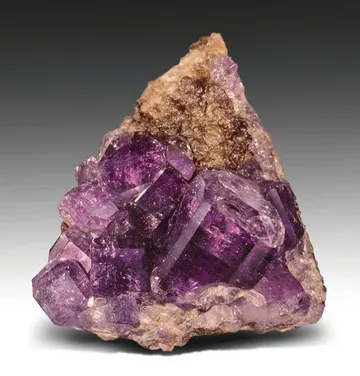
Fluorapatite is one of the signature display minerals of Emmons Quarry and reaches about 3 cm in the finest documented crystals. Emmons apatites occur in colorless, white, gray, blue, purple-lilac, and olive-green crystals, with a strong relationship between color and habit: olive-green crystals are commonly short prismatic forms dominated by prism and pinacoid faces; blue crystals may be short prismatic or show the flattened “Hebron habit” with dominant dipyramids and pinacoids; colorless crystals are often tabular with multiple dipyramid orders; gray crystals tend to be more elongate; and lilac crystals may be equant to thick tabular with more complex forms. The best pieces come from vugs formed by beryl alteration and from miarolitic cavities where crystals sit on cleavelandite, albite, or muscovite, commonly with bertrandite, cookeite, and Fe-Mn oxides after siderite-rhodochrosite. Strong Emmons fluorapatite specimens have sharp, lustrous, isolated crystals on contrasting matrix, recognizable color, and undamaged edge faces; ordinary pieces are more massive, stained, incomplete, or lost among pale feldspar and mica without the crisp sculptural presence that made the locality famous.
Lithiophilite from Emmons is unusually important because the locality produced genuine, reasonably sharp crystals rather than only the massive phosphate nodules typical of many pegmatites. It occurs as salmon-brown to pinkish-brown pods in the intermediate zone and core margin, with documented pods to 45 cm across and high-manganese core-margin masses to about 80 cm; one illustrated pod had a vertical dimension of roughly 110 cm when related lithiophilite, rhodochrosite, montebrasite, pollucite, quartz, beryl, and ball muscovite were considered together. The finest crystals formed along margins of large lithiophilite pods and can exceed 5 cm, ranking among the best known for the species. Emmons lithiophilite is commonly associated with rhodochrosite and montebrasite, and alteration may convert it to sicklerite, heterosite-purpurite, Mn-Fe oxides, vivianite films, or vuggy secondary phosphate assemblages containing hureaulite, fluorapatite, phosphoferrite, reddingite, strunzite, laueite, stewartite, eosphorite, and related species. Excellent specimens show discrete, lustrous, well-formed crystals with matrix and minimal oxidation; lesser examples are massive, friable, heavily altered, or visually indistinct from dark phosphate-oxide mixtures.
Beyond fluorapatite and lithiophilite, Emmons has a long documented mineral list and several true collector rarities. Tantalowodginite, (Mn0.5□0.5)TaTa2O8, was described from Emmons as its type locality and occurs in red to deep-red masses and crystals associated with wodginite, lithiowodginite, tantalite-(Mn), columbite-group minerals, muscovite, quartz, K-feldspar, and fluorapatite. Perhamite from Emmons is among the finest for the species, forming white to tan spherical aggregates to about 8 mm on albite, quartz, and muscovite in miarolitic cavities and albitized zones. Bertrandite is widespread in corroded beryl molds and can form platy crystals to about 7 mm; hydroxylherderite is common as colorless, white, or yellow-brown crystals to 2–3 cm and as spheroidal aggregates. Pollucite occurs as large masses over 1 meter across in the core-margin zone, cut by lepidolite or fine-grained muscovite veinlets locally carrying analcime, perhamite, fluorapatite, and quartz. Other notable species include beryllonite, väyrynenite, pezzottaite, elbaite and fluor-elbaite, cassiterite, columbite-(Fe), columbite-(Mn), tantalite-(Mn), löllingite, arsenopyrite, eosphorite, fairfieldite, hureaulite, laueite, phosphosiderite, stewartite, strunzite, switzerite-metaswitzerite, and correianevesite.
Emmons specimens reward close provenance work. Many pieces are visually similar to material from other Greenwood-area pegmatites, especially Harvard, Tamminen-Waisanen, Hayes, and other Oxford pegmatite field localities, so old labels should be preserved and checked for collector names, mine operators, and find context. Labels associated with Mongort Minerals, Ray Sprague, Tony Wielkiewicz, Gene Bearss, David Seaman, Don Dallaire, James Nizamoff, Alexander Falster, Rob Lavinsky/iRocks, or documented Maine Mineral & Gem Museum material deserve particular attention because so much of the modern Emmons record is tied to those collectors and researchers.
The main authenticity problem is not widespread fakery but misidentification. Many Emmons species are visually treacherous: fluorapatite versus hydroxylapatite in small crystals; phosphosiderite versus strengite; laueite versus pseudolaueite; lithiophilite versus triphylite, sicklerite, heterosite, purpurite, or black Mn-Fe oxide replacements; tantalite-(Mn) versus tantalowodginite; and wodginite-group intergrowths that cannot be confidently separated by eye. For expensive rarities, especially tantalowodginite, lithiowodginite, correianevesite, väyrynenite, pezzottaite, and uncommon secondary phosphates, analytical confirmation or a strong chain of provenance is far more valuable than a confident-looking label.
Condition is a serious issue. Lithiophilite can be fresh and attractive, but it is commonly partly oxidized, veined, fractured, or replaced; some masses deteriorate visually into dark, friable phosphate-oxide material. Fluorapatite crystals may have chipped edges, bruised terminations, iron staining, or pocket-clay residues. Perhamite spheres and sprays are delicate and should not be cleaned aggressively. Many phosphate microassemblages occur in vuggy rhodochrosite or altered lithiophilite and are easily damaged by water, acids, ultrasonic cleaning, or vigorous brushing. Any cleaning should begin with the assumption that the most interesting mineral present may be the least robust one.
Fluorescence can help but should not be overinterpreted. Hyalite opal coatings from Emmons are reported as strongly yellow-green under shortwave ultraviolet light, and uralolite is fluorescent whereas visually similar moraesite is nonfluorescent. Some uranium-bearing alteration species occur at the locality, including autunite-group and schoepite-group minerals, but uranium minerals are not abundant. Even so, small radioactive specimens should be stored sensibly, labeled accurately, and kept away from unnecessary handling, dust generation, or display situations where children can touch them.
Market availability is uneven. Fluorapatite and lithiophilite appear often enough that serious collectors can be selective, but top pieces remain scarce: freestanding blue apatites on matrix, lilac crystals with complex form, and lustrous lithiophilite crystals over 3–5 cm are not routine. Perhamite, tantalowodginite, and rare phosphate micros are more specialized and may surface through older collections rather than ordinary dealer stock. Because access is controlled and the most productive specimen mining period has passed, the best Emmons pieces increasingly behave like classic locality specimens rather than casual field-collecting material.
Willard “Willie” Emmons enters the story like many good Maine pegmatite prospectors: a persistent local collector roaming the hills above West Paris and Greenwood in the early 1900s, finding beryl and other odd minerals long before the quarry’s chemistry was understood. One detail survives with particular charm. Emmons met a young Stanley Perham, a boy who collected almost anything—“from butterflies to rocks”—and offered him mineral specimens if he would build a cabinet to hold them. Perham did. That small cabinet bargain became part of the origin story of one of Maine’s most important mineral figures.
The first commercial chapter was less romantic. In 1931 the Oxford Mining and Milling Company leased the property and drove an excavation into the pegmatite roughly 6 meters wide by 7.6 meters high. The quarry was difficult enough to reach that crude feldspar had to be hauled out first by horse-drawn wagon to Willis Mills, then by truck to the West Paris mill. It is easy to forget, looking at a 2.5 cm blue fluorapatite today, that the earliest operators were not hunting such crystals; they were extracting feldspar from a hard hillside cut and moving it by an awkward two-stage transport chain.
The pollucite story is pure Oxford County mineral history. Lewis Proctor brought a piece of glassy material from Emmons to Stanley Perham, who identified it as pollucite. The same early period produced pink beryl significant enough to yield about 5,000 carats of gem stock, with faceted stones of 2–3 carats and larger. Before the Bennett quarry discovery in 1989 reset expectations for Maine morganite, Emmons held a special position as the state’s most important morganite locality.
By 1951, Emmons had become almost a lost place. Charles Marble visited with John Dillingham and William Townsend of Naples, Maine, and described the trail to the mine as obscure and hard to find. Once there, they dug in the dumps and found ball mica, amblygonite—now understood in much of this context as montebrasite—green tourmaline, spodumene, and rose quartz. The tantalizing earlier finds, pollucite and cesium-rich beryl, were already scarce enough to feel elusive.
Gene Bearss’s rediscovery episode has the dry humor that only field collectors fully appreciate. Bearss, a Sanford, Maine micromineral collector, became interested in Emmons during the 1970s after seeing its specimens in other collections. He tried several times to locate the quarry and failed, misled by erroneous guidebook information. In 1983, Dana Jewell of Massachusetts helped him find it. Bearss later grumbled that he had needed a Massachusetts collector to find a locality in his own state. Once he had it, he worked it hard, collecting a great variety of phosphate and other minerals and building an Emmons suite so extensive that more than one thousand of his specimens are now part of the Bearss collection housed at the Maine Mineral & Gem Museum.
Ray Sprague and Tony Wielkiewicz gave Emmons its modern specimen-mining identity. In the early 1990s they made a “handshake deal” with Penley Corporation of West Paris and worked the quarry for specimens as Mongort Minerals. Their finds reshaped how collectors judged the locality: not merely a feldspar quarry with odd phosphates, but a source of some of the world’s best lithiophilite and perhamite and a locality capable of producing major tantalum minerals. The defining event came in May 1997, when a core-zone discovery yielded material later recognized as tantalowodginite, probably the world’s largest known occurrence of the species and ultimately the type material for a new mineral.
The quarry also helped create an institution of learning. In 1992 Eugene Foord of the U.S. Geological Survey, William Simmons, and Alexander Falster made a field trip to Emmons. Sprague listened to the animated discussions about zoning and pegmatite structure and invited the researchers and their students to study the quarry. Repeated visits followed until Sprague persuaded Simmons to hold a week-long pegmatite workshop with visits to local pegmatites, including Emmons. In 2002 the Maine Pegmatite Workshop was born, eventually drawing collectors, students, miners, mineralogists, and geologists from around the world.
Even the pocket names carry the flavor of working-miner geology. Late-stage fluids near the bottom edges of pollucite masses produced veins of pale lepidolite and feldspar coated with fluorapatite, crude quartz, and sprays or crystals of perhamite. The researchers connected this unusual vein mineralogy to fluids from a very large miarolitic cavity system known to the miners as the “Gross pocket.” Despite the name and scale, the pocket yielded little valuable specimen material; its importance is scientific, as a fluid pathway explaining why perhamite, pollucite, lepidolite, fluorapatite, and quartz meet in such an unexpected association.