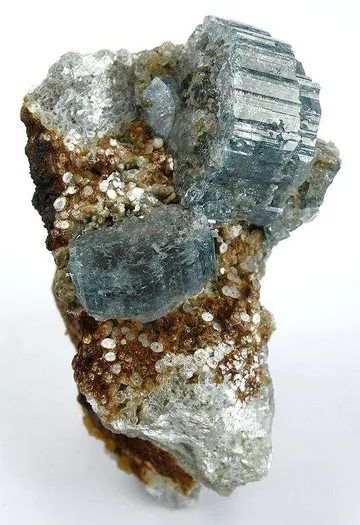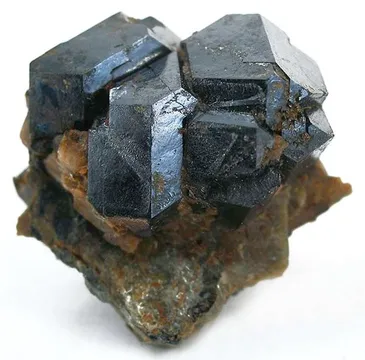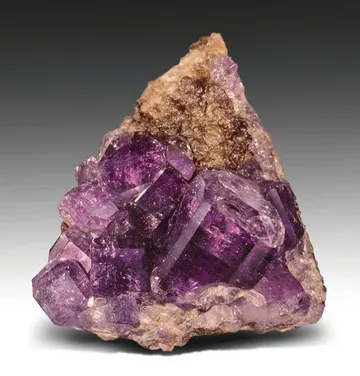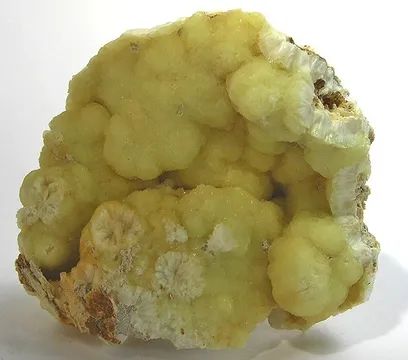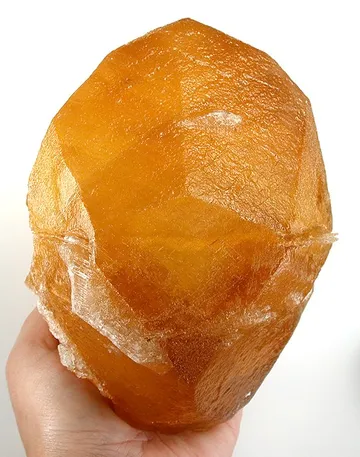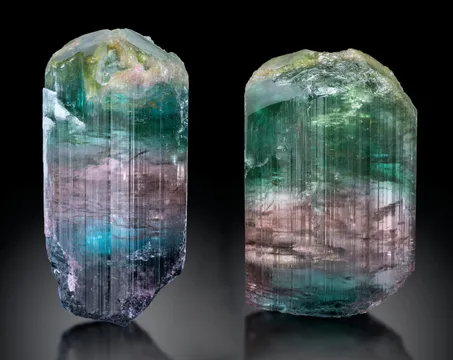
Dunton Gem Quarry, Maine — a classic LCT pegmatite yielding watermelon tourmaline varieties and rare phosphates; a landmark locality for collectors.
Key facts
Dunton Gem Quarry, on Newry Hill in the Plumbago–Puzzle Mountain area of Oxford County, Maine, is one of the defining American tourmaline localities: a classic LCT rare-element granitic pegmatite that moved from turn-of-the-century gem curiosity to international landmark after the immense 1972–1974 “Big Find.” For collectors, Dunton matters on two levels at once. It is a source of unmistakable Maine elbaite—rubellite, verdelite, indicolite, achroite, and especially watermelon tourmaline with raspberry-red cores and green rinds—and it is also a serious rare-phosphate locality, with an unusually deep species list and multiple type-locality minerals.
The finest Dunton pieces have a look that seasoned collectors recognize immediately: rounded-triangular, strongly striated elbaite sections; polished or natural cross-sections showing sharp red-green zoning; gemmy green to blue-green crystals from the 1970s finds; and, more rarely, matrix specimens with albite, cookeite, lepidolite, or other pocket minerals still attached. Much of the celebrated material is not in pristine single-crystal form but in broken, rehealed, or sectioned crystals—evidence of a violent and chemically active pocket history that also created some of the locality’s most desirable gem rough.
Regional View
Country View
Scientifically, Dunton is a textbook example of why gem pegmatites are never just gem deposits. The tourmaline-bearing pocket zone is dominated by cleavelandite, quartz, and muscovite, with elbaite as the star accessory, but the core-margin and altered zones carry beryllium, lithium, cesium, tantalum-niobium, uranium, zirconium, manganese, iron, and phosphorus in a complex secondary-mineral assemblage. That chemistry explains why a place famous for watermelon slices also gave the mineral world perhamite, mangangordonite, and zigrasite.

Photo: Wikimedia Commons

Photo: Wikimedia Commons
Search for specimens: View all specimens from Dunton Gem Quarry, USA
Dunton Gem Quarry lies at Newry, Oxford County, Maine, in the Oxford pegmatite field, on Hall’s Ridge in the Plumbago–Puzzle Mountain district. The deposit is an LCT-class granite pegmatite—lithium, cesium, and tantalum enriched—hosted by metamorphic country rock. Early descriptions treated the body as a sill-like pegmatite with an average thickness of about 20 feet and a southeast dip of roughly 40 degrees. Later locality summaries place Dunton among the Newry pegmatites whose mineral lists include both true pegmatite species and minerals from the adjacent schistose host rocks.
The mineralization is zoned and pocket-controlled. In the famous gem-producing zones, the pocket assemblage is chiefly cleavelandite, quartz, and muscovite, with elbaite as the principal gem mineral and lesser cassiterite and columbite-tantalite. Secondary phosphate minerals are especially developed in the interstices of coarse cleavelandite blades along the core margin; beryllonite, hydroxylherderite, moraesite, childrenite-eosphorite, apatite-group species, and related alteration minerals are part of the quarry’s scientific identity. The gem tourmaline pockets themselves are less phosphate-rich, but montebrasite and childrenite-eosphorite are documented exceptions.
The locality was discovered in 1898 by Henry C. Hall, brother-in-law of landowner Joshua Abbott, and passed into the orbit of International Paper Company the same year. Hollis C. Dunton of Rumford Falls and partners leased and worked the mine in the early 1900s, with USGS accounts recording active operation during the summers of 1903 and 1904. The early workings yielded colored and black tourmaline, feldspar, mica, and small pockets, but the commercial value was limited by the abundance of black tourmaline in feldspar-rich portions of the pegmatite.
A second important period came in 1926–1930, when General Electric leased the property, with Wallace Dickerson “Dick” Nevel as superintendent and George Crooker working for Nevel in the late 1920s. Later leases and investigations involved academic and industrial interest in feldspar, spodumene, beryl, pollucite, uranium minerals, and rare phosphates. Harvard University briefly leased the property in 1949, and the broader Newry mine group was also examined in the mid-20th century for strategic beryllium-bearing minerals.
The event that made Dunton legendary came in 1972, when Plumbago Mining Corporation opened an extraordinary series of gem-tourmaline pockets. Contemporary and later accounts vary in whether they describe the find as beginning in August or October 1972, but they agree on the scale: the 1972–1974 mining period produced more than a metric ton of gem tourmaline and millions of carats of faceting rough, including red, pink, green, blue-green, and watermelon material. The best-known individual crystal from this period is the “Jolly Green Giant,” a roughly 10-inch green tourmaline now associated with the National Museum of Natural History in Washington, D.C. The find also supplied stones for the State of Maine tourmaline necklace presented in 1975.
Collecting access today should be treated as private-land access, not as an open public collecting site. Dunton and nearby Plumbago Mountain quarries have been worked, leased, posted, and intermittently made available through permission, operators, fee-dig arrangements, or organized mineral-club trips at different times. Anyone planning field activity must verify current ownership, permission, mineral rights, road conditions, and safety requirements before visiting. The old mine roads are steep, rough, and seasonally wet, and the productive dumps have been searched for decades.
Elbaite from Dunton is the locality’s essential mineral: prismatic, hemimorphic, strongly striated tourmaline occurring from small fragments to crystals reported as long as 27 cm, with many recovered pieces in broken sections around 5 cm wide and 10–15 cm long. The classic colors are rich burgundy rubellite, pink, light to medium green, blue-green, indicolite-blue zones, colorless achroite, and red-green watermelon sections; the most characteristic zoning is parallel to the prism, commonly with a red to pink core and a green rind, although sharp pedion-parallel bicolors also occur. Good specimens here are judged less by perfect termination than by saturation, translucency to gemminess, clean internal red or green zones, sharp color boundaries, attractive rehealed or polished cross-sections, and convincing Newry provenance; ordinary Dunton material is more fractured, opaque, or poorly zoned, while the finest 1972–1974 pieces have the unmistakable glow of high-grade Maine gem elbaite.
“Tourmaline” labels from Dunton usually refer to elbaite-group material from the same complex pegmatite, but older labels, dealer tags, and field collections may use the group name for anything from black schorl in feldspar to gemmy colored sections from the Big Find. The best collector pieces are the intensely saturated green to blue-green crystals, pink and rubellite sections, and watermelon slices or cross-sections that show the locality’s red core and green rind clearly; matrix pieces with albite, cookeite, or lepidolite are scarcer and more desirable than loose broken sections of comparable color. Schorl is abundant enough in parts of the pegmatite to have reduced the early feldspar value, but the market premium belongs to well-provenanced colored tourmaline from the 1972–1974 pockets, especially pieces with old Maine labels or documented connection to Plumbago Mining Corporation, Frank Perham, Dean McCrillis, or early Newry collections.
Beyond tourmaline, Dunton is one of Maine’s great rare-phosphate localities. Zigrasite, MgZr(PO4)2(H2O)4, is a Dunton type-locality species from the giant 1972 tourmaline pocket, occurring as tiny pale-yellow to tan blocky grains associated with tourmaline, microcline, quartz, albite, beryl, amblygonite-montebrasite, childrenite-eosphorite, and apatite. Perhamite, a calcium aluminum silico-phosphate named for Frank C. Perham, has Dunton as a co-type locality with the Bell pit and occurs at Dunton as extremely rare delicate white botryoidal material. Mangangordonite, MnAl2(PO4)2(OH)2 · 8H2O, also has Dunton as a co-type locality, documented as bladed crystals and divergent aggregates in the Newry material. The broader species list includes beryllonite, hydroxylherderite, moraesite, eosphorite, childrenite, wardite, triphylite, montebrasite, pollucite, spodumene including kunzite, goshenite, morganite, lepidolite, cassiterite, columbite-(Mn), tantalite-(Mn), wodginite, uraninite, autunite, torbernite, and a suite of iron-manganese phosphate alteration minerals.
Dunton provenance is valuable, and that value brings real authentication concerns. Old labels may say “Dunton Mine,” “Dunton Gem Mine,” “Newry,” “Plumbago Mountain,” or simply “Maine tourmaline,” and not every Newry-labeled piece is from the Dunton pegmatite. Nearby Nevel, Bell pit, Crooker, and other Newry workings produced overlapping phosphate and pegmatite assemblages, so matrix, associated minerals, and label history matter. A loose polished slice is often harder to prove than a matrix specimen or an old collection piece with a credible chain of ownership.
The most specific mislabeling risk is imported tourmaline sold or represented as Newry material. Afghan and Namibian tourmalines can approach the same attractive pink, green, and blue-green range, and modern rough has circulated in New England. Dunton material should be evaluated by a combination of provenance, growth zoning, inclusions, fluorescence behavior, cutting style, and label history rather than by color alone. Some gemological notes on Newry elbaite emphasize diagnostic inclusions and short-wave ultraviolet response, but UV is not a standalone locality proof: published observations differ by color, shade, specimen, and test conditions.
Condition is the other major issue. Many Dunton tourmalines are naturally broken sections from collapsed pockets, and partly rehealed end surfaces are common. Fractures in the green rind of watermelon material are especially frequent, while the red or pink core may be cleaner. Collectors should distinguish natural healed pocket damage from modern trimming, sawing, polishing, or stabilization. Polished cross-sections can be excellent locality specimens when the color zoning is strong, but their value is different from an unrepaired crystal with natural terminations and matrix.
Matrix pieces deserve careful handling. Cookeite, lepidolite, cleavelandite, and soft secondary phosphates can be friable, and tiny rare phosphates such as zigrasite, perhamite, or mangangordonite belong in closed boxes or protected micromount mounts rather than open display trays. Uranium-bearing species are documented from Dunton, including autunite, torbernite, uraninite, and related secondary uranyl minerals; specimens containing these should be stored with normal radioactive-mineral precautions: good labeling, dust control, limited handling, and separation from children’s collections.
Market availability is divided sharply between common and great. Small green, blue-green, pink, and watermelon fragments from old material appear periodically, as do polished slices and cut gems. Fine crystals with sharp color, high luster, gem transparency, matrix, old labels, or direct Big Find provenance are much less common and are avidly pursued. Type-locality phosphate specimens are rarer still; most serious examples reside in specialist collections, museums, or micromount holdings and should not be expected in ordinary gem-tourmaline dealer stock.
The great Dunton story begins not with the glamour of the 1970s but with an old Maine hilltop pegmatite above the farm of Joshua Abbott. In the early USGS account, the mine was not a glittering bonanza but a stubborn, uphill feldspar-and-tourmaline prospect. Hollis C. Dunton of Rumford Falls worked it in the summers of 1903 and 1904. The feldspar had to be hauled about five miles, mostly downhill, to South Paris on the Grand Trunk Railway, and even then only a few tons were shipped. The same black tourmaline that collectors prize as proof of a pegmatite’s mineral vigor made much of the feldspar commercially poor. Bastin’s verdict was blunt in effect: even if mica and tourmaline could be sold as by-products, the deposit was unlikely to pay as a feldspar operation.
Hollis Dunton himself belongs to the old industrial Maine that surrounded the mine. He was born in Etna in 1855, became a lumberman, and helped form the Dunton Lumber Company. When Rumford Falls began to boom, Dunton Lumber built a new mill on the Androscoggin River; Hollis served as treasurer and general manager. The family archive preserves an almost cinematic detail from another member of the Dunton circle: Joseph Abbott Nile remembered that Hollis worked with Sandy Nile and Walter Morse in the mica business, where they had mica “two feet across just as clear as glass.” It is a reminder that the Dunton name came into pegmatites through practical Maine industry—lumber, mica, feldspar, and hard hauling—long before the gem world learned to say “Newry watermelon.”
The turning point came seven decades later. In 1972, George Hartman, Dale Sweatt, James Young, and the Plumbago Mining Corporation effort brought Frank Perham into the Newry workings. Perham had grown up inside Perham’s Mineral Store in West Paris, among labels, crates, dealers, lapidaries, and field stories, and by the time of the Big Find he was already known among collectors for a kind of instinctive pocket sense. Later accounts call him the “Pocket Fairy,” a nickname that captures the way pegmatite miners speak about judgment when the rock begins to change—when cleavelandite, quartz, clay, and subtle textures suggest that a cavity may be near.
The 1972 pockets did not merely produce a good crystal; they changed the scale of Maine gem mining. Daily mining records and later retellings describe large cavities packed with interlocked tourmalines, including a reported 6-foot pocket filled with watermelon material. Over the 1972–1974 period, the Dunton workings yielded more than a ton of tourmaline, with estimates of gem material reaching into the millions of carats. Collectors still repeat the phrase “The Big Find” because no longer explanation is needed: in Maine mineral history it means Newry, Plumbago Mountain, Dunton, and a sudden abundance of red, green, and watermelon elbaite unlike anything the state had seen since the earliest Mount Mica legends.
One of the most human details from the Perham story is almost domestic. During the mining operations, specimens were sometimes hauled in a small red wagon belonging to one of Perham’s children. In a world where famous gem finds are often reduced to tonnage and dollar value, that wagon is the detail that makes the scene real: heavy pocket clay, loose crystals, excited miners, and a child’s wagon pressed into service because the mine had suddenly given up more treasure than ordinary carrying methods could comfortably move.
Dunton also produced a quieter scientific story decades after the Big Find. In 2005, collector James Zigras noticed small orange “balls” on a specimen of green elbaite from Dunton and thought them unusual enough to send for study. William “Skip” Simmons recognized that the material was not a familiar species, and Frank Hawthorne later resolved its structure. The new mineral, zigrasite, was approved as IMA 2008-046 and named for Zigras. For collectors, that episode is a perfect Dunton footnote: a world-famous gem pocket still had mineralogical secrets hidden in millimeter-scale grains on a tourmaline specimen.
Pete J. Dunn, “Gem elbaite from Newry, Maine, U.S.A.,” The Journal of Gemmology, Vol. 14, No. 8, 1975, pp. 357–367. A gemological study of the 1972 Dunton elbaite, including zoning, optical properties, fluorescence observations, and Smithsonian specimen numbers.
https://gem-a.com/wp-content/uploads/2023/11/JoG1975_14_8.pdf
Dean A. McCrillis, “Gem tourmaline rediscovered at Newry,” The Mineralogical Record, Vol. 6, 1975, pp. 14–21. The key contemporary narrative of the 1972 discovery and mining of the gem pockets.
Pete J. Dunn, “Elbaite from Newry, Maine,” The Mineralogical Record, Vol. 6, 1975, pp. 22–25. A mineralogical companion to the Newry tourmaline discovery.
https://mineralogicalrecord.com/wp-content/uploads/2022/11/digital1975vol6n1janfeb.pdf
Vandall T. King, “Newry, Maine: A Pegmatite Phosphate Locality,” The Mineralogical Record, Vol. 6, 1975, pp. 189–204. A foundational paper on the phosphate mineralogy of the Newry pegmatites, including Dunton.
Edson S. Bastin, Geology of the Pegmatites and Associated Rocks of Maine, Including Feldspar, Quartz, Mica, and Gem Deposits, U.S. Geological Survey Bulletin 445, 1911. The early federal description of the Dunton tourmaline mine and its pegmatite setting.
https://pubs.usgs.gov/publication/b445
Pete J. Dunn and Daniel E. Appleman, “Perhamite, a new calcium aluminum silico-phosphate mineral, and a re-examination of viséite,” Mineralogical Magazine, Vol. 41, 1977, pp. 437–442. Describes perhamite from Newry Hill, including Dunton as a co-type locality.
https://rruff.info/doclib/MinMag/Volume_41/41-320-437.pdf
P. B. Leavens, J. S. White, G. W. Robinson, and J. A. Nelen, “Mangangordonite, a new phosphate mineral from Kings Mountain, North Carolina and Newry, Maine, USA,” Neues Jahrbuch für Mineralogie – Monatshefte, 1991, pp. 169–176. Describes mangangordonite with Dunton Gem Quarry as a co-type locality.
F. C. Hawthorne, N. A. Ball, J. W. Nizamoff, and W. B. Simmons, “Zigrasite, MgZr(PO4)2(H2O)4, a new phosphate mineral from the Dunton Quarry, Newry, Oxford County, Maine, USA,” Mineralogical Magazine, Vol. 73, No. 3, 2009, pp. 415–420. The type description of zigrasite from the giant 1972 tourmaline-bearing pocket.
https://rruff.info/uploads/MM73_415.pdf
F. C. Hawthorne and W. B. Simmons, “The crystal structure of zigrasite, MgZr(PO4)2(H2O)4, a heteropolyhedral framework structure,” Mineralogical Magazine, Vol. 74, No. 3, 2010, pp. 567–575. Follow-up structure paper on Dunton zigrasite.
Vandall T. King and Eugene E. Foord, Mineralogy of Maine, Volume 1: Descriptive Mineralogy, Maine Geological Survey, 1994. The major descriptive reference for Maine species, including extensive Dunton listings.
Vandall T. King, ed., Mineralogy of Maine, Volume 2: Mining History, Gems, and Geology, Maine Geological Survey, 2000. Important for mine history, operators, and the broader Newry pegmatite context.
Karen Webber, William B. “Skip” Simmons, and Alexander U. Falster, “The Dunton Gem Quarry,” Rubellite, 2019. A modern treatment of the locality by Maine pegmatite specialists, listed by the Maine Mineral & Gem Museum.
National Museum of Natural History specimen references in Dunn’s 1975 gemological study include Newry elbaite sections and analyzed material; the 10-inch “Jolly Green Giant” green tourmaline from the Dunton Mine is also widely reported as part of the Smithsonian-associated Newry record.
“Lucky Finds Chapter 4,” Maine Mineral & Gem Museum. A short museum video connected to the Newry Big Find and the history of Maine tourmaline.
https://player.vimeo.com/video/408473031
“Borealis, Season 2, Episode 2,” PBS. A Maine minerals episode that discusses Mount Mica, the 1972 Newry tourmaline discovery, and the broader culture of collecting in Maine.
https://www.pbs.org/video/episode-2-kvkwxc/
Mindat: Dunton Gem Quarry, Newry, Oxford County, Maine, USA — The most useful locality database entry for coordinates, species list, synonyms, references, and notes on provenance and access.
Maine Geological Survey: Maine’s State Mineral — Concise state overview of Maine tourmaline, including the 1972 Dunton pockets, the Jolly Green Giant, and the Maine tourmaline necklace.
USGS Bulletin 445: Geology of the Pegmatites and Associated Rocks of Maine — The early geologic and mining description of Maine pegmatites, including the Dunton tourmaline mine.
Wikimedia Commons: Dunton Gem Quarry media category — Open image archive of Dunton specimens, including elbaite, cookeite, amblygonite-montebrasite, and tourmaline photos.
Maine Geological Survey Field Photo: Dunton tourmaline mine, Newry — 1981 field photograph documenting a cleavelandite replacement body in a pillar at the Dunton mine.
Maine Geological Survey Field Photo: Opening of Tourmaline Pockets at Dunton Mine — Archival field-photo record tied to the famous tourmaline-pocket work at Dunton.
Frank Perham historical archive — Biographical and historical material on Frank Perham and his role in the 1972 Newry Big Find.
Dunton Family Archive: Hollis Dunton and the Dunton Mine — Family-history and mining-history notes on Hollis C. Dunton, early mine work, and Van King’s research.
Sun Journal: “From Mount Mica to the ‘Big Find,’ Western Maine’s history told by tourmaline” — Modern regional feature tying the Dunton Big Find to Maine’s wider tourmaline history.
National Jeweler: “Tourmaline by the Ton: Maine Museum Celebrates ‘The Big Find’ 50 Years Later” — Useful account of the Maine Mineral & Gem Museum’s 50th-anniversary interpretation of the Big Find.
The Maine Monitor: “A day exploring rocks, minerals and that jaw-dropping lithium mine” — Places Dunton and the Newry tourmaline story in the broader modern Plumbago Mountain lithium-pegmatite context.
RRUFF: Zigrasite type-description PDF — Full paper describing zigrasite from the giant 1972 tourmaline-bearing pocket.
Handbook of Mineralogy: Zigrasite — Compact mineral data sheet for the Dunton type-locality phosphate zigrasite.
Handbook of Mineralogy: Perhamite — Data sheet for perhamite, named for Frank C. Perham and documented from the Newry Dunton/Bell pit area.