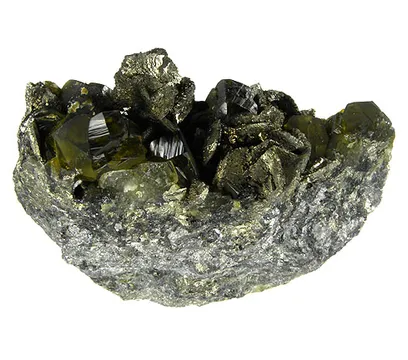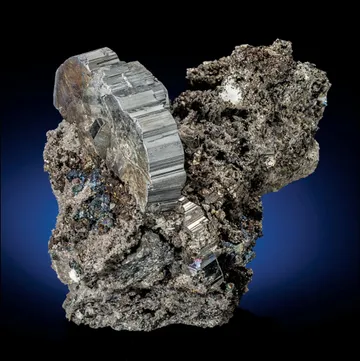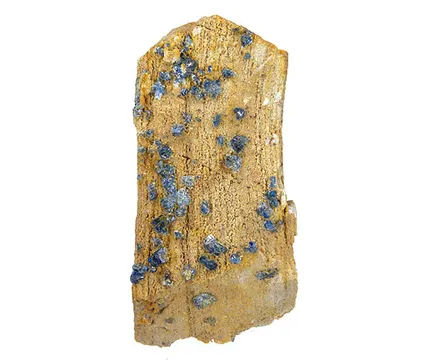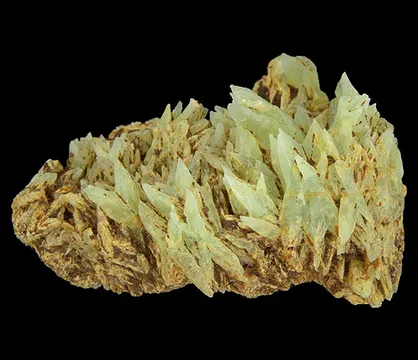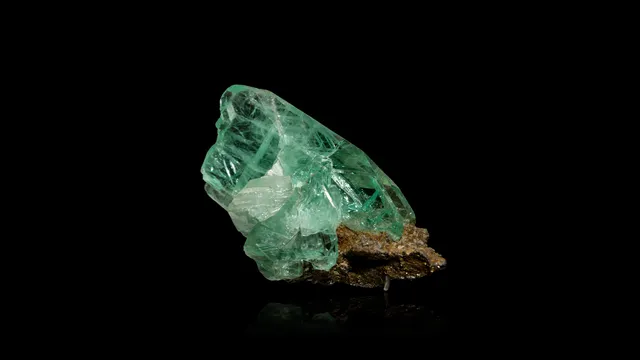
Tomokoni mine, Bolivia — premier vivianite locality with emerald-green, sword-shaped crystals on red sandstone; prized for pure presentation and collectability.
Key facts
Tomokoni mine is one of the most instantly recognizable modern vivianite localities in the world: sharp, glassy green Fe3(PO4)2·8H2O crystals rising from a rusty red sandstone matrix, with almost none of the clutter that accompanies many Bolivian ore-vein vivianites. Its importance to collectors rests on a very specific combination of features. The occurrence is not a big metallic mine that happened to yield a few phosphates; it is a small set of adits worked essentially for vivianite specimens, a few hundred meters below the Canutillos mine in the Canutillos subdistrict of the Colavi-Machacamarca mining district of Potosí. The host is non-mineralized red argillaceous sandstone, and that simple, friable, iron-colored rock is the visual signature of the locality.
The best Tomokoni pieces have a clean architectural look: isolated to clustered, sword-shaped prismatic vivianite crystals, typically emerald green to bottle green, sometimes darkening toward blue-green or nearly black in older or light-exposed examples. In transmitted light, fine crystals can glow with deep green and blue tones; in reflected light, the best pieces show a wet, high luster and crisp terminations. Good matrix pieces are prized because the sandstone makes the green crystals look exceptionally vivid, but that same matrix is soft and crumbly, so undamaged crystals still perched naturally on original rock are much less common than loose or repaired-looking material.
Regional View
Country View
Tomokoni belongs in the same collecting conversation as Huanuni, Morococala, and Siglo Veinte, but it has a very different personality. Those classic Bolivian localities commonly produced vivianite in sulfide- and carbonate-rich ore settings, with siderite, pyrite, ludlamite, vauxite-family phosphates, or other associated species. Tomokoni, by contrast, is famous for purity of presentation: green vivianite, red sandstone, and only sparse baryte or siderite associations. This is why fine Tomokoni examples look so modern, almost sculptural, and why their labels matter. A true Tomokoni piece should usually make geological sense at a glance: vivianite on red sandstone, not on the heavy pyritic ore matrices typical of several older Bolivian vivianite districts.

Photo: Wikimedia Commons
Search for specimens: View all specimens from Tomokoni mine, Bolivia
Tomokoni mine is in the Canutillos subdistrict, Tacobamba Municipality, Cornelio Saavedra Province, Potosí Department, Bolivia, within the broader Machacamarca or Colavi-Machacamarca mining district. Older specimen labels may read “Tomokoni adit,” “near Canutillos,” “Colavi,” “Machacamarca District,” or “Saavedra Province.” Those variations reflect older dealer geography and district-level usage rather than a different vivianite source.
The locality is best understood as a specimen-producing vivianite occurrence adjacent to a historic silver-tin mining district, not as a conventional ore mine. The reported Tomokoni workings consist of three small adits mined specifically for vivianite specimens. They lie a few hundred meters downhill from Canutillos mine and have been described as belonging to, or being controlled by, members of the Canutillos cooperative. The immediate host rock is non-mineralized red argillaceous sandstone. That point is essential: the classic vivianite-bearing Tomokoni rock is not a sulfide orebody, and it is not the pyrite-siderite matrix seen on many other Bolivian vivianites.
Regionally, the Colavi-Machacamarca district sits in the mineralized belt of the southern Bolivian Eastern Cordillera, where Cretaceous sandstones, siltstones, and mudstones rest against older Paleozoic marine sedimentary rocks and are cut by small dacitic to porphyritic intrusions. Historic mining in the district targeted silver and tin, with mineralization in veins, fractures, stockworks, and manto-style bodies. In the surrounding district, mineralization is commonly described in terms of silver-bearing sulfosalts and sulfides, cassiterite-bearing tin zones, base-metal sulfides, siderite, quartz, baryte, hematite or specular hematite, and iron oxides in oxidized zones. Tomokoni’s vivianite pockets are a collector’s anomaly within that landscape: phosphate crystals in open fractures and cavities in red sandstone, with very little accompanying ore mineralogy.
The discovery story belongs to the early 2000s. The best-documented account places the first important find in June 2003, when three miner brothers from Colavi noticed a blue streak in red sandstone on the Tomokoni claim. When they opened the fractures and cavities, they found green vivianite crystals that entered the Bolivian dealer network within days. By August 2003, visiting collectors reported three small adits at Tomokoni, and by late 2003 to early 2004 an arrangement had apparently allowed collecting to continue after a brief dispute over collecting rights. Contemporary reports expected a substantial output but also warned that groundwater would eventually restrict production.
The production window that matters for collectors is therefore narrow: the first flood of specimens in 2003 and 2004, followed by intermittent dispersal from dealers, collections, and later secondary-market offerings. Recent auction and dealer descriptions continue to cite early-2000s Tomokoni material and increasingly describe the occurrence as mined out or no longer yielding meaningful new specimens. A 2023 COMIBOL contract with Cooperativa Minera Canutillos Altiplano R.L. shows that cooperative mining tenure in the Canutillos area remains a living administrative matter, but that should not be mistaken for public collecting access at Tomokoni. This is not an open recreational collecting site. Any visit would require permission from the legal mineral-rights or cooperative holders and real underground-mine safety competence.
Tomokoni vivianite is known for sharp, flattened, sword-like prismatic crystals, usually deep green to emerald green on red argillaceous sandstone, with crystals commonly in thumbnail to miniature scale and documented matrix specimens carrying crystals from a couple of centimeters to more than 7 cm; Mineralogical Record indexing notes Canutillos-area crystals to 9 cm on red sandstone. The finest pieces show bright vitreous luster, clean terminations, strong transparency or translucency when backlit, and natural attachment to the fragile sandstone matrix. Associations are sparse but include thin white baryte rosettes and siderite druses; pyritic ore matrix is not characteristic of the classic Tomokoni material. Ordinary examples tend to be darkened, edge-cleaved, contacted, detached from matrix, or mounted on crumbly rock that cannot safely support the crystal, while the best pieces preserve a crisp green crystal rising cleanly from the red sandstone in an undisturbed composition.
Other verified minerals from Tomokoni are few: baryte, siderite, hematite, and quartz accompany vivianite in the published locality record. No type-locality mineral is reliably documented from Tomokoni in the standard locality listing, despite occasional loose web claims for unrelated rare phosphates. For collectors, the important rarities are therefore not a long species list but the best accessory associations: white baryte rosettes or siderite druse on the same red sandstone matrix, plus the occasional hematitic or quartz-bearing matrix that helps confirm the geological setting.
The first authenticity question with Tomokoni is locality plausibility. True Tomokoni vivianite should usually fit the red-sandstone story: sharp green to blue-green vivianite on friable argillaceous sandstone, sometimes with baryte or siderite. Specimens labeled Tomokoni but sitting on massive pyrite, heavy sulfide ore, or a classic siderite-pyrite ore matrix deserve skepticism, because that matrix better matches other Bolivian vivianite localities. Conversely, some Tomokoni pieces have been labeled broadly as Canutillos, Colavi, Machacamarca, or “near Potosí,” so a nonstandard old label is not automatically wrong if the specimen and provenance make sense.
A specific mislabeling problem is documented for magnetite: the Tomokoni locality record warns that abundant recent magnetite crystals from Potosí Department have incorrectly appeared on some dealer labels as Tomokoni, but the correct locality for that material is Cerro Huañaquino, not Tomokoni. Magnetite is not part of the verified Tomokoni mineral list. Any “Tomokoni magnetite” should be treated as a label error unless accompanied by unusually strong analytical and provenance evidence.
Condition is the central issue. Vivianite has perfect cleavage, very low hardness, and thin crystals may be flexible or splintery; Tomokoni’s sandstone matrix is also weak. Many specimens suffered broken tips, contacted faces, detached crystals, or matrix loss during extraction and later handling. Dealers have repeatedly noted that a high proportion of Tomokoni pieces were damaged, so a specimen with intact terminations, sharp edges, and stable natural matrix commands a large premium. Examine the crystal bases carefully for glue, old repairs, or reattachment, especially on larger “floating” crystals rising from crumbly sandstone.
Light sensitivity is not folklore. Vivianite darkens as Fe2+ in the structure oxidizes, and the process is accelerated by light exposure. A fresh or relatively bright green Tomokoni crystal should not be kept in a sunny case, under hot display lighting, or in continuous exhibition. Store important pieces in the dark, bring them out for short viewing sessions, and avoid unnecessary photography under intense lamps. The usual collector myth that a coating, oil, or sealed box will stop the change is unreliable, because much of the relevant reaction is internal to the crystal structure rather than simple atmospheric oxidation.
Market availability is better than for many one-pocket Bolivian classics, but the best Tomokoni material is not common. Small darkened or contacted crystals appear periodically; good miniatures and small-cabinet pieces on natural red sandstone are actively collected; large, transparent, highly lustrous, undamaged matrix specimens are genuinely scarce. Recent auction records show everything from modest miniatures to multi-thousand-dollar examples, with price driven less by size alone than by luster, green transparency under backlighting, intact terminations, aesthetics on matrix, and confidence in the Tomokoni provenance.
The Tomokoni story begins not with a formal exploration program but with a streak of blue in red sandstone. In June 2003, three brothers, miners from Colavi, were walking on the Tomokoni claim when they noticed the color. Within hours they had opened fractures and cavities carrying green vivianite crystals. Within days, Bolivian dealers were buying the new material and sending it abroad. That speed explains why early Tomokoni labels can be confusing: the specimens raced into commerce under names such as Canutillos, Colavi, Machacamarca, or simply Potosí before the small locality had settled into collector usage as “Tomokoni.”
The discovery immediately created a dispute. Miners from nearby Colavi and Canutillos both wanted the right to collect at the new pocket ground, and COMIBOL stepped in, reportedly stopping collecting while the issue was sorted out. By August 2003, American visitors Alfredo Petrov, Rock Currier, and John Lucking found that three small adits had already been driven at Tomokoni and that local miners were still slipping in to recover specimens. By December 2003, an agreement had apparently been negotiated and collecting was again under way. The optimistic prediction at the time was that several thousand specimens might be recovered in the following year, though groundwater was expected to put a practical end to production.
There is also a wonderfully human coda to Tomokoni’s rise, told in Alfredo Petrov’s later essay on vivianite instability. At the Tucson show, he met buyers who were not dismayed that their Bolivian vivianites had darkened; they were delighted. “The last ones we got turned black already,” they told him, because they believed the crystals were absorbing bad influences from their surroundings. Petrov used the story to puncture collector myths about vivianite stability, but it also captures why Tomokoni specimens are so treacherous and so seductive: the very green clarity that made them famous is a temporary state unless the owner understands how to protect it.