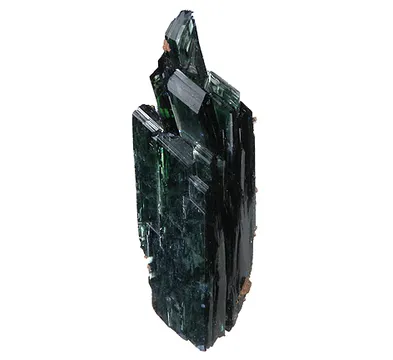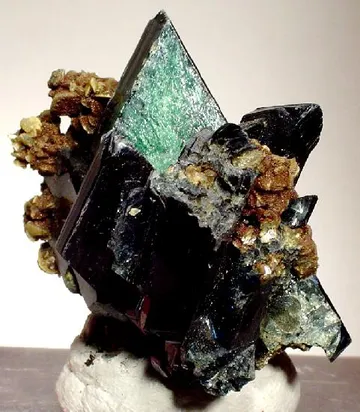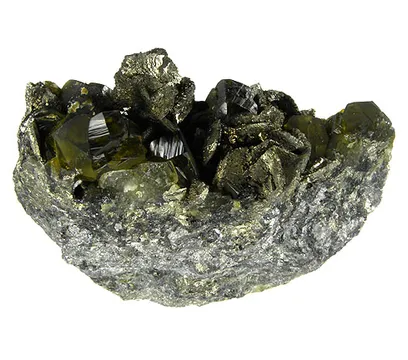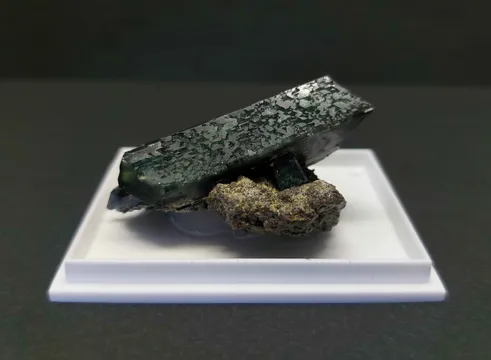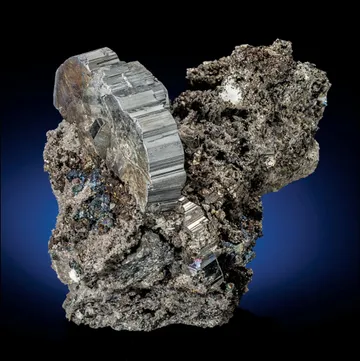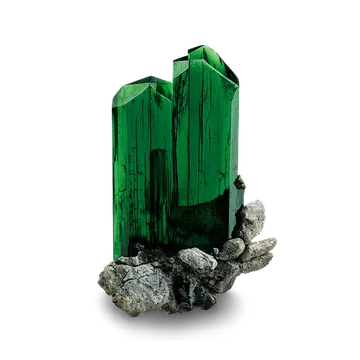
Vivianite from Tomokoni Mine, Bolivia: sharp, glassy green crystals on red sandstone, prized for purity, timing, and matrix retention.
Key facts
Tomokoni vivianite is a modern Bolivian classic: sharp, highly lustrous, bottle- to emerald-green crystals perched on a red argillaceous sandstone matrix that looks almost too simple for such superb phosphates. The contrast is the signature. Instead of the sulfide-rich tin-ore setting that produced many Bolivian vivianites, the Tomokoni occurrence sits in non-mineralized red sandstone a few hundred meters below the Canutillos mine. That unusual setting helps explain why the best Tomokoni crystals are so clean-faced, glassy, and fresh-looking compared with many older Bolivian vivianites that are rounded, dull, darkened, or heavily contacted.

Photo: Wikimedia Commons
The finest pieces show sword-shaped, tabular-to-prismatic crystals with steep terminations, mirror-bright luster, and transmitted green to blue-green color when backlit. Many are singles or small groups on jagged shards of sandstone; the locality is not known for complex assemblages so much as for the purity of the vivianite form. Collectors prize examples that retain their matrix, because loose blades and broken-off crystals are common, and the crumbly sandstone can be as much a condition issue as the vivianite itself.

Photo: Wikimedia Commons
The find’s collecting importance rests on timing as well as quality. Tomokoni material began reaching the mineral market in the early 2000s, quickly becoming one of the reference styles for Bolivian vivianite. By the mid-2000s, the best pieces had already gained the aura of a short-lived discovery. Today, Tomokoni specimens are mostly traded as old-stock pieces, dispersed collection specimens, or dealer-held inventory from earlier finds.
Tomokoni Mine is in the Canutillos subdistrict, Tacobamba Municipality, Cornelio Saavedra Province, Potosí Department, Bolivia. In older labels and dealer descriptions it may appear as Tomokoni adit, near Canutillos, Colavi, or Machacamarca District; those names reflect the broader mining district and changing locality conventions rather than a different vivianite occurrence.
The locality consists of three small adits developed specifically for vivianite specimens. It lies a few hundred meters downhill from the Canutillos mine, to whose cooperative the workings have been reported to belong. The host is red argillaceous sandstone, commonly described in specimen notes as altered, metamorphosed, or silicified sandstone. For collectors, that rock is not just background matrix: it is the visual fingerprint of Tomokoni.
The wider Colavi-Machacamarca district is a historic Bolivian silver-tin mining area, with mining roots extending back to the colonial period. Tomokoni, however, is not best understood as a normal ore-producing extension of the tin deposits. The vivianite occurrence is a small sandstone-hosted specimen occurrence associated with the Canutillos complex but not inside the main ore body. This matters mineralogically, because the absence of abundant sulfides at the immediate occurrence is repeatedly invoked by experienced dealers and writers to explain the locality’s unusually sharp, lustrous, non-sooty vivianite.
The discovery story centers on 2003. Contemporary accounts describe three miner brothers from Colavi noticing a blue streak in red sandstone on the Tomokoni claim in June 2003. Fractures and cavities yielded green vivianite within hours, and local Bolivian dealers were buying specimens within days. Competition between miners from nearby Colavi and Canutillos followed, COMIBOL intervened, and by August 2003 American visitors found small adits already dug at the occurrence. By late 2003 an agreement was reportedly in place and collection continued, though groundwater was expected to become a limiting factor.
Access should be treated as private mining/cooperative access, not recreational collecting ground. The locality was developed for specimens, and published locality data explicitly caution against visiting without permission from the land and mineral-rights holders and without appropriate mine-safety precautions. For most collectors, Tomokoni is a market locality, not a field-collecting locality.
Production was concentrated in the early-to-mid 2000s. Some dealer records describe the material as “mid-2000s finds,” and later listings repeatedly note that no new material had been forthcoming or that the occurrence had been mined out. Even allowing for the cautious language appropriate to dealer reports, the market behavior is consistent: fine Tomokoni pieces now appear intermittently from collections and old holdings rather than as a continuing stream of new production.
Tomokoni vivianite is immediately recognizable by three features: the red sandstone matrix, the sword-like crystal habit, and the luster. Crystals are commonly flattened prisms or blades with steep, chisel-like terminations. Doubly terminated examples occur and are especially desirable when the termination edges remain clean. Some specimens show parallel growth, stepped faces, or layered-looking prismatic forms.
Color ranges from saturated emerald green to dark bottle green, with blue-green or deep blue flashes under strong transmitted light. Good pieces are not merely dark; they pass light in selected zones and can reveal a luminous interior even when the surface appears nearly black-green. The finest crystals balance depth of color with transparency, so that the specimen reads as both saturated and gemmy.
Most available Tomokoni specimens fall in the thumbnail to small-cabinet range. Many matrix pieces are 3 to 7 cm across, with individual vivianite crystals around 2 to 3 cm. Larger examples exist: documented dealer specimens include crystals over 6 cm on cabinet-size sandstone matrix. Those larger, clean, undamaged crystals are uncommon and command disproportionate interest because the species has perfect cleavage, the matrix is fragile, and many recovered pieces were damaged during extraction.
Associated minerals are sparse. The verified mineral list for Tomokoni includes vivianite with baryte, siderite, hematite, quartz, and the sandstone host. The most relevant associations for collectors are occasional thin white baryte rosettes and siderite druses; pyrite-rich or sulfide-heavy matrix is not characteristic of the classic Tomokoni sandstone pieces.
Quality depends on a narrow set of factors. Look first for intact terminations and edges, because vivianite’s cleavage makes sharp crystals vulnerable. Then check luster: Tomokoni’s best pieces should be glassy to highly lustrous, not matte. Next assess transparency by backlighting, looking for green or blue-green transmission rather than a dead black mass. Finally, consider aesthetics of matrix: a well-seated crystal on natural red sandstone is far more desirable than a loose blade unless the single crystal is exceptional.
Tomokoni vivianite is not a casual display mineral. Vivianite darkens through oxidation processes associated with light exposure, and the change is not usefully prevented by coating, oiling, or simply sealing the specimen in a glass case. The sensible collector’s practice is short viewing and dark storage: a closed box, drawer, or cabinet, ideally with a stable mount that minimizes handling.
Condition problems are the rule rather than the exception. Reports from dealers who handled large numbers of Tomokoni pieces repeatedly emphasize that a high proportion had serious damage. Expect contacted edges, cleaved corners, detached crystals, or repaired matrix. A piece described as “undamaged” or “pristine” deserves careful inspection under magnification, especially along termination edges and along the basal and side cleavages.
The red argillaceous sandstone matrix is itself fragile. It can crumble, shed grains, or release crystals if handled carelessly. Some specimens may have been consolidated, especially where the sandstone matrix was weak; consolidation is not necessarily disqualifying, but it should be disclosed and should be distinguished from crystal repair. Avoid soaking, ultrasonic cleaning, or aggressive mechanical cleaning.
No verified Tomokoni-specific fake vivianite problem has become a standard warning in the mineral literature or dealer record. The more important authenticity issues are locality accuracy, damage concealment, and restoration. Tomokoni should show the right habit and matrix: sharp green blades or prisms on red argillaceous sandstone, with few associated minerals. Specimens labeled Tomokoni but sitting on sulfide-rich matrix, pyrite-siderite ore, or unfamiliar dark ore matrix deserve scrutiny, because other Bolivian vivianite localities have different geological styles.
A separate locality-label caution concerns magnetite, not vivianite: recent abundant magnetite crystals from Potosí have sometimes been mislabeled as Tomokoni, but that material belongs elsewhere. For vivianite, the most useful provenance indicators are old labels from reputable Bolivian dealers or established mineral firms, mindat minID records, and photographic continuity.
On the market, Tomokoni is available but no longer plentiful in top quality. Auction records and dealer listings from recent years show small-cabinet and cabinet pieces still circulating, but often as closed-auction examples, collection specimens, or old-stock offerings. Prices vary widely with condition: modest miniatures with damage or dark color can remain accessible, while clean, lustrous, matrix examples with strong transparency and undamaged terminations are much scarcer.
The Tomokoni story begins with an almost cinematic detail: a blue streak in red sandstone. In June 2003, three brothers from Colavi were hiking on the nearby Tomokoni claim when that streak caught their attention. Within hours they had opened fractures and cavities holding green vivianite. Within days, the specimens were moving through local Bolivian dealers and heading overseas.
The discovery did not remain quiet. Miners from Colavi and Canutillos both claimed the right to collect, and the quarrel became serious enough that COMIBOL, the Corporación Minera de Bolivia, stepped in and stopped collecting. By August 2003, visiting American collectors saw three small adits already driven at Tomokoni, while local miners were still slipping in to recover pieces. By December of that year, an agreement had reportedly been negotiated and collecting had resumed.
There is a wonderfully practical detail in early descriptions of the matrix. The red argillaceous sandstone was said to give off an earthy odor when breathed upon, a small field trick for recognizing clay-rich sedimentary material. For collectors accustomed to quartz, calcite, and metallic ore matrices, Tomokoni’s sandstone is almost shockingly humble: soft-looking, brick-red, and prone to crumbling. Yet it is exactly that red matrix that gives the vivianite its stage.
The care lore around vivianite has its own folklore. Alfredo Petrov’s famous essay on the “absorption of evil” begins with the familiar collector’s hesitation over a gemmy Bolivian vivianite: will it darken, turn black, and fall apart? He recounts a Tucson encounter with young buyers who had purchased Bolivian vivianites and returned delighted because “the last ones we got turned black already.” Their explanation was not chemistry but metaphysics: the stones had absorbed “evil energies” and, once black, had done their work. Petrov’s punchline is dry mineralogical wisdom: keep vivianite in the dark. Not shaded, not merely away from the window, but in a closed box, brought out briefly for appreciative eyes.