






A collector's guide to Terlingua, USA: its geology, mining history and notable minerals, illustrated with the 22 specimens documented from this locality on EarthWonders.
Key facts
Terlingua is one of the essential American mercury localities: a remote quicksilver district in the Big Bend country of southwest Texas where cinnabar, native mercury, and a suite of rare mercury chlorides and oxychlorides formed in fractured Cretaceous carbonate rocks and associated Tertiary intrusions. For specimen collectors, the district matters on two different scales. On the ore-mineral scale it is a classic cinnabar district, with red HgS in calcite, limestone, quartzose gangue, and altered igneous rock. On the fine-mineral scale it is far more unusual: Terlingua gave mineralogy terlinguaite, eglestonite, montroydite, kleinite, mosesite, comancheite, gianellaite, and terlinguacreekite—names that read almost like a chemical map of oxidized mercury, chlorine, nitrogen, bromine, and carbonate groundwater in a desert mining camp.
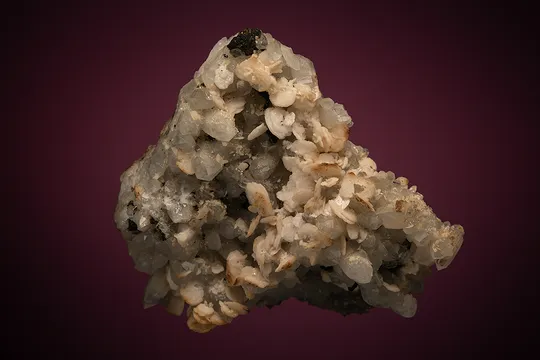
The finest specimens from the district are rarely large in the way a collector expects from lead-zinc or pegmatite fields. Terlingua is a locality of intimate, high-density, chemically improbable mineralization: yellow to yellow-green terlinguaite microcrystals, red-brown montroydite, white to gray calomel, cinnabar-red phantoms inside calcite, globules and films of native mercury, and the celebrated curved “ram’s horn” selenite for which Terlingua has long been a Texas classic. The best cabinet pieces tend to have either sculptural gypsum form, sharp calcite architecture, visible cinnabar zoning, or richly associated rare mercury species on contrasting calcite.
Regional View
Country View

Photo: Wikimedia Commons
The district lies in a narrow east-west belt near Terlingua, Study Butte, Lajitas, and the Rio Grande. Its mining history is inseparable from the Chisos Mining Company, the Mariposa Mine at California Hill, and the Study Butte/Rainbow group. The field is also one of the best illustrations in the United States of how a major industrial ore district can become a mineralogical locality of type-species importance: the same furnace economy that treated cinnabar by the flask also exposed cavities, seams, calcite crusts, and oxidized pockets that later became research material for crystallographers and collectors.
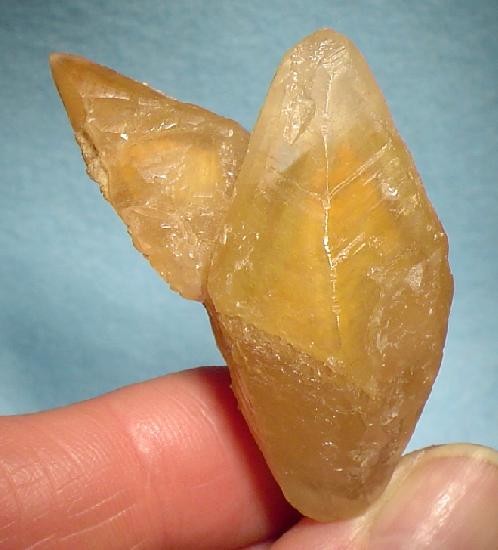
Photo: Wikimedia Commons
Search for specimens: View all specimens from Terlingua, USA
The Terlingua quicksilver district occupies the southern Big Bend region of southwest Texas, mostly in Brewster County, with mineralization distributed across a long, narrow belt rather than a single mine. The district is classically described as a hydrothermal mercury system developed in Cretaceous sedimentary rocks—especially carbonate units and clay horizons—and in places affected by Tertiary igneous intrusions, folding, faulting, doming, graben formation, and breccia pipes. The ore solutions exploited fractures, joints, cavernous openings, limestone-clay contacts, and intrusive contacts; cinnabar was the principal ore mineral, but the oxidized mercury assemblage is what made the district famous among mineralogists.
Several ore settings recur through the district. One important style is mineralization near the base of the impervious Del Rio clay, where solutions moved along favorable limestone-clay contacts. Another is open-space filling in fractures and caves, commonly with coarsely crystalline calcite and cinnabar coatings. A third occurs in or near intrusive rocks, including mineralized fracture systems related to syenitic or other alkalic intrusions. These settings help explain the specimen character: calcite-lined cavities, cinnabar-bearing veins and replacements, calomel and oxychloride coatings in oxidized zones, and gypsum in limestone caverns.
Production was heavily concentrated. Although the district contained roughly twenty mines and numerous prospects, the great majority of the quicksilver came from the Chisos-Rainbow, Mariposa, and Study Butte operations. The Mariposa Mine, also known historically as the California Mountain Mine, was the second-ranking producer in the district and lay about seven miles west of the Terlingua post office. Its workings included miles of drifts, crosscuts, shafts, pits, trenches, and winzes beneath and around California Hill; most of its ore came from relatively shallow upper workings, even though deeper shafts explored a vertical range of hundreds of feet.
The Chisos Mining Company became the dominant name in Terlingua’s boom years. Howard E. Perry organized the company in 1903, and early production relied on retorts before larger furnaces were installed as the mine expanded. A rich cinnabar vein discovered in 1914 coincided with World War I demand for mercury, giving the company its most profitable period. In the broader district, substantial production began around 1900 after earlier discoveries and prospecting in the late nineteenth century; the strongest years were during World War I, with later revivals during the 1930s, World War II, and limited postwar efforts tied to changing mercury prices.
The district’s later production history is more complicated than the ghost-town image suggests. Major mines had declined sharply by the mid-1940s, and the classic collecting era for many mercury species belongs to older mine dumps and oxidized workings. Yet Texas mercury activity did not simply end overnight: Study Butte and other district properties saw renewed interest during periods of federal price support and industrial demand, and modern environmental studies treat the Big Bend mercury-mining region as active historically from the late nineteenth century into the early 1970s. For collectors, the practical consequence is clear: most collectible Terlingua material is old, reclaimed, salvaged, or from legacy collections.
Collecting access today should be approached conservatively. The productive mines are old mercury workings, many openings have been capped, gated, backfilled, reclaimed, or otherwise treated as abandoned-mine hazards, and much of the land in and around Terlingua is private. Big Bend National Park and other protected lands prohibit mineral collecting. Even where ruins are publicly visible as historic scenery, that does not imply permission to collect. Serious collectors should treat old labels, collection history, and documented provenance as part of the specimen, especially for rare mercury minerals, ram’s horn gypsum, and genuine Terlingua fluorescent calcite.
Notable specimen-producing material came from several distinct contexts. The Mariposa Mine and especially the Perry Pit are central for rare mercury oxychlorides and type-locality material. The Little 38 Mine is the best-known source for true Terlingua fluorescent calcite, with blue shortwave fluorescence, blue phosphorescence, and pink longwave response. The limestone caverns of the district produced the classic curved selenite. Calcite and cinnabar specimens occur across the mercury mines, but high-grade aesthetic pieces—transparent scalenohedra with red cinnabar phantoms, rich montroydite-terlinguaite associations, or clean ram’s horn gypsum—have never been common.
Terlingua gypsum is prized above all as “ram’s horn” selenite: curved, translucent to white gypsum growths that bend into sculptural horns, sprays, and splitting curled forms rather than ordinary flat blades. The best examples are small-cabinet to cabinet-size pieces with stout curvature, clean surfaces, minimal bruising at the termination, and a balanced 360-degree display form. Documented Terlingua gypsum is associated with the mercury-mining district rather than broad evaporite collecting; classic pieces came from limestone caverns and are part of the same carbonate-hosted environment that produced calcite, cinnabar, and rare mercury minerals. Ordinary pieces may be chalky, broken, contacted, or merely fibrous, while fine specimens show the unmistakable hornlike growth habit and old-time Texas provenance that separates Terlingua material from more common selenite localities.
Beyond gypsum, Terlingua’s mineral list is dominated by mercury species and carbonate gangue. Cinnabar is the principal ore mineral, with metacinnabar, native mercury, calomel, calcite, aragonite, baryte, fluorite, quartz, iron oxides, jarosite, and alteration clays also recorded from the district and its mines. The locality’s greatest mineralogical distinction is its type-species suite: terlinguaite, eglestonite, montroydite, kleinite, mosesite, comancheite, gianellaite, and terlinguacreekite are all tied to Terlingua or the Mariposa/Perry Pit occurrence. Many of these are not cabinet-display minerals in the ordinary sense; they are micromount and research minerals, commonly as thin crusts, minute crystals, earthy masses, or associated specks on calcite. Their value lies in rarity, chemistry, provenance, and association.
The first authenticity issue with Terlingua is locality precision. “Terlingua” can mean the town, the old Chisos Mining Company camp, the broader Terlingua Mining District, the Mariposa Mine, the Perry Pit, the Little 38 Mine, Study Butte, or a general Big Bend mercury locality. For common cinnabar or calcite this may be acceptable on an old label, but for type-locality mercury minerals it matters. A specimen labeled simply “Terlingua” should not automatically be upgraded to Mariposa Mine or Perry Pit without a label chain, analytical support, or a credible collection history.
True Terlingua fluorescent calcite is another frequent source of confusion. Calcite with a similar blue/pink “Terlingua-type” response occurs outside Texas, and collectors use the phrase “Terlingua-type” for the optical behavior even when the specimen is not from Terlingua. Genuine Terlingua calcite should have a locality tied to the mercury mines, most notably the Little 38 Mine. The classic response is blue fluorescence and persistent blue phosphorescence under shortwave UV, with bright pink to orange-pink fluorescence under longwave UV; lamp differences can affect perceived longwave color. Massive pieces, large blocks, and sharply zoned crystal interiors with triangular fluorescent domains are especially desirable.
Condition is critical for gypsum. Terlingua ram’s horn selenite is soft, easily bruised, and often contacted or chipped where the curved terminations were attached or extracted. A clean, freestanding horn with intact curvature, no repaired breaks, and minimal whitening from abrasion is much better than a larger but battered example. Avoid aggressive cleaning: gypsum is water-sensitive and mechanically fragile, and iron-stained or clay-coated pieces can be ruined by overzealous treatment.
Mercury minerals require extra care. Cinnabar and many of the rare Terlingua species contain mercury; native mercury may occur as visible droplets or hidden films. Do not grind, saw, tumble, acid-clean, heat, or ultrasonically clean Terlingua mercury specimens. Keep them boxed, avoid dust generation, wash hands after handling, and store delicate calomel, terlinguaite, montroydite, and related species away from strong light, heat, and chemical fumes. Some mercury oxychlorides are light-sensitive or may darken with exposure, and several occur only as microscopic crusts that can be destroyed by casual handling.
No major modern fake industry is associated with Terlingua in the way that exists for some gem crystals, but mislabeling is a real market hazard. Moroccan or other curved gypsum should not be sold as Terlingua without provenance. “Terlingua-type” calcite from other localities should not be represented as Terlingua calcite. Rare mercury species should be verified analytically when possible, especially if offered as terlinguaite, eglestonite, mosesite, comancheite, gianellaite, or terlinguacreekite rather than as a general mercury-mineral association.
Market availability is uneven. Cinnabar and calcite from old Terlingua material appear periodically. True Little 38 fluorescent calcite is sought after and increasingly dependent on old stock. Ram’s horn gypsum is a classic but not abundant. The rare mercury minerals, especially well-provenanced type-locality material with visible crystals, remain specialist specimens; many worthwhile examples are micromounts or thumbnails, and the best pieces usually come through old collections rather than new field production.
Terlingua’s origin story is already half legend by the time it reaches the mining record. Cinnabar was apparently known in the region before American mining companies arrived, and red mercury ore was said to have been used as pigment. By the 1890s, prospectors were following reports from Mexican miners and local finds of cinnabar float around California Mountain. The remoteness is hard to overstate: ore, supplies, mail, water, and people moved through desert country far from the railroad, with Alpine and Marfa functioning as distant shipping points rather than nearby conveniences.
Howard E. Perry’s story gives Terlingua its sharpest human outline. Perry was not a desert prospector in the romantic sense; he was a Chicago industrialist whose Texas land became valuable when mining on neighboring ground was found to be crossing onto his property. After litigation confirmed his possession in 1901, he organized the Chisos Mining Company in 1903 with borrowed capital. What followed was one of the strangest company towns in the American Southwest: a mercury camp directed in detail from afar, with production reports telegraphed to Perry while managers, geologists, furnace men, and mostly Mexican miners worked the ground.
Perry built a two-story mansion above the camp in 1906, reportedly inspired by Moorish architecture he had seen at Almadén, Spain, the great Old World mercury district. The house had nine bedrooms, a wine cellar, nine ten-foot arches, and a ninety-foot front porch. Below it stood the industrial and social machinery of the Chisos operation: furnaces, a company store, hotel, school, doctor, telephone service, water system, mail delivery, and eventually a theater and confectionery. Terlingua became a settlement where modern services and desert isolation sat side by side—an industrial town in a landscape that still demanded hauled water, hard labor, and close company control.
The World War I years were the boom. A rich cinnabar vein found in 1914 met wartime demand just as mercury prices rose. In one ten-day span in September 1916, the company shipped two carloads of quicksilver from Alpine valued at more than $50,000. Long afterward, one Chisos employee claimed profits averaged $2,000 a day during the early war years, with more than $1,250,000 in the company’s best year. Those figures explain both the mansion on the hill and the feverish pace underground.
Then came the slow unmaking of the empire. In 1930, Perry had to settle with the neighboring Rainbow Mine after Chisos workings followed a rich ore body roughly 200 feet into the Rainbow claim. In the 1930s, labor and safety scrutiny increased. One Chisos geologist, A. R. Fletcher, later described the mine as “extremely hot, horribly hot,” and said there was no provision for ventilation. Perry bought the Mariposa Mine in 1928 and the Rainbow Mine in 1938, trying to hold the district together as older ore bodies weakened. By 1939, Fletcher reported that the Chisos Mine had been worked out. Bankruptcy came in 1942.
One of the best modern specimen stories belongs not to cinnabar but to fluorescent calcite. The Little 38 Mine dump, long known quietly among a few collectors as the chief source of Terlingua calcite, was partly removed during a 2004 highway-related construction project. Fred G., a Terlingua resident and collector, had spent years tracing the material to that dump and had collected there with permission. When equipment arrived in early March, about a third of the dump was taken for fill, then most of the remainder was moved to a crusher site. Some was reduced to tennis-ball- to football-size pieces; some was pulverized. By April 7, only about five percent of the original dump was still intact, and that too was leveled and covered.
During roughly three weeks of salvage, Fred collected daily from the disturbed material while construction went on around him. He later estimated that the amount he saved during the removal nearly equaled what he had collected in the previous two years. He also believed that roughly ten thousand pounds of Terlingua calcite “bit the dust,” with two or three times that amount possible. For fluorescent-mineral collectors, that episode transformed Terlingua calcite from a regional curiosity into a finite, salvaged classic: the mine dump no longer existed in its old form, and large authentic pieces became part mineral specimen, part rescue artifact.
.jpg)
