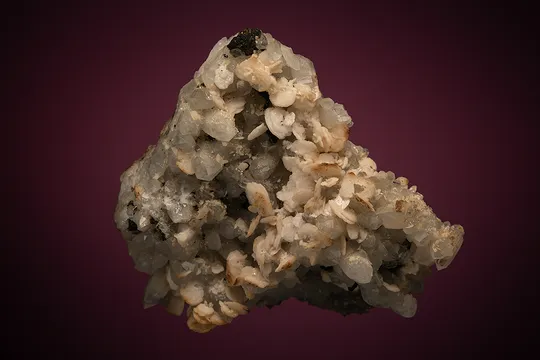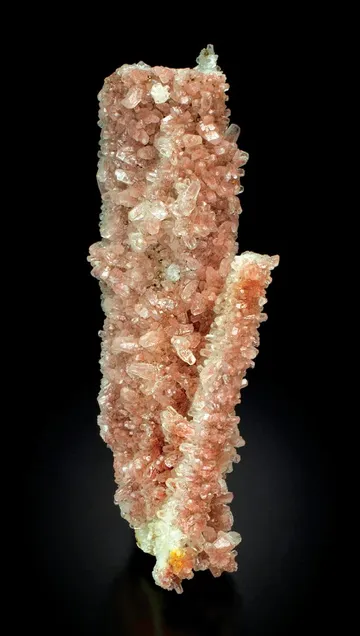
Austin, USA — iconic celestine from the Glen Rose Formation near Mount Bonnell; blue-tipped, glassy prisms in limestone, a regional collector favorite.
Key facts
Austin, Texas, is one of the few American city localities whose name still carries real weight with mineral collectors, and that reputation rests above all on celestine from the Lower Cretaceous Glen Rose Formation west and northwest of downtown. The classic specimens came from vugs, geodes, nodules, and pockety zones in limestone and dolomitic limestone around Mount Bonnell, Bull Creek, Loop 360, Mount Barker, the Highway 183–Loop 1 interchange, and related Travis County exposures. The setting is not a metallic mine camp or a great quarry district in the usual specimen-market sense; it is a faulted, karstic carbonate landscape on the Balcones Fault Zone, where resistant limestone ledges, marly partings, creek cuts, roadworks, and old small workings occasionally opened the right cavities.
The best Austin celestine has a look that is instantly regional: white, pale gray, or faintly smoky prisms and spear-like crystals with clean sky-blue tips, often seated in tan Glen Rose limestone. Older literature used “celestite,” and that name remains common on labels, but celestine is the accepted species name. Crystals reported from Travis County range from the usual thumbnail-to-miniature pieces to crystals several inches long, and The Mineralogical Record index notes Bull Creek celestine as lustrous gray-blue crystals to 10 cm. The very best examples combine glassy, undamaged blue terminations, sharp form, and enough limestone matrix to make the crystal look naturally poised rather than merely extracted.
Regional View
Country View
Austin is also a silica locality in the collector’s sense, though not in the grand crystalline-quartz sense of Arkansas or the pegmatite districts west of the Llano Uplift. Chalcedony, agate, chert, and quartz are documented from Travis County, with research on Edwards Limestone silica in Travis County giving the area an unusually interesting petrographic twist: some chalcedony associated with evaporite dissolution shows length-slow character and grades outward into megaquartz. For specimen collectors, this helps explain why some Austin-area silica is more than “just chert”—the better pieces can show botryoidal, drusy, translucent, or pale bluish surfaces tied to the same carbonate-and-evaporite history that produced the more famous strontium minerals.
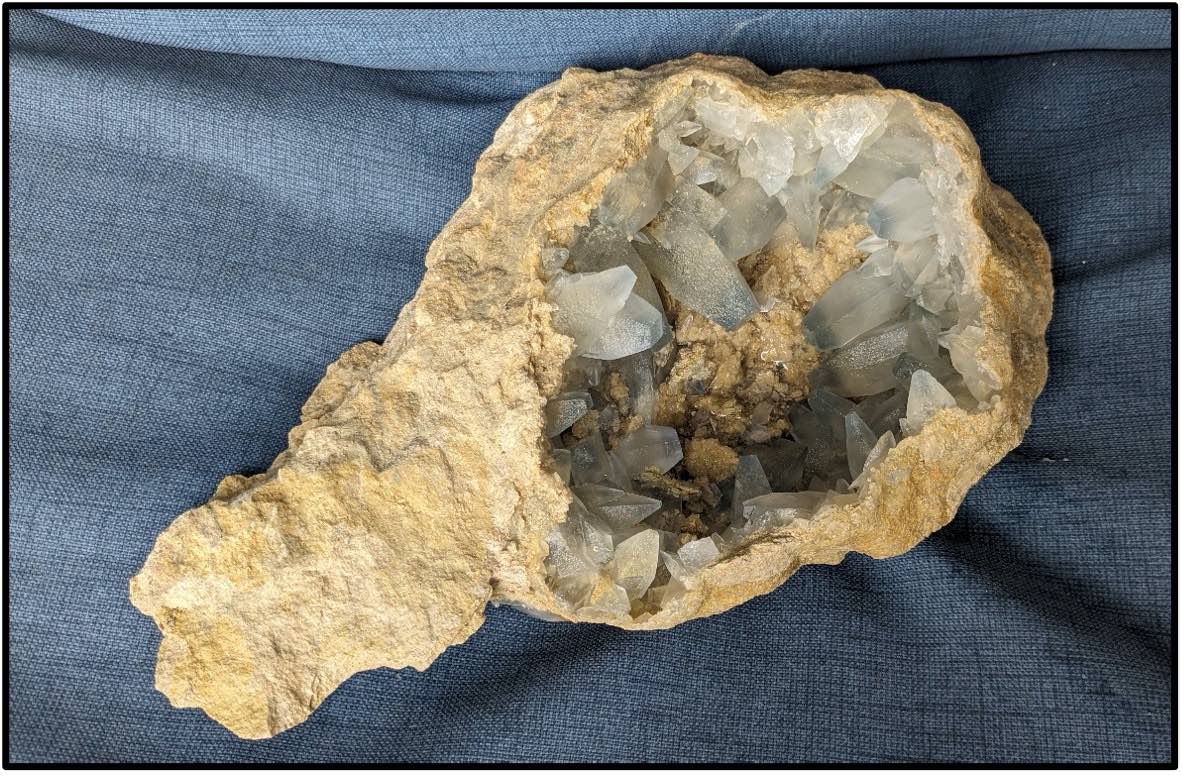
Photo: Houston Gem & Mineral Society
Search for specimens: View all specimens from Austin, USA
The Austin locality is best understood as a cluster of western Travis County carbonate exposures rather than a single mine. The specimen-producing horizon is chiefly in the Glen Rose Formation of the Trinity Group, a Lower Cretaceous sequence of limestone, dolomitic limestone, marl, and related shallow-marine beds. Around Austin these strata are exposed along the eroded edge of the Edwards Plateau and are disrupted by the Balcones Fault Zone, including the Mount Bonnell fault. Bureau of Economic Geology mapping of the Austin West quadrangle describes Cretaceous marine limestones and clays broken by one large Mount Bonnell fault and numerous smaller northeast-trending faults, with most faults downthrown to the east and total displacement across the zone of about 1,000 feet.
That structural setting matters to collectors because it brings the Glen Rose, Walnut, Edwards, Georgetown, Del Rio, Buda, Eagle Ford, Austin, Taylor, and Navarro units into a narrow, complex belt near the city. West of the main fault zone, Glen Rose and Edwards limestones form the hard ledges, creek bluffs, and stair-step slopes that define the Hill Country side of Austin. Eastward, younger clays and chalks become more important. The celestine pockets belong to the Glen Rose part of that section, especially where limestone and dolomite beds once hosted evaporite nodules or cavity systems.
The ore bodies, if the old Travis County occurrences deserve that term, were never large industrial ore bodies in the Nolan or Brown County sense. They were pockets, nodules, geodes, and localized masses of celestine and associated strontianite within certain beds of Glen Rose limestone. Early Bureau of Economic Geology work recorded celestite at Mount Bonnell and elsewhere in Travis County, with small quantities mined from pockets. Later Texas celestite work emphasized that the Mount Bonnell–Mount Barker district was the first reported Texas strontium-mineral district, and that celestine with subordinate strontianite occurred as nodular masses and geodes within Glen Rose beds. The same work made clear why Austin never became a significant strontium-mining district: the ratio of celestine to enclosing limestone was too low for profitable commercial mining under normal conditions.
The commercial history is brief but important for labels. In 1904, R. C. Walker of Austin produced 17 tons of celestite at Mount Bonnell and shipped it to Germany for experimental purposes. The same deposit was worked again on a limited scale in 1917, with small quantities sold for domestic use. Those figures are modest beside later Texas celestite production from Nolan and Brown Counties, but they give Austin’s Mount Bonnell material a real mining history rather than a purely casual collecting history. It is a locality with both specimen tradition and documented trial production.
The named Austin collecting localities most often seen on labels are Mount Bonnell, Bull Creek, Loop 360, the Highway 183 and Loop 1 interchange, Mount Barker, and nearby Oak Hill/Convict Hill occurrences in the wider Travis County district. Mount Bonnell is the historical anchor. Bull Creek is the modern collector classic, famous for gray to blue prisms and blue-tipped crystals on limestone. Loop 360 and the Highway 183–Loop 1 interchange produced calcite, celestine, strontianite, and related carbonate-sulfate material from road and construction exposures. At the Highway 183–Loop 1 locality, strontianite has been noted as abundant and apparently formed at the expense of large celestine crystals, leaving some crystals corroded or encrusted.
Austin’s carbonate building-stone history also intersects the mineral story. The old Oatmanville or Convict quarry near Oak Hill, in Glen Rose limestone, supplied stone for the foundation and interior walls of the Texas State Capitol as well as other Austin buildings. The same broader Oak Hill–Convict Hill area is now mineralogically recorded for calcite, celestine, quartz, strontianite, and limestone. Deep Eddy and other Edwards and Austin limestone quarries likewise remind collectors that much of Austin’s mineral access historically came from cuts, quarries, construction, and creek erosion rather than from mines developed for specimen recovery.
Collecting access today is the difficult part. Many of the best-known exposures lie in city parks, greenbelts, road cuts, developed land, or private property. Austin Parks and Recreation promotes Leave No Trace practices that explicitly include leaving rocks and other natural objects as found, and Texas state-park rules prohibit removing rocks, minerals, fossils, soil, or geological deposits except by permit. The practical collector’s rule is therefore simple: old Austin celestine with good provenance is a specimen-market item, not an invitation to dig public ground. Legal collecting requires explicit landowner or managing-agency permission, safe access, and no disturbance of protected parks, preserves, road rights-of-way, or active construction sites.
Austin chalcedony is best read as a carbonate-replacement and cavity-lining silica, not as desert-agate field material in the West Texas sense. Travis County records include chalcedony and agate, and petrographic work on the Cretaceous Edwards Limestone in Travis County documented unusual length-slow chalcedony associated with collapse structures formed by solution of gypsum or anhydrite nodules, with chalcedony masses grading outward into megaquartz. Collectible Austin pieces tend to be small cabinet and miniature specimens showing translucent white, gray, or faintly blue chalcedony, botryoidal or drusy surfaces, and limestone-related textures; the better examples have lively surface luster, clean botryoidal form, or attractive contrast with tan carbonate matrix, while ordinary pieces are simply massive chert or dull silica nodules without display character.
Quartz from Austin is a subtle collector’s mineral, documented in Travis County and at the Convict Hill Quarry area rather than known for large freestanding crystals. Its most interesting local expression is tied to the same authigenic-silica story as the chalcedony: microcrystalline silica can pass outward into coarser megaquartz in carbonate collapse or replacement settings, and quartz is associated in county records with limestone and calcite. On specimens, expect drusy quartz, small cavity linings, massive silica, chert-like replacements, or quartzose zones in limestone rather than major crystal groups; desirable examples are those with sparkle, translucency, botryoidal-to-drusy transitions, or a clear Austin carbonate association, while undiagnostic loose chert fragments are far less compelling unless accompanied by old, credible locality data.
Celestine is the signature mineral of Austin and the species by which the locality is judged. The classic crystals come from vugs, geodes, pockets, and linear cavity zones in Glen Rose limestone at Mount Bonnell, Bull Creek, Loop 360, Mount Barker, the Highway 183–Loop 1 interchange, and nearby Travis County exposures. Older sources describe Mount Bonnell and west Austin crystals as mostly white or colorless near the base, commonly fractured where attached, but with clear celestine-blue tips that may be flawless; average crystals are about 1 inch, but crystals several inches long have been found, and Bull Creek material is recorded up to 10 cm. The best specimens show sharp, lustrous gray-white prisms with blue terminations on limestone matrix, minimal bruising, and strong three-dimensional placement; lesser pieces are loose, broken, cloudy, or heavily corroded by later strontianite.
Other documented Austin and Travis County minerals include calcite, strontianite, aragonite, gypsum, anhydrite, baryte, pyrite, marcasite, petrified wood, bitumen, and a recorded serpentine subgroup occurrence in the broader county. Strontianite is the most important accessory for collectors because it occurs at Mount Bonnell, Bull Creek, Loop 360, the Highway 183–Loop 1 interchange, and Convict Hill, and because it can replace, encrust, or corrode celestine. Calcite is common in the limestone cavities and can provide attractive association, while anhydrite and gypsum are geologically significant as part of the evaporite story even when they are not the showiest cabinet minerals. Austin is not known as a type locality for a mineral species; its importance lies instead in a distinctive and well-documented carbonate-hosted celestine suite inside a major American city.
Austin labels deserve careful reading. “Austin celestite,” “Austin celestine,” “Bull Creek,” “Mount Bonnell,” “Loop 360,” and “Travis County” are not identical levels of precision. A specimen labelled only “Austin, Texas” may be perfectly legitimate, but a more specific old label—Bull Creek, Mount Bonnell, Mount Barker, Highway 183 and Loop 1, Loop 360, or Convict Hill—is more informative and generally more desirable. Older labels almost always say celestite; this is not a red flag, simply historical usage.
The principal mislabelling problem is not exotic fakery but confusion among the pale blue to gray cavity minerals of the Austin limestones. Celestine may be mistaken for quartz or calcite by casual finders, and loose pale-blue fragments can be difficult to assign without hardness, cleavage, density, and provenance. Celestine is heavy for its size, softer than quartz, and has good cleavage; quartz is harder, lighter, and lacks cleavage; calcite effervesces in dilute acid and cleaves rhombohedrally. Strontianite coatings can complicate old celestine, especially from localities where celestine crystals were partly altered or encrusted.
Condition is the main value issue. Austin celestine is brittle and cleavable, with many crystals naturally damaged near their attachment points. Chips to blue terminations, cleaved bases, internal fractures, iron staining, muddy residues, and missing crystals in opened geodes are all common. Matrix pieces should be inspected for old glue, plaster, or reconstructed limestone. A loose blue-tipped crystal may be attractive, but a naturally positioned crystal on limestone matrix with no termination damage is far more desirable.
Avoid soaking celestine specimens aggressively. Mud-filled pockets often tempt overcleaning, but celestine is softer than most display minerals and vulnerable at cleavage planes and terminations. Use gentle mechanical cleaning, repeated water rinses where appropriate, and patience; avoid acids unless the chemistry and associations are fully understood, especially when calcite, strontianite, or delicate clay-lined cavities are present. Fine Austin material should be stored away from heavier quartz specimens and transported as carefully as barite or fluorite.
Market availability is limited. Texas is not generally a prolific source of fine crystallized display minerals, so well-provenanced Austin celestine tends to be retained in regional collections. Bull Creek and Mount Bonnell examples appear intermittently through older collections, small dealer inventories, and auctions. Modern collecting pressure is constrained by public-park restrictions, urban development, road-cut hazards, and private-property access, making old specimens with credible provenance increasingly important.
The best modern Austin celestine story begins the way many field-collecting stories do: at the end of a disappointing day. Greg Sullivan, writing for the Houston Gem & Mineral Society, described canvassing Travis County with his brother Ian after hours of preparation. They had found pockets, but the haul was modest—“a ball cap full” of tiny crystal-speckled pieces. Greg tried to make peace with the day: “It could be worse.” Ian’s reply had the sting every celestine hunter understands: “Yes, they could be bigger and blue.”
They had one small pocket left, one they had skipped earlier for lack of tools. Until a trip back to the car, their kit had amounted to a single screwdriver. Returning with a rock hammer, they started by checking the tailings. Ian suddenly dropped to his knees and came up with a 3-inch point of blue-tipped celestine, immediately the best crystal of the trip. Following the float led them back to the source pocket.
The pocket earned a name: “The Coconut.” It was full of mud, 5.5 by 4.5 inches across, and, in Sullivan’s phrase, looked back with a “blue snaggle-toothed grin.” It was almost dark, which is exactly when a sensible collector should pack up and exactly when a committed collector does not. The brothers stayed. With only a screwdriver and rock hammer, they spent four hours chiseling around the geode. After about three hours of working the perimeter, they tried a high-angle wedge from both sides, coaxed the fractures together, and lifted the piece free intact. Then the pocket gave them the line every field collector dreams of: behind the first geode was a second, larger cavity.
They came back properly equipped, this time with a hammer drill, and extracted the second pocket by the same wedge strategy. It measured 7 by 7 by 5 inches deep. The story has no need for exaggeration; the exact measurements, the near-dark extraction, the screwdriver, the rock hammer, the mud, the blue teeth, and the second pocket do the work.
Austin also has a cautionary collecting story preserved in print. A 2005 letter in The Mineralogical Record corrected an earlier note on Bull Creek celestine, emphasizing that the crystals were not from the Upper Cretaceous Austin Chalk but from the Lower Cretaceous Glen Rose Limestone. The writer added important field observations: Bull Creek crystals occurred in cavities in linear zones in limestone, then believed to have been formed by small anhydrite masses that had since been removed. Even within the exposed Bull Creek area, the celestine varied: classic blue-tipped crystals had white to pale gray prisms and transparent smaller crystals, while more solid gray to blue crystals were more common in the west part of the canyon and blue-tipped crystals on the east.
The same letter also explains why old Austin specimens matter. The writer doubted that more Bull Creek material would become available unless an old stash was released, because the last serious collectors known to him to enter the area some years earlier had been arrested, jailed, and had their tools confiscated by Austin Park Police. Whether one reads that as a legal warning, a collecting-era boundary marker, or both, it marks the shift from Austin celestine as a field locality to Austin celestine as a provenance locality.
Elbert A. King, Jr. (1961), Texas Gemstones, Bureau of Economic Geology, Report of Investigations No. 42 — The key gem-and-specimen reference for Travis County celestine, noting colorless and blue gem-quality crystals from Mount Bonnell and other localities west of Austin, with discussion of crystal size, blue tips, and lapidary limitations.
E. H. Sellards (1930), “Travis County,” in Mineral Resources of Texas, Bureau of Economic Geology — Early county mineral-resource treatment documenting Glen Rose celestite at Mount Bonnell and elsewhere in Travis County, small pocket mining, Balcones faulting, and local stratigraphy.
G. I. Evans, Celestite Deposits in Texas, Bureau of Economic Geology Mineral Resource Survey No. 46 — Important statewide celestite report placing Mount Bonnell–Mount Barker as the earliest reported Texas strontium-mineral district and recording the 1904 and 1917 trial production at Mount Bonnell.
G. I. Evans (1946), “Celestite deposits in Texas [Brown district, Brown County],” University of Texas Publication No. 4301, listed by the National Geologic Map Database — NGMDB bibliographic record for Evans’ Texas celestite work, useful for tracing publication history and related state strontium-mineral mapping.
P. U. Rodda (1969), Geologic Map of the Austin West Quadrangle, Travis County, Texas, Bureau of Economic Geology GQ0038 — The essential geologic-map reference for the Austin West area, including Cretaceous marine limestones and clays, Mount Bonnell faulting, Balcones Fault Zone structure, and Hill Country carbonate units.
R. T. Hill and T. W. Vaughan (1900), Austin Folio, U.S. Geological Survey Geologic Atlas Folio 76 — Foundational geologic description of the Austin quadrangle, including the Glen Rose Formation and associated pockets or nodules of calcite, aragonite, strontianite, celestite, and epsomite.
Arthur E. Smith (1991), “Texas Mineral Locality Index,” Rocks & Minerals, 66(3), 196–224 — Core locality-index reference repeatedly cited for Austin-area calcite, celestine, strontianite, gypsum, pyrite, aragonite, and anhydrite localities.
J. S. Pittman and Robert L. Folk (1971), “Length-slow Chalcedony after Sulphate Evaporite Minerals in Sedimentary Rocks,” Nature Physical Science, 230, 64–65 — Petrographic paper based on authigenic silica in the Cretaceous Edwards Limestone of Travis County, important for understanding chalcedony–megaquartz relationships tied to dissolved evaporites.
Museums Victoria Collections, Specimen M 29906 Celestine, Austin, Travis County, Texas — Museum record showing Austin celestine represented in an institutional mineral collection outside the United States.
The Mineralogical Record index entry for Bull Creek, Austin, Travis County — Indexes Bull Creek celestine as lustrous gray-blue crystals to 10 cm in volume 35, page 144.
The Mineralogical Record, July–August 2005, “Bull Creek Celestine” letter — Important correction and field note distinguishing Glen Rose Limestone Bull Creek celestine from Austin Chalk and recording color, zoning, pocket style, and access problems.
Mindat — Austin, Travis County, Texas, USA — Main locality page for Austin-area minerals and sublocalities.
Mindat — Travis County, Texas, USA — County-level mineral list including Austin sublocalities and silica varieties.
Mindat — Bull Creek, Austin, Travis County, Texas, USA — Key modern celestine locality page for the Austin district.
Mindat — Mount Bonnell, Austin, Travis County, Texas, USA — Historic Austin celestine and strontianite locality.
Mindat — Highway 183 and Loop 1 interchange, Austin, Travis County, Texas, USA — Useful record for celestine, strontianite, calcite, and aragonite from a specific Austin roadwork locality.
Mindat — Mount Barker, Austin, Travis County, Texas, USA — Historic Mount Barker sublocality for celestine and anhydrite.
Mindat — Oak Hill, Travis County, Texas, USA — Broader Oak Hill locality record including Convict Hill Quarry minerals.
Houston Gem & Mineral Society — “Austin Celestine,” by Greg Sullivan — Firsthand collecting narrative with photographs of a mud-filled blue-tipped celestine pocket.
Bureau of Economic Geology — Texas Gemstones — Classic Texas gem reference with one of the best short descriptions of Travis County celestine crystals.
Bureau of Economic Geology — Mineral Resources of Texas: Travis County — Early county report covering stratigraphy, Balcones faulting, celestite, building stone, and other Travis County resources.
Bureau of Economic Geology — Celestite Deposits in Texas — Statewide celestite report with historical production data for Mount Bonnell.
Bureau of Economic Geology — Geologic Map of the Austin West Quadrangle — Best concise map reference for the Austin West geologic setting and Mount Bonnell fault.
Museums Victoria Collections — Austin celestine specimen M 29906 — Institutional collection record for an Austin celestine hand specimen.