A collector's guide to Teresita Mine, Spain: its geology, mining history and notable minerals, illustrated with the 43 specimens documented from this locality on EarthWonders.
Key facts
The Teresita Mine treated here is the classic Catalan Teresita of the Can Donadeu–Sant Fost de Campsentelles area near Barcelona, not the separate Murcian mine of the same name in the Cartagena–La Unión district. For collectors, Teresita’s importance rests on a very particular association: white to colorless barite, fluorite, galena and calcite in hydrothermal veins, later altered to secondary lead minerals, with the prize being pale cream, tungsten-rich wulfenite known in the trade and literature as chillagite. Good Teresita pieces have a restrained, old-European look: thin, irregular, cream-colored laminae or lenticular plates of wulfenite standing out against pale barite or fluorite, sometimes with cerussite and galena in the matrix. They are not showy in the Red Cloud or Ojuela sense; their appeal is locality, chemistry, history and rarity.
Regional View
Country View
Geologically, the mine belongs to the mineralized belt around Sant Fost de Campsentelles, close to the boundary with Montcada i Reixac, where fractures and veins cut granodioritic basement and Cambro-Ordovician slates close to the granitic intrusion. The useful collecting distinction is between the old Teresita mine proper and the nearby Can Donadeu and Can Rovira quarries: the mineralization is closely related, and specimens have not always travelled through collections with perfect locality discipline, but Teresita is the name attached to the classic Spanish chillagite specimens.
Historically, the mine was registered in 1925 and worked principally in the 1940s for barite and fluorite. Later collecting episodes and small disturbances in the area brought additional material to light, but fine specimens are now essentially old-collection pieces. The best labels one can hope for are from established Spanish collections or dealers, with dates around the mid-20th century or the small 1979–1980 collecting episode associated with works near the railway.
Search for specimens: View all specimens from Teresita Mine, Spain
Teresita is best understood as a small hydrothermal vein occurrence rather than a large specimen mine. The veins carry quartz, barite, fluorite, calcite and galena, with oxidation of the lead-bearing assemblage producing cerussite, mimetite and wulfenite. In the surrounding Sant Fost workings, the same style of mineralization appears in fractures of the granodioritic basement; published work on the district records primary sulfides including galena, sphalerite, pyrite, chalcopyrite and arsenopyrite, and a secondary suite that includes azurite, brochantite, cerussite, epidote, erythrite, malachite, mimetite, posnjakite, surite, willemite and wulfenite. The important collector’s point is that Teresita’s classic specimens are tied to the barite–fluorite–galena vein system, not to the more abundant quarry minerals of the wider district.
The mine’s older production was for barite and fluorite. The Teresita concession was registered in 1925, and its principal working period was in the 1940s. Later accounts indicate that the mine had ceased work by the early 1970s; by the time collectors were trying to relocate it in the 2000s and 2010s, the old workings were already difficult to identify in the landscape. A small 1979–1980 collecting episode is especially important for specimens: material with chillagite on white barite is thought to belong to that period, when minor extractions or disturbances connected with nearby railway work exposed mineralized material. Older chillagite specimens are more often described with fluorite.
The ore bodies were modest vein fillings rather than broad replacement zones. Barite occurs both as massive vein material and as tabular crystals in cavities; fluorite is commonly massive and pale, especially white, cream or greenish material in the broader Sant Fost vein system; galena supplies the lead for the secondary species. Where the system oxidized, cerussite developed on or after galena, and wulfenite appeared as millimetric to centimetric cream laminae, commonly with barite and fluorite. The tungsten-rich composition of the wulfenite is what gives these pieces their special standing: “chillagite” is a variety name for W-bearing wulfenite, compositionally intermediate toward stolzite, and Teresita is one of the classic Spanish localities for it.
Collecting access today should be treated as essentially closed for practical purposes. The old mine has been described by collectors as hard to find, deteriorated and partly lost in vegetation and later landscape changes; a 2010 field search reported a small headframe over a filled shaft, ruined buildings, no evident dumps and no accessible adits. Any collecting on active quarry land or private land in the broader Can Donadeu–Can Rovira area requires explicit permission. For the collector, the realistic supply is from old Spanish collections, dealer stock, and occasional rediscoveries of mid-century material.
The notable finds are the old cream chillagite pieces, especially those dated around 1950–1955, and a later suite probably collected around 1979–1980 with wulfenite on white barite. The better old specimens are small miniatures rather than cabinet monsters: thin, pale wulfenite blades or lamellae set on white barite or fluorite, with galena and occasional cerussite. The most desirable examples combine locality integrity, visible W-rich wulfenite, matrix contrast, and documented age.
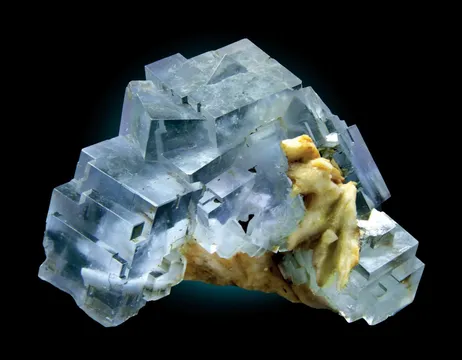
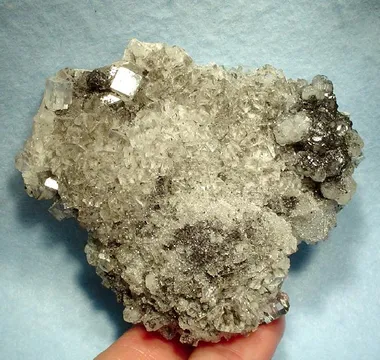
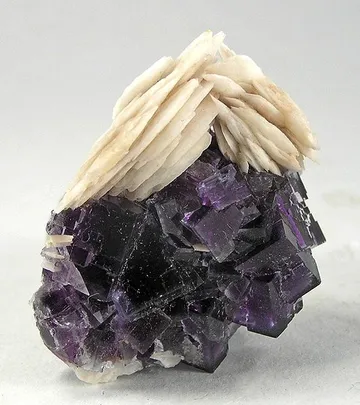
Barite at Teresita is the principal gangue and collector matrix: white to colorless, commonly massive in the veins, but locally forming tabular crystals in cavities within barite itself or in calcite; older finds from Teresita and nearby Can Donadeu produced centimetric crystals, whereas modern finds in the related workings are generally only millimetric. The finest Teresita barite specimens are not merely lumps of pale vein material, but matrix pieces where clean white barite frames cream chillagite, fluorite, galena or small cerussite; in such pieces, crisp tabular barite, contrasting white matrix and an old label separate a collection-grade specimen from ordinary vein barite.
Teresita wulfenite is famous as the tungsten-rich variety chillagite, occurring as pale cream to beige, thin lamellar, tabular, irregular or slightly lenticular crystals on barite, fluorite and galena-bearing matrix; old dealer and museum examples are usually miniatures, with individual crystals commonly millimetric to about a centimeter and exceptional labelled pieces showing principal crystals around 1.8 cm. The classic older material is often associated with fluorite, while specimens on white barite are linked to later small extractions around 1979–1980; top pieces show well-defined cream blades standing proud of a light matrix, preferably with old provenance, rather than dull, broken, embedded or visually confused plates.
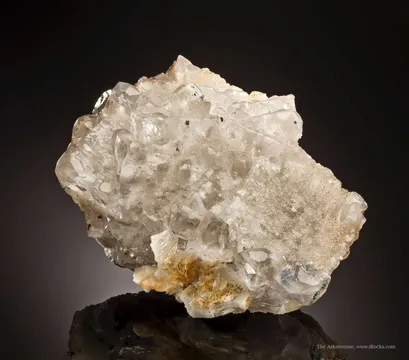
Cerussite from Teresita is a secondary lead mineral formed from alteration of galena and is valued chiefly as part of the chillagite association rather than as a major display species on its own. In Teresita specimens it appears as small white, cream, grayish or honey-toned crystals with galena, barite and fluorite; dealer descriptions repeatedly emphasize that cerussite is a peculiarity in the classic chillagite pieces, since it did not usually appear with wulfenite at this deposit. The best examples show identifiable cerussite adding mineralogical completeness to a wulfenite–barite–galena association, while ordinary examples have only indistinct pale alteration crusts or heavily bruised lead-carbonate patches.
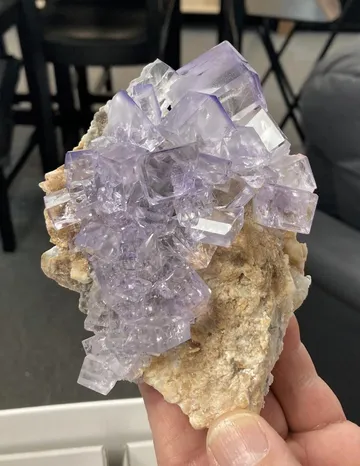
Other minerals documented from Teresita include fluorite, galena, calcite, dolomite, mimetite and siderite. In the closely related Sant Fost quarries, modern analytical work has added considerably to the district picture, including calcium-bearing mimetite, willemite and the very rare phyllosilicate surite in nearby Can Rovira material; those are important for understanding the local geochemistry but should not be casually transferred to a Teresita label without evidence. No verified IMA type-locality species is tied to Teresita itself; its “type” importance to collectors is instead as a classic Spanish occurrence of W-rich wulfenite variety chillagite.
Teresita labels deserve scrutiny because Spain has several mines named Teresita or La Teresita, including well-known barite localities in Murcia and other occurrences in Catalonia. A cream W-rich wulfenite labelled “Teresita” should normally resolve to Can Donadeu / Sant Fost de Campsentelles / Vallès Oriental / Barcelona / Catalonia, sometimes with older labels placing the mine near Montcada i Reixac because the concession straddled or lay close to municipal boundaries. Blue barite from “Mina Teresita” is a warning sign for a different locality: attractive blue barites labelled Teresita are known from Atamaría, Cartagena, Murcia, and should not be folded into the Catalan chillagite locality.
The most common condition issue is mechanical: the wulfenite crystals are thin, lamellar and often irregular, so edge bruising and cleaved or contacted blades are routine. Cerussite can be delicate and may occur as small crystals on altered galena; barite edges and fluorite contacts can also be abraded. Because many specimens are small and pale, mediocre photography can make broken laminae look better than they are; ask for side views, close-ups of the principal crystal edges, and confirmation that the wulfenite is not simply a stain or unidentified pale plate.
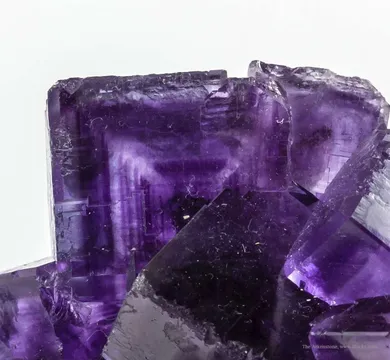
Fluorescence can be a useful supporting observation but not a stand-alone authentication tool. Reported Teresita and related Sant Fost specimens may show fluorescence in fluorite, cerussite or barite under longwave and shortwave ultraviolet light, and some W-rich wulfenite examples are described as weakly fluorescent. Fluorescence varies with mineral, generation and impurities, so it should be recorded as a feature, not used as a substitute for locality provenance or analytical identification.
Analytical caution is warranted for the lead secondary minerals. The Sant Fost work has shown that visually similar small white or honey crystals can require XRD, SEM-EDS or microprobe work to distinguish among cerussite, mimetite, calcium-bearing mimetite and related phases. On a significant Teresita specimen, especially one sold as chillagite, the wulfenite identification is usually traditional and locality-based, but the “chillagite” claim ultimately depends on tungsten enrichment; the term is a variety name, not a separate modern species name.
Market availability is thin. Attractive Teresita chillagites appear mostly as miniatures from old collections, notably mid-century material and occasional duplicates from important Spanish holdings. Prices depend less on size alone than on three factors: clear chillagite crystals, clean contrast on barite or fluorite, and reliable old provenance. Barite-only pieces from the Catalan Teresita are much less sought after unless they have crystal quality or a strong historic label; wulfenite with cerussite and galena is the combination that serious collectors chase.
The most memorable Teresita story is not of a glittering pocket being opened, but of collectors trying to find the mine after history had nearly swallowed it. In late May 2010, a Spanish collector asked the FMF forum how to reach the Teresita Mine of Can Donadeu at Sant Fost de Campsentelles, whether it was open, and whether good specimens could still be found. The first answers were not encouraging. One participant had heard that nobody had found it for years and that work had ended in 1972. Ricard Mocholí, with Joan M. Bruguera, then set out to look for the old workings anyway.
Their report the next day has the flavor every field collector recognizes. They believed they had found the zone, but not the hoped-for mine dumps or specimen-bearing openings. What remained were ruins: the remnants of a building interpreted as miners’ sleeping quarters and a small headframe over a filled shaft, presumed to be the main shaft. They found no adits, no dumps and no collectible material. Ricard’s field inventory was brutally concise: ruins, a blind shaft, deterioration, vegetation, scratches and a tick. Frederic Varela’s reply was dry and exact: welcome to the real world of mineral hunters in Catalonia, where old mines are like that “99%” of the time.
The other Teresita episode lives through specimens rather than field photographs. A wulfenite var. chillagite specimen in the Museo de Ciencias Naturales de Álava, catalogue MCNA 03909, was photographed on slide by J.M. Sanchis in 2000. It measures 5 x 4 x 3 cm and shows the pale W-rich wulfenite associated with white barite. That association is what places it in the later Teresita collecting story: specimens on white barite are interpreted as probably collected during the 1979–1980 disturbance or small extractions linked to nearby railway works, whereas the older examples are said to have been more commonly associated with fluorite. For a locality whose workings have almost vanished, such museum and old-collection pieces are not just specimens; they are the surviving field record.
Adolf Cortel Ortuño and Frederic Varela Balcells, “Color y luminiscencia de fluoritas de Cataluña. 1ª parte: el color,” Paragénesis, vol. 3, no. 3 (2022-1), pp. 43–70. Includes a concise geological and locality note on Mina “Teresita,” describing its position, zinc-mining history, fluorite exploitation and vein assemblage.
https://www.minercat.com/docs/revistas/pg/2022-1/Revista-GMC-Pg-2022-1-4.pdf
Josep A. Ignacio Herrera, Xavier Rodríguez Poblador, Emilio Téllez García, Joan Rosell-Riba et al., “Willemita y otros minerales de las canteras de Sant Fost de Campsentelles, Vallès Oriental, Barcelona, Cataluña,” Paragénesis, vol. 3, no. 1 (2021-1), pp. 3–46. The key modern analytical paper on the related Sant Fost vein system, with detailed treatment of barite, cerussite, mimetite, wulfenite and rare secondary species in the Can Donadeu–Can Rovira area.
https://www.researchgate.net/publication/372452177_Willemita_y_otros_minerales_de_las_canteras_de_Sant_Fost_de_Campsentelles_Valles_Oriental_Barcelona_Cataluna_Paragenesis_Revista_de_Mineralogia_vol_3_num_1_2021-1_pp_3-46
Josep Closas i Miralles, “Presència de la Wulfenita (MoO4Pb) a San Fost de Capcentelles,” 1999. Cited in later Sant Fost literature as an earlier record of wulfenite from the area.
https://www.researchgate.net/publication/372452177_Willemita_y_otros_minerales_de_las_canteras_de_Sant_Fost_de_Campsentelles_Valles_Oriental_Barcelona_Cataluna_Paragenesis_Revista_de_Mineralogia_vol_3_num_1_2021-1_pp_3-46
“Minerals de Catalunya,” Museu d’Arenys de Mar / Mollfulleda collection catalogue. Includes a Teresita Mine wulfenite entry: beige tabular chillagite crystals to 1 cm in quartz matrix, from Sant Fost de Campsentelles, donated from the Joaquim Mollfulleda i Borrell collection.
https://museu.arenysdemar.cat/sites/default/files/Minerals%20de%20Catalunya%20%28xweb%29_0.pdf
Museo de Ciencias Naturales de Álava specimen MCNA 03909, illustrated by MTI Blog: wulfenite var. chillagite, 5 x 4 x 3 cm, Mina Teresita, Sant Fost de Campsentelles, photographed by J.M. Sanchis.
https://www.mtiblog.com/2025/02/chillagita-de-mina-teresita-sant-fost.html
Fabre Minerals reference specimens and old collection duplicates, including Folch-collection chillagites from Mina Teresita. These dealer records are useful for dimensions, associations, historical dates and market provenance.
https://www.expominerals.com/specimens/RSFOL-folch-minerales-de-referencia.php?CODE=RJ47W6
MTI Blog — Chillagita de Mina Teresita, Sant Fost de Campsentelles, Barcelona — A concise Spanish note on the mine’s registration, main working period, 1979–1980 material and an Álava museum specimen.
Paragénesis — Color y luminiscencia de fluoritas de Cataluña, 1ª parte — Best short published source for Teresita’s geological setting and fluorite-bearing vein assemblage.
ResearchGate — Willemita y otros minerales de las canteras de Sant Fost de Campsentelles — The most useful modern analytical treatment of the related Sant Fost mineralization.
FMF Forum — Mina Teresita — Field-collector discussion with locality, access and 2010 search details.
Fabre Minerals — Spanish reference minerals: Teresita chillagites — Dealer archive with specimen dimensions and associations for classic W-rich wulfenite.
Fabre / Expominerals — Folch Collection reference specimens — Old-collection Teresita chillagites with Folch duplicate provenance.
Mindat specimen J0F-K15 — Wulfenite var. chillagite with fluorite and baryte — Useful illustrated record of a classic Teresita miniature.
Minerals de Catalunya catalogue — Museum catalogue entry documenting Teresita chillagite in a Catalan institutional collection.