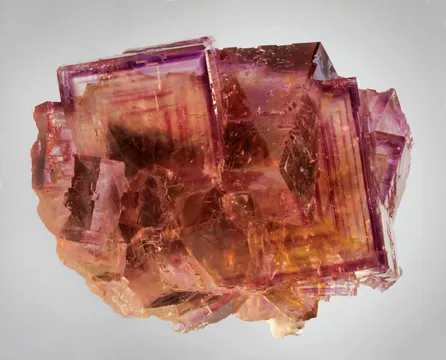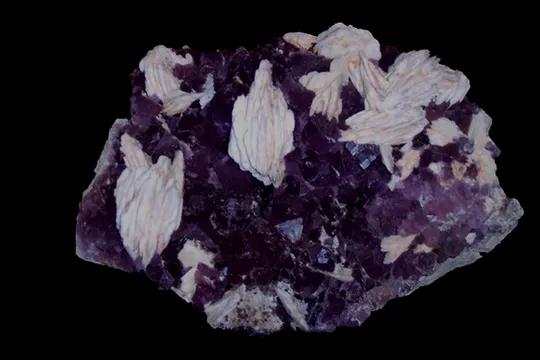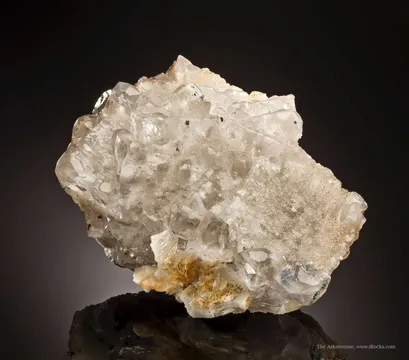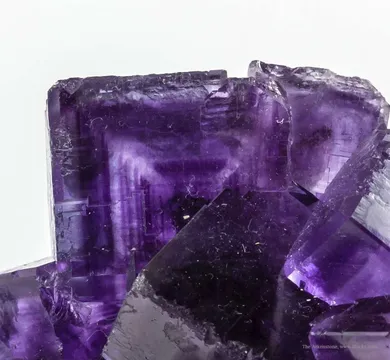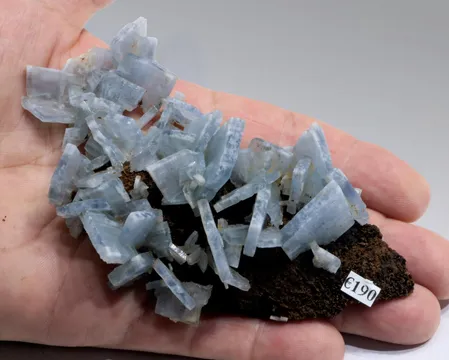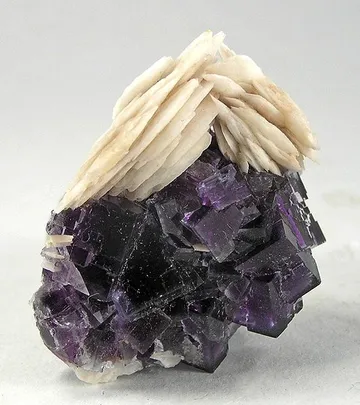
La Cabaña, Spain — renowned Berbes fluorite locality famed for purple cubic crystals on white baryte, with zoning, translucence, and strong collecting appeal.
Key facts
La Cabaña is one of the classic names in Spanish fluorite, not as a single “mine” in the tidy catalog sense, but as a cliff-and-quarry zone within the Berbes mining area near Ribadesella, Asturias. It lies in the coastal Caravia-Berbes fluorite district, where the Bay of Biscay, the meadows above Playa de Vega, and old fluorspar workings meet in a locality whose best specimens are among the most recognizable European fluorites: glassy to silky purple cubes, commonly beveled by dodecahedral faces, perched on white lamellar baryte or snow-like drusy quartz.
The mineralization belongs to the Asturian fluorspar province, a low-temperature hydrothermal system developed along the margin of the Mesozoic Asturian basin. At Berbes the ore is strongly controlled by fractures and faults in Carboniferous limestone basement, with mineralized veins, stockworks, and karst-cavity fillings sealed or overlain by Permo-Triassic red beds. La Cabaña, Valdelmar, Los Cobayos, and El Frondil occupy the collector’s heart of this setting: silicified, dolomitized limestone cut by the Ana vein system, where fluorite, baryte, quartz, and calcite formed in open spaces and where later weathering, cliff collapse, and decades of collecting exposed pockets of exceptional display material.
Regional View
Country View
Collectors value La Cabaña pieces for a combination that is harder to find than the broad label “Berbes fluorite” suggests: sharp purple cubic crystals with clean zoning, enough transparency to glow under backlighting, and a matrix that is not merely supportive but part of the composition. The finest miniature and small-cabinet specimens show lilac-to-deep-violet fluorite set high on pearly white baryte rosettes, or scattered across fine quartz crusts. Larger plates can show intergrown purple cubes to several centimeters across; the most dramatic examples preserve blue or lilac phantoms, stepped or mosaic overgrowths, and strongly contrasting white matrix.

Photo: Wikimedia Commons

Photo: Fabre Minerals
Search for specimens: View all specimens from La Cabaña, Spain
La Cabaña is a coastal sector of the Berbes mining area in the municipality of Ribadesella, Asturias, north Spain. The locality sits just inland from the western end of Playa de Vega, with the old workings distributed around La Cabaña, Valdelmar, Los Cobayos, La Paredona, El Frondil, and related cuts on the Ana vein system. In modern locality usage, this distinction matters: many older labels say “Ana Mine” or “La Cabaña Mine,” but most collector specimens attributed to La Cabaña came from open-cast cuts, cliff pockets, and quarry exposures on the same vein system rather than from the underground Ana Mine proper.
Geologically, the deposit is part of the Caravia-Berbes sector of the Asturian fluorspar district. The country rock includes dark, fine-grained Carboniferous Barcaliente limestone, locally dolomitized, silicified, fractured, and karstified. Above it, discordant Permo-Triassic red beds form a cover sequence that helped seal the hydrothermal system. The ore occurs mainly as steep vein mineralization and stockworks, with local cavity fillings in the karstified limestone. The principal assemblage is fluorite-baryte-quartz-calcite, with pyrite and other sulfides sparsely present, and with supergene iron oxides and locally reported copper carbonates in the broader Berbes field.
The Ana vein is the structural backbone of the district. The underground Ana Mine was developed by MINERSA in the mid-20th century and operated through a network of galleries on several levels before closing in May 1968. Its proximity to the sea was a serious mining problem: workings below level 106 were affected by water inflow, requiring continuous pumping and increasing costs. After the underground phase, mining and specimen recovery continued through open-cast cuts along the vein system, including La Cabaña, El Frondil, Cuetu l’Aspa, Cueto I, Cueto II, Cueto Norte, Bloque IV, and La Gusteriza. Open-pit activity on the Ana, Concha, and Emma concessions continued from 1969 into the mid-1980s, and in the 1970s MINERSA worked La Cabaña as an open pit, recovering about 300,000 tons of fluorspar ore.
For collectors, the key zones at La Cabaña are Valdelmar and Los Cobayos-La Paredona. The upper mineralized level around Los Cobayos exposed large caves and pockets in cliff faces looking toward the Cantabrian Sea. These pockets produced large, deep purple fluorite crystals, but the silicified host rock is extremely hard, and extraction was notoriously unforgiving: fine crystals were easy to bruise, and weathered pocket surfaces often dulled otherwise impressive groups. Valdelmar is more closely associated in the specimen trade with the most gemmy small pieces: transparent purple to lilac fluorite on white baryte, small cubes on drusy quartz, doubly terminated quartz crystals with hydrocarbon inclusions, and fine fluorite-baryte-quartz combinations.
Today the Berbes-La Cabaña workings are abandoned as commercial mines. The Spanish geological inventory treats the Berbes barite-fluorite deposits as a geosite of mineralogical importance, with mineral collecting considered admissible for research purposes and visitor hazards noted around old mine openings, rockfall-prone cuts, and water-filled areas, especially near El Frondil. Access must be approached as abandoned industrial ground rather than a casual collecting stop: permission, current local restrictions, tides and cliff stability, and personal safety all matter. The easily found specimen pockets of the 1970s through 1990s are gone; modern finds are generally small, sporadic, and hard-won from very tough matrix.
The standout find most closely tied to La Cabaña is Coquera del Liso, or Coquera del Llisu, discovered in March 1993 after a block of more than 50 tons fell from the cliffs. Inside it collectors found water-clear to violet fluorite with naturally modified corners, typically associated with quartz and baryte. The pieces from this fall are not large in the way many Berbes plates are large; their importance lies in transparency, luster, sharp beveling, and the distinctive story of a single collapsed block that yielded a small, memorable population of numbered specimens.
La Cabaña fluorite is best known as purple to lilac cubic crystals, often beveled by dodecahedral faces and commonly showing geometric internal zoning or phantoms when backlit. Ordinary pieces may be drusy plates of 5 mm to 1 cm cubes on quartz or baryte; good miniatures and small cabinets show isolated lustrous cubes set cleanly on white lamellar baryte, while the best historic pieces carry gemmy crystals of several centimeters, locally to about 5 cm or more, with strong contrast, open composition, and minimal bruising. Some upper-level Los Cobayos-La Paredona material forms flattened plates or interlocked crystal groups with intense purple color, but surface weathering and late silica coatings are common detractions. Valdelmar pieces tend to carry the highest market prestige when they combine transparency, sharp purple zoning, pearly baryte, and bright quartz in a balanced cabinet-scale specimen; Coquera del Liso material is a special subset from the March 1993 cliff-fall pocket, prized for unusually water-clear violet fluorite with modified cube corners on quartz and baryte.
Beyond fluorite, La Cabaña is a classic source of baryte, quartz, calcite, pyrite, goethite, and rare cinnabar in the locality records. Baryte is not just an accessory here: white lamellar plates and rosettes form the stage for many of the most desirable fluorite specimens, and “oakstone” baryte has been recorded from the locality. Quartz is equally important, especially as drusy linings and as doubly terminated, “Herkimer-style” crystals rich in hydrocarbon inclusions; some are bright, transparent, and unusually large for the district. Calcite is part of the fluorite-calcite-quartz paragenesis studied in the classic fluid-inclusion literature, while cinnabar, pyrite, and goethite are far scarcer collector entries. No formally recognized type-mineral species is the reason La Cabaña is famous; its importance rests instead on specimen quality, hydrocarbon-bearing inclusions, and the benchmark status of its fluorite-baryte-quartz combinations.
La Cabaña labels deserve careful reading. The most common problem is not outright fakery but imprecision: “Ana Mine,” “Ana vein,” “La Cabaña,” “Valdelmar,” “Los Cobayos,” “El Frondil,” and “Berbes” have often been used interchangeably by dealers and collectors. The underground Ana Mine yielded comparatively few collector specimens; most classic pieces came from the open cuts and cliff pockets along the vein system. A label reading “Ana Mine, La Cabaña” may be historically understandable, but a more precise modern label should distinguish La Cabaña or Valdelmar within the Berbes mining area when that information is known.
Another documented label trap is confusion with La Collada or with non-existent or misapplied mine names. A well-known Wikimedia-hosted specimen page preserves a correction by José Ramón García identifying a piece originally labelled from La Collada/Basurto as instead belonging to the March 1993 Llisu pocket in the Ana-La Cabaña zone. That kind of correction is typical of Asturian fluorite collecting: the specimens may be genuine Spanish fluorite, but the district-level, mine-level, and pocket-level names are easily scrambled unless old labels, collection history, and specimen style agree.
Condition is central. La Cabaña fluorite came from hard silicified limestone and cliff pockets, so edge wear, bruised cube corners, cleaved fluorite, rehealed backs, and contacted margins are common. Silky luster is not always damage—it can be a natural surface character on some larger Berbes crystals—but late silica coatings and weathering can dull pieces severely. Backlighting is essential when judging value: many dark purple cubes appear nearly opaque until a strong light reveals clean zoning, phantoms, and genuine transparency. Conversely, a richly colored but heavily bruised druse may be far less desirable than a smaller, sharper miniature on clean baryte.
Fluorescence is variable and sometimes surprising. Berbes fluorite is not collected primarily as a fluorescent mineral, but red to purple responses have been documented, and hydrocarbon inclusions in quartz and some associated material can fluoresce under longwave and shortwave ultraviolet light. The famous hydrocarbon-bearing quartz should be handled and stored as a mineralogical object rather than a curiosity to be overheated or intensely irradiated; fluid inclusions and organic material are part of the scientific and aesthetic value of the specimen.
Market availability is better than for many classic European fluorite localities because decades of mining and collecting put La Cabaña pieces into Spanish, European, and American collections. However, truly fine examples are much scarcer than generic “Berbes” listings suggest. Small purple druses remain obtainable, but transparent, damage-free fluorite on white baryte from Valdelmar, documented Coquera del Liso specimens, large well-composed plates, and quartz specimens with abundant mobile hydrocarbon inclusions all occupy a higher tier. Provenance to old Spanish collections, Raúl Sanabria, Jordi Fabre, José Ramón García, or other documented Berbes specialists adds real confidence and collector value.
The name La Cabaña comes from something disarmingly plain. In the Valdelmar area there once stood a rustic Asturian cattle shelter, a cabaña, in the middle of what would become one of the most internationally recognized fluorite collecting grounds in Spain. Around it were small named sectors—Las Picas to the south, Los Cobayos toward El Frondil, La Huelga to the west, and La Cabaña in the center. The modest agricultural landmark survived as a mineral locality name long after collectors cared less about the shed than about the purple crystals coming out of the ground around it.
The great La Cabaña collecting years were not gentle hand-tool episodes in soft clay. The rock was hard, silicified limestone, and the pockets could be perched in cliff faces above the Cantabrian coast. A pocket might open into mud-caked fluorite, with the crystals so obscured that collectors could not judge on site whether a plate was ordinary or magnificent. The best pieces emerged only after patient cleaning, when white baryte, transparent purple cubes, and phantom zoning appeared from under the mud. That uncertainty is part of the old Berbes lore: the moment of discovery was often delayed until the specimen had been carried away, washed, and turned under a light.
In April 1980, during the industrial mining period in the La Cabaña-Valdelmar zones, an extraordinary pocket was opened in the lower mineralized part of Valdelmar, close to the edge of a cliff face. It contained isolated clusters of baryte on silicified matrix, with fluorite growing over the baryte. The crystals showed an earlier lilac generation, close-spaced phantoms, and then a sharp transition to pale blue transparent outer zones, also phantom-rich. Some trapped clay and carbonaceous material between the generations. The find became known in collector retelling as the “Mother of All Fluorite Pockets,” but it was not a neatly preserved treasure chamber: many specimens fell from the cliff when the pocket was opened, and only a small number survived. Some of the better pieces reportedly sat in a house for four decades and were not fully cleaned until they were offered to a mineral dealer in 2020.
Also in 1980, Francisco “Paco” Margolles opened a pocket in the Los Cobayos-La Paredona area that many Berbes specialists regard as one of the finest ever found in the district. Margolles lived in Ribadesella rather than Berbes, but he became one of the best-known crystal diggers of the golden years. The pocket produced three especially iconic specimens. One was a hemispherical baryte cluster carrying superb fluorite; another, later illustrated as a 12 cm specimen with crystals to 3 cm, became known as the second-best piece from the pocket. The best specimens from this find had the kind of sculptural elevation collectors dream about: fluorite not merely coating baryte, but sitting above it, sharp, transparent, and composed like a finished object.
Coquera del Liso is the most cinematic La Cabaña story because the pocket arrived by collapse. In March 1993, a rock mass of more than 50 tons fell from the cliffs. Inside, local collectors found a small number of high-quality fluorite specimens: water-clear to violet cubes, naturally modified at the corners, with quartz and baryte. The find was not a huge commercial flood; it was a concentrated event, remembered specimen by specimen. Some examples were numbered with commemorative labels, and individual pieces can still be recognized by their combination of compact matrix, bright transparent violet cubes, and the distinctive Coquera del Liso attribution.
A quieter but equally revealing story comes from the quartz. La Cabaña and Valdelmar produced doubly terminated quartz crystals rich in hydrocarbon inclusions—some visible as dark or yellowish inclusions, some mobile. These are not mere accessories to the fluorite district; they are part of why La Cabaña became important in mineralogical literature. In some specimens the quartz is bright, glassy, and complete, with the included hydrocarbon bubbles turning a small crystal into a record of the fluids that moved through the basin. Under ultraviolet light, those hydrocarbons can fluoresce, making a transparent quartz from a coastal Spanish fluorspar deposit read like a tiny sealed archive of petroleum migration.
J. García-Iglesias and J.-C. Touray, “Hydrocarbures liquides en inclusions dans la fluorite du gisement de ‘La Cabaña’ (Berbès, Asturies, Espagne),” Bulletin de la Société française de Minéralogie et de Cristallographie, 99, 117–118, 1976 — The short classic paper documenting liquid hydrocarbon inclusions in La Cabaña fluorite.
J. García-Iglesias and J.-C. Touray, “A fluorite-calcite-quartz paragenesis with liquid and gaseous organic inclusions at La Cabana, Berbes, Asturias fluorspar district, Spain,” Economic Geology, 72(2), 298–303, 1977 — Bibliographic record for the core paragenesis and fluid-inclusion study of the locality.
J. R. García-Álvarez, “Los cuarzos biterminados de la mina ‘Ana’, Berbes, Ribadesella, Asturias,” Paragénesis, Revista de Mineralogía, 2017-1, 51–60 — Focused article on the doubly terminated hydrocarbon-bearing quartz crystals of the Ana-La Cabaña-Valdelmar area.
J. García-Iglesias and J. Loredo, “Geological, geochemical and mineralogical characteristics of the Asturias fluorspar district, northern Spain,” Exploration and Mining Geology, 3(1), 31–37, 1994 — Regional technical reference for the Asturias fluorspar district, including Berbes.
V. Sánchez, M. Corbella, J. M. Fuenlabrada, E. Vindel, and T. Martín-Crespo, “Sr and Nd isotope data from the fluorspar district of Asturias, northern Spain,” Journal of Geochemical Exploration, 89, 348–350, 2006 — Isotopic constraints on the origin and age of hydrothermal fluids precipitating fluorite, baryte, and calcite in Asturias.
V. Sánchez, M. Corbella, J. M. Fuenlabrada, E. Vindel, and T. Martín-Crespo, “Variability in fluid sources in the fluorite deposits from Asturias (N Spain): Further evidences from REE, radiogenic (Sr, Sm, Nd) and stable (S, C, O) isotope data,” Ore Geology Reviews, 37(2), 87–100, 2010 — Broader geochemical treatment of Asturian fluorite deposits, useful for placing Berbes-La Cabaña in its regional hydrothermal context.
Miguel Gutiérrez-Claverol, Carlos Luque, J. R. García, and L. M. Rodríguez-Terente, La Fluorita: Un siglo de minería en Asturias, Universidad de Oviedo, 2009 — Major book-length reference repeatedly cited for the mining history and mineralogy of Asturian fluorite localities.
“Berbes! The Berbes Fluorite District, Asturias, Spain,” The Mineralogical Record, vol. 55, no. 1, January–February 2024 — Modern illustrated locality monograph with detailed history, pockets, specimens, and named La Cabaña-Valdelmar finds.
mim Museum specimen record discussed on Friends of Minerals Forum: fluorite from La Cabaña, Valdelmar, Berbes — Documents a major museum specimen: a plate of white baryte ridges covered with transparent purple fluorite cubes, with inner phantoms and notable provenance.
Mindat: La Cabaña, Berbes mining area, Ribadesella, Asturias, Spain — Core locality page with coordinates, mineral list, and the Coquera del Liso note.
Mindat: Fluorite from La Cabaña — Species-specific page with photo data and associated-mineral statistics for La Cabaña fluorite.
Mindat: Ana concession / Ana Mine, Berbes — Important clarification of the Ana Mine versus Ana vein and the open-pit localities that produced most specimens.
IGME IELIG CA063: Yacimientos de barita y fluorita de Berbes — Official Spanish geological-inventory entry covering geology, access, hazards, mineralization, and references for the Berbes barite-fluorite deposits.
Wikimedia Commons: Fluorite-76735.jpg — Open-licensed image page preserving both a La Cabaña fluorite photograph and a valuable label-correction note by José Ramón García.
Fabre Minerals: Berbes Fluorite – Coquera del Liso reference specimens — Dealer reference archive for the March 1993 Coquera del Liso find.
Fabre Minerals: Reference specimens from Spain, including La Cabaña-Valdelmar quartz and baryte — Useful for documented hydrocarbon-bearing quartz, baryte, and fluorite-baryte-quartz specimens.
Fluorescent Mineral Society FMDB: Fluorite with red fluorescence and baryte from Berbes — Notes red longwave fluorescence and the collecting context of La Cabaña and Los Cobayos.
Museo Virtual de Mineralogía: Fluorita, Asturias — Spanish museum resource illustrating Asturian fluorite, including La Cabaña material.