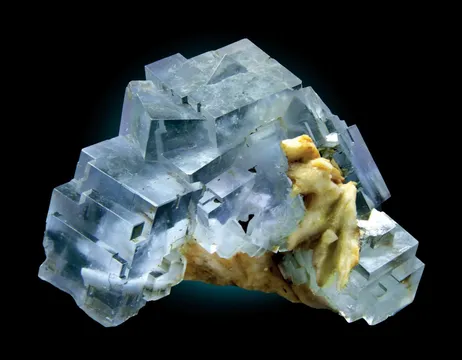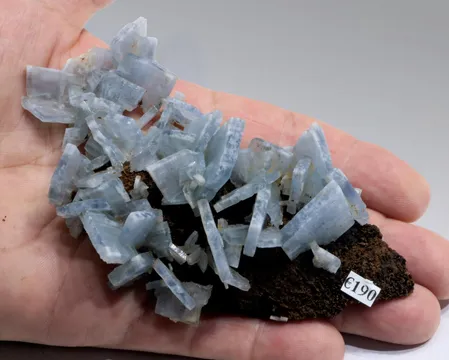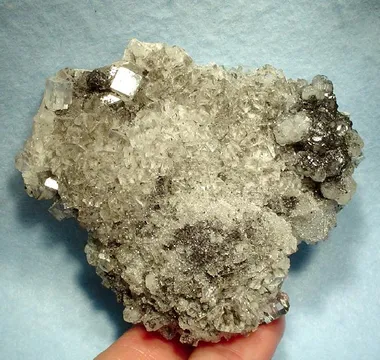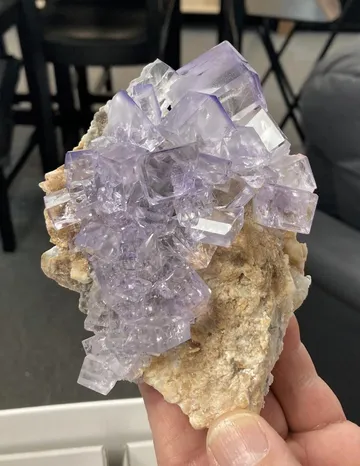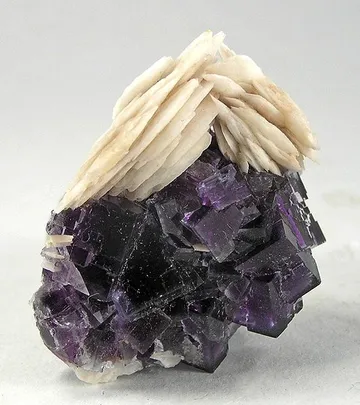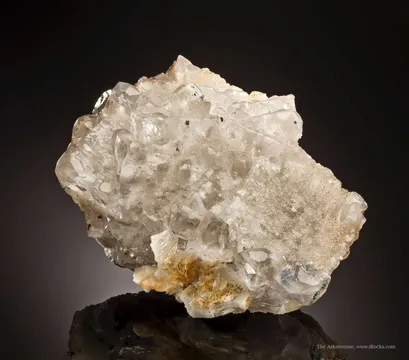
La Collada, Spain — Asturian fluorite locality famed for blue to violet cubic crystals on calcite, satin to glassy faces, and prized pocket specimens for colle…
Key facts
La Collada is one of the great Asturian fluorite names: not a single pocket, not a single mine, but a compact mining area in Siero, close to the Gijón boundary, where several veins and open workings together produced some of Spain’s most recognizable fluorite specimens. In the collecting world the name usually calls up blue, lilac, violet, and indigo fluorite, commonly cubed but often bevelled by dodecahedral faces, seated on snowy calcite, honey calcite scalenohedrons, drusy quartz, or pale limestone. The district belongs to the Cantabrian Zone and the Central Asturian Carboniferous Basin, where fluorite mineralization is tied to the broad Asturian Permo-Triassic hydrothermal system: mineralizing fluids moved through faults, fractures, breccias, and carbonate horizons near the contact between Paleozoic basement and Permo-Triassic cover.
Historically, La Collada matters because it was among the earliest Asturian fluorite areas to be worked, with references to fluorite there beginning in 1904. Industrially it fed the fluorspar economy of northern Spain; aesthetically it fed museums and private collections with specimens that remain unmistakable. The great classics are the Josefa-Veneros level 75 pieces: fluorite perched on calcite, with blue-violet zoning, strong bevels, and an architectural contrast between the cold glass of fluorite and the warm or white carbonate beneath. La Viesca, farther north within the same mining area, added later generations of blue to lilac fluorites, many on quartz-rich matrix, including celebrated pocket names such as Tres de la Collada, Coquera de la Calcita, La Falla, La Negrina, Las Calcitas, Galería 65, El Furaco, and others.
Regional View
Country View
The best La Collada fluorites are not merely purple cubes. They have a particular personality: satin to glassy faces, stepped cube surfaces, darker purple or blue-violet edges, geometric phantoms, and, in the more desirable examples, enough translucency for the colour zoning to ignite under transmitted light. Some pieces are quiet and pastel, with pale blue cubes rising from white quartz; others are saturated, almost black-blue in hand until lit from behind. The locality’s calcite associations are equally diagnostic: long scalenohedrons, sometimes amber and lustrous, sometimes white and rugged, can provide the stage on which the fluorite is displayed.
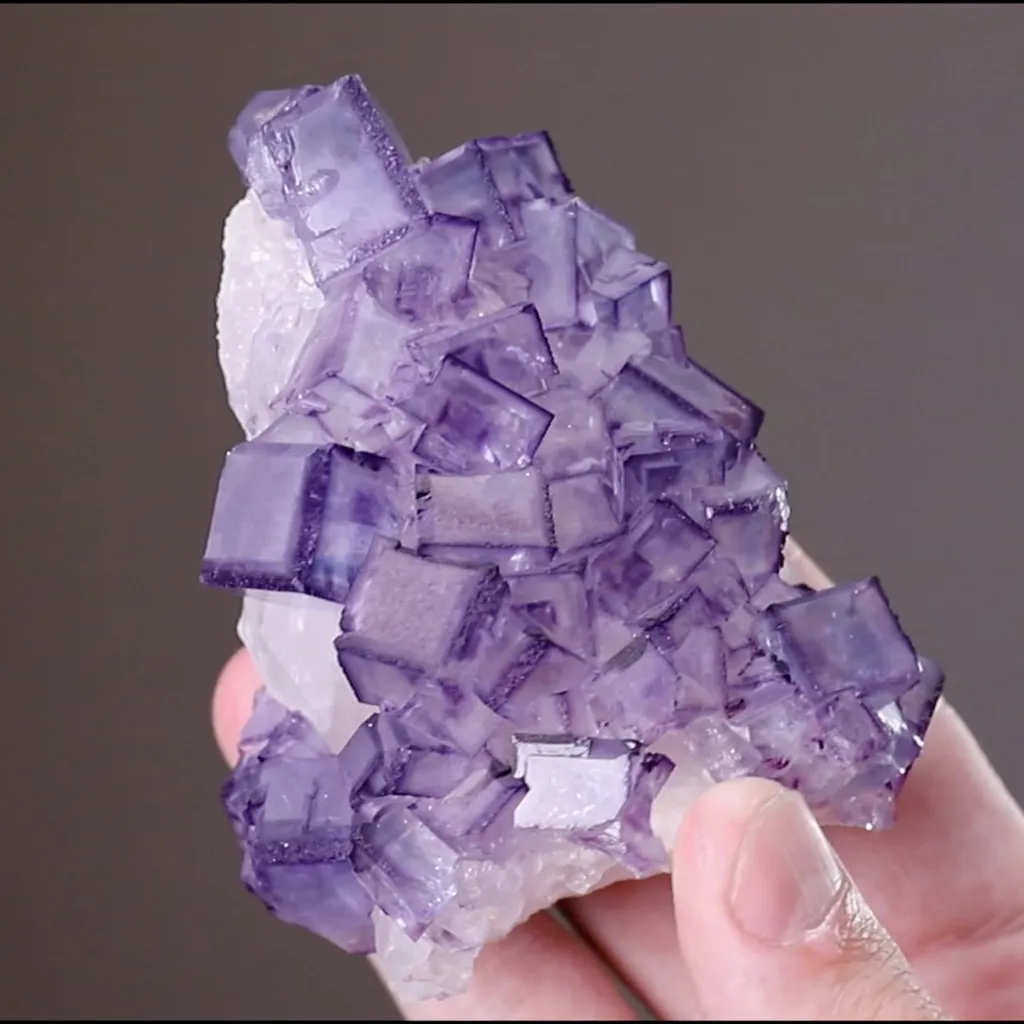
Photo:
Search for specimens: View all specimens from La Collada mining area, Spain
The La Collada mining area lies in the municipality of Siero, Asturias, in northern Spain. In collector usage it includes several related localities and workings rather than one isolated hole in the ground: La Collada Mine on the Collada vein, the Josefa-Veneros vein in the Coroña de Arriba-La Collada sector, La Viesca Mine at Huergo, the Veneros-Sur open pit, the Coroña shaft, Basurto, and a number of smaller workings and pocket sublocalities. This matters for attribution. A specimen simply labelled “La Collada” may be a true Collada-vein specimen, a Josefa-Veneros level 75 specimen, a La Viesca specimen, or a more general district label applied later by a dealer or collector.
Geologically, La Collada belongs to the same broad Asturian fluorite province as Caravia-Berbes and Villabona. The regional system is hosted by Permo-Triassic and Paleozoic rocks, with mineralization concentrated in veins and stratabound bodies along basin-margin structures, fractures, breccias, and carbonate units. The Spanish geological inventory classifies the La Collada fluorite mineralizations as a mining-metallogenic locality of high scientific value, set in the Cantabrian Zone and the Central Carboniferous Basin, with host rocks ranging from Namurian Carboniferous to Triassic. Research on the Asturian districts describes a hydrothermal system in which deep brines and more superficial fluids mixed in carbonates, breccias, and fractures, precipitating fluorite with calcite, quartz, dolomite, baryte, and minor sulphides.
The paragenesis is simple but visually rich. Fluorite is dominant; calcite is the great companion mineral; quartz is common, especially in many La Viesca specimens; dolomite occurs locally; baryte is much less important here than in Berbes; and the sulphides include pyrite, chalcopyrite, galena, and sphalerite. Cinnabar, hematite, and malachite are also recorded from the wider mining area. In the central Asturian fluorite districts, La Collada is especially known for blue and purple fluorite, whereas Berbes is more strongly associated with purple to violet fluorite and Villabona with yellow fluorite. That broad colour contrast is useful, but it is not enough for confident attribution; habit, matrix, associated minerals, pocket history, and old labels matter.
The mining story begins in 1904, when Felipe Valdés Menéndez-Corvera, while involved with work connected to a coal railway route between Lieres and the port of Gijón, encountered mineralized veins crossing the La Collada area. Early work focused on the Collada vein in the area called La Collada de atrás, with additional shallow and open workings at nearby properties such as Basurto in Coroña de Arriba and Florentina in Muñó. These early fluorspar operations were modest, property-driven, and practical: extracting saleable fluorite rather than preserving cabinet specimens.
More systematic exploitation developed from the 1930s onward. The Valdés Cores family worked the Josefa area, and in 1941 Fluoruros S.A., founded by Ángel Pérez de Leza, began mining La Collada on concessions leased from the Valdés family. From 1945, La Audacia Minera, owned by Félix Cifuentes, operated the La Viesca and Baldomón open pits near the village of that name. In the 1960s Fluoruros S.A. leased rights in the Josefa-Veneros system, enlarged activity, opened the Veneros-Sur open pit and the Coroña shaft, and drove the famous level 75 connecting gallery between the Collada and Josefa veins. That level became one of the classic specimen-producing places in Spanish fluorite history.
The Josefa-Veneros vein is essentially parallel to the Collada vein. Mineralogically it carries the familiar fluorite-calcite assemblage, with minor sulphides appearing sporadically. In the northern Coroña shaft area, scalenohedral calcite is more frequent and can reach impressive sizes, while fluorite is often small. Moving southward, the calcite becomes less dominant and fluorite groups increase in size, culminating in the level 75 pockets where blue-violet cubes, bevelled by dodecahedral faces, grew over calcite. These are the pieces that define “old La Collada” in many collections: fluorite on calcite, highly sculptural, often with paler cube faces and more intense colour concentrated in the bevels and edges. The crosscut was closed in 1977, and the demise of Fluoruros S.A. followed in 1978.
La Viesca later became the great productive name within the district. Specimen production from La Viesca is unusually well documented because important material passed through collectors and dealers who preserved pocket names and dates. The La Viesca aesthetic overlaps with Josefa-Veneros but is not identical. Many La Viesca specimens show blue to lilac fluorite on quartz, sometimes with smoother bevels, satin or “bubbly” surfaces from later microgrowth, and a dramatic change in perceived tone between daylight or fluorescent light and warmer incandescent illumination. La Viesca pockets produced colour-zoned crystals, crystals with stepped faces, and, in a few cases, specimens with unusual accessory sphalerite or chalcopyrite.
Among the named La Viesca finds, Tres de la Collada, found in May 2003, is especially memorable: a large geode, described as bigger than two cars together, reportedly yielded around 6,000 specimens, not all of high quality. Coquera de la Calcita, found in January 2004, was named for its abundance of calcite and produced attractive blue, transparent fluorite with carbonate. La Falla, in August 2004, came from a cavity-rich zone near mineralizing faults and produced fluorites with unusually prominent dodecahedral development. La Negrina, in spring 2006, took its name from the intense blue-black appearance of its crystals and was compared with the older level 75 Josefa-Veneros material. Las Calcitas, worked between February and May 2007, produced honey-coloured calcite scalenohedrons with exceptional lustre carrying pale blue fluorite cubes up to about 5 cm on edge. Galería 65, in April 2008, was a small but high-quality find: about twenty specimens with fluorite cubes to about 5 cm, tiny chalcopyrite on the faces, occasional caramel sphalerite, bright lustre, and internal growth lines. El Furaco, discovered in August 2009 near the surface behind mine service buildings, was a cavity about 4 m long, 2 m high, and 3.5 m wide, producing fluorite with large calcite scalenohedrons, though the calcite commonly suffered from near-surface weathering.
Collecting access today should be treated as restricted. La Viesca has been an active industrial fluorspar mine and an area of modern exploration interest rather than a casual public collecting site. In 2026 the regional government authorized a Minersa-group investigation project involving 31 mechanical drill holes in 25 locations across Gijón and Siero, with the stated purpose of determining fluorite presence and quantifying the deposit’s extension to give continuity to the existing mine. That modern context is important for collectors: current material on the market usually comes through commercial channels, old collections, or documented mine-connected specimen recovery, not through open public collecting.
La Collada fluorite is prized for blue, lilac, violet, indigo, and blue-violet crystals, most commonly cubic but frequently modified by dodecahedral bevels, with stepped cube faces, geometric colour zoning, darker edge phantoms, and a satin to glassy surface depending on pocket and generation. The classic Josefa-Veneros level 75 specimens, mostly dating from the great 1960s-1970s period and especially around 1970-1975 in collector labels, are fluorite-on-calcite pieces: cubes and cube-dodecahedron combinations perched on white to amber calcite, with crystals reported up to about 15 cm on edge in exceptional old groups. La Viesca specimens tend to be blue to lilac, often on white quartz or quartz-coated limestone, with notable pockets from 1998 through the 2000s producing transparent cubes, phantoms, polycrystalline growths, and colour shifts under different lighting; pieces from Las Calcitas may carry pale blue cubes to about 5 cm on honey calcite, while Galería 65 produced a small number of especially lustrous fluorites with tiny chalcopyrite and occasional caramel sphalerite. Good La Collada fluorite is separated from ordinary material by clean bevels, strong internal zoning, translucency under backlight, attractive calcite or quartz matrix, and minimal bruising on corners; dull, heavily cleaved, or weathered pieces are far more common than top cabinet specimens.
Calcite at La Collada is not a mere gangue mineral: it is often the sculptural foundation that makes the fluorite memorable. The Coroña shaft sector of the Josefa-Veneros vein is noted for abundant scalenohedral calcite, from clay-white to transparent amber, with crystals reaching about 25 cm; farther south, the level 75 gallery produced the famous fluorite-on-calcite specimens in which blue-violet fluorite cubes sit on long lustrous scalenohedrons, commonly white, cream, or amber, and old Collada-vein descriptions note calcite scalenohedrons to about 20 cm. La Viesca added pocket-specific calcite habits, especially the Las Calcitas zone of 2007, where honey-coloured, highly lustrous scalenohedrons carried pale blue fluorite cubes, and El Furaco in 2009, where large calcites occurred with fluorite but were often compromised by corrosion from near-surface rainwater exposure. Fine calcite pieces from La Collada are judged by lustre, transparency, undamaged tips, and how naturally they support the fluorite; many otherwise dramatic examples suffer from bruised scalenohedron points or etched carbonate surfaces.
La Collada is not a type-locality story so much as a classic-fluorite story. The wider mineral list includes quartz, dolomite, baryte, sphalerite, chalcopyrite, galena, pyrite, cinnabar, hematite, and malachite. Quartz is important as matrix at La Viesca, where white drusy coatings set off pale blue to purple fluorite; dolomite is part of the regional carbonate paragenesis; baryte is recorded but scarce compared with Berbes; and sulphides are usually minor. Sphalerite deserves special note because clear to caramel crystals with fluorite and quartz from La Viesca caused real interest among Spanish collectors when first encountered, being unusual for a mine otherwise dominated by fluorite, calcite, and quartz. Chalcopyrite may occur as tiny crystals on fluorite faces or as inclusions, and pyrite, galena, and other sulphides are accessory rather than specimen-defining for most collectors.
The first authenticity issue with La Collada is locality precision. “La Collada” can mean the whole mining area, the Collada vein, the old Collada Mine, Josefa-Veneros level 75, or La Viesca. Specimens from Berbes and La Viesca can be confused when they are simply labelled “Asturias” or when a dealer uses a broad district name. Fluorite on bladed white baryte, for example, should raise a Berbes question unless the piece has strong provenance, because baryte is far more characteristic there than at La Collada. Conversely, blue to lilac fluorite on white quartz with smooth bevels and satin or bubbly faces is very plausible for La Viesca, while fluorite on prominent calcite scalenohedrons with strong cube-dodecahedron habit points more toward the old Josefa-Veneros and Collada-vein material.
No widespread, locality-specific treatment scandal is documented for La Collada fluorite, but repairs and restoration are real collector issues. Bevelled fluorite corners chip easily, and calcite scalenohedron tips are vulnerable. Professional restoration of corners has been disclosed on some high-end La Viesca specimens; other dealer descriptions note corner bruises, cleavages, and damage to associated baryte or calcite. A careful buyer should inspect every cube corner, the junction between fluorite and matrix, and any long calcite tips under magnification and strong side light. Repaired fluorite corners can be difficult to see on deeply coloured crystals unless viewed through a loupe and with transmitted light.
Fluorescence should not be used as the primary test for La Collada. Published collector descriptions of La Viesca material note absent fluorescence in at least some blue-to-lilac examples, and many La Collada fluorites are valued for daylight colour zoning rather than UV response. Backlighting is far more useful: true quality shows itself in internal colour architecture, blue and purple phantoms, and the way the bevels concentrate colour. Very dark specimens may be beautiful but can look almost opaque without transmitted light; pale specimens may be more elegant than dramatic.
Condition is the dividing line in the market. Ordinary La Collada fluorite is available with some regularity, especially small to small-cabinet La Viesca pieces and later pocket material. Fine old Josefa-Veneros level 75 fluorite on calcite is much scarcer, and large, clean, well-composed cabinet specimens with documented 1960s-1970s provenance command serious attention. Specimens with old labels, named pockets, ex-Fernando Brugos, ex-José Ramón García, ex-Raúl Sanabria, ex-Jordi Fabre, or other documented Spanish collection provenance deserve a premium when the mineral quality supports it. The market rewards pieces that combine clean fluorite, visible zoning, strong matrix contrast, and a precise sublocality; vague “Asturias fluorite” labels should be priced more cautiously.
The origin story of La Collada begins not with a specimen hunter but with infrastructure. In 1904, Felipe Valdés Menéndez-Corvera was connected with work on a coal-train route between the village of Lieres and the port of Gijón when the works cut several mineralized veins crossing La Collada. He recognized the opportunity and wrote to Víctor Felgueroso, another major Spanish industrial figure tied to coal mining, proposing a partnership. From that practical railway encounter came the first fluorspar mining in the district and, eventually, one of Spain’s most famous mineral names.
The later romance of the locality is level 75. Fluoruros S.A. drove the connecting gallery between the Collada and Josefa workings in the 1960s to recover ore, but collectors remember it for the cavities it opened. In that crosscut the district’s signature specimens appeared: blue-violet fluorite perched on calcite, the fluorite showing cube faces bevelled by dodecahedron faces, the calcite rising as white to amber scalenohedrons. The gallery closed in 1977, which gives the best old pieces the finality collectors value: not merely attractive, but historically bounded.
La Viesca has its own pocket chronicle, and the names read like field notes turned into folklore. Tres de la Collada, found in May 2003, was named because the old gallery in which it was found was number three of the former operation. The cavity was described as larger than two cars together and completely packed with specimens, around 6,000 of them. Quantity did not equal quality; many were ordinary, but the best carried the blue to violet light-shift and bevelled habit that made the find instantly recognizable.
Coquera de la Calcita followed in January 2004 and was named plainly for what miners and collectors saw: abundant calcite. Its fluorites were clean blue, transparent, and of good size, with the carbonate association giving them a crisp, old-Spanish look. Later that year, La Falla appeared near one of the mineralizing faults crossing the deposit and produced fluorite with unusually strong dodecahedral expression. Then came La Negrina in 2006, named for the almost blue-black intensity of the crystals, a La Viesca pocket that reminded collectors of the much older level 75 Josefa-Veneros material nearby.
Las Calcitas, worked from February through May 2007, was one of the most collector-friendly names because the specimens explained the name immediately: honey-coloured scalenohedral calcite, bright and lustrous, with pale blue fluorite cubes rising from it. In April 2008, Galería 65 produced only about twenty specimens, but they were memorable: fluorite cubes up to about 5 cm on edge, tiny chalcopyrite on the faces, sometimes caramel sphalerite, unusually high lustre, and internal growth lines that gave the pieces a refinement unusual for the deposit.
El Furaco is the best named pocket of all. In Asturian usage, “furaco” means a small hole, and in August 2009 the owner of La Viesca reportedly noticed just such a hole on the surface behind the service buildings. Behind it was no small void but a cavity about 4 m long, 2 m high, and 3.5 m wide. It yielded numerous fluorite specimens with cube-dodecahedron crystals and large calcite scalenohedrons, though nature had already been at work: because the geode lay close to the surface, rainwater weathering had corroded much of the calcite and dulled the carbonate’s appeal.
A 2010 visit to La Viesca captures the peculiar thrill of collecting in an active industrial mine. The writer arrived around ten in the morning, met Roberto, one of the mine technicians, and waited for José Luis, the engineer who would guide the group underground. Outside, the operation did not pause for mineral romance: loaders and trucks were moving tonnes of ore toward the Minersa washing plant, while aggregates and limestone went elsewhere. The visitors were allowed to enter and even to work a geode, but under a hard rule: because the mine also sold collector specimens, nothing extracted could be kept. They were there for the privilege of bringing crystals into the light, not for possession.
On that same visit they were shown the recently found Geoda de las Monjas, a huge cavity that had produced more than 200 fluorite-with-calcite specimens, with cubes of 8 and 10 cm on edge and gem quality. The geode had been sold to the Asturian collector-dealer José Ramón García, who extracted the pieces; part later passed through José Manuel Jurado of Prominer S.L., with the material to be presented at Sainte-Marie-aux-Mines under a shared Asturmineral/Prominer arrangement. Nearby, in older emptied cavities, the visitor noticed the remains of what had once been spectacular: an enormous massive blue fluorite plate with quartz crystallization, and below it a rubble pile where broken cubes 7 and 8 cm on edge hinted at the beauty of the intact specimens already removed.
Carles Curto Milá and Jordi Fabre Fornaguera, “Fluorite and Associated Minerals from Asturias, Spain,” The Mineralogical Record, 23(1), 69-76, 1992 — The classic English-language collector article on Asturian fluorite, including La Collada, its habits, associations, and place among the great Spanish fluorite districts.
Carles Curto Milá and Jordi Fabre Fornaguera, “Fluorite and Associated Minerals from Asturias, Spain,” scan hosted through Recercat — A useful accessible record of the 1992 article text and figures where available.
Manuel Gutiérrez Claverol, Carlos Luque Cabal, José Ramón García Álvarez, and Luis Miguel Rodríguez Terente, La Fluorita: un siglo de minería en Asturias, 2009 — The essential Spanish monograph on a century of Asturian fluorspar mining, with La Collada mining history, operators, veins, and specimen context.
V. Sánchez, A. Cardellach, D. Banks, S. Boyce, and A. Pujals, “Sources and composition of fluids associated with fluorite deposits of Asturias (N Spain),” Geofluids, 9(4), 338-355, 2009 — A key geochemical and fluid-inclusion paper explaining the Asturian fluorite deposits, including La Viesca in the La Collada district, as products of mixed brines in carbonate, breccia, and fracture settings.
V. Sánchez, A. Cardellach, D. Banks, S. Boyce, and A. Pujals, “Variability in fluid sources in the fluorite deposits from Asturias (N Spain): Further evidences from REE, radiogenic (Sr, Sm, Nd) and stable (S, C, O) isotope data,” Ore Geology Reviews, 2009 — The companion isotopic study comparing Berbes, La Collada, and Villabona and documenting district-scale differences in colour, chemistry, and fluid sources.
Instituto Geológico y Minero de España, IELIG CA060: Mineralizaciones de fluorita de La Collada — Official Spanish geological inventory entry for the La Collada fluorite mineralizations, classed as a mining-metallogenic locality with mineralogical interest and very high protection priority.
Smithsonian National Museum of Natural History, Fluorite NMNH R17986 — A public-domain museum record for a fluorite-on-calcite specimen from La Collada, Asturias, showing the locality’s presence in major institutional collections.
Museo de Ciencias Naturales de Álava, fluorite specimen MCNA 03930 as documented by MTI Blog — Record of a large Josefa-Veneros level 75 fluorite specimen acquired in 1999, photographed by J. M. Sanchis in 2000, and preserved in the Álava museum collection.
“Fluorite from Josefa-Veneros vein, La Collada mining area, Spain” — Fabre Minerals — A video record of a small Josefa-Veneros level 75 fluorite from around 1974, showing cubic crystals bevelled by dodecahedral faces.
“Fluorite from the Josefa-Veneros vein, 75 level, Asturias, Spain” — Fabre Minerals — A video of a larger deep violet Josefa-Veneros specimen with polycrystalline growth and bevelled faces.
“Fluorite with Quartz” — Wilensky Minerals — A video presentation of a La Viesca fluorite with quartz, useful for seeing the La Viesca habit, pale blue-lilac colour, and quartz-rich matrix.
“Desde el aire: Fluoritas de Asturias (I)” — MTI Blog / Gonzalo García — Drone-based media covering Asturian fluorite landscapes and mines, including La Viesca, La Collada, and the former Fluoruros S.A. plant.
Mindat: La Collada mining area, Siero, Asturias, Spain — The central locality page for the mining area, with hierarchy, mineral list, history, and sublocality structure.
Mindat: La Collada Mine, La Collada vein — Focused entry on the old Collada Mine and vein, including the 1904 discovery, level 75 connection, and classic fluorite-calcite specimen style.
Mindat: Josefa-Veneros vein — Essential sublocality page for the famous level 75 material and the north-south change from calcite-rich to fluorite-rich specimen production.
Mindat: La Viesca Mine — Key sublocality page for the later La Viesca production and its fluorite, calcite, quartz, dolomite, and sulphide assemblage.
Foro de Mineralogía Formativa: “La mina La Viesca y sus geodas” — Detailed Spanish collector thread documenting La Viesca pocket names, dates, habits, colours, and specimen characteristics.
El Mineral Digital: “Mina La Viesca. La Collada. Pola de Siero. Asturias” — First-hand 2010 visit account to the active La Viesca mine, including Geoda de las Monjas and underground observations.
Fabre Minerals: Reference Specimens / Spanish Fluorite — La Collada and La Viesca — Dealer-archival reference page with documented La Viesca pocket names, specimen dates, dimensions, and provenance.
Rutas por Asturias: “Minería de Fluorita en Siero y Gijón” — Readable Spanish overview of fluorspar mining in the Siero-Gijón area, including historical, industrial, and human context.
IGME: IELIG CA060 Mineralizaciones de fluorita de La Collada — Official geological-interest inventory entry for the La Collada fluorite mineralizations.
RTPA: 2026 authorization of new Minersa drill holes in Gijón and Siero — Current context for exploration around La Collada and La Viesca.
Europa Press: 2026 report on 31 new drill holes tied to La Viesca continuity — News coverage of the modern permitting debate and environmental opposition.