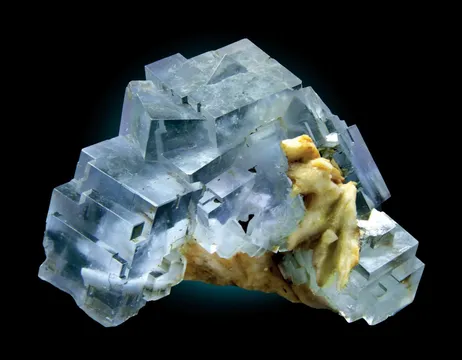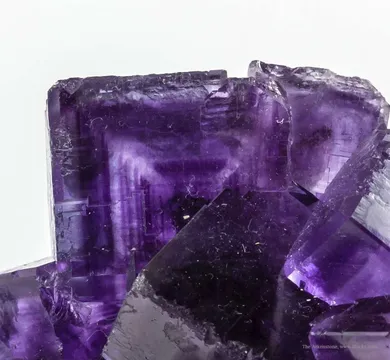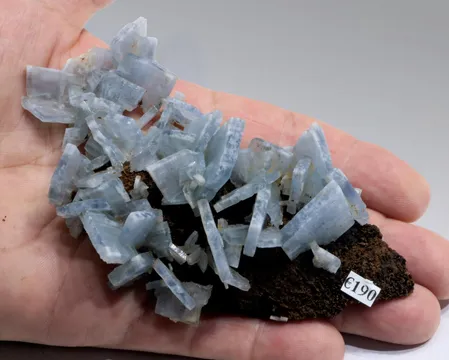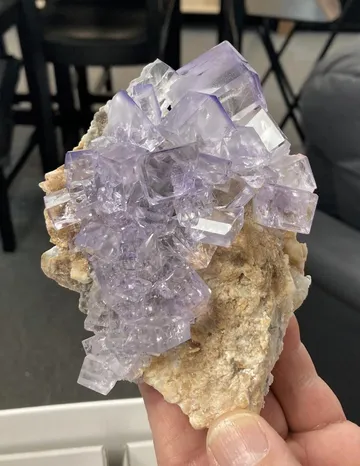
Emilio Mine, Spain — renowned Asturias fluorite locality known for water-clear fluorite, colorless to pale blue on baryte and quartz, prized by collectors.
Key facts
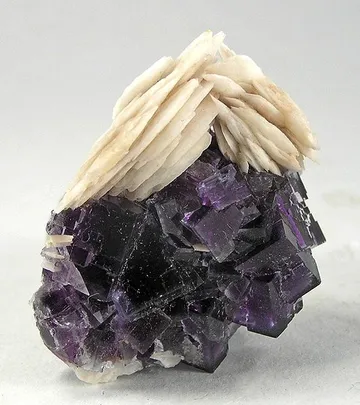
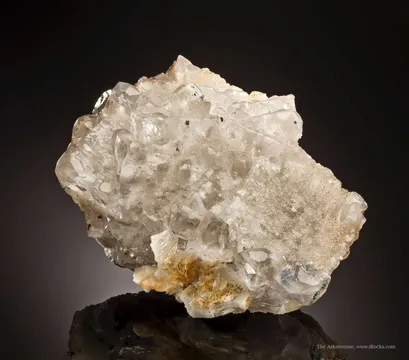
The Emilio Mine is one of the defining modern fluorite localities of Asturias: an underground fluorspar operation at Loroñe, on the Colunga–Caravia side of the famous Caravia-Berbes district, where collector-grade specimens are a byproduct of a serious industrial ore body rather than the reason for mining. Its importance lies in the contrast it offers within the Asturian fluorite suite. Berbes is remembered for purples and lilacs, La Collada for richly zoned blues and violets, Moscona for yellow cubes; Emilio’s signature is instead an almost paradoxical kind of showiness—water-clear, glass-bright fluorite, commonly colorless to very pale blue, on white baryte, calcite, dolomite, quartz, and darker specks or inclusions of sulphides and hydrocarbons.
Geologically, Emilio belongs to the low-temperature F-Ba hydrothermal mineralization of the Asturian fluorspar province. The district sits along the northern flank of the Sueve massif, where mineralization is controlled both by subvertical vein systems and by stratabound replacement along calcareous breccio-conglomerates at the base of the Permo-Triassic cover over Carboniferous carbonate basement. Emilio is especially tied to the Obdulia vein system and to the manto-style ore developed in the Caravia-Berbes district. For collectors, this setting matters because the mine’s finest specimens combine industrial fluorite textures with open-space crystallization: sharp cubic fluorite, beveled and modified at edges and corners, sometimes hovering on snowy bladed baryte or set among scalenohedral calcite and lustrous quartz.
Historically, Emilio is not a nineteenth-century cabinet classic in the way some European metalliferous localities are. Its prominence belongs to the late twentieth and twenty-first centuries, as Asturias became internationally recognized for fluorite specimens and as the Caravia-Berbes district continued to yield both ore and occasional pockets. Emilio’s best pieces are unmistakable in hand: glassy, colorless cubes that can vanish visually against their own matrix, pale blue cubes with edge zoning, rarer violet specimens, white platy baryte visible through transparent fluorite, and distinctive black, brown, or metallic inclusions that give otherwise colorless crystals depth and locality character.
Regional View
Country View

Photo: Wikimedia Commons
The locality rewards close looking. At first glance a fine Emilio specimen may seem almost austere beside saturated Berbes purple or Moscona yellow. Then the collector notices the technical virtues: the wet luster; the optical clarity; the way white baryte blades can be seen through fluorite cubes; the beveling on cube edges; the tiny sulphide inclusions; the occasional hydrocarbon zoning; and, in the quartz pieces, the doubly terminated “Herkimer-style” crystals with aqueous and hydrocarbon inclusions. Emilio’s best specimens are not loud; they are precise, clean, and mineralogically sophisticated.
Search for specimens: View all specimens from Emilio Mine, Spain
The Emilio Mine lies near Loroñe, in the municipality of Colunga, Asturias, within the Caravia mining area of the broader Caravia-Berbes fluorite district. Although locality labels vary—Emilio Mine, Loroñe, Obdulia vein, Caravia mining area, La Rubiera, Colunga, Asturias—the specimen-producing mineralization is tied to the northern Caravia-Berbes system and especially to the Obdulia vein. The official Asturian extractive-industry register lists Mina Emilio No. 24.417 as an underground fluorspar/fluorite operation at Loroñe, operated and held by Minerales y Productos Derivados, S.A., the Minersa company long associated with Asturias fluorspar.
The deposit belongs to the classic Asturian low-temperature hydrothermal fluorite-barite system. In the Caravia district, ore occurs in two main geometries: subvertical vein swarms with a preferred NW-SE trend, and stratabound or stratiform replacement mineralization in calcareous breccia levels at the base of the Permo-Triassic cover. The darker Carboniferous limestone basement is described in regional work as Barcaliente Formation carbonate, while the overlying Permo-Triassic succession includes breccia-conglomeratic basal units and red-green marly Keuper facies higher in the sequence. The Sueve fault is a major structural element on the southern side of the district, and the mineralized bodies lie north of it, where the irregular Carboniferous carbonate paleorelief is partly overlain by Permo-Triassic rocks.
The ore assemblage is simple but productive: fluorite dominates, with quartz, calcite, and baryte as the chief gangue minerals. Accessory sulphides and related minerals include pyrite, chalcopyrite, sphalerite, cinnabar, marcasite, and tetrahedrite, with oxidation products such as azurite and malachite reported in the district. At Emilio, these accessory minerals are especially important to collectors because they frequently appear as inclusions—tiny metallic specks, dark clouds, or isolated grains sealed inside transparent fluorite. Hydrocarbon or organic inclusions are another locality hallmark, seen both in fluorite and in some of the doubly terminated quartz crystals.
Industrial fluorspar mining in the Caravia area began before Emilio became a specimen name familiar to collectors. The district’s first fluorite workings date to the 1940s, while the modern Emilio operation was authorized in 1985 and has been worked underground. Regional sources describe Asturias as one of Europe’s major fluorite-producing regions, with the Caravia-Berbes, La Collada, and Villabona-Arlós districts together accounting for a large historic resource base. Within the Caravia sector, Emilio is treated as a major deposit in size, production, and reserves. Its ore has been processed through the Minersa fluorspar infrastructure in Asturias, including the long-running Ribadesella-area washing plant.
Collecting access is not comparable to an abandoned dump or public dig. Emilio is an industrial underground mine using explosives, and access to active workings is restricted by the operator and by normal mine-safety requirements. Older open cuts in the broader Caravia district, such as San Lino and Valnegro, are discussed in geological-inventory material as accessible localities for observing the regional setting, but Emilio itself should be treated as a controlled mine site. Collector specimens have reached the market through mine production, mine-associated recovery, older collections, and occasional commercial dispersals rather than through casual public collecting.
The most collector-famous Emilio material is linked to the Obdulia vein and, in several documented specimens, to the “zona intermedia” or intermediate zone. From there came transparent fluorite on white lamellar baryte, colorless to pale blue cubes with hydrocarbon inclusions, and the remarkable quartz finds of the mid-2000s. Between about 2005 and 2009, the intermediate zone produced geodes containing large doubly terminated quartz crystals—some reportedly reaching 20 cm—often associated with calcite, fluorite, pyrite, and hydrocarbon inclusions. These quartz pieces gave Emilio a second identity beyond fluorite: not merely a Spanish fluorite mine, but one of the few Asturian sources of substantial “Herkimer-style” quartz.
Fluorite from Emilio is best known as sharp cubic CaF2, usually colorless to very pale blue and highly transparent, with the cube dominant but commonly modified by dodecahedral, tetrahexahedral, or other complex edge and corner forms. Good crystals are often small to moderate—1 to 3 cm on many display pieces—but documented museum and market examples include much larger cubes, including an IGME Museo Geominero specimen with crystals to 4.5 cm on edge and reports of Emilio fluorite reaching still larger dimensions. The finest pieces show water-clear luster, clean separation of crystals, pale blue or violet edge zoning, and associations with white platy baryte, calcite, dolomite, quartz, pyrite, chalcopyrite, sphalerite, cinnabar, or hydrocarbon inclusions; ordinary pieces tend to be more massive, contacted, bruised along edges, or visually confused because the crystals are so transparent that damage and matrix show through immediately.
Barite at Emilio is less often the headline species than the stage on which the fluorite performs, but it is central to the locality’s look: white to creamy, lamellar, leafy, tabular, or bladed BaSO4 forming bright matrices and coatings beneath or around transparent fluorite cubes. On better specimens, baryte is crisp enough to be appreciated in its own right, yet thin and pale enough to remain visible through the fluorite, producing the characteristic Emilio effect of white blades seen inside or below water-clear cubes. Standout pieces preserve undamaged fluorite perched on airy baryte, sometimes with calcite scalenohedra, pyrite, chalcopyrite, or sphalerite; more ordinary examples have baryte as a heavy, opaque, compact matrix with only scattered or contacted fluorite.
Quartz from Emilio occupies a special collector niche because the mine produced both drusy quartz matrices for fluorite and larger transparent to translucent, doubly terminated “Herkimer-style” SiO2 crystals with aqueous and hydrocarbon inclusions. The most admired pieces are from the intermediate zone, especially the 2005-era finds, where sharp, glassy, doubly terminated crystals grew in geodes with fluorite, calcite, pyrite, and sometimes black hydrocarbon inclusions or tiny movable bubbles; documented commercial examples include cabinet-size clusters with main crystals around 8 cm, and field accounts mention much larger crystals. The best Emilio quartz is three-dimensional, lustrous, and clean enough to read through, with inclusions adding geological character rather than murk; lesser material is contacted, cloudy, or merely a quartz-covered matrix without the doubly terminated, oil-inclusion personality that separates Emilio’s finest quartz from routine gangue.
Other documented minerals from Emilio include calcite, dolomite, pyrite, chalcopyrite, sphalerite, cinnabar, pyrolusite, and pyrobitumen, with organic or hydrocarbon material playing an outsized role in the visual identity of the specimens. Calcite occurs as white scalenohedral crystals and coatings with fluorite; dolomite appears as small rhombohedra on some pieces; pyrite and chalcopyrite may sit on the matrix or be enclosed in fluorite; sphalerite can appear as sparkling dark microcrystals included in or sprinkled across water-clear fluorite; and cinnabar is one of the more unusual reported sulphide inclusions. No type-mineral fame attaches to Emilio in the way a new-species locality would; its mineralogical importance is instead the unusual specimen expression of a well-studied Asturian F-Ba hydrothermal system.
Emilio fluorite is a locality where mislabeling is more likely than outright fakery. Colorless to pale blue Asturian fluorite on baryte can be confused with Jaimina, Llamas, or broader Caravia-Berbes material, while purple specimens may be casually labeled Berbes or simply “Asturias.” A good Emilio attribution should be supported by old labels, mine or vein detail such as Obdulia, association with white lamellar baryte or calcite, characteristic water-clear colorless cubes, and, when present, sulphide or hydrocarbon inclusions. Labels reading “Caravia,” “Loroñe,” “Colunga,” or “Obdulia vein” are not necessarily contradictory, but they should be interpreted carefully because the mine and its mineralization sit near municipal and district naming boundaries.
Condition is the main practical issue. Emilio fluorite is often so transparent that small edge bruises, internal cracks, cleaves, and contacted faces are immediately visible. The locality’s habit of producing colorless cubes on white baryte also makes damage difficult to hide; a chipped corner that might disappear visually on a saturated purple Berbes cube stands out on an Emilio. Many specimens are matrix pieces recovered from working ore zones rather than delicately excavated pocket plates, so perfection is scarce. This scarcity is not marketing language: multiple dealer and reference descriptions emphasize that undamaged, high-quality Emilio fluorites are difficult to obtain.
Fluorescence can add another dimension, particularly where hydrocarbon inclusions are present. Some Emilio fluorites show response under long-wave and short-wave ultraviolet light, and the inclusions themselves can be striking under UV. Collectors should test gently and avoid prolonged heat or strong sunlight exposure; fluorite is stable under normal display conditions, but its perfect cleavage and sensitivity to thermal shock make rapid temperature changes unwise. Do not use acids or aggressive cleaning on baryte-calcite-fluorite combinations unless you fully understand the assemblage: calcite can be etched, baryte can trap residues, and inclusions or micro-sulphides can make surfaces visually delicate.
In market terms, Emilio remains available but uneven. Small fluorites on baryte and older mine-run pieces appear periodically; clean, aesthetic, transparent fluorites with sharp undamaged crystals are much scarcer. Violet Emilio fluorite is distinctly less typical than colorless or pale blue material and should be judged both for color and for whether the attribution is well supported. The “Herkimer-style” quartz from Emilio is a specialty submarket: serious quartz collectors prize transparent, doubly terminated crystals with hydrocarbon or aqueous inclusions, especially if the specimen is complete, three-dimensional, and clearly tied to the mid-2000s intermediate-zone finds.
One of the most memorable Emilio stories is not about a famous dealer pocket but about how fluorite entered an Asturian household. Conchita Ávila, later known locally as a collector of fluorite, said she had no real knowledge of minerals at first; her husband worked extracting fluorite at Mina Emilio and would sometimes bring home an eye-catching stone. From that domestic beginning grew a collection that reflected the character of each Asturian mine: violet tones from Berbes, transparent or bluish pieces from Emilio, and a collector’s pride strong enough that she exhibited the material each March at the Escuela de Minas de Oviedo.
Another Emilio episode belongs to the intermediate zone. As mining crossed that part of the workings between 2005 and 2009, numerous geodes were opened, some described as large, containing doubly terminated quartz crystals of exceptional size for the locality. The best accounts speak of transparent, lustrous quartz crystals up to 20 cm, frequently accompanied by calcite, fluorite, and pyrite, and showing window growths on crystal faces. For a mine known primarily for fluorite, those quartz pockets changed the collector conversation: Emilio could now produce not only glassy cubes but also Spanish “Herkimer-style” quartz with aqueous and hydrocarbon inclusions.
The contrast between Emilio’s industrial character and its fragile collector specimens is part of its appeal. The mine is an underground fluorspar operation, not a specimen quarry, and the fluorite occurs in a deposit style that is hard on crystals. That is why a truly clean Emilio fluorite—colorless, brilliant, cubic, and sitting undamaged on white baryte—feels improbable. The finest pieces look as if they should have been destroyed by mining, yet survived as transparent records of the hydrothermal system: fluorine-bearing fluids rising through carbonate rocks, barium sulphate crystallizing as pale blades, sulphides trapped as specks, and hydrocarbons sealed inside quartz and fluorite.