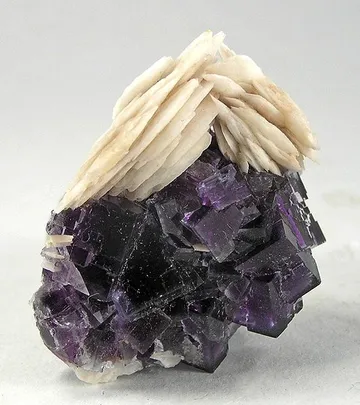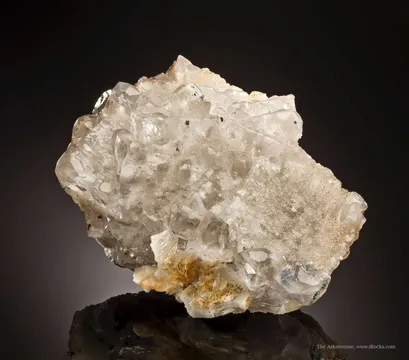
Llamas Quarry, Spain - a small Asturian locality yielding water-clear fluorite cubes in pale lilac to colorless hues, prized for crisp bevels and strong collec…
Key facts
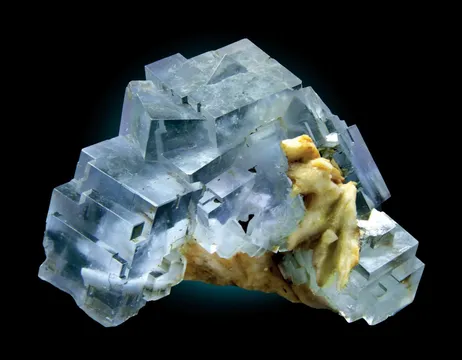
Llamas Quarry is one of the small localities that explains why the Caravia–Berbes fluorite belt has such an oversized reputation among collectors. It is not a vast showpiece quarry like Valnegro, nor a long-lived modern underground producer like Emilio or Jaimina; its importance rests on a remarkably aesthetic run of specimens from the Obdulia vein near Duyos, in the Caravia mining area of eastern Asturias. The quarry worked fluorite in the 1970s, and later, quite unexpectedly, road and access work on the private ground above the old workings exposed new specimen-bearing ground. From that modest footprint came fluorites that are instantly recognizable: transparent to water-clear, pale lilac, violet-blue, or nearly colorless cubes, commonly flattened or tabular, with crisp rhombododecahedral bevels and bright luster, perched on white scalenohedral calcite and drusy quartz.
Geologically, Llamas belongs to the low-temperature hydrothermal fluorite-barite system of Caravia–Berbes, where fluorite mineralization is controlled by the interaction of structures, carbonate host rocks, and the Permo-Triassic cover along the northern flank of the Sueve massif. The Obdulia vein is one of the major mineralized structures of the Caravia area, and Llamas represents a small but specimen-rich exposure along it. The assemblage is the classic Asturian one—fluorite, quartz, calcite, and baryte, with subordinate copper minerals and minor sulfides—but the best Llamas pieces are prized less for size than for form: open, balanced miniatures and small cabinets with unusually clean fluorite, beveled cubes, strong contrast, and the airy look of crystals rising above pale carbonate and silica matrix.
Regional View
Country View
For serious collectors, Llamas occupies a special middle ground between classic Asturian mining history and modern specimen discovery. Older pieces from the working period are relatively scarce and can be difficult to recognize without solid labels. The post-2010 material, by contrast, is better documented, with named pockets such as the Coquera del Tubo and Coquera del Agua entering the specimen market through specialist dealers. These finds helped turn what had been a small, almost footnote locality into one of the most desirable names in modern Spanish fluorite.
Search for specimens: View all specimens from Llamas Quarry, Spain
Llamas Quarry lies at Duyos, in the Caravia mining area of Asturias, on the Obdulia vein, within the larger Caravia–Berbes fluorite district. The district sits near the eastern end of the Asturian Mesozoic basin and its mineralization is developed around Carboniferous limestone basement and an overlying Permo-Triassic cover. Regional descriptions of the Caravia fluorite deposits identify both vein and stratabound styles: subvertical vein systems in the carbonate basement and replacive or stratiform bodies in brecciated calcareous levels at the base of the Permo-Triassic sequence. The Llamas quarry is specifically a vein locality on Obdulia, a structure reported as about 5 km long, with widths from decimeter scale to several meters.
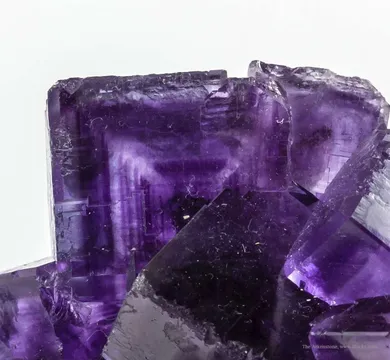
The ore assemblage at Llamas is the district’s familiar fluorite-quartz-calcite-baryte association. Fluorite is the economic mineral and the collector mineral; quartz and calcite are abundant enough to become essential parts of the specimen aesthetics, while baryte and accessory sulfides occur more sparingly. The best pieces show cavity growth rather than massive ore: fluorite cubes and modified cubes rising from quartz or calcite-lined openings. Many specimens show rhombododecahedral bevels on cubic fluorite, and some show flattening toward a tabular habit. Color ranges from colorless through pale lilac to violet-blue and deeper blue-violet, sometimes with geometric zoning or phantom growth. Malachite coatings and azurite crystals appear on some later pieces, reflecting the minor copper component of the vein system.
Llamas was a small private fluorite quarry in operation during the 1970s. The broader Obdulia vein system hosted some of the most productive operations of the Caravia district, including better-known mines and quarries such as Jaimina, Emilio, Valnegro, El Fumo, and El Coronel, but Llamas itself remained small. That scale is part of its collector appeal: specimens from the old working period are not abundant, and they have a distinct habit that differs from many of the larger Berbes and Caravia localities. The quarry’s best old fluorites were already considered among the finest specimens from the Caravia mining district.
The modern history is almost as important as the industrial history. Around 2010, work connected with improving access on the private property over the old quarry intersected the Obdulia vein again and produced fresh fluorite specimens. These were soon recognized by collectors for their exceptional transparency, luster, and precise beveled forms. Later named finds added to the locality’s reputation: the Coquera del Tubo, documented in 2017, produced high-quality transparent lilac to violet-blue fluorites with quartz and calcite; 2018 material included some of the best larger combination specimens; and the Coquera del Agua, documented in 2022, produced pale lilac to colorless fluorites on calcite and quartz. Llamas specimens have continued to appear in small numbers in the trade from documented finds, but the locality should not be considered a public collecting site.
Collecting access today is effectively private and restricted. The ground is privately owned, the productive exposures are limited, and the active mines of the district are not open to casual collectors. Specimens seen on the market generally come through earlier finds, specialist dealers, or collections. This makes labels unusually important: a precise Llamas label should ideally include Duyos, Obdulia vein, Caravia mining area, Asturias, and, for modern finds, the pocket or year where known.
Fluorite is the defining mineral of Llamas Quarry, and the locality’s best pieces are prized for glassy transparency, sharp cubic habit, and pronounced rhombododecahedral bevels rather than for giant size. Most collectible crystals are thumbnail to miniature-scale, commonly around 0.5–2 cm on edge, though exceptional modern cabinet specimens from the 2018 finds reached matrix sizes around 14–15 cm with individual fluorite crystals to about 3 cm. Colors range from water-clear and faint lilac to vivid lilac, violet-blue, and rarer deeper blue tones, often with subtle zoning or phantom growth; older and early modern pieces also show flattened, matchbox-like forms that are especially characteristic. The most desirable specimens are airy crystals on quartz or white scalenohedral calcite, sometimes with malachite or azurite accents, and they stand apart from ordinary Llamas pieces by having undamaged bevels, strong luster, clean interiors, and enough matrix to give the fluorite contrast without overwhelming it.
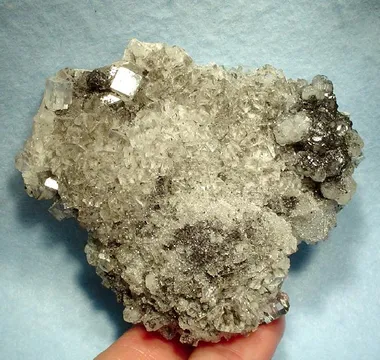
Quartz at Llamas is generally a matrix and pocket-lining mineral rather than the main attraction, but it is critical to the look of the best specimens. It occurs as white to colorless drusy coatings, microcrystalline quartz crusts, and small crystals lining cavities in the Obdulia vein, commonly beneath or around fluorite and intergrown with scalenohedral calcite. In the best combinations, the quartz provides a pale sparkling ground that makes the transparent fluorite appear more saturated by contrast; on lesser pieces it can be massive, friable, or too visually busy. Documented Llamas fluorites from the 2010, 2017 Coquera del Tubo, 2018, and 2022 Coquera del Agua finds repeatedly show quartz as the matrix for beveled fluorite cubes, and fine examples are judged by the cleanliness of the quartz surface, the spacing of fluorite crystals, and the absence of abrasion where the quartz crust meets the fluorite.
Calcite from Llamas is best known as the white to cream scalenohedral matrix that hosts the quarry’s fluorite, although brownish or iron-stained calcite also occurs. It forms sharp scalenohedral crystals and leafy or platy aggregates, sometimes with included material or slight alteration from circulating water. On specimen-grade pieces, calcite functions as both contrast and architecture: a bed of slender white scalenohedra can lift pale fluorite visually and make even small cubes look sculptural. The finest calcite-bearing Llamas specimens show transparent, beveled fluorite set cleanly on undamaged calcite, while more ordinary examples suffer from bruised calcite tips, sawn or bulky matrix, or calcite that competes with rather than supports the fluorite. Some dealer-documented pieces report weak calcite fluorescence under shortwave or longwave ultraviolet light, but fluorescence is secondary to form, balance, and condition here.
Other minerals documented from Llamas Quarry include baryte, dolomite, aragonite, azurite, malachite, and minerals of the tetrahedrite subgroup, with pyrite and other sulfides noted in district and collector discussions. Baryte is much less common here as a showy specimen mineral than at some Asturian localities, but it belongs to the same fluorite-barite hydrothermal system. Malachite appears as small green coatings on some fluorite-calcite-quartz pieces. Azurite is the standout rarity: although it had been detected at Llamas previously, a 2018 find produced notably bright, translucent crystals and spheroidal aggregates on quartz, sometimes associated with calcite and fluorite. No type-locality mineral has been verified for Llamas Quarry itself; its significance is instead aesthetic and paragenetic, especially as a small locality that produced unusually refined fluorite habits on the Obdulia vein.
Llamas fluorite is a locality where condition and provenance matter intensely. The fluorite crystals are often small, transparent, and sharply modified, so even minor bruising on an edge, bevel, or corner is conspicuous. The best specimens have clean faces and intact bevels; a chipped cube that might be tolerable on a larger, darker fluorite from another locality is much more obvious on pale Llamas material. Matrix condition is also important. Quartz and calcite matrices can be friable, and dealer descriptions repeatedly note sawn backs or trimmed bases made to reduce excess matrix or stabilize the specimen. A sawn back is not a treatment or a red flag by itself; it is common for Llamas combinations and should be judged by whether the display face remains natural and balanced.
No well-documented class of fake Llamas fluorite has emerged in the collector literature, but mislabeling is a real concern. Some older specimens circulated simply as “Berbes” or “Caravia,” and Llamas may only be recognized by habit, matrix, and comparison with documented examples. Conversely, transparent lilac fluorites from other localities can resemble Llamas at first glance; one published dealer note even used a Tunisian fluorite on calcite as a comparison because its pale, sharp, zoned cubes looked deceptively Asturian. Serious buyers should look for old labels, dealer histories, pocket names, or collection provenance, especially for costly specimens attributed to the 1970s production period or the best modern finds.
The most characteristic Llamas fluorites are colorless to pale lilac beveled cubes, often tabular or slightly elongated, on quartz and calcite. Deep violet-blue, strongly zoned, unusually large, or exceptionally aerial examples are scarcer and priced accordingly. Miniatures and small cabinet pieces appear on the market with some regularity because of the modern finds, but top examples—especially balanced 2018 combinations, Coquera del Tubo pieces with rich color, and Coquera del Agua pieces with clean pale fluorite on white calcite—are far less common. Associated azurite from the 2018 find is a separate specialty and should not be confused with ordinary malachite-stained fluorite.
For handling, treat Llamas specimens as delicate cabinet fluorites rather than rugged ore pieces. Fluorite has perfect octahedral cleavage, and the matrix minerals are often more fragile than the fluorite itself. Avoid ultrasonic cleaning and aggressive acid work unless the piece has already been professionally stabilized or prepared; calcite will react with acids, and delicate quartz/calcite pocket surfaces can trap residues. Strong light from behind can enhance the transparency and zoning, but prolonged display in harsh sunlight is best avoided as standard practice for fluorite specimens.
The defining Llamas story begins not with a major mine blast but with a road. The quarry had worked fluorite in the 1970s and then slipped into the category of small, remembered Asturian localities—known to specialists, but not a steady modern source. About forty years later, at the end of the first decade of the twenty-first century, work to open or improve an access road on the private property above the old quarry cut the Obdulia vein again. That accidental exposure brought out fresh fluorites with calcite and quartz, and a locality that had been a historical name suddenly became current. One documented specimen from that fortuitous 2010 find, with two generations of fluorite on calcite and quartz, entered the Museo de Ciencias Naturales de Álava collection as MCNA 20650 and was later illustrated in a suite of close-up images by Enrique Ortiz de Zárate.
Collectors immediately noticed that the new pieces were not simply “more Berbes.” In 2011, discussion among Spanish collectors centered on the correct locality name—Cantera Llamas, Duyos, Caravia, Asturias—and on the paragenesis visible in the new material: fluorite with calcite, quartz, aragonite, dolomite, copper carbonates, limonitized pyrite, tiny tetrahedrite, and baryte. One collector, examining dark inclusions in fluorite, wondered whether they might be hematite after pyrite. The reply from another experienced voice was more nuanced: the images did look pyritic, but the striking feature was the presence of fluid inclusions, with bitumens and related organic material being familiar in the district. Another response identified the tiny opaque mineral as tetrahedrite, already listed for the mine by José Ramón García.
The specialist trade then gave names and dates to several of the modern Llamas episodes. The Coquera del Tubo, documented from April 2017, produced very sharp transparent fluorite with strong lilac to violet-blue color, cube-dominant crystals beveled by rhombododecahedron faces, and quartz-calcite matrices. These were not anonymous flats of Spanish fluorite; they were shown as new, high-quality material from a specific pocket, with examples published in European mineral magazines. In 2018, Llamas produced some of its most celebrated larger combinations: transparent beveled cubes, in one case a blue fluorite group with phantom growths on quartz and scalenohedral calcite, reaching a specimen size of 14.8 x 9.6 x 7.8 cm with a main fluorite crystal of 3 x 3 cm. For a locality better known for miniatures, that kind of cabinet specimen reset expectations.
The Coquera del Agua added another chapter in 2022, with pale lilac to colorless fluorites on white calcite and quartz. These pieces emphasized the refined side of Llamas: open arrangements, clean crystal faces, delicate purple tones, and the quiet contrast of transparent fluorite against white scalenohedral calcite. Some pieces were as interesting from the back as from the front, showing fluorite on one face and calcite architecture on the other. The pocket name itself—“water cavity”—fits the look of many of the specimens, which seem less like broken ore than like small, preserved windows into a pale hydrothermal cavity.
A final, more human story concerns attribution. When Jordi Fabre acquired the Daunis collection, he found two or three pieces that looked like Llamas, but the locality had not been well documented during its working period. Rather than rely on appearance alone, he consulted José Ramón García, who confirmed that one specimen was a clear example of what had come out of Llamas when the quarry was operating. That episode is a useful lesson for collectors: Llamas has a recognizable face, but old Llamas needs evidence. The best labels are not decorative extras; they are part of the specimen.