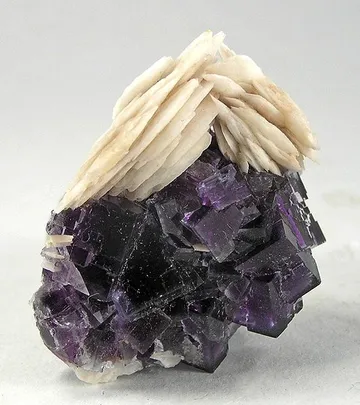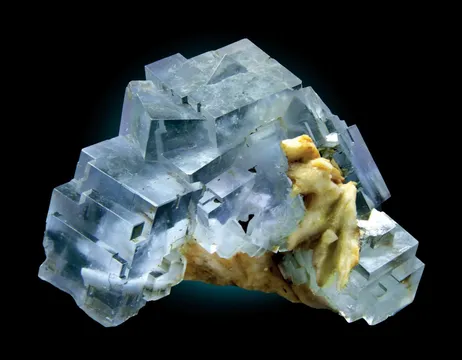
Jaimina Mine, Spain - Asturias fluorite locality known for glassy colorless to lilac crystals on barite, with sculptural edges and collectible rarity.
Key facts
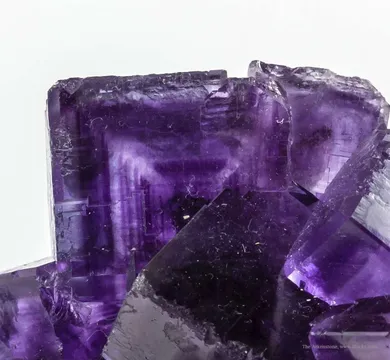
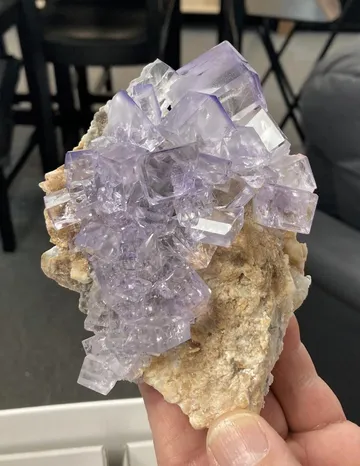
Jaimina is one of the collector-critical fluorite localities of the Caravia mining area in eastern Asturias, the coastal fluorspar belt where industrial ore bodies and fine mineral specimens are unusually inseparable. The mine is catalogued at Carrales, on the Obdulia-vein side of the Caravia-Berbes district, in a low-temperature hydrothermal fluorite system developed at and near the unconformable contact between older Carboniferous carbonate basement and Permo-Triassic red-bed cover. For specimen collectors, the essential point is not merely that Jaimina produced fluorite: it produced a distinctive Asturian style of fluorite, often colorless to pale blue or lilac, sometimes stronger violet, and commonly sharpened or complicated by tetrahexahedral modification rather than sitting as simple cubes.
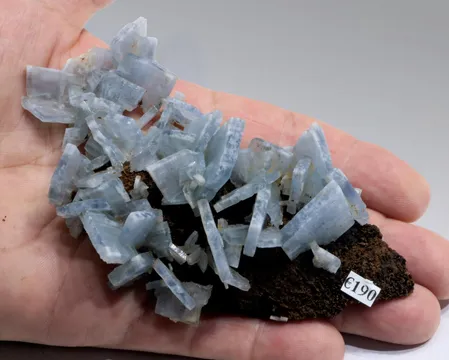
The classic Jaimina look is architectural. Transparent fluorite crystals perch on white, bladed to book-like barite; calcite, quartz, pyrite, chalcopyrite, dolomite and occasional sulfide inclusions complete the paragenesis. The best pieces combine three attributes that are not always found together here: glassy transparency, undamaged exposed crystal edges, and a sculptural white barite matrix that makes the pale fluorite visible rather than lost. In hand, fine Jaimina specimens can appear almost icy until a turn of the wrist reveals lilac or blue zoning, stepped edges, phantom-like interiors, or included chalcopyrite flashes.
Historically, Jaimina belongs to the modern fluorspar story of Asturias: a region that moved from small open workings and scattered concessions into one of Europe’s important fluorspar-producing areas. The mine’s modern reputation rests on specimen recoveries from active or recently active underground work, especially material that reached collections and the market from the 1990s onward. It is less famous to the general public than Berbes, and less consistently water-clear than Emilio, but to serious fluorite collectors Jaimina has its own signature: complex pale crystals, white barite architecture, and a quietly Spanish elegance.
Regional View
Country View
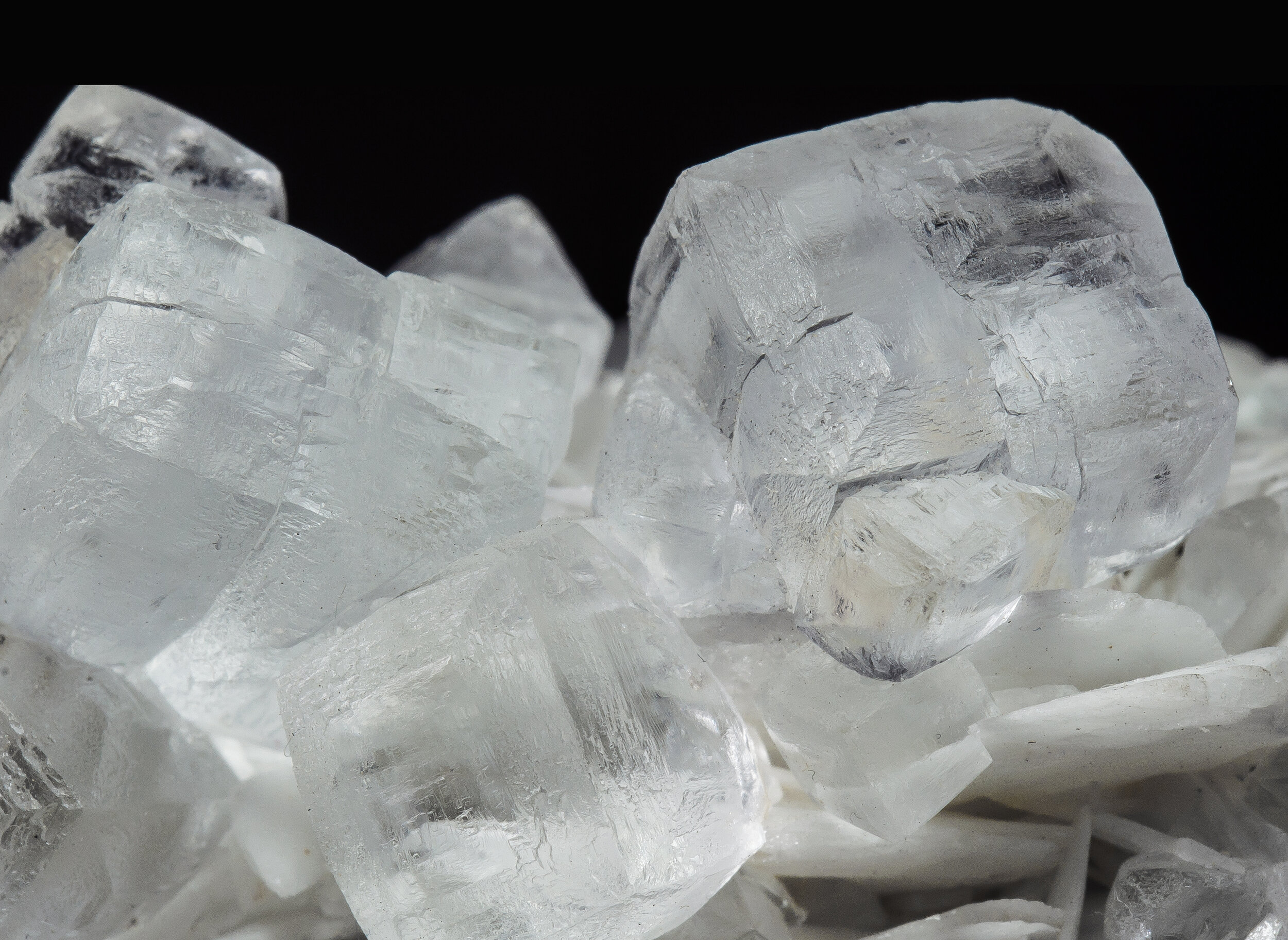
Photo: Fabre Minerals
Jaimina’s finest specimens sit in an interesting middle ground among Asturian fluorites. Berbes pieces are loved for saturated purples and coastal-mine romance; Emilio is prized for water-clear crystals with exceptionally sharp faces; Jaimina overlaps both worlds while adding its own tendency toward tetrahexahedral faces, modified cubes, white barite sprays, and in some examples visible sulfide inclusions. The mine is therefore not a one-note locality. A Jaimina label can belong to a colorless fluorite on barite miniature, a pale bluish cabinet plate, a lilac-zoned fluorite with quartz and calcite, or a large architectural combination with barite blades and chalcopyrite trapped in the fluorite.
Search for specimens: View all specimens from Jaimina Mine, Spain
Jaimina is an underground fluorspar mine in the municipality of Caravia, near Carrales, in Asturias, northern Spain. The locality is generally placed within the Caravia mining area of the wider Caravia-Berbes district, the eastern Asturian fluorspar belt that also includes such familiar names as Berbes, San Lino, Emilio, Valnegro, Llamas and related workings. Modern locality usage commonly gives the full hierarchy as Jaimina Mine, Carrales, Obdulia vein, Caravia mining area, Asturias, Spain, although older and collector labels may shorten this drastically to “Jaimina,” “Caravia,” “Caravia-Berbes,” or even “Berbes-Caravia.”
Geologically, the district is a low-temperature hydrothermal fluorite system with both structurally controlled and lithologically controlled mineralization. Fluorite occurs in steep veins and in bedded or stratiform replacement bodies developed in favorable carbonate or brecciated horizons. The mineralized system lies close to the unconformity between Paleozoic carbonate basement—especially Carboniferous limestones and dolostones—and overlying Permo-Triassic sedimentary rocks. The ore fluids deposited fluorite as the main economic mineral, with quartz, calcite and barite as major companions and smaller amounts of sulfides and later oxidation products. In district terms, the important mining targets were not single isolated pockets but persistent mineralized structures and mantos that could be worked by open cuts where they neared surface and by underground workings where the ore continued at depth.
The Obdulia-vein grouping is especially important for understanding Jaimina. The Obdulia structure is described in collector and locality literature as a several-kilometer mineralized line with variable thickness, feeding or aligning a chain of workings that include Jaimina, Emilio, Valnegro or Pie de Potro, El Fumu, El Coronel, Llamas, Llamarga and Margolles. These mines and quarries share a broadly similar paragenesis, but their specimen personalities differ. Jaimina’s strength is the combination of pale to lilac fluorite, complex tetrahexahedral or modified cubic habits, white barite, and occasional visible inclusions of pyrite, chalcopyrite or cinnabar-like red sulfide material.
Mining in the Caravia area began with small and surface workings before the district became a modern fluorspar producer. Early extraction in the municipality is recorded around the Melfonso area in 1922, followed by scattered open workings and concession activity through the 1930s and 1940s. The Jaimina concession is recorded in locality sources as having been demarcated in 1941; the official Asturias extractive-industry register lists Mina Jaimina as an underground Section C fluorspar operation, with Minerales y Productos Derivados, S.A. as both operator and title holder. In modern industrial terms, Jaimina belongs to the Minersa fluorspar network in Asturias, where ore from underground mines is treated through the company’s regional facilities.
For collectors, the important production window is not simply the start of mining but the period in which specimen-quality pockets were recognized, preserved and distributed. Documented Jaimina specimens include material extracted in the 1990s, especially 1995 pieces in the José Miguel Cavia collection, as well as market specimens from finds or production dates recorded around 1996, 2000, 2002, 2005, 2008, 2011, 2012 and 2014. These dates show why Jaimina appears both as a “classic” Asturian locality and as a mine that supplied comparatively modern collector material. Many specimens were saved from ore production, not collected in a public dig setting.
Access today should be treated as industrial, private and restricted. Jaimina is an underground mine, not a recreational collecting site, and the Asturias registry records the use of explosives. Any visit or collecting attempt would require explicit permission from the landowner and mineral-rights holder and compliance with active-mine safety rules. For collectors, legitimate acquisition is therefore through old collections, reputable dealers, Spanish show material, and documented specimens released from mine-associated or dealer stocks.
The notable pockets from Jaimina are remembered less by romantic pocket names than by their specimen character. Pieces from the mid-1990s include colorless to weak lilac fluorite with barite, calcite, pyrite, chalcopyrite and red sulfide inclusions; later market pieces show tetrahexahedral colorless fluorite on white lamellar barite, blue-toned groups, lilac-zoned crystals on quartz, and larger cabinet pieces with barite “architecture.” The mine’s best combinations are not necessarily the largest. A small cabinet specimen with one pristine barite rosette and a handful of glassy modified fluorites can be more important than a bigger, more massive plate with cloudy crystals or bruised barite.
Fluorite from Jaimina is prized for modified cubic and tetrahexahedral habits, commonly as transparent colorless, pale blue, pale lilac, malva or violet crystals on barite, quartz, calcite or dolomite; crystals on documented specimens range from sub-centimeter examples scattered over barite to cabinet pieces with main crystals around 2–4.5 cm, and the most desirable pieces show sharp geometry, glassy luster, visible zoning or phantoms, and minimal bruising on exposed edges. Jaimina fluorite is especially recognizable when pale, transparent crystals sit on white lamellar barite and show beveled or stepped faces; some pieces carry pyrite, chalcopyrite or cinnabar-like inclusions, and several documented 1995 specimens show precisely this suite with calcite and barite. Compared with ordinary Jaimina material, superior examples are cleaner, more three-dimensional, and more visibly complex crystallographically, with the fluorite not merely coating matrix but rising as distinct, readable crystals.
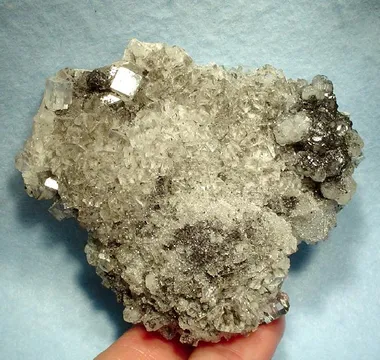
Barite at Jaimina is the principal display partner for fluorite and appears most characteristically as white to colorless lamellar blades, book-like aggregates, sprays, rosettes and jackstraw plates, often acting as the matrix on which pale fluorite crystals are implanted. Documented specimens include an 18 x 14.5 cm Museo Geominero example with several book-like white barite aggregates on fluorite cubes up to 2 cm, as well as small cabinet pieces where diverging barite sprays carry colorless or lavender fluorite cubes; the best barite-bearing Jaimina specimens have clean, undamaged blade terminations and an open sculptural arrangement that frames the fluorite rather than hiding it. Ordinary examples may have crushed, bruised or massive barite, but fine pieces use barite as architecture: white blades, pale transparent fluorite, and occasional calcite or sulfides arranged in a balanced display.
Other minerals documented from Jaimina and its immediate locality include calcite, quartz, dolomite, pyrite, marcasite, chalcopyrite, sphalerite and cinnabar. Calcite occurs with fluorite and barite, sometimes as scalenohedral crystals; quartz may form small matrices beneath fluorite or appear in the broader district as doubly terminated crystals; pyrite and chalcopyrite are notable both as associated crystals and as inclusions within fluorite. Cinnabar is a minor but locality-significant sulfide, and the presence of sulfide inclusions is one of the features that helps give some Jaimina fluorites their internal character. Jaimina is not important as a type locality for new species; its importance is specimen-mineralogical, centered on habit, transparency, association and the preservation of fluorite-barite combinations from an active fluorspar district.
The main authenticity issue with Jaimina specimens is locality precision, not artificial treatment. Many older Asturian fluorites were sold under broad labels such as “Asturias,” “Oviedo,” “Caravia,” “Berbes,” or “Caravia-Berbes,” and later relabeling can blur the difference between Jaimina, Emilio, San Lino, Llamas, Valnegro and Berbes proper. For a serious collection, a Jaimina specimen should be accompanied by as much label history as possible: mine name, Carrales or Caravia, Obdulia vein if given, date of find if known, and any former collection or dealer provenance. A pale blue or colorless fluorite on white barite is plausible for Jaimina, but it is not proof by itself; neighboring mines can produce related material.
No well-documented, locality-specific industry of dyed, irradiated, glued or manufactured Jaimina fluorites is apparent from the reliable locality literature. That said, general fluorite treatment and repair concerns still apply. Examine large crystals under strong side lighting for glued breaks along cleavage planes, oiling or resin in fractures, and matrix repairs where heavy barite blades meet fluorite. Because Jaimina fluorites can be very pale, overzealous photography or lighting can make blue and lilac tones look stronger than they are. A reputable seller should be able to provide neutral daylight images and should disclose repairs, trimming, acid cleaning or stabilization.
Condition is central to value. Fluorite has perfect octahedral cleavage, and Jaimina’s modified crystals often expose delicate edges, bevels and corners that are easy to nick. Barite is also vulnerable: the white lamellar blades that make the pieces so attractive can be bruised, cleaved or snapped. Minor edge chatter on peripheral crystals is common on mine-run material, but premium examples should have the display crystals and principal barite sprays intact. If a specimen has complex tetrahexahedral faces, inspect them carefully; what first appears to be a broken corner may be natural stepped growth, but actual cleavage will show fresher, flatter, more glassy break surfaces.
Fluorescence is variable. Some documented Jaimina fluorites show purple fluorescence, ranging from faint to moderate, and some dealer-recorded examples note response under shortwave and/or longwave ultraviolet. Fluorescence should be treated as a bonus rather than a defining diagnostic feature. Store pieces out of harsh sunlight as a matter of good practice, especially pale fluorite and barite combinations, and handle them from the matrix rather than by exposed fluorite or barite crystals.
Market availability is better than for many closed European classics but still selective. Jaimina specimens appear periodically from Spanish dealers, older European collections, and international auction houses, with most available pieces being miniatures to small cabinet specimens. Large, aesthetic cabinet plates with undamaged barite architecture, transparent fluorite and good provenance are much scarcer. Pieces dated to the 1990s, especially those tied to known Spanish collections, are particularly desirable because they capture a documented period of specimen recovery from the mine.
The Jaimina story begins in a district where the mine names lie close together but the labels often drift. In Caravia, the earliest fluorspar work was not a polished specimen enterprise but a practical hunt for ore. Around 1922, workings at Melfonso in Prado marked the beginning of extraction in the municipality. Later, near the slopes of the Sueve at the Riega del Beyu close to Casa Pique, Celestino Llaneza and Eduardo Ottlet de Wolf—remembered in the sources as “El Belga”—worked surface outcrops and set up a washing plant beside the path. Those details matter because they capture the pre-collector atmosphere of Caravia: fluorite as an industrial mineral first, with fine crystals only accidentally saved.
By the late 1930s and early 1940s the concession map became more formal. The Argüelles family demarcated Jaimina, while Manuel Menéndez Manjón, a retired artillery captain, demarcated María del Carmen. Those concessions later passed into the Fluoritas Asturianas S.A. orbit, and both Jaimina and the nearby El Vallín quarry—popularly called La Coria—became known among collectors for notable crystallized pieces. It is easy, looking at a clean fluorite-on-barite miniature today, to forget that its ancestry lies in a crowded industrial landscape of competing companies, parallel veins, local names, and ore moving through Asturias as a commercial raw material.
One of the most vivid collecting windows comes from the 1995 Jaimina specimens documented in the José Miguel Cavia collection. A 10.5 x 7 x 7 cm piece carried fluorite with barite, calcite and pyrite; another, 9 x 6.5 x 5 cm, showed fluorite with chalcopyrite, pyrite and cinnabar. The same group of documented 1990s specimens ranges from the colorless material most typical of the mine to weak lilac tones, with inclusions of pyrite, chalcopyrite and cinnabar in many examples. These were not anonymous “Spanish fluorites.” They were recognizably Jaimina: pale, included, associated, and collected at a moment when serious Spanish collectors were paying attention.
Collectors also remember Jaimina for internal ghosts. In a forum discussion of James Catmur’s collection, one Jaimina fluorite is described as an 18 x 14 cm specimen with a largest crystal of 4 cm, and the remarkable note that “the phantoms form croses in each crystal.” That misspelled but memorable line is exactly the kind of detail collectors remember: not simply a purple fluorite, not simply a large plate, but crystals with cross-like phantom patterns inside them. Jaimina’s best pieces often reward that kind of close viewing, where the locality emerges not from color alone but from internal zoning, modified form, and the way transparent fluorite reveals what happened during growth.
The Obdulia-vein neighborhood adds one more lesson about specimen survival. Older workings on the same mineralized system produced attractive crystallized material, but much of it was lost because early mining was purely industrial. Fine fluorite and calcite could pass across the sorting table as ore, not as future cabinet specimens. The contrast is sharp: later collectors celebrate a 6.8 cm barite-fluorite cabinet piece or a 15.1 cm fluorite-barite-chalcopyrite plate, while earlier generations may have sent comparable material directly into production. Jaimina specimens that survived with labels, dates and collection history are therefore not just pretty objects; they are survivors from an ore district that did not always preserve its crystals.