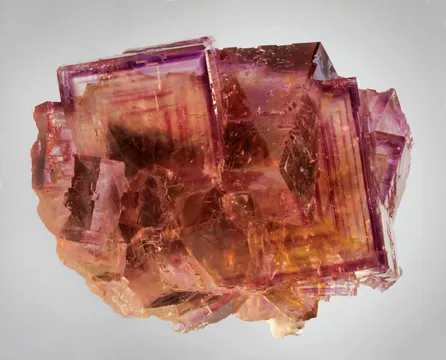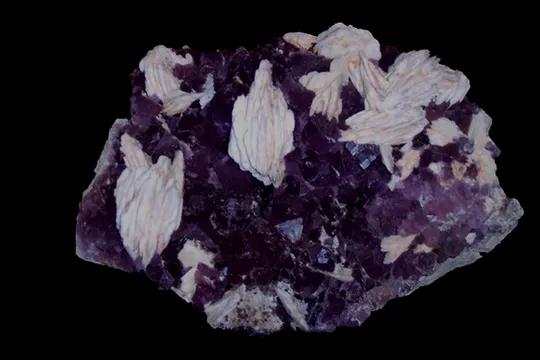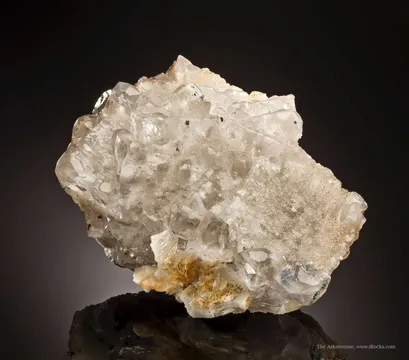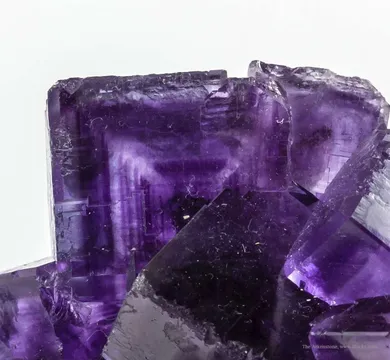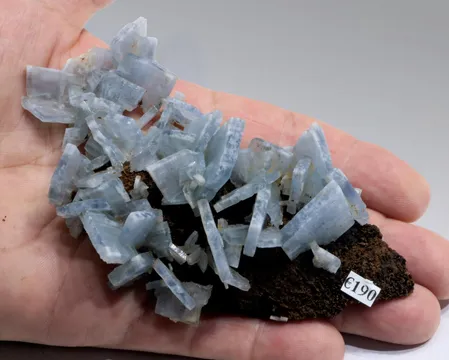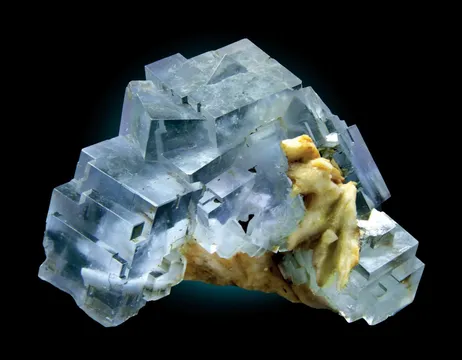
Berbes mining area, Spain — renowned coastal locality for glassy purple fluorite cubes with color zoning, often on barite and quartz, prized by collectors.
Key facts
Berbes is one of the great European names in collectible fluorite: a compact coastal mining area in Ribadesella, Asturias, set between the village of Berbes and Vega beach, where low-temperature fluorite-barite-quartz mineralization occupies faults, stockworks, and karstic cavities at the contact between Permo-Triassic cover rocks and Carboniferous limestone. The locality matters because its best specimens combine a deceptively simple mineral suite with extraordinary aesthetics: glassy violet fluorite cubes, commonly with sharp geometric color zoning, perched on white lamellar barite and drusy to doubly terminated quartz. In the finest pieces the fluorite is not just purple, but layered—lilac interiors, wine-violet rims, bluish flashes, and phantom-like growth zones that light through the crystal rather than merely coat its surface.
Regional View
Country View
The classic Berbes specimen is instantly recognizable: purple cubic fluorite, often modified subtly by dodecahedral bevels, sitting in open contrast against pale barite “books” and sugary quartz. La Cabaña and Cuetu L’Aspa produced much of the material that built the locality’s reputation, while Los Cobayos, El Frondil, Valdelmar, La Huelga, and related workings added their own variations in quartz habit, hydrocarbon inclusions, and matrix style. The mining area is small—only a few square kilometers—but its influence on Spanish mineral collecting is immense, and Berbes fluorite remains one of the standard visual benchmarks against which European fluorite is judged.

Photo: Didier Descouens, Wikimedia Commons

Photo: Rob Lavinsky, Wikimedia Commons
Search for specimens: View all specimens from Berbes mining area, Spain
The Berbes mining area lies in the northwestern part of the Ribadesella municipality, in the coastal strip between Berbes and Vega, east of the Caravia-Colunga workings. Geologically it is the eastern continuation of the Caravia-Berbes fluorspar district, a low-temperature hydrothermal F-Ba system generally comparable with Mississippi Valley Type fluorite-barite deposits. Mineralization is concentrated along the Ana vein system and associated satellite veins, with replacement, open-space filling, and stockwork development in karstified and faulted Carboniferous limestone beneath and along Permo-Triassic cover rocks.
The ore morphology at Berbes is chiefly vein-like rather than the broad stratiform mantos better developed in parts of the adjacent Caravia sector. The Ana vein trends NW-SE, is subvertical, and is reported with an average thickness near 8 m, though local swellings could exceed 30 m. Around it, small veinlets form stockworks in the limestone, and mineralizing fluids partly filled karst cavities and vugs. The main gangue-and-specimen minerals are fluorite, barite, calcite, and quartz; minor sulfides and copper carbonates occur locally. Silicification and dolomitization of the limestone host are important alteration features.
Mining records and later locality work distinguish between the underground Ana Mine and the broader Ana vein/concession system. This distinction is crucial for collectors. The underground Ana Mine itself, developed by Minersa after earlier ownership and prospecting, yielded relatively few saved collector specimens, whereas the open cuts and surface workings along the same vein—La Cabaña, Cuetu L’Aspa, El Frondil, Cuetu I, Cuetu II, Cuetu Norte or Bloque IV, La Busteriza, La Gusteriza, and related zones—produced many of the classic fluorite-barite-quartz specimens found in museums and private collections.
The first Ana claim was filed in 1910 for iron, but fluorspar became the real strategic mineral. During the World War II period, SOMIMET and the Lipperheide group recognized the importance of the concession, and Minersa later became the dominant company in the area. Underground mining of the Ana vein began around 1950, after earlier open-cast work, and continued until closure in May 1968. El Frondil has an older history, with work reported from 1930; Sociedad Minera Vulcano took charge in 1952 and sold the workings to Somimet a decade later. Later HECOR work in the El Frondil area, under contract with Minersa, added another gallery, now associated with water capture rather than specimen mining.
La Cabaña is the collector’s heart of Berbes. The name comes from a rustic cattle shelter that once stood in the central part of Valdelmar, but in mineralogical usage it became shorthand for one of the most prolific specimen zones in Spain. Geodes in the silicified and karstified limestone are commonly clay-filled; when opened, the crystals could be hidden under sticky mud, making first evaluation difficult. Once cleaned, the best pockets revealed glassy violet fluorite cubes, white barite books, and bright quartz—sometimes including the doubly terminated “diamond” habit that made La Cabaña famous beyond fluorite collecting circles.
Los Cobayos, often modernly and informally called La Paredona by collectors, lies close to El Frondil and produced smaller but often very attractive associations of quartz, fluorite, and barite. Cuetu L’Aspa is noted for quartz layers on which fluorite crystallized, commonly with milky quartz and less developed prisms, but also for strong fluorite specimens from the same broader vein system. La Huelga is especially notable for quartz with abundant fluorescent hydrocarbon inclusions; old excavation fill now prevents access to that particular deposit. Las Picas yielded small transparent quartz crystals exposed by erosion, remembered locally from a time when children reportedly played with them before the collector value of Berbes material was widely understood.
The mining area is abandoned as an industrial operation, and many workings have been restored, filled, flooded, overgrown, or repurposed. Any modern visit should be treated as a visit to an old mining and geological heritage site, not as a fee-dig locality. Surface collecting has historically occurred, but underground entries, unstable collector tunnels, old cuts, and steep mineralized faces present serious hazards, and land ownership, protected-use restrictions, and local access rules must be respected. Specimens seen on today’s market are overwhelmingly from older finds, old miner and collector stock, and occasional small modern recoveries from weathered material or previously disturbed ground.
Berbes fluorite is best known as transparent to translucent cubic crystals, usually violet to lilac-purple, commonly with darker geometric zoning at edges, corners, or internal growth layers; cubes may be sharp and glassy, stepped, mosaic-grown, or lightly modified by dodecahedral faces, with reported crystals reaching cabinet-scale sizes and exceptional individuals approaching 10 cm on an edge. The classic associations are white lamellar barite and drusy quartz, with La Cabaña and Cuetu L’Aspa providing many of the finest pieces, while Los Cobayos and El Frondil contributed smaller but distinctive combinations. The difference between an ordinary Berbes fluorite and a serious collection piece is usually transparency, luster, undamaged cube edges, strong internal zoning, and spatial separation from the matrix—ideally a sharp violet cube or cluster rising cleanly above white barite or quartz rather than a bruised, massive, or muddy aggregate.
At Berbes, barite is the essential pale counterpoint to the fluorite: white to cream, sometimes yellowish or orange-tinted, forming lamellar, tabular, leafy, “book” or cockscomb aggregates that may be either matrix for fluorite or a sculptural association in its own right. La Cabaña is especially famous for these barite books interleaved with purple fluorite cubes and bright quartz, while La Busteriza is recorded for distinctive fluorite with yellowish barite from late-1980s finds. Good barite-associated Berbes specimens show fresh, upright blades with clean terminations and minimal bruising; lesser examples are flattened, iron-stained, broken along the blade edges, or visually overwhelmed by massive fluorite and quartz.
“Baryte” is the same BaSO4 species that many American labels call barite, and Berbes baryte deserves attention because its habit is one of the locality’s diagnostic features: stacked, laminar, snow-white to cream crystals, frequently thickest toward the center and thinning toward delicate blade edges. On classic La Cabaña pieces, baryte forms the book-like stage on which violet fluorite cubes sit, with quartz adding sparkle in the open spaces; on some specimens, baryte is the dominant aesthetic element and the fluorite serves as color accent. The best baryte pieces are airy rather than massive, with blades that stand upright and separate, preserving the contrast and architecture that make Berbes combinations unmistakable.
Quartz at Berbes ranges from common milky coatings and druses to exceptional transparent doubly terminated crystals from La Cabaña, locally compared to “Herkimer” quartz because of their short-prism, double-ended habit and high glassy luster. The most prized quartz came from specific parts of Valdelmar and La Cabaña, where crystals occur in cavities in karstified limestone, commonly with fluorite and barite and sometimes with visible liquid, gas, bitumen, or carbonaceous hydrocarbon inclusions; reported sizes range from tiny crystals to exceptional individuals over 20 cm, though fine collector crystals are usually far smaller. Top Berbes quartz specimens combine water-clear brilliance, complete terminations, visible mobile inclusions or fluorescence, and balanced association with fluorite and baryte; ordinary pieces are milky, broken, or merely quartz-coated matrix without the “diamond” character.
Other documented minerals from the Berbes mining area are fewer and generally far less important as collector species than fluorite, barite, and quartz. Calcite is part of the main paragenesis and occurs in some geodes and late cavities, while dolomite is important as an alteration and cavity-lining carbonate. Minor sulfides include pyrite, marcasite, chalcopyrite, galena, sphalerite, cinnabar, and tetrahedrite in localized occurrences, with goethite as an oxide and azurite and malachite as supergene copper carbonates where chalcopyrite was altered. The rarities are scientifically interesting, but they rarely define the market identity of Berbes; the locality’s greatness rests on the unusually high aesthetic ceiling reached by a very small mineral suite.
The central authenticity issue with Berbes is not usually outright faking, but locality precision. Labels reading “Ana Mine” need scrutiny: many fine specimens historically called Ana are actually from open cuts and surface workings on the Ana vein or Ana concession, especially La Cabaña, Cuetu L’Aspa, El Frondil, Los Cobayos, or Valdelmar, rather than from the underground Ana Mine itself. A practical warning repeated in locality discussions is that fluorite with obvious baryte should not be casually assigned to the underground Ana Mine; it is more appropriately labeled Berbes mining area, or the specific pocket/zone if documented.
Condition is critical. Berbes fluorite is beautiful but unforgiving: the transparent purple cubes readily show bruised corners, cleaved edges, internal cracks, and dulling from aggressive cleaning. The best specimens often came from clay-filled pockets, so cleaning can reveal superb crystals—but overcleaning, acid etching, and careless removal of mud or iron staining can leave frosted faces, loosened baryte, or quartz-bruised fluorite. Barite blades are especially vulnerable to chipping along their thin edges, and doubly terminated quartz crystals can detach from pocket matrices.
Fluorescence and inclusions add value when documented. Some Berbes fluorite fluoresces in the blue range under ultraviolet light, while certain quartz and colorless fluorite from La Cabaña and La Huelga contain hydrocarbon inclusions that may fluoresce yellow, blue, or green. On quartz, visible moving bubbles, black carbonaceous particles, or oil-like droplets are a locality-specific bonus, but they also require careful handling: avoid heat, ultrasonic cleaning, and sudden temperature change. Specimens with organic inclusions should be stored away from strong heat and harsh light, and any cleaning should be conservative.
Market availability remains better than many exhausted classic localities because Berbes produced heavily for decades and old collections continue to release specimens. Still, top examples—sharp glassy violet cubes with clean zoning on white baryte, or large transparent La Cabaña quartz with inclusions—are not common and command a premium. Small to miniature fluorite-barite-quartz combinations are obtainable, but the leap in price is steep for undamaged, aesthetic cabinet specimens with old provenance, named pocket history, or illustration in a major publication.
Long before Berbes became a marketplace name, Valdelmar was already making an impression on people who had no modern mineral-collecting vocabulary for what they were seeing. In 1802, Lope José Bernardo de Miranda y Quirós, parish priest of San Esteban de Leces, described abundant rock crystal at the site and wrote of transparent, diaphanous “diamonds.” Three decades later, in 1836, Guillermo Schulz passed through Ribadesella and noted in his field book an “infinity” of quartz, fluorite, and heavy spar. Those early observations point directly to Valdelmar, the western part of the Ana system, the same ground that later collectors would know through Las Picas, Los Cobayos, La Huelga, and above all La Cabaña.
The name La Cabaña has a wonderfully unromantic origin. Before it became one of the most famous fluorite words in Europe, it referred to a simple rustic Asturian cattle shelter in the middle of Valdelmar. Mineral collectors made the name international. Over the following decades, a livestock shelter’s name became attached to geodes full of violet fluorite, book-like barite, transparent quartz, sticky clay, and petroleum-bearing inclusions—an unusually vivid example of rural topography being transformed into mineralogical shorthand.
One of the most memorable local recollections concerns Las Picas in the 1950s. When the upper fields were plowed, small transparent quartz crystals turned up abundantly. Children reportedly played by throwing the crystals against one another to watch them break, and at night to see the sparks. It is an almost painful story for collectors now, but it captures the pre-boom innocence of the locality: crystals that would later be studied, traded, labeled, and treasured were once simply bright objects in the fields above the Bay of Biscay.
La Cabaña’s best quartz stories have the texture of real pockets: mud, cramped cavities, fragile associations, and sudden beauty after washing. The geodes were commonly filled with very plastic clay, and the crystals inside could not be properly judged in the field. A pocket might look unimpressive until the mud was removed, revealing doubly terminated quartz with bright luster, mobile fluid inclusions, barite books, and small blue to violet fluorite cubes tucked between the crystals.
A standout La Cabaña specimen found in December 1987 has become one of the locality’s touchstones: an 11 x 11 cm association built on roughly thirty doubly terminated quartz crystals of different sizes, interleaved with book-like barite and carrying several pale blue fluorite cubes measuring about 1 to 2 cm on edge. The largest quartz crystal is about 6 cm long, and the quartz contains numerous three-phase fluid inclusions—solid, liquid, and gas—some of them mobile. It is the kind of specimen that explains why Berbes is not merely a fluorite locality; it is also one of Europe’s great localities for hydrocarbon-bearing “diamond” quartz.
Another historic piece, collected in 1956 during the early workings at La Cabaña, weighed 1.8 kg and measured nearly a handspan. Then there is the 1982 specimen found by José María Costales, known as “el Grello”: about thirty doubly terminated quartz crystals and a weight of 12 kg. It reportedly sold for the then-astonishing sum of 250,000 pesetas and entered the collection of the heirs of Wilhem Zimmerman. Names of former Berbes miners and collectors—Abel, Ernesto, Indalecio Prieto “Lelo”—still circulate around these old pieces, a reminder that much of the best material moved directly from local hands into international collections.
The locality also carries a cautionary field story. In parts of the old workings, collectors dug small, unsupported tunnels several meters long into unstable ground. Collapses caused accidents, fortunately described as minor in the source account, but the risk is obvious. A later field report from El Frondil and La Cabaña compared parts of the famous wall to Gruyère cheese, riddled with small collector excavations, and warned that some people underestimated the danger. Berbes is a classic, but it is also an abandoned mine landscape; the same cavities that made the specimens can make the ground treacherous.