Teófilo Otoni, Brazil — renowned pegmatite locality yielding aquamarine, beryl and related gems; historic trade hub with strong collector appeal and distinctiv…
Key facts
Teófilo Otoni sits in northeastern Minas Gerais, in the Mucuri Valley, where collectors have long used the town name in two overlapping ways: as a real municipality with its own claims and alluvial workings, and as the great trading doorway to the broader Teófilo Otoni–Marambaia pegmatite country. The collector significance is not a single tidy mine so much as a whole beryl province and gem market centered on a town whose name became inseparable from Brazilian aquamarine. The geological setting is the Eastern Brazilian Pegmatite Province, developed in the Araçuaí orogen, where granitic pegmatites and related secondary deposits have yielded gem beryl, aquamarine, topaz, chrysoberyl, alexandrite, quartz varieties, cassiterite, columbite-(Fe), schorl, feldspar, muscovite, and a small suite of unusual uranium-bearing secondary minerals.
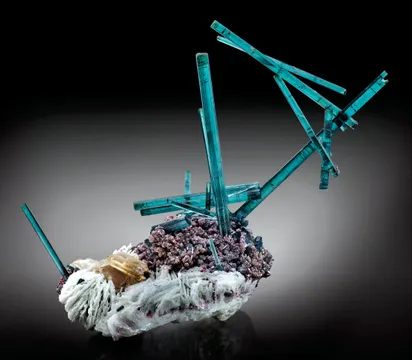
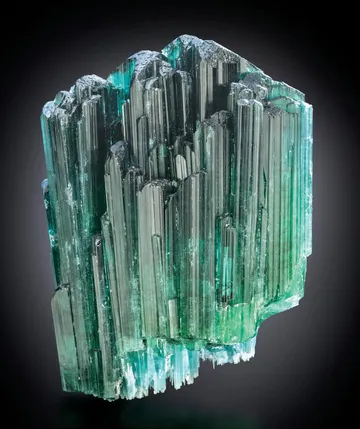
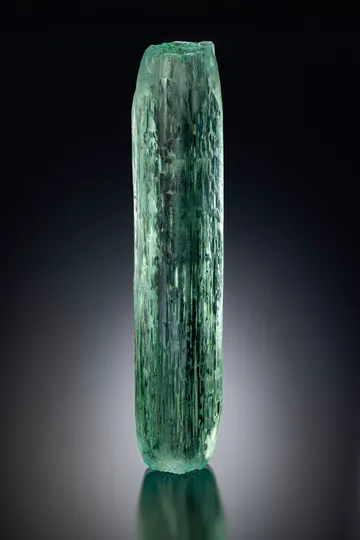
The best Teófilo Otoni aquamarines have a very particular look: pale to medium blue-green prisms, commonly etched or alluvial-worn, with lustrous pinacoidal terminations or pyramidal modifications, sometimes so water-clear that they seem less like mined stones than frozen pieces of the Mucuri sky. Fine old crystals can be slender, pencil-like, and internally tubed; others are blockier, with frosted prism faces and glassy terminations. The locality is equally important historically. Large aquamarine discoveries in the region made the town a global name in the gem trade, while the modern city became a cutting, dealing, exporting, and show center rather than merely a place on a specimen label.
Regional View
Country View
For the serious collector, “Teófilo Otoni” should be read with care. Some specimens truly come from the municipality or its listed claims, such as Fazenda Mucuri and Paineiras. Others entered the trade in Teófilo Otoni after being mined in nearby districts of the Mucuri and Marambaia valleys. That distinction matters: a label that says only “Teófilo Otoni” may be an honest old trade label, but the best modern provenance preserves the claim, village, valley, or garimpo as well.

Photo: Wikimedia Commons
Search for specimens: View all specimens from Teófilo Otoni, Brazil
Teófilo Otoni is a municipality in northeastern Minas Gerais on the Todos os Santos River, within the Mucuri Valley, and it lies on the BR-116 corridor that connects it with Governador Valadares to the south and the pegmatite districts to the north and northwest. In mineralogical usage, the name is attached both to the municipality itself and to a wider commercial region that includes the Teófilo Otoni–Marambaia aquamarine district. That wider district is dominated by pegmatites emplaced in gneissic and granitic terranes, and it is geochemically distinct among the Minas Gerais pegmatite fields: rich in silicon, beryllium, aluminum, fluorine, and boron, with aquamarine and topaz often present in the same pegmatite system but not typically in the same pocket.
The Geological Survey of Brazil’s Teófilo Otoni sheet records the broader bedrock framework as a mixture of Rio Doce Group metasedimentary units, Neoproterozoic to Eopaleozoic granitoids, and Cenozoic alluvium. The São Tomé Formation is especially important regionally because its schists commonly host tabular pegmatites parallel to foliation. The Tumiritinga Formation, present in the central and eastern parts of the sheet, includes biotite gneiss and associated tabular, lenticular, or irregular pegmatite bodies. The São Vitor Tonalite and related granitoids are cut by granitic and pegmatitic veins. The economic expression of all this is simple to the collector’s eye: pegmatites and their weathered secondary deposits have been the source of beryl, aquamarine, topaz, quartz, feldspar, mica, schorl, cassiterite, columbite-tantalite minerals, and related gem material.
The ore bodies are not “ore” in the massive sulfide sense; they are gem-bearing pegmatite bodies and their eluvial, colluvial, and alluvial derivatives. Primary pockets occur near quartz cores or intermediate zones of pegmatites, while many of the celebrated aquamarines were recovered from secondary gravels and red tropical soils after weathering freed beryl from its pegmatite host. This explains the contrast in specimen style. Some pieces are sharp enough to show clean hexagonal prism form, pinacoid faces, and pyramidal terminations; others are rounded, battered, etched, or internally clay-filled, carrying the signature of transport or deep weathering rather than fresh pocket removal.
The most famous producing belt associated with the name is the Teófilo Otoni–Marambaia district, especially the valleys around Topázio, Pavão, Crisólita, Marambaia, and Três Barras. Within the municipality record itself, Mindat lists Fazenda Mucuri as a sublocality for beryl and aquamarine, and Paineiras as a sublocality for topaz. A particularly useful diagnostic note survives for Lavra da Coroa do Ouro, cited as a major producer of pencil-like alluvial aquamarine crystals in the Teófilo Otoni region; those crystals are described as recognizable by clay-filled tubes running through the centers of the crystals parallel to the prism faces.
Mining has been mostly garimpo-scale rather than a single integrated industrial operation. Individual miners, claim holders, dealers, and cutters shaped the region’s history. Prospecting in the broader Topázio–Pavão–Crisólita area began early in the twentieth century, and the landscape was punctured by shafts, pits, and tunnels as secondary deposits and pegmatites were followed. The Second World War and postwar demand for beryllium, mica, quartz, tantalum, niobium, tin, and gemstones pushed many Minas Gerais pegmatites into production. By the 1950s, the aquamarine discoveries had made Teófilo Otoni internationally famous; by the later twentieth century, the town’s role as a cutting, dealing, and exporting center was as important as the mining itself.
Access today is not a matter of casual public collecting. Many old workings are on private rural land, some are exhausted or inactive, and active gem recovery is regulated. Collectors should assume that permission, local guidance, and legal documentation are required for any mine visit or collecting attempt. In practice, most collectible Teófilo Otoni material reaches collectors through dealers, old collections, FIPP, and the long-established gem trade in the city.
The finds that collectors remember are the great aquamarines. The Marta Rocha crystal, discovered in July 1954 in the Topázio area, became a legend because of its size, color, and timing. Other large aquamarines from the district, including Papamel, Quarto Centenário, and Estrela de Alva, reinforce the same point: this was one of the few gem regions in the world where a miner could realistically dream of unearthing a life-changing beryl. For mineral collectors rather than gem cutters, the most desirable Teófilo Otoni pieces are not necessarily the largest, but the crystals that preserve form, transparency, color, and honest old provenance before they disappeared into the cutting wheel.
Beryl from Teófilo Otoni is best understood as the parent species behind the locality’s aquamarine fame, but good non-varietal beryl labels do occur, including pale green, sea-green, colorless, and aquamarine-leaning crystals from pegmatite and secondary deposits. The classic crystals are hexagonal prisms, commonly detached, with smooth to etched prism faces, pinacoidal caps, and in better examples pyramidal terminal modifications; sizes in documented collection pieces range from small thumbnails to cabinet-sized crystals, with an 8.2 cm Fazenda Mucuri aquamarine-beryl specimen from 1981 giving a useful benchmark for fine display size. Albite, cleavelandite, muscovite, quartz, microcline, and black tourmaline are the natural companions to expect, while the most collectible beryls here are the old, transparent, well-terminated pieces with intact faces and a label more precise than the broad commercial phrase “Minas Gerais.”
Aquamarine is the signature mineral of Teófilo Otoni, ranging from pale blue-green to desirable stronger blue material in slender prisms, etched transparent crystals, and alluvial-worn forms. The most distinctive locality style includes pencil-like crystals from Lavra da Coroa do Ouro with central clay-filled tubes parallel to prism faces, while Fazenda Mucuri specimens are known for lustrous, transparent blue-green prisms with fine terminations. Historically, the larger district produced enormous gem crystals, including the Marta Rocha and other named aquamarines, but mineral collectors prize a different balance: rich but natural color, sharp or unusual terminations, clean prism geometry, minimal bruising, and credible provenance distinguishing true Teófilo Otoni-area pieces from the many Brazilian aquamarines that merely passed through the city’s dealers.
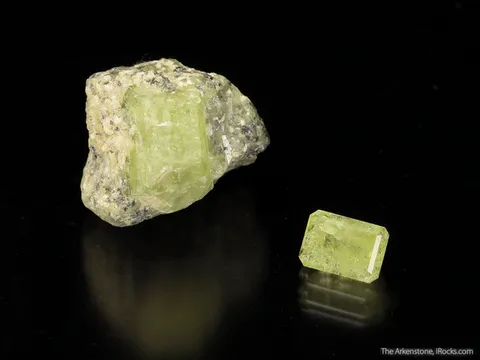
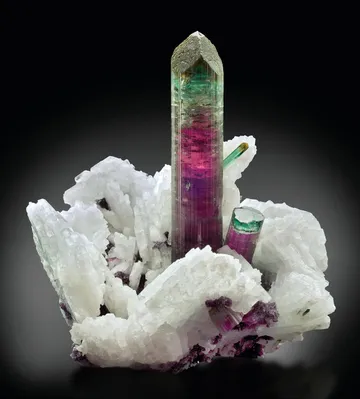
Other minerals documented from Teófilo Otoni include albite, cassiterite, chrysoberyl and alexandrite, columbite-(Fe), elbaite, fluorapatite, forsterite including peridot, haiweeite, microcline, muscovite, native iron, parauranophane, quartz varieties including agate, amethyst, citrine, rutilated quartz, and smoky quartz, rutile, schorl, topaz, and uranophane. Topaz is especially notable because colorless crystals from the Teófilo Otoni area include museum-scale examples, and Paineiras is listed as a topaz sublocality. The rarest collector entries are the uranium silicates—haiweeite, uranophane, and parauranophane—which are not what made the district famous, but they remind us that the pegmatite and weathering systems here were chemically varied. No IMA type-locality mineral is securely attached to the Teófilo Otoni municipality in the standard locality lists consulted; nearby districts of eastern Minas Gerais, however, are rich in Brazilian type-mineral history, which is one reason old labels from this region deserve exact reading.
The main authenticity issue is not fake aquamarine so much as locality inflation. Teófilo Otoni is a famous gem-trading city, and stones mined elsewhere in Minas Gerais, Bahia, or Espírito Santo have long moved through its dealers. A label reading “Teófilo Otoni” may therefore mean the municipality, the broader Mucuri/Marambaia district, or simply the commercial source. For locality collectors, an old label is desirable, but a claim name such as Fazenda Mucuri, Paineiras, Lavra da Coroa do Ouro, or a specific nearby valley is much stronger.
Treatment is another concern, especially for cut stones. Heating aquamarine to reduce greenish tones and improve blue color is common in the Brazilian trade, and colorless beryl from the area has been reported as material that could be irradiated to golden color. For mineral specimens, heat treatment is less commonly disclosed and harder to prove visually, but collectors should be cautious with unusually saturated blue loose crystals lacking provenance. Dark “Maxixe-type” blue beryl is a separate caution in the broader Brazilian market because some irradiation-related colors are unstable in light; do not assume every intense blue beryl sold through Teófilo Otoni is a stable natural aquamarine.
Condition matters greatly. Alluvial aquamarines may be naturally rounded, abraded, or frosted; that is not necessarily damage, but it should be priced differently from a sharp pocket crystal. Watch for bruised terminations, edge nicks along prism faces, internal fractures that reach the surface, glued repairs at the base, and acid-cleaning residues in tubes or pits. Topaz from the area should be handled with extra care because of its perfect basal cleavage. Uranophane, parauranophane, and haiweeite specimens should be kept labeled, boxed, and handled with ordinary radioactive-mineral precautions: avoid dust, wash hands after handling, and do not store them loosely with delicate gem crystals.
Good Teófilo Otoni aquamarine specimens are scarcer than the name’s fame suggests. Much of the best transparent material was cut, old stock was dispersed decades ago, and modern market availability is irregular. Affordable examples are usually pale, incomplete, etched, or broadly labeled. The premium pieces are old-collection aquamarines with strong form, clean color, and credible documentation tying them to Fazenda Mucuri, Coroa do Ouro, Topázio-area workings, or another specific Teófilo Otoni-region source.
Every aquamarine district has its campfire story, but Teófilo Otoni has Marta Rocha. In July 1954, the garimpeiro Wilson Martins da Silva and twelve miners he led and helped finance were digging in red soil on the flank of a hill only about 100 meters high. Their working, Lavra de Clemente Francisco, lay 6 kilometers northeast of the village of Topázio and only 200 meters west of the Pavão road. Out of that red ground came a rounded aquamarine prism weighing 34.7 kilograms, with superb, even blue color.
Jules Sauer, the Rio de Janeiro jeweler whose name is woven through the Brazilian gem trade, happened to be in Teófilo Otoni that morning. Word reached him quickly. He was at the mine scarcely two hours after the discovery and negotiated the purchase before the dust of the find had really settled. The stone was named after Marta Rocha, Miss Brazil of 1954, and the name stuck because it captured both beauty and public imagination. When the crystal was cut, it yielded 57,200 carats of finished gems; one documented stone from the crystal weighed 125.92 carats, and a 54-carat gem from it was set in a brooch.
The aftermath was as dramatic as the find. The discovery set off a rush over the hillside and valley below. Thousands of garimpeiros descended on the area, digging so intensely that the landowner reportedly had to move his cattle because there was nothing left for them to graze—only bare earth and abandoned pits. Sauer later estimated that six million man-hours were wasted over the next twelve months without a single additional aquamarine being found. It is a perfect Teófilo Otoni story: a fortune revealed in a morning, a landscape overturned by hope, and then silence from the ground.