Tasmania, Australia — a premier collector locality, famed for Zeehan–Dundas crocoite on gossans with dundasite and cerussite, plus Mount Bischoff cassiterite t…
Key facts
Tasmania is not a single mine locality so much as a compact mineral province: an island where Cambrian volcanic arcs, ultramafic bodies, Proterozoic metasediments, Devonian granites, skarns, greisens, silver-lead lodes, alluvial tinfields, and deeply weathered gossans are crowded into a collector’s map of unusual density. For specimen collectors, the island’s signature is the west coast—especially the Zeehan-Dundas district—where lead-rich veins intersected chromium-bearing serpentinites and serpentinite-derived rocks, producing the world’s most celebrated crocoite and an accompanying suite of secondary lead minerals: dundasite, cerussite, anglesite, mimetite, pyromorphite, philipsbornite, petterdite, hinsdalite/plumbogummite pseudomorphs, coronadite, and other gossan species.
Tasmania also matters because it is one of Australia’s great tin provinces. Mount Bischoff, Renison Bell, Cleveland, Heemskirk, Blue Tier, Derby, Gladstone, Weld River, and other fields yielded cassiterite from granite-related greisen, vein, skarn, replacement, and alluvial systems. Mount Bischoff’s discovery in 1871 by James “Philosopher” Smith transformed Tasmanian mining and opened the west coast to decades of prospecting. For collectors, its best cassiterite is not merely ore: it is heavy, dark, glassy to submetallic, and locally associated with quartz, topaz, fluorite, siderite, tourmaline, pyrrhotite, pyrite, and other products of intense granite-driven alteration.
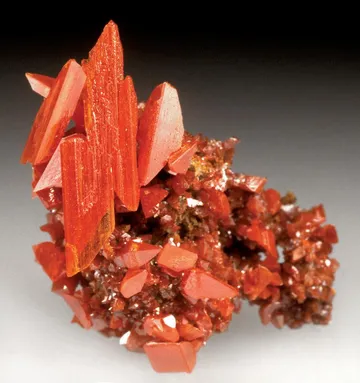
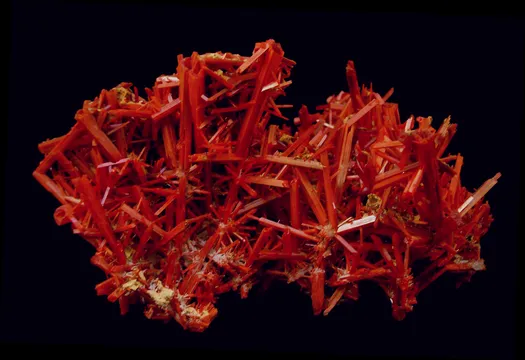
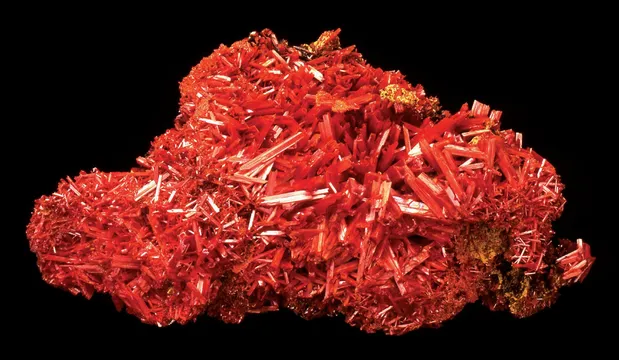
The best Tasmanian specimens have a look that is hard to mistake. Dundas crocoite is red-orange fire on brown-black gossan, often with white dundasite or pale gibbsite; pyromorphite from Platt Prospect can add vivid green crystals to the same rusty matrix. Stichtite from Stichtite Hill is purple to lilac, waxy and soft, woven through green serpentine and dotted at times with black chromite or magnetite. Cassiterite ranges from black, resinous, compact lode material to rounded alluvial grains and occasional ruby-brown “ruby tin.” The island’s mineralogical personality is therefore both scientific and visual: a collision of chromium, lead, tin, ultramafic rocks, granites, and rainforest-weathered lodes that produced specimens unlike those of mainland Australia.
Regional View
Country View
Tasmania’s collecting history is unusually well documented because the same localities that produced commercial ore also fascinated early naturalists, museum curators, mine managers, and later specimen miners. William Frederick Petterd’s catalogues, the Tasmanian Department of Mines, Mineral Resources Tasmania, the Australian Journal of Mineralogy, and The Mineralogical Record all preserved a record of species, pockets, and mining episodes that would otherwise have been lost in the scrub and collapsed adits.


Search for specimens: View all specimens from Tasmania, Australia
Tasmania’s specimen localities fall into several mineralogical belts rather than one deposit. The west coast is the collector’s core: the Zeehan-Dundas district, the Mount Read volcanic belt, the Renison-Bell and Heemskirk tin systems, the Heazlewood and Magnet ultramafic-nickel-crocoite localities, and the Mount Bischoff tin camp near Waratah. Northeast Tasmania adds the old alluvial and lode tinfields—Derby, Weld River, Gladstone, Blue Tier, Moorina, and related granite-derived placers. Southern localities such as Coal Hill and Lune River are better known for agate, chalcedony, jasper, petrified wood, and quartz; they belong to a very different collecting tradition from the gossan and ore-mineral specimens of the west.
The most famous specimen environment is the Dundas crocoite field. Here, Cambrian ultramafic rocks altered to serpentinite and related chromium-bearing assemblages lie in close spatial association with silver-lead lodes. Primary mining sought galena-rich, silver-bearing ore, but collectors prize the oxidized zone: deep, vuggy, iron-manganese gossans where lead from galena met chromium derived from chromite, stichtite, and chromian muscovite in adjacent or reworked ultramafic rocks. That geochemical accident explains why Dundas produced not only abundant crocoite but also a remarkably varied suite of secondary lead minerals, including pyromorphite, mimetite, cerussite, anglesite, dundasite, petterdite, philipsbornite, coronadite, chalcophanite, and related species.
The important Dundas specimen mines include the Adelaide Mine, Red Lead Mine, Dundas Extended, West Comet, Platt Prospect, Comet-Maestries, Kapi, and several smaller workings. Adelaide is the legendary crocoite producer, with major pocket discoveries in 1971, the early 1990s, and the 2012 Red River Find. Red Lead, close by on Stichtite Hill, is also a classic source of rich crocoite and associated lead-chromium minerals. Platt Prospect is particularly important for collectors of pyromorphite, because it produced green pyromorphite with crocoite in some of the most attractive colour-contrast combinations from Tasmania. Old labels for this material may say Kosminsky Mine, Kapi Mine, or simply Dundas; careful provenance matters because several of these names were historically used loosely.
The Zeehan field, just west of Dundas, was a great silver-lead district. Its oxidized lodes produced cerussite, anglesite, pyromorphite, and the well-known hinsdalite or plumbogummite pseudomorphs after pyromorphite from the Zeehan Queen/Sylvester-Queen area. The old Oonah, Queen, Austral, Sylvester, and related workings supplied much of the historic material now seen in museums and old collections. The best pieces are usually not large by modern show standards, but they are sharply local: limonitic matrix, acicular or barrel-like pseudomorphs, remnant green pyromorphite sprays, and old handwritten labels that carry as much value as the mineral itself.
Mount Bischoff, near Waratah, represents the other great Tasmanian collecting theme: tin. Its cassiterite mineralization is granite-related and complex, developed in and around Devonian quartz-feldspar porphyry dykes and breccia bodies related to the Meredith Granite. The system includes dolomite-replacement mineralization, greisenized porphyry, veins, fracture linings, sulphide-rich skarn-like assemblages, and fluorine- and magnesium-rich alteration. This is why Mount Bischoff is not merely a tin locality but a mineralogical locality: cassiterite occurs with quartz, topaz, fluorite, tourmaline, siderite, pyrrhotite, pyrite, galena, sphalerite, chalcopyrite, bismuthinite, stannite, wolframite, and a long list of uncommon magnesium and fluorine species including sellaite, chondrodite, norbergite, fluoborite, wagnerite, and franckeite.
The mining history of Mount Bischoff is foundational to Tasmania. James “Philosopher” Smith found alluvial cassiterite at Tinstone Creek on 4 December 1871 and traced it to the Mount Bischoff orebody in 1872. The Mount Bischoff Tin Mining Company formed in 1873, and mining began with simple hand methods before expanding into sluicing, open cuts, underground workings, tramways, rail transport, and a smelter at Launceston. Most production came between 1873 and 1915, although mining continued in phases, with closure in 1947 after wartime reopening and later smaller revivals. Open-cut mining restarted in 2008 under Bluestone Mines Tasmania/Metals X, with ore trucked to the Renison Bell mill, and the most recent open-pit phase finished in 2011.
Renison Bell, Cleveland, and Heemskirk add further tin depth. Renison is a major primary tin system with cassiterite in replacement and lode-style bodies in older sedimentary rocks. Cleveland, west of Waratah, produced cassiterite in sulphide-rich lodes dominated by pyrite and pyrrhotite. Heemskirk and associated prospects include unusual cassiterite habits, including fibrous and radiating material reported near the Federation and Mayne’s mines. Northeast Tasmania, by contrast, is famous for broad alluvial tinfields where cassiterite is accompanied by sapphire, zircon, topaz, chrysoberyl, spinel-group minerals, and other heavy minerals derived from tin granites, basaltic sources, and older rocks.
Collecting access today is mixed and must be treated seriously. Some Tasmanian areas are designated fossicking areas, including Weld River, Magnet, Lord Brassey, Coal Hill, Lune River, Gladstone, Penguin, and others, each with its own boundaries and conditions. Weld River remains a classic place for alluvial sapphire and cassiterite; Magnet is notable because crocoite has been reported from the old mine area, although good crystals are uncommon and increasingly difficult to locate. Lord Brassey is a public fossicking area for nickel-related ultramafic minerals and rare secondary species, reached by rough four-wheel-drive access. By contrast, major mines such as Mount Bischoff and active or privately held specimen mines in the Dundas district require permission from the tenement holder, and many old workings are unsafe, collapsed, flooded, or legally closed. In Tasmania, a prospecting licence covers certain activities outside declared fossicking areas, but entry onto mining leases, exploration licences, retention licences, or private land requires the appropriate consent.
Tasmanian pyromorphite is chiefly a Zeehan-Dundas collector’s mineral rather than a large-crystal showpiece species, and its best expressions come from the oxidized silver-lead gossans where phosphate-bearing solutions acted on lead lodes. Platt Prospect is the key locality for aesthetic pieces: small translucent to opaque hexagonal prisms in light to dark green, commonly perched on limonitic gossan and, at their best, intergrown with bright orange-red crocoite for one of Tasmania’s most desirable colour contrasts. Comet-Maestries produced lustrous yellow-green to dark green prismatic crystals to about 4 mm, but very few specimens were saved and many surviving examples are museum pieces. Zeehan Queen/Sylvester-Queen material is important because pyromorphite there is tied to the famous hinsdalite or plumbogummite pseudomorphs; the most desirable examples retain bright green sprays or sharp acicular crystal form on iron-stained matrix, while ordinary pieces are merely thin crusts or scattered microcrystals with weak colour and little association.
Cassiterite is Tasmania’s great ore mineral, but collector-quality pieces vary sharply by field. Mount Bischoff specimens tend to be small, dense, dark brown to black, and associated with quartz-topaz-fluorite-sulphide greisen and skarn assemblages; early accounts emphasize that well-formed crystals there are generally small, often only a few millimetres, though the geological variety of the mine gives good matrix pieces strong locality character. Northeast Tasmanian alluvial fields such as Weld River yield subrounded to well-rounded cassiterite grains in heavy black sands, usually dark brown to black and occasionally ruby red “ruby tin,” derived from tin-bearing granites. In the Heemskirk area, unusual fibrous and radiating cassiterite habits have been reported from the vicinity of the Federation and Mayne’s mines. The best Tasmanian cassiterite for a cabinet is heavy, sharp, lustrous, and convincingly local—preferably on quartz, topaz, fluorite, siderite, tourmaline, or sulphide matrix—whereas ordinary material is massive ore, loose black placer grains, or poorly labelled “Tasmanian tin” without a mine or field.
Tasmanian brucite is a quiet specialist’s mineral, very different from the bright modern brucites of Pakistan; it belongs to serpentinite and magnesium-rich alteration settings, with historic records noting massive to foliated pearly material near Heazlewood and hexagonal plates embedded in serpentine along the Lower Castray River. Mount Bischoff adds a different context, with brucite recorded in the porphyry-greisen and magnesium-skarn environment that also produced talc, serpentine, fluorine minerals, magnesium silicates, cassiterite, pyrrhotite, and related alteration products. For collectors, the best pieces are not judged by neon colour but by texture, association, and locality: pearly foliated masses, discernible platy habit, or brucite visibly set in serpentine or Mg-skarn matrix are preferable to anonymous pale massive material. Because brucite is soft and can be visually confused with other pale magnesium minerals in altered ultramafics, well-documented provenance or analytical confirmation adds real value.
The classic Tasmanian hinsdalite occurrence is the Zeehan Queen/Sylvester-Queen pyromorphite lode, where pale white, buff, cream, greenish-yellow, or light green material forms pseudomorphs after pyromorphite, preserving small hexagonal barrel, spindle, acicular, or prismatic forms on limonitic matrix. The occurrence was described by W. E. Baker in 1963 and became a noted rarity through later studies and collector circulation, but modern labels require caution: some specimens historically called hinsdalite have been reinterpreted as plumbogummite replacing pyromorphite, and the Sylvester Mine name has often been used for material more likely from the nearby Zeehan Queen workings. Sizes are usually thumbnail to miniature, with individual pseudomorph crystals commonly only millimetres long; the best specimens show sharp inherited pyromorphite form, rich coverage, contrasting remnant green pyromorphite, and old provenance, while ordinary pieces are pale crusts with weak morphology and uncertain identification.
Tasmania’s broader mineral list is unusually rich for an island state. Dundasite was named from Dundas and is a type-locality mineral of the Adelaide Proprietary Mine area; stichtite was first recognized from the Dundas serpentinites and remains one of the island’s signature minerals; petterdite and reynoldsite are tied to Red Lead-style lead-chromium environments; philipsbornite is associated with the Adelaide Mine; and Tasmanian localities also figure prominently in the histories of heazlewoodite, shandite, mawsonite, ferroaxinite, crocoite, vauquelinite, bindheimite, cerussite, mimetite, gibbsite, chalcophanite, coronadite, osmiridium, chromite, magnesiochromite, topaz, sapphire, zircon, chrysoberyl, and numerous tin-, tungsten-, nickel-, lead-, zinc-, copper-, and chromium-bearing species. Many are not showy in the usual sense, but they are deeply collectable because the locality story is so strong.
Tasmania rewards locality precision. A label reading only “Tasmania” is often inadequate unless the species itself is geographically diagnostic. For crocoite, pyromorphite, dundasite, petterdite, and related gossan minerals, distinguish Adelaide, Red Lead, Dundas Extended, West Comet, Platt Prospect, Kapi, Comet-Maestries, Magnet, Heazlewood, and Zeehan-area mines wherever possible. The Platt Prospect versus Kosminsky label problem is especially important for pyromorphite-crocoite combinations: many pieces historically attributed to Kosminsky are now considered more likely to be from Platt Prospect. Likewise, “Sylvester Mine” labels on hinsdalite or pyromorphite pseudomorph material may refer to Zeehan Queen/Sylvester-Queen pyromorphite-lode material rather than the Sylvester workings strictly.
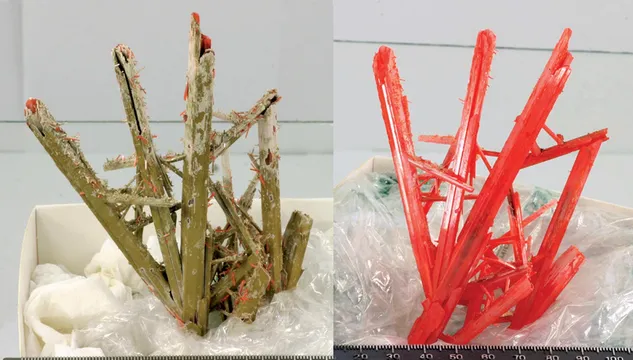
Repairs and stabilization are the chief condition issue for Tasmanian crocoite and crocoite-associated pyromorphite pieces. Crocoite is brittle, soft, and often grows as slender needles or blades from crumbly gossan; broken tips, repaired sprays, glued fragments, trimmed matrix, and consolidated gossan are all plausible in the marketplace. A repaired specimen can still be desirable, especially if the locality and pocket history are strong, but the repair should be disclosed. Examine high-value specimens under magnification for glue lines, mismatched lustre, improbable crystal orientation, fresh breaks, or matrix patches that look artificially hardened.
Cleaning history matters. Dundas crocoite specimens have sometimes required skilled preparation to remove coatings and reveal colour, but aggressive or amateur chemical cleaning can dull crystals, loosen gossan, or make a specimen look unnaturally bright. Avoid soaking mixed Tasmanian gossan specimens casually; lead minerals, chromium minerals, phosphates, carbonates, and iron-manganese oxides respond differently to acids and water. If a piece carries dundasite, gibbsite, cerussite, or delicate pyromorphite, the safest collector practice is dry dust removal with air and very gentle mechanical work only.
Handle lead and chromate minerals with normal toxic-mineral discipline. Crocoite is lead chromate; pyromorphite, hinsdalite, plumbogummite, mimetite, cerussite, anglesite, dundasite, and petterdite are lead minerals. Do not lick, grind, cut, tumble, or powder them; wash hands after handling; keep fragments away from children and pets; and store fragile pieces in covered boxes that prevent shed crystals from becoming dust. Cassiterite itself is robust and chemically resistant, but old sulphide-rich tin specimens from Mount Bischoff, Cleveland, Renison, and Heemskirk may contain pyrite, pyrrhotite, arsenic-bearing sulphosalts, or unstable iron sulphides, so watch for acid smell, powdering, or staining.
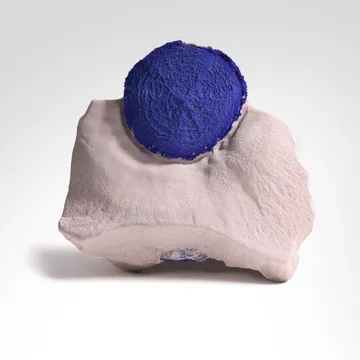
Brucite and stichtite require different care. Brucite is soft and easily scratched; Tasmanian material is often pale and associated with serpentine or Mg-skarn minerals, so abrasion can erase its visual character. Stichtite in serpentine is commonly sold as ornamental “Atlantisite,” a legitimate trade material when properly labelled, but collectors should distinguish true mineralogical descriptions from metaphysical marketing names. Much “stichtite” material is mostly green serpentine with variable purple stichtite content; the best mineral specimens show strong purple colour, natural distribution in the serpentine, and recognizable locality provenance from Stichtite Hill or other western Tasmanian serpentinite occurrences.
Market availability is species-dependent. Tasmanian crocoite remains obtainable because of modern specimen mining, though large undamaged cabinet specimens are still serious purchases. Pyromorphite from Platt Prospect and Comet-Maestries is much scarcer, especially in rich, well-crystallized pieces with crocoite. Cassiterite is common as Tasmanian ore or alluvial material but less common as sharp, aesthetic, well-labelled crystals on matrix. Brucite is a specialist rarity rather than a mainstream market mineral. Hinsdalite or plumbogummite pseudomorphs after pyromorphite from Zeehan are genuinely scarce, and the best examples carry analytical, collection, or old-label support.
James “Philosopher” Smith’s Mount Bischoff discovery has the shape of a frontier legend because it began not with a grand mine but with mistaken expectations. On 4 December 1871, after repeated prospecting trips into difficult country, Smith found a resinous-looking heavy mineral in Tinstone Creek on the southwest slope of Mount Bischoff. The sample was carried out for identification; early hopes leaned toward silver, and disappointment followed when it proved to be cassiterite, an ore of tin. That disappointment did not last. Smith returned in 1872 with W. M. Crosby and workmen to trace the loose ore back to its source through thick vegetation and detrital cover. By 1873 the Mount Bischoff Tin Mining Company had been floated, and the discovery that first looked like the wrong metal became the find that changed Tasmanian mining.
The transformation was swift and physical. The first loads of ore were hauled by bullock cart through mud to Emu Bay. Sluicing gave way to open cuts and underground workings. A tramway reached the coast in 1879, a railway followed in 1883, and the company built a smelter in Launceston. Mount Bischoff became one of the great tin names of the nineteenth century, returning more than tenfold on initial investment, yet Smith himself parted company with the directors before the first dividend was paid. In collector terms, that story gives even a small Bischoff cassiterite crystal a historical weight: it is not just SnO2, but a fragment of the discovery that pushed prospectors into the west.
The Adelaide Mine produced one of the classic mineral-pocket moments in July 1971, when Frank Mihajlowits and Ken Bugg were working the mine. Frank, alone underground, broke into a cavity about eight feet long, six feet high, and four feet six inches wide. When he enlarged the opening enough to hold his light inside, the roof, walls, and floor were covered with crocoite crystals, from pin-sized needles to crystals exceeding three inches. Albert Chapman’s later account captured the shock of the view with the phrase “sparkling beauty,” and that is exactly why the episode survived in collector memory. A crocoite-lined cave of that scale is not an abstract geological occurrence; it is the kind of underground sight most collectors imagine but almost never witness.
Four decades later, the Adelaide Mine again reminded collectors that old localities are not necessarily finished. In August 2012, Adam Wright, Bruce Stark, and the Adelaide Mining Company encountered an extraordinary watercourse pocket that came to be called the Red River Find. John Cornish travelled to Tasmania in October and November 2012 to help develop it, describing the pocket as completely lined with brilliant bright-orange crocoite crystals. The work continued into 2013, with Bryan Swoboda of BlueCap Productions documenting the recovery of a crocoite crystal plate from the hanging wall. The find mattered not only because of the specimens, but because it was modern, photographed, filmed, named, and placed into the literature while the pocket was still being opened.
The Kapi Mine has its own quieter but important chapter. In late 1976, after Rod Williams took over the Kapi lease from Mike Phelan, a significant pyromorphite occurrence was opened in North Dundas. Peter Andersen later recorded that he was involved in extracting the strike, with Rod Williams and Jerry Bernaski part of the episode. For collectors, Kapi is often overshadowed by Adelaide and Red Lead crocoite, but the pyromorphite story helps explain why Tasmanian secondary lead minerals cannot be reduced to one mine or one species. The same weathered lead systems that made crocoite famous also held small, localized surprises—green pyromorphite crusts, pseudomorphs, rare lead-chromium species—that were easy to miss and hard to replace once mined out.
Stichtite’s story is different: less dramatic underground pocket, more slow recognition. Purple material in the Dundas serpentinites was first noticed before 1891 in the Adelaide Mine–Stichtite Hill area, but it was not formally established as a new mineral until William Frederick Petterd and collaborators completed the necessary work in 1910. It was named for Robert Carl Sticht, the American-born metallurgist and Mount Lyell figure who worked in Tasmania from 1897 until his death in 1922. Today, stichtite in green serpentine is one of the most widely recognized Tasmanian mineral materials, but its best examples still carry the feel of the west coast: soft purple patches, black chromite relics, and green altered ultramafic rock from a landscape shaped by mining, rainforest, and oceanic crust.
Bottrill, R. S. and Baker, W. E. (2008), A Catalogue of the Minerals of Tasmania, Geological Survey of Tasmania Bulletin 73, Mineral Resources Tasmania, 254 pp. — The essential modern catalogue, updating earlier Tasmanian mineral lists and documenting hundreds of confirmed and doubtful species.
Petterd, W. F. (1893), “Catalogue of the minerals known to occur in Tasmania, with notes on their distribution,” Papers and Proceedings of the Royal Society of Tasmania. — Foundational nineteenth-century Tasmanian mineral catalogue by the collector-mineralogist who named dundasite.
Petterd, W. F. (1910), The Minerals of Tasmania, Department of Mines / Royal Society of Tasmania. — Historic catalogue with early locality notes on cassiterite, brucite, crocoite, stichtite, and many other Tasmanian species.
Bottrill, R. S., Williams, P. A., Dohnt, S., Sorrell, S. and Kemp, N. R. (2006), “Crocoite and associated minerals from Tasmania,” Australian Journal of Mineralogy, 12(2). — Key modern paper on the Dundas, Heazlewood, Magnet, and related crocoite localities, including their associated secondary lead minerals and geological controls.
Chapman, A. H. (1972), “On a Spectacular Find of Crocoite in the Adelaide Mine, Dundas, Tasmania,” The Mineralogical Record, 3(3), 111–114. — The classic account of the 1971 Adelaide Mine pocket.
Moore, T. P. and Wilson, W. E. (2012), “Major Crocoite Discoveries at the Adelaide Mine, Tasmania,” The Mineralogical Record, 43(6), 651–673. — Detailed modern treatment of Adelaide Mine crocoite, especially the 2012 Red River Find.
Baker, W. E. (1963), “Hinsdalite pseudomorphous after pyromorphite, from Dundas, Tasmania,” Papers and Proceedings of the Royal Society of Tasmania, 97, 129–132. — Original published account of the famous Zeehan-Dundas hinsdalite pseudomorph material.
Baker, W. E. (1964), “Mineral equilibrium studies of the pseudomorphism of pyromorphite by hinsdalite,” American Mineralogist, 49(5–6), 607–613. — Follow-up study on the mineralogical replacement process.
Birch, W. D. (1977), “Hinsdalite from the Zeehan area, Tasmania,” The Mineralogical Record, 8(5), 391–393. — Mineralogical note that helped bring the Zeehan hinsdalite occurrence into collector literature.
Wright, J. H. and Kwak, T. A. P. (1989), “Tin-bearing greisens of Mount Bischoff, northwestern Tasmania, Australia,” Economic Geology, 84(3), 551–574. — Important technical reference on Mount Bischoff’s greisen-hosted tin mineralization.
Groves, D. I., Martin, E. L., Murchie, H. and Wellington, H. K. (1972), A century of tin mining at Mount Bischoff, 1871–1971, Geological Survey Bulletin 54, Tasmanian Department of Mines. — Major historical and geological source for the Mount Bischoff tin camp.
Bottrill, R., Davidson, P. and Anderson, P. (2002), “Famous Mineral Localities: The Lord Brassey Mine, Tasmania,” The Mineralogical Record, 33(4), 321–332. — Focused treatment of the nickel-ultramafic Lord Brassey locality and its rare secondary minerals.
Museum Victoria specimen record: Pyromorphite with crocoite, Dundas, Tasmania. — Museum-held example documenting the pyromorphite-crocoite association.
Museum Victoria specimen record: Hinsdalite pseudomorphing pyromorphite, Zeehan, Tasmania. — Museum-held example of the classic pseudomorph material.
Australian Museum specimen record: Crocoite on limonite, Adelaide Mine, Dundas, Tasmania, Albert Chapman Collection. — Public museum example of a substantial Adelaide Mine crocoite specimen.
The Adelaide Mine — BlueCap Productions — Underground documentary-style visit to the Adelaide Mine, including the modern crocoite specimen-mining story and the Red River Find.
Tasmania’s Fiery Jewel: The Remarkable Story of Crocoite — OzGeology — Geology-focused overview of Tasmanian crocoite, its formation, associated minerals, and cultural significance.
Crocoite Reveal — Crocoite.com — Short media post showing crocoite and pyromorphite from the Platt Mine, Dundas.
LRL01 Video Clip — The Adelaide Mining Company Pty. Ltd. — Mine-company media clip connected with Adelaide Mine crocoite specimen documentation.
Mindat: Tasmania, Australia — Broad locality framework for Tasmania and its subordinate mineral localities.
Mindat: Dundas mineral field, Zeehan mining district, Tasmania — Central reference for the crocoite, pyromorphite, dundasite, stichtite, petterdite, philipsbornite, and related west-coast localities.
Mindat: Platt Prospect, Dundas mineral field — Important locality page for pyromorphite-crocoite combinations and the Platt/Kosminsky label issue.
Mindat: Mount Bischoff Mine — Detailed locality entry for Tasmania’s historic tin mine, including geology, production history, cassiterite, brucite, and rare alteration minerals.
Mineral Resources Tasmania: The Geology and Mineral Deposits of Tasmania — A Summary — Authoritative regional overview of Tasmania’s geological history and mineral deposit types.
Mineral Resources Tasmania: A Catalogue of the Minerals of Tasmania — Modern catalogue and buying information for the standard Tasmanian mineral reference.
Mineral Resources Tasmania: Prospecting in Tasmania — Official guidance on prospecting licences, permissions, and tenement access.
Mineral Resources Tasmania: Weld River fossicking area — Official access and mineral information for a classic alluvial sapphire-cassiterite fossicking area.
Mineral Resources Tasmania: Lord Brassey Mine fossicking area — Official information for the ultramafic nickel-mineral fossicking locality west of Waratah.
Australian Museum: Crocoite on Limonite — Concise museum specimen note on Adelaide Mine crocoite and its significance.
Western Sydney University research record: “Crocoite and associated minerals from Tasmania” — Abstract and bibliographic record for the major 2006 paper on Tasmanian crocoite localities.
Mineralogical Record PDF: “Major Crocoite Discoveries at the Adelaide Mine, Tasmania” — Detailed illustrated article on the Adelaide Mine and the 2012 Red River Find.
Mindat article: “The 1971 crocoite pocket” — Peter Andersen’s note preserving Albert Chapman’s description of the 1971 Adelaide Mine pocket.
TMAG / Shaping Tasmania: Stichtite in serpentine — Accessible museum essay on Tasmanian stichtite, its discovery, naming, and occurrence in serpentine.
Wikimedia Commons: Crocoite from the Dundas Extended Mine — High-quality public image of Tasmanian crocoite.
Wikimedia Commons: Stichtite and lizardite from Stichtite Hill — Public image documenting the classic purple-and-green Tasmanian stichtite-serpentine material.