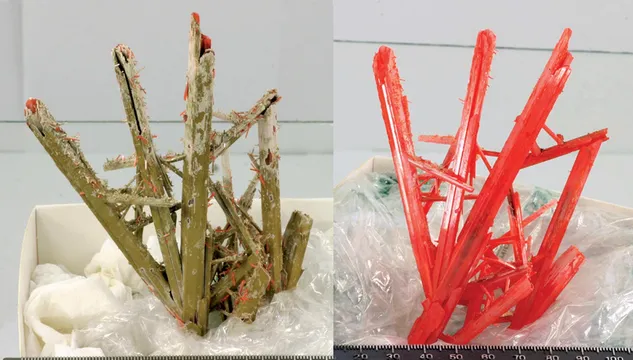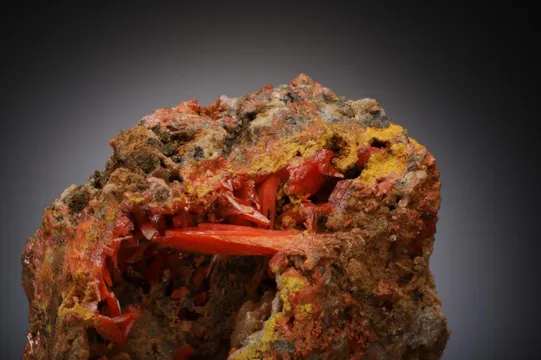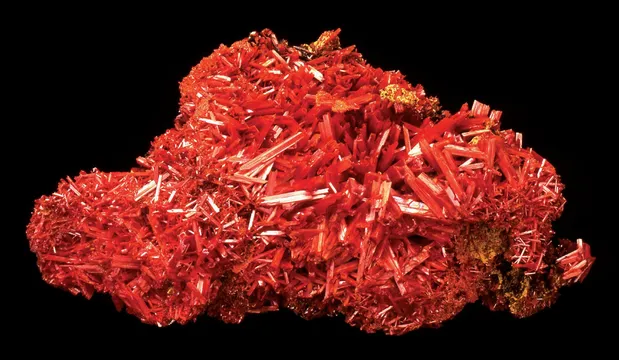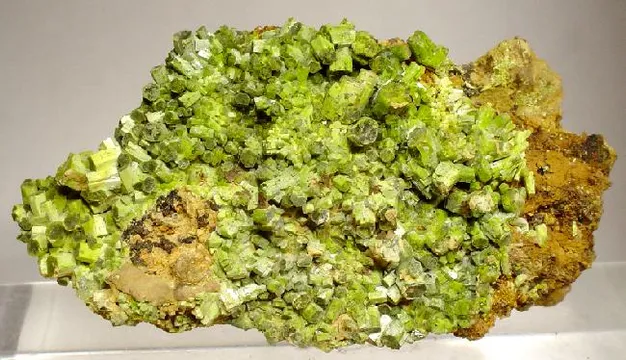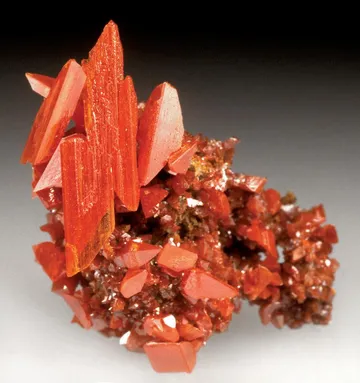
Crocoite from the Adelaide Mine, Tasmania: orange-red to crimson needle crystals with gossan matrix, prized for collecting quality and rarity.
Key facts
Adelaide Mine crocoite is the material by which most collectors learn what crocoite can be at its best: incandescent orange-red to deep crimson needles and prisms, often bristling from chocolate-brown to black gossan, sometimes with creamy gibbsite or white dundasite setting off the color. The finest specimens have the unruly architecture collectors call “jackstraw” — rigid, spear-like crystals crossing, leaning, and radiating through open pockets — but the best Adelaide pieces also show a sculptural balance that is surprisingly elegant for such a fragile mineral.

Photo: Didier Descouens / Wikimedia Commons
The mine lies in the Dundas mineral field near Zeehan on Tasmania’s west coast, in a geological setting almost custom-built for crocoite. Lead was supplied by galena-bearing lodes, chromium by nearby serpentinite and associated chromium-rich minerals, and the wet, acidic, deeply weathered gossan environment allowed mobile chromate-bearing fluids to meet lead in open cavities. The result was PbCrO4 in abundance: a rare chromate elsewhere, but at Adelaide present in quantities and quality unmatched in the collecting world.

Photo: Sailko / Wikimedia Commons
The locality is historically important not only as a lead-silver mine, but as one of the world’s great specimen mines. Crocoite was already famous from Adelaide by the 1890s, was traded internationally by early mineral dealers, and later became the focus of dedicated specimen mining by Frank Mihajlowits, Adam Wright, and The Adelaide Mining Company. Tasmania proclaimed crocoite its mineral emblem in 2000, and the Adelaide Mine is central to why that choice feels inevitable.
For collectors, the appeal is immediate but the evaluation is subtle. Color, luster, and undamaged crystal tips matter, of course, but so do matrix strength, aesthetics, three-dimensionality, whether the crystals are hollow or sharply terminated, whether gibbsite has obscured or etched the crocoite, and whether the piece represents a named pocket such as the 2010 Pocket, Premiere Pocket, Gibbsite Pocket, Black Forest Pocket, or the 2012 Red River Find.
Search for specimens: View all crocoite specimens from Adelaide Mine, Tasmania, Australia
The Adelaide Mine is an underground silver-lead mine at Dundas, in the Zeehan mining district of western Tasmania. The mine is also known historically as the Adelaide Proprietary Mine or Adelaide Pty Mine. It sits near the junction of Comet Creek and Adelaide Creek, close to the base of a spur of Stichtite Hill, roughly southeast of the old Dundas townsite and east of Zeehan.
The deposit belongs to the Dundas mineral field, a compact cluster of historic lead-silver workings including Adelaide, Red Lead, Dundas Extended, West Comet, Platt, Kosminsky, Comet, Maestries, and South Comet. The Adelaide Mine occupies one of the richest intersections of the field’s geology: Cambrian ultramafic rocks altered to serpentinite and related chromium-bearing assemblages, lead-bearing carbonate and sulfide zones, and deeply weathered gossans. Chromium from serpentinite-associated minerals and lead from galena-bearing lodes were brought together in the oxidized zone, where secondary minerals crystallized in open, porous cavities.
The mine was first claimed by T. Anderson in 1890 and was acquired the following year by the Adelaide Proprietary Silver Mining Company. By 1893 adits had been driven and a shaft had been sunk. Commercial ore production was disappointing at first, and the mine closed in 1895, but crocoite had already become known as one of its great prizes. New work in 1908 reached better lead-silver ore, and by the mine’s closure in 1915 it had produced lead, silver, and large quantities of gossan used as smelter flux.
The irony of Adelaide’s early history is that material now prized as world-class mineral specimens was often part of the gossan environment being mined and carted away. Some fine pieces were saved and entered collections, but great quantities of crocoite were destroyed during the era of ore mining. That loss is part of what gives early Adelaide specimens their aura: the survivors are not merely old, but rescued from an industrial episode that did not yet fully recognize their specimen value.
Adelaide also has a claim to being one of the earliest mines worked deliberately for scientific mineral specimens. In the late 1890s and early 1900s, the A. E. Foote mineral business marketed brilliant Tasmanian crocoite from the Adelaide area to collectors in the United States and Europe. The early descriptions emphasize red, highly lustrous, sharply crystallized crystals that outclassed the older Russian material then known to collectors.
Modern specimen mining gave the locality its present standing. Frank Mihajlowits, the “Crocoite King” of Zeehan, worked the mine from about 1970 until 2004 and opened several of the great pockets that established Adelaide as the premier crocoite source. In 2004 he sold the mine to The Adelaide Mining Company Pty. Ltd., associated with Adam Wright, Richard Wolfe, and Robert Reid, and specimen production continued.
The major modern production history is punctuated by named pockets. The 1971 discovery was a crystal-lined cave of exceptional beauty. The great 1990 watercourse, worked over many years, yielded thousands of specimens but also destroyed many because of the waterlogged, weak gangue and the extreme fragility of the crocoite. In 2006 the Premiere Pocket produced about 200 excellent specimens. In 2010, a crystal-lined chamber roughly 45 cm by 1 m by 2 m produced about 350 fine specimens, plus many loose crystals. In 2012, the Red River Find opened a long, wet, crocoite-lined watercourse that became one of the most famous modern mineral discoveries in Australia.
The mine remains an active specimen locality rather than a public collecting site. Access is controlled by the leaseholders and should be treated as private, hazardous underground mining ground. The workings are wet, muddy, confined, and locally unstable; specimens are embedded in friable gossan and waterlogged oxide material. Serious collectors should acquire pieces through reputable dealers or directly documented mine production, not by attempting unauthorized visits.
Adelaide Mine crocoite is typically orange-red, scarlet-red, or deep red-orange, with the best examples showing a fiery internal glow and vitreous to adamantine luster after careful cleaning. Color can vary within a pocket: the 2010 Pocket, for example, produced material ranging from intense bright orange through very deep red.
The classic habit is long-prismatic to acicular crocoite in sprays, reticulated masses, and jackstraw aggregates. Adelaide crystals are often hollow or partly hollow, a point that helps distinguish many Adelaide pieces from Red Lead Mine material, where solid, more transparent crystals are more characteristic. Good terminations are highly prized because many Adelaide crystals are broken, contacted, etched, or naturally incomplete. Thick, sharply terminated individual crystals are scarcer than dramatic sprays of thinner needles.
Crystal size varies widely. Small cabinet and miniature specimens commonly show crystals from a few millimeters to several centimeters. Better pocket pieces can carry crystals 5 cm or longer. Historic and modern reports document Adelaide crystals reaching 8–10 cm in important finds, 14 cm in the 2010 Pocket, and first-generation crystals over 20 cm in some gibbsite-rich material, though such large crystals are exceptional and often compromised by coatings, etching, hollowing, or damage.
The matrix is as much a part of Adelaide identity as the crocoite itself. The usual matrix is porous brown to black ferromanganese gossan, limonite, goethite, and other oxide mixtures. Some specimens are on crumbly earthy brown matrix; others are on black goethite-rich material that can make the red crystals especially dramatic. The matrix may be weak, waterlogged when mined, and prone to shedding grains or small crystal fragments as it dries.
Associated minerals include gibbsite, dundasite, cerussite, chrome-colored cerussite, goethite, limonite, coronadite, bindheimite, chlorargyrite, anglesite, mimetite, philipsbornite, phosgenite, quartz, dolomite, siderite, rhodochrosite, galena, sphalerite, pyrite, chromite, and fuchsite-bearing muscovite. For display specimens, the most visible associates are usually creamy gibbsite, white to pale greenish dundasite, white to yellow cerussite, and dark oxide matrix.
Gibbsite is especially important at Adelaide. It can form botryoidal or crusty coatings, cement crocoite into groups, or obscure the luster and color of the crystals beneath. In some material the removal of gibbsite reveals etched or scarred crocoite; in other pieces the gibbsite itself provides an attractive pale contrast. Some Adelaide specimens show multiple generations of growth, with early crocoite coated or partly replaced and later, cleaner crystals added over the top.
Quality is judged by a combination of intensity of color, brightness of luster, completeness of terminations, three-dimensional architecture, matrix stability, absence of obvious repairs, and freshness of the crystal surfaces. The highest-level Adelaide specimens are not necessarily the largest: a smaller, well-balanced piece with vivid color, open composition, and intact tips is often more desirable than a large but battered mass. Named-pocket provenance can add interest, particularly for the 2010 Pocket and Red River Find, but it should support the mineral quality rather than substitute for it.
Crocoite is beautiful but delicate. It has low hardness, brittle crystals, and a tendency to form thin, hollow prisms that snap with little pressure. Adelaide specimens should be handled by the matrix, kept away from vibration, and displayed where they cannot be brushed by sleeves, case doors, or cleaning cloths. Even good specimens may shed tiny fragments over time if the matrix is friable.
The species is PbCrO4, a lead chromate. It should be treated as a toxic mineral specimen: do not lick, grind, cut, tumble, or soak it casually; wash hands after handling; keep dust and broken fragments away from children and pets; and avoid any treatment that could create soluble lead or chromium compounds without proper chemical knowledge and disposal procedures. For ordinary display, intact crocoite is manageable with sensible mineral-collection hygiene.
Many Adelaide specimens have been chemically cleaned. This is not automatically a defect; it is part of the normal preparation history for much modern production, especially where black ferromanganese oxides or gibbsite coatings obscure the crystals. Documented preparation has included phosphoric acid baths and proprietary procedures used by experienced mine operators to remove coatings and reveal color and luster. Collectors should distinguish professional cleaning from crude overcleaning: etched, dulled, loosened, or unnaturally brightened-looking pieces deserve caution.
Repairs are a natural concern because Adelaide crocoite is so fragile. Broken crystal tips, reattached sprays, stabilized matrix, and glued fragments can occur in the marketplace. High-value specimens should be examined under magnification for glue lines, mismatched luster at breaks, oddly positioned crystals, or matrix patches that look consolidated. A repaired specimen may still be collectable, but the repair history should be disclosed and priced accordingly.
Old labels require close reading. Many historic pieces are labeled simply “Dundas,” “Zeehan,” or “Tasmania,” and even some “Adelaide” labels may reflect older lease names, dealer assumptions, or the broad use of Adelaide as a famous locality name. The Red Lead Mine lies very close to Adelaide on Stichtite Hill, and older locality attributions between the two can be complicated. When provenance matters, favor specimens with mine-issued labels, named-pocket documentation, trustworthy dealer history, or older collection labels that are consistent with the specimen’s habit and matrix.
Current market availability is better than for most world-class classic localities because the Adelaide Mine has had modern specimen production, yet fine pieces are still not common. Small fragments and modest sprays appear regularly; attractive miniatures and small-cabinet specimens are obtainable with patience; large, aesthetic, undamaged, named-pocket examples are significantly rarer. The top echelon — lustrous, well-composed, richly colored cabinet specimens with intact crystals — remains a serious collector purchase.
In July 1971, Frank Mihajlowits was working alone when he broke into the pocket that would make him legendary. The cavity was about eight feet long, six feet high, and four feet six inches wide. He opened the hole enough to push his light and arm into the space, and the beam caught a room lined with crocoite: roof, walls, and floor covered in red crystals from pin-sized needles to crystals exceeding three inches. The account preserved from that find says Frank was “spellbound by a scene of sparkling beauty,” and the phrase feels earned. Around 1,000 specimens came from the cave, with individual crystals to about 8 cm.
The 1990 watercourse was larger and more difficult. Mihajlowits first hit the upper part of a 14-meter-long crocoite-bearing channel but could not simply attack it from that point without dropping debris onto the better material below. His crew went back outside, opened a lower work face, and tried to intersect the channel from below. By early 1992 they had reached it again, only to discover they still were not at the lowest level. They ramped farther down toward the water table, then worked upward as groundwater became a problem. When the first large batches came out in late 1992 and early 1993, they included deep red-orange crocoite clusters with crystals to 10 cm, along with cerussite, dundasite, phosgenite, pyrite, and other associates. Over 14 years, thousands of fine specimens were recovered — and many thousands more were damaged or destroyed by the wet, weak gangue and the almost unreasonable fragility of the crystals.
Some of the named pockets from that long watercourse sound like chapters in a mine novel. The Gibbsite Pocket was the upper portion, where crocoite was thickly coated and, in places, badly etched beneath the coating. Some pieces showed up to seven generations of growth, with early crocoite crystals exceeding 20 cm. The Bridge Pocket came from pillars left to support a manual rail truck track that Mihajlowits had laid in the lower workings. Adam Wright later timbered around those pillars so they could be mined out. The Clay Pocket was a clay-filled zone, ranging from soft to concrete-hard, riddled with broken crocoite. The Black Forest Pocket took its name from black radiating sprays up to about 8 cm; when dried, much of that material proved so light, soft, and fragile that it could disintegrate.
The 2010 Pocket was found while the miners were trying to intersect the watercourse that had fed into the top of the 2006 Premiere Pocket. A series of raises gradually revealed more open, richer ground until the work ended in a crystal-lined chamber about 45 cm by 1 m by 2 m. Roughly 350 fine specimens were recovered, not counting loose crystals fallen from the hanging wall. The largest crystal attached to a cluster reached 14 cm and was terminated. Some pieces from the pocket appeared at Munich in 2010, and many more reached Tucson in 2011, where collectors immediately understood that Adelaide had delivered one of its great modern productions.
Then came Red River. In 2012, the Adelaide Mining Company opened a new watercourse pocket, and Thomas P. Moore of The Mineralogical Record visited with Bryan Swoboda of BlueCap Productions to document it. The approach itself was memorable: about 50 meters into the working entrance, up a few steel ladder rungs, then into a narrow muddy drift and along a crawlway to the pocket mouth. The opening was about a meter wide and 2 meters high, and the channel curved away with no visible end. The walls were wet, black and brown with oxides, and completely covered with fiery red to red-orange crocoite.
The scene was not a dry museum fantasy. It glistened. Water beaded on the crystals. Many crystals were clearly 5 cm or more, projecting into the open space at different angles. Some formed bunches and knots; others crossed like stacked weapons. Farther back, the light dissolved into reds and blacks, with orange points shining in the dark. The paradox of field collecting was naked there: the pocket was most beautiful before removal, yet it could only enter collections by being dismantled.
Near the Red River opening, Moore noticed a small vuggy zone on the adit floor and, with Adam Wright’s permission, spent half an hour extracting pieces with a prybar and gentle hammer taps. About a dozen specimens came out of what he jokingly named the “Mineralogical Record Pocket.” He carried four home in a keep-this-side-up cardboard box, fielding questions from airport security through three airports. Adam, with the casual confidence of someone who knew the mine intimately, removed far better specimens the same day — one a 12 cm crumbly matrix carrying a maze of red-orange crocoite rising a full 5 cm.
The ground around the mine carried its own poetry. Near the older entrance was a reddish-brown apron of waste the miners called “the red carpet,” made of limonite, goethite, mud, and millions of broken crocoite fragments. Walking over it produced the sound of countless tiny crystals breaking underfoot. It is a painful image for a collector, but an honest one: Adelaide Mine is not a place of pristine abstractions. It is mud, water, steel ladders, timber, oxide, patience, chemical preparation, breakage, rescue, and the occasional red miracle that survives intact.