A collector's guide to Dundas Extended Mine, Australia: its geology, mining history and notable minerals, illustrated with the 43 specimens documented from this locality on EarthWonders.
Key facts
Dundas Extended is one of the quieter but sharply distinctive crocoite localities of the Dundas mineral field on Tasmania’s west coast. It sits in the same remarkable geological province that made Dundas the world’s classic district for crocoite: lead-silver mineralization emplaced along fractured, brecciated contacts near chromium-bearing serpentinite, then deeply weathered in a wet climate into gossanous cavities where lead from galena and chromium from ultramafic rocks could recombine as PbCrO4. The mine is not the huge, museum-filling Adelaide Mine, nor the deep-red Red Lead Mine; its collector identity is more intimate and diagnostic. Dundas Extended is prized for small, bright, well-terminated crocoite crystals, including unusual pseudo-bipyramidal forms on pale quartz-rich matrix, and for yellow “chrome” cerussite in reticulated groups, plates and twinned cogwheel-like forms.
Regional View
Country View
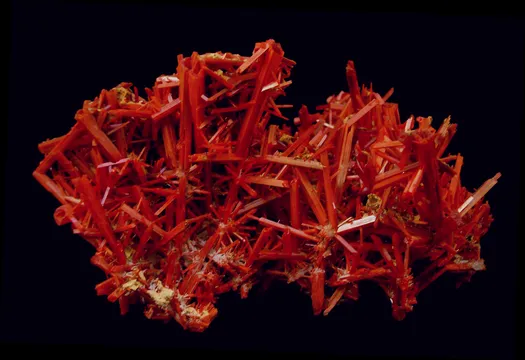
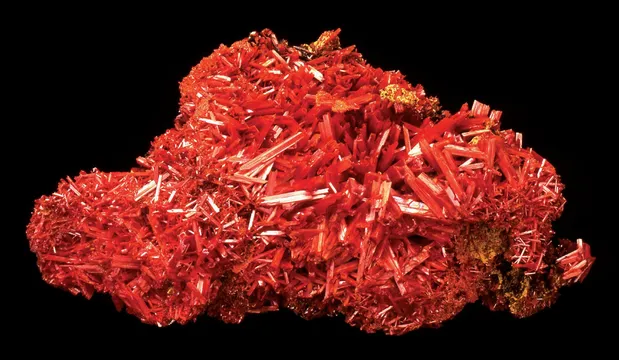
The best Dundas Extended specimens have an immediacy that appeals to connoisseurs: orange-red to pinkish-orange crystals perched on whitish granular quartz, iron-stained breccia, manganese-oxide-stained gossan or decomposed serpentinite, with individual crystals commonly modest in size but frequently sharp, glassy and complete. The locality is also historically important because it bridges the early silver-lead prospecting era of the 1890s and the modern Tasmanian specimen-mining tradition. In recent decades Mike and Eleanor Phelan have kept the mine alive as a small specimen operation, producing material for collectors, shops, tourists and researchers rather than bulk ore.

Photo: JJ Harrison, Wikimedia Commons
A necessary locality warning follows every serious discussion of Dundas Extended: the present Dundas Extended Mine is not the same locality as the Red Lead Mine. Older literature used “Dundas Extended” for operations around 1900 on ground now understood to belong to the Red Lead lease. Modern Dundas Extended specimens, especially those from the Phelan workings east of the old Dundas townsite, have their own recognizable matrix and habits and should not be folded casually into “Red Lead” or “Adelaide” provenance.
Search for specimens: View all specimens from Dundas Extended Mine, Australia
Dundas Extended lies in the Dundas mineral field of the Zeehan mining district, West Coast municipality, Tasmania, roughly 1.5 km east of the old Dundas townsite and several kilometres from Zeehan. The Dundas field is a compact but mineralogically extraordinary district, with mines developed along breccia zones near chromium-rich serpentinite bodies. The regional recipe is unusually favorable for crocoite: Ag-Pb-rich sulfide and carbonate veins containing galena were emplaced near serpentinite and serpentinite-derived rocks carrying chromite, chromian muscovite and related chromium phases; later oxidation and groundwater movement in the near-surface gossan allowed lead and chromate to meet under conditions where crocoite was stable.
The mine’s workings expose shattered quartzose rock, ore breccia, ferruginous and manganese-stained gossan, decomposed serpentinite, and pockets or seams where supergene lead minerals line openings. Incompletely decomposed galena has been observed in small masses within the fault-hosted workings, marking the primary lead source from which anglesite, cerussite and crocoite formed. Anglesite appears as an early alteration product in small, mostly fine-grained white to pale grey masses, but it has not been the species for which the mine is collected. Minor copper minerals — malachite, azurite and chrysocolla — occur as small facings and veinlets in the ore breccia. The specimen reputation of the mine rests overwhelmingly on crocoite and cerussite.
The nineteenth-century history of the ground is part mining record, part locality puzzle. An 1895–1896 Tasmanian mining report described a lease formerly associated with the Dundas Extended Company where an adit had been driven about 200 feet to cut the lode, a shaft had been sunk below adit level, and the country rock seen in the adit was strongly weathered serpentine. The inspector noted a large gossan body with a vein of chromate of lead, probably corresponding to a galena vein below, and remarked that pumping would be needed to work the lode properly. Later locality work distinguishes this present Dundas Extended Mine from the historical “Dundas Extended” name applied to some operations around what is now Red Lead ground, a distinction that matters greatly for old labels.
In the modern collecting era the mine became known through the work of Mike and Eleanor Phelan, who mined it from the mid-1980s as a small specimen operation. By 2019 the mine was publicly described as a hobby-scale operation with a 130-metre tunnel, a rail cart and camp facilities, offered for sale at $300,000 as the Phelans approached retirement age. Even so, the locality remained associated with small-scale specimen production and with the broader Dundas community of collectors and leaseholders rather than with industrial mining.
The notable productive areas reported from the present workings include the No. 1 raise, where doubly terminated elongated crocoite prisms to about 20 mm were found; the upper workings, where shattered quartz breccia carried isolated flesh-pink pseudo-bipyramidal crocoite crystals to about 5 mm; and the vicinity of the No. 2 raise and the southeast crosscut to it, where delicate reticulated cerussite, yellow “chrome” cerussite, beveled twinned forms and yellow plate aggregates were recovered. Some crocoite specimens mined about 2006 by Mike Phelan show bright crystals to around 15 mm on small cabinet-size matrix pieces, typical of the refined scale on which this mine is most satisfying.
Collecting access today should be treated as private or tenement-controlled mine access, not as casual fossicking ground. Tasmania’s declared fossicking areas have their own rules, and collecting outside those areas, on Crown or reserved land, private land or mineral tenements, requires the appropriate permission or authority. Dundas Extended is an underground mine with historic workings, unstable rock, water, shafts and fragile specimen zones; collector access is by permission only, and specimens on the market should be acquired through lawful mine, dealer or collection channels.
Crocoite from Dundas Extended is best appreciated as a locality of finesse rather than bulk: crystals are commonly acicular to slender prismatic, orange-red to orange-pink, on manganese-oxide-stained or ferruginous gossan, quartz breccia, decomposed serpentinite and especially a pale granular quartz-rich matrix that helps distinguish much of the mine’s output from Adelaide and Red Lead material. The most diagnostic pieces show small, sharply terminated pseudo-bipyramidal crystals, some only a few millimetres long and with a flesh-pink tint, while the No. 1 raise produced doubly terminated elongated prisms to about 20 mm; later finds also yielded more conventional prismatic crystals resembling nearby classic Dundas mines. Good Dundas Extended crocoite is sharply terminated, bright, undamaged and well isolated on contrasting matrix, or attractively associated with yellow cerussite; ordinary pieces tend to be small, broken, dull, crowded into iron-stained rubble, or lacking the crisp terminations that make the locality special.
Cerussite from Dundas Extended is a serious secondary lead species in its own right, especially the yellow “chrome” cerussite for which the mine is well known among Tasmanian specialists. It occurs as delicate reticulated white to yellow aggregates, bright yellow plates, prismatic to platey crystals, blocky forms, and beveled twinned crystals that can resemble little cogwheels; documented pieces include white-to-yellow reticulated groups around 13 mm, yellow crystals about 12 mm long, and larger quartz-matrix specimens with yellow cerussite and red crocoite. The best pieces come from zones such as the top of the No. 2 raise and the southeast crosscut to it, where open space allowed crisp intergrown forms rather than massive carbonate; collector-grade examples show strong yellow colour, undamaged openwork texture, visible twinning or plate development, and — at the top end — contrasting red crocoite on the same quartz-rich matrix.
Other minerals documented from Dundas Extended include anglesite, azurite, chrysocolla, galena, goethite, limonite, malachite, manganese oxides, quartz and talc, with chrome-cerussite treated as a yellow variety of cerussite rather than a separate species. These species are mostly paragenetic context rather than display minerals here: anglesite is generally minor and massive, copper minerals are sparse surface facings or veinlets, and galena is usually altered remnant ore. No type-locality species is established from the present Dundas Extended Mine in the available locality record; the famous Dundas type-locality minerals and extreme rarities — including dundasite from Adelaide and petterdite, philipsbornite and reynoldsite from Red Lead — belong to neighboring parts of the Dundas field and should not be transferred to Dundas Extended labels without specimen-specific evidence.
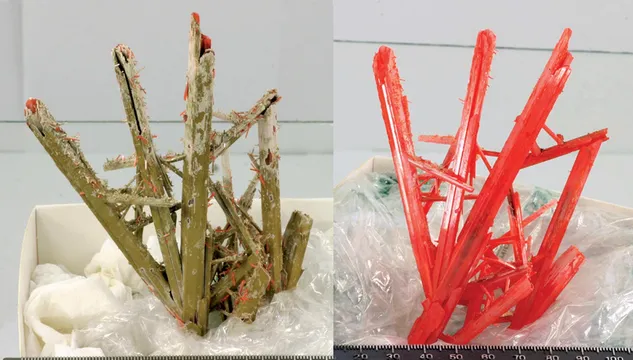
Dundas Extended crocoite is fragile even by crocoite standards. Many crystals are thin, small and highly exposed on crumbly gossan, quartz breccia or decomposed serpentinite, so the usual handling rule is absolute: pick up the specimen by solid matrix only, never by the crystals, and keep it away from sleeves, display-case doors, dusting brushes and vibration. Shipment should use a rigid box-in-box arrangement with the specimen immobilized from the matrix side; soft fiber pressed into the crystals is a common cause of breakage.
The most important authenticity issue is locality precision. “Dundas,” “Dundas Extended,” “Red Lead,” “Adelaide,” “West Comet” and “Mt. Dundas” have all appeared in old and modern usage, and the name Dundas Extended has been especially confusing because an older usage has been tied to ground now regarded as Red Lead rather than the present Phelan-operated Dundas Extended Mine. Modern Dundas Extended pieces often show smaller, sharply terminated crocoite, pseudo-bipyramidal habits, orange-pink tones, yellow cerussite associations and whitish quartz-rich matrix; large jackstraw sprays on limonite are more likely to invite Adelaide comparison, while richer deep red stout groups may invite Red Lead comparison. Provenance should be supported by a mine label, a known dealer chain, an old collection label consistent with the habit, or a specimen history that acknowledges the locality-name problem.
There is no well-documented Dundas Extended-specific fake industry, but the species and the district invite several practical cautions. Repaired crocoite exists in the wider Tasmanian market because crystals break easily; discrete repairs and stabilizing adhesives are not automatically disqualifying on good specimens, but they should be disclosed and evaluated under magnification. Reattached crystals, filled matrix gaps, glued loose sprays, and specimen composites are all worth checking for when a piece appears too perfect for its price. Yellow “chrome” cerussite should be labelled as cerussite variety chrome-cerussite or simply yellow cerussite, not as a separate mineral species.
Crocoite is PbCrO4, a lead chromate, and cerussite is PbCO3, a lead carbonate. Both should be handled with normal toxic-mineral discipline: do not lick, grind, cut, tumble, soak, or use them in jewelry or handling objects; wash hands after handling; and keep broken fragments and dust away from children and pets. Normal cabinet display is reasonable for intact specimens. Crocoite has a reputation for light sensitivity, and high-UV or direct sunlight should be avoided, but careful indoor display under low-UV lighting is generally considered far less risky than prolonged strong light exposure. The best practice is a stable, dry, low-vibration cabinet with filtered light and minimal handling.
Market availability is modest but real. Dundas Extended is not the dominant source of Tasmanian crocoite in world collections; Adelaide and Red Lead account for far more material. Its appeal is therefore selective: thumbnails and small miniatures with bright terminated crystals are obtainable, while large, aesthetic, undamaged pieces with strong colour and yellow cerussite associations are much less common. Cerussite from the mine is scarcer on the general market than crocoite and is especially worth considering when the locality, yellow colour and reticulated or cogwheel habit are well documented.
In the modern history of Dundas Extended, the most human episode is not a great pocket with a triumphant name, but a retirement advertisement from a ghost town. In April 2019 the mine appeared in Australian national news because Mike and Eleanor Phelan, after decades of work, were willing to sell their small west-coast Tasmanian hobby mine for $300,000. The offering sounded like the contents of a collector’s daydream and a bush mechanic’s shed at the same time: a 130-metre tunnel, a rail cart, camp facilities, a toilet and a barbecue, all attached to an underground source of Tasmania’s mineral emblem.
Mike Phelan’s own explanation was plainspoken and memorable. He had been “chiselling away in there” for decades and had reached retirement age. What he hoped for was not a casual buyer looking for a weekend novelty, but someone who could develop what he had already opened. His line that “a new team could find some really marvellous material there” captures the persistent optimism of specimen miners everywhere: every raise, crosscut and iron-stained fracture might be the one that opens into colour.
The setting sharpened the story. The Phelans were described as the only residents of the once thriving town of Dundas, which at its peak had about 1,000 people. Their life there was off-grid, practical and self-contained: gardening, hobbies, mineral work, and the quiet persistence of living among the ruins of a boomtown. They had worked as employees and contractors for major west-coast mines before taking on their own small leases. Dundas Extended was not presented as an easy fortune. Lease fees, public liability insurance and environmental bonds meant that a small mine needed real finds to pay its way. That is exactly why the best Dundas Extended specimens feel like they do: not anonymous commercial output, but the result of years of patient, selective work in a narrow and demanding underground setting.
A later glimpse from 2024 adds the physical texture that every collector should remember when holding one of these pieces. A Mindat gallery photograph by Chris Emproto records looking up a roughly 10-metre shaft inside Dundas Extended after he had climbed down it during a tour with Mike and Eleanor Phelan. It is a stark reminder that the small, precise crystals in a display case came from a wet, old, vertical and very real mine — a place of ladders, shafts, adits, fractured rock and the practiced caution of people who know exactly where to put a boot.