






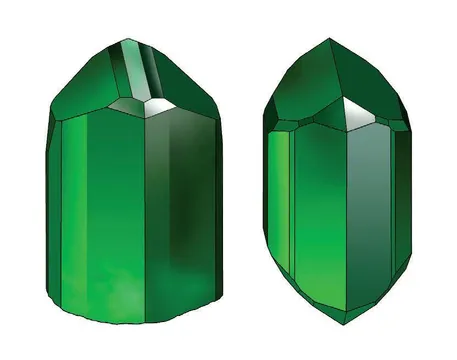
Australia: a continent-scale locality guide highlighting diverse mineral provinces, iconic specimens (crocoite, opal, sapphires), and top collecting hotspots.
Key facts
Australia is not a single mineral locality in the way that Tsumeb, Panasqueira, or Dalnegorsk is. For collectors it is something broader and, in many ways, more unruly: a continent-scale suite of classic specimen provinces, each with its own mineral language. The best Australian specimens carry unmistakable locality signatures—incandescent crocoite from the wet, gossanous mines of western Tasmania; rose-red rhodonite, pyromorphite, cerussite, smithsonite, linarite and arsenates from the Broken Hill lode system; black opal from Lightning Ridge; white and crystal opal from Coober Pedy and Mintabie; boulder opal in ironstone from Queensland; dark blue-green and parti-coloured sapphires from basaltic placer fields; and native gold from the Victorian and Western Australian goldfields.
Australia’s collecting importance rests on several very different geological settings. The Proterozoic zinc-lead-silver belt includes Broken Hill, Mount Isa, McArthur River and Cannington, with Broken Hill standing apart as one of the great mineralogical districts of the world. The Gawler Craton hosts Olympic Dam and the younger South Australian IOCG giants. The Great Artesian Basin and related deeply weathered Cretaceous sedimentary rocks supplied the silica pathways for precious opal. Tasmania’s Dundas field produced world-standard crocoite where lead-bearing lodes interacted with chromium-bearing ultramafic rocks during supergene alteration. Eastern Australian basalts shed sapphires, zircons and spinels into creeks and older alluvial leads. The Victorian goldfields yielded a sequence of legendary alluvial nuggets whose names still read like folklore.
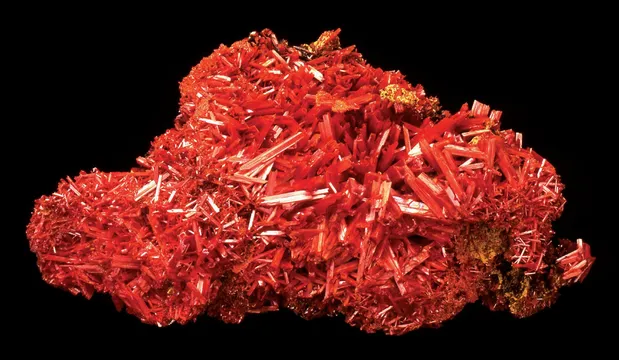
The look of fine Australian specimens is correspondingly diverse. A top Tasmanian crocoite is a spray of lacquer-red to orange-red needles, brittle as spun sugar, rising from brown-black gossan or set off against white dundasite. A good Broken Hill cabinet piece may be an old-time rhodonite with glassy rose blades, a cerussite from oxidized lead ore, a green pyromorphite cluster, or a rare arsenate/phosphate association that demands analytical confirmation. Australian opal is more gem than cabinet mineral in most collections, but a serious mineral cabinet can still include seam material, ironstone boulder opal, opal pseudomorphs and opalized fossils—objects in which mineral replacement and paleontology meet under a play of colour.
Regional View
Country View
For collectors, Australia is also historically central. Copper at Kapunda and Burra helped build colonial South Australia; Victorian gold transformed the colonies in the 1850s; Broken Hill gave its name to Broken Hill Proprietary and helped launch what became BHP; Mount Isa became a mining city around one of the great base-metal camps; Argyle reshaped the diamond market by making Western Australia synonymous with pink diamonds before closing in 2020. Mineral specimens from these districts therefore sit at the intersection of cabinet aesthetics, mining history, and national identity.

Photo: Wikimedia Commons

Photo: Wikimedia Commons

Photo: Wikimedia Commons
Search for specimens: View all specimens from Australia
Australia’s specimen localities are best understood by province. The Broken Hill district of far-western New South Wales is the country’s classic mineral-specimen engine: a giant metamorphosed silver-lead-zinc lode, the Line of Lode, discovered in 1883 and mined for well over a century. Its orebody is long, folded, structurally complex, and mineralogically extravagant. The primary assemblage is dominated by galena, sphalerite, pyrrhotite, pyrite, arsenopyrite, quartz, garnet, rhodonite, bustamite and fluorite-bearing gangue, while oxidation and later mining exposures created an extraordinary secondary suite. For the collector, Broken Hill is not just an ore deposit; it is a source of species diversity, old cabinet classics, and rare minerals that remain tied to very specific mine names and open cuts: Kintore, Block 14, Potosi, North Mine, South Mine, Zinc Corporation, British, BHP, Pinnacles and others.
The Kintore Opencut, active from the late 1980s to 1996, was especially important for secondary species. It worked the oxidized southern end of the Broken Hill lode and became a celebrated source of small but highly varied specimens: chlorargyrite and bromargyrite, pyromorphite, cerussite, anglesite, mimetite, stolzite, smithsonite, linarite, malachite, azurite, serpierite, kintoreite-group phosphates and rare arsenates. A serious Broken Hill label should ideally include the mine or cut, not merely “Broken Hill,” because the difference between Kintore, Block 14 and Potosi is mineralogically meaningful.
The Dundas mineral field on Tasmania’s west coast is the other Australian locality every collector learns early. There, the Adelaide Mine, Red Lead Mine, West Comet, Dundas Extended and related workings cut oxidized lead-silver lodes in a district where chromium-bearing ultramafic rocks supplied the chemistry for crocoite. The resulting PbCrO4 crystals are among the most visually arresting mineral specimens on Earth: brilliant red-orange prisms, needles and jackstraw sprays, often extremely delicate. Associated minerals include cerussite, pyromorphite, gibbsite, dundasite, manganese oxides and iron oxides. The Adelaide Mine, historically a silver-lead mine, later became a specimen mine, and modern pockets have continued to supply the market in small bursts rather than in predictable production.
Australia’s opal fields belong to a different collecting tradition. Precious opal formed in weathered Cretaceous sandstones and mudstones where silica-bearing groundwater moved through joints, faults, cavities and bedding surfaces, then hardened into veins, lenses and replacements. Lightning Ridge in New South Wales is the classic home of black opal, with dark body colour carrying intense play-of-colour. White Cliffs is famous both historically and for opal pseudomorphs after ikaite known to collectors as “opal pineapples.” South Australia’s Coober Pedy is the great white-opal field; Andamooka and Mintabie added crystal, light and darker opals to the Australian reputation. Queensland’s boulder opal fields, running through districts such as Quilpie, Yowah, Winton, Eromanga and Koroit, produce precious opal in ironstone concretions and seams, giving collectors and lapidaries specimens where the host rock is part of the aesthetic.
Corundum collecting in Australia is centred on placer sapphire fields. In New South Wales, the New England district around Inverell and Glen Innes is a major source; in Queensland, the Central Queensland Gemfields around Anakie, Sapphire, Rubyvale, the Willows and Glenalva have long supplied dark blue, green, yellow and parti-coloured sapphire, along with zircon and other heavy minerals. These deposits are generally secondary concentrations derived from basaltic volcanic terrains or related alluvial systems. Fine single sapphire crystals are less commonly cabinet minerals than cut stones, but well-shaped, waterworn crystals and parcels of associated heavy-mineral concentrate have strong locality appeal.
Australia’s gold localities are broad and historically layered. Victoria’s central goldfields—Ballarat, Bendigo, Castlemaine, Dunolly, Moliagul, Wedderburn and surrounding districts—produced some of the world’s most famous alluvial nuggets. Western Australia’s Yilgarn goldfields, including Kalgoorlie and the Eastern Goldfields, became a long-lived hard-rock and alluvial gold province. Collectible Australian gold spans crystalline leaf and wire forms, reef gold in quartz, nugget gold, and historic casts of vanished nuggets that were quickly melted after discovery.
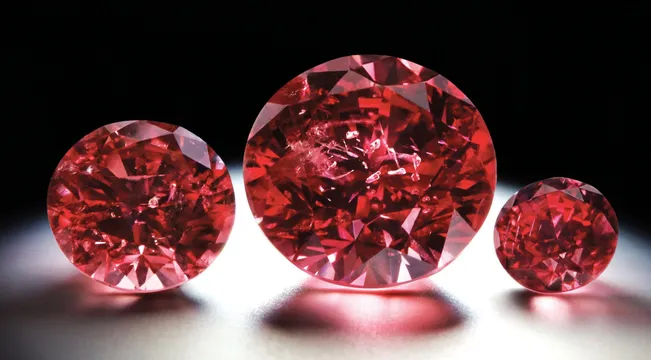
Diamonds belong chiefly to the Kimberley story. The Argyle diamond mine in Western Australia, discovered in 1979 and mined from 1983 until its final day of mining on 3 November 2020, was a lamproite-hosted deposit that became the world’s defining source of pink, purple and champagne diamonds. Cabinet mineral collectors encounter Argyle mostly through gem diamonds and historical provenance rather than matrix specimens, but its closure permanently changed the availability and significance of documented Argyle stones.
Collecting access in Australia is not uniform. Mineral ownership, fossicking rules and permit requirements are handled by state and territory authorities, and active mining leases are not open collecting grounds. Queensland requires a fossicking licence and restricts fossicking to hand tools and recreational or educational activity. New South Wales allows fossicking under the Mining Act framework, with additional permit requirements in State forests and ongoing consent rules for land access. South Australian opal mining and prospecting are separately regulated under opal-mining legislation, with precious-stones fields such as Coober Pedy, Andamooka, Mintabie and Stuart Creek subject to specific rules. In practical collecting terms, the safest legal opportunities are designated fossicking areas, fee-dig or tourist noodling areas, shows, old collections, and specimens purchased from miners or dealers with clear provenance.
Australia’s national mineral list is immense, and country-level databases record hundreds of localities and a large number of valid type-locality species. The collector’s task is not to memorize the whole list, but to understand which Australian occurrences define the country in cabinets.
Crocoite is the most dramatic Tasmanian contribution. Although the species was first described from Russia, the finest and most abundant collector specimens are from Dundas, especially Adelaide and Red Lead. The best pieces have intense orange-red colour, slender prismatic crystals, open vugs, and enough matrix to protect what is otherwise a notoriously fragile mineral. Dundasite, PbAl2(CO3)2(OH)4·H2O, is itself a Tasmanian type-locality mineral from the Adelaide Mine and is most familiar to collectors as white to cream sprays or crusts associated with crocoite. Stichtite, Mg6Cr2(OH)16[CO3]·4H2O, is another Tasmanian signature species: lilac to purple, soft and waxy, commonly in green serpentinite from Stichtite Hill and related Dundas-area serpentinites. These Tasmanian chromium minerals are not merely pretty; they record unusual alteration chemistry in ultramafic rocks.
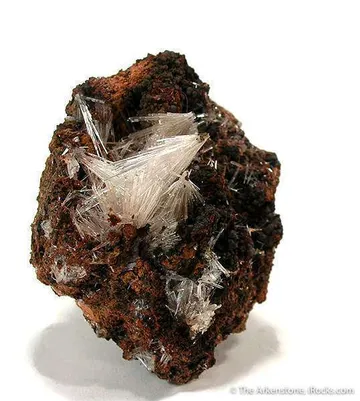
Broken Hill is Australia’s great species locality. Its mineralogy ranges from common ore minerals to highly specialized secondary arsenates, phosphates, carbonates, halides and sulfates. The district is especially prized for rhodonite and bustamite associated with the metamorphosed lode, for cerussite and pyromorphite from oxidized lead zones, for smithsonite, anglesite, linarite, malachite and azurite, and for rare species that emerged from specific open cuts and mine dumps. The phrase “Broken Hill” on a label should make a collector ask a second question: which mine, which cut, which part of the Line of Lode?
The district has also produced scientifically important new species. Hoganite, Cu(CH3COO)2·H2O, and paceite, CaCu(CH3COO)4·6H2O, were described from the Potosi Pit as natural acetate minerals—an extraordinary organic-mineral occurrence linked to copper-bearing gossan and post-mining environments. Nyholmite, Cd3Zn2(AsO3OH)2(AsO4)2·4H2O, was described from the Block 14 Opencut as a cadmium-zinc arsenate related to the hureaulite group. Kintoreite, PbFe3(PO4)2(OH,H2O)6, gives the Kintore Opencut a name embedded in mineral nomenclature. Such species are typically micromount or analytical minerals, not showy cabinet pieces, but they are central to why Broken Hill remains a reference locality.
Opal is Australia’s national gemstone and the mineralogical material most closely identified with the country outside specialist collecting circles. Chemically it is hydrated silica, SiO2·nH2O, and its play-of-colour is produced by the diffraction of light through ordered silica spheres. Lightning Ridge black opal is the aristocrat: dark body tone, sharp spectral colour, and a capacity for red, orange, green and blue fire against a nearly black ground. Coober Pedy material is usually lighter-bodied, often white to pale, and historically abundant. Mintabie is noted for crystal opal and darker material; Andamooka for matrix and treated matrix material as well as solid opal; Queensland for ironstone-backed boulder opal, Yowah nuts and matrix patterns. White Cliffs adds the mineralogical curiosity of opal pseudomorphs after ikaite—the famous opal pineapples.
Australian sapphire is a basalt-related placer story. The crystals are typically alluvial, tough, waterworn and often dark blue, blue-green, green, yellow or parti-coloured. New England and Central Queensland material may not always match the cornflower-blue ideal marketed elsewhere, but good Australian sapphire has a distinctive palette and is valued today for its traceable origin, durability and often unheated character when properly documented.
Native gold from Australia includes some of the world’s most storied nuggets. Most historic giant nuggets were melted, so original large pieces are exceedingly rare; casts and replicas carry much of the historical record. Smaller nuggets and crystalline gold from Victoria, Western Australia and other fields remain available, but documented locality and natural surface are decisive for collector value.
Australian specimens reward precise labels. “Australia” alone is too broad for serious collecting, and even “Broken Hill” or “Tasmania” may be insufficient. A rhodonite from Broken Hill, a pyromorphite from Kintore, a crocoite from Adelaide, and a crocoite from Red Lead are not interchangeable in advanced cabinets. For opal, the distinction between Lightning Ridge, Coober Pedy, Andamooka, Mintabie, White Cliffs, Yowah and Koroit is commercially and aesthetically significant. For sapphire, ask whether a stone is from New England, Anakie/Rubyvale, Lava Plains or another field.
Crocoite needs special handling. It is lead chromate, so normal mineral hygiene applies: do not grind it, lick it, clean it aggressively, or leave broken dust where it can be ingested; wash hands after handling. Its greater everyday problem is physical fragility. Tasmanian crocoite needles shear off easily, and many otherwise fine pieces have lost terminations in shipment or cabinet handling. The best examples are often mounted in protective boxes, and a slightly recessed vug can be more durable than a spectacular spray projecting far beyond the matrix.
Australian opal is commonly sold as solid opal, boulder opal, doublet or triplet. These are not the same product. A solid Lightning Ridge stone is a single piece of opal; Queensland boulder opal includes natural ironstone backing; a doublet is an assembled stone with a thin opal layer adhered to a backing; a triplet adds a transparent cap. Doublets and triplets can be legitimate when disclosed, but they are a major source of misrepresentation. Closed-back jewellery, perfectly flat dark backing, visible glue lines, a glassy domed cap, or suspiciously bright colour at a low price should prompt caution. Solid opal can craze, and opal should be protected from impact, sudden temperature change and careless ultrasonic cleaning; doublets and triplets are especially vulnerable to water penetration and adhesive failure.
Opalized fossils deserve extra care in both ethics and legality. Australia’s opal fields have produced scientifically important Cretaceous plant, invertebrate and vertebrate fossils, some preserved in precious opal. Collectors should be alert to export restrictions, provenance, and the difference between ordinary opal rough and paleontologically significant material.
Australian sapphire is widely treated in the gem trade, especially by heating, though unheated stones exist and command interest when documented. Dark blue Australian sapphire may cut nearly black if oriented poorly, while parti-coloured material can be much more attractive than older market prejudices suggest. For mineral collectors rather than gem buyers, intact alluvial crystals with field provenance are often more interesting than anonymous parcels of cut stones.
Broken Hill rarities require discipline. Many secondary species are visually similar at small scale, and older labels may reflect pre-analytical identifications. Rare arsenates, phosphates and organic minerals such as hoganite and paceite should not be bought on colour alone. If the specimen value depends on a rare species name, insist on credible provenance, prior analytical work, or a seller willing to support verification.
The great Australian mineral story begins, for many collectors, not in a mine office but under a tree at Bulldog Gully. On 5 February 1869, Cornish miner John Deason was working near Moliagul in central Victoria when his pick struck something only a few centimetres below the surface. The object was too large to be a normal nugget. Deason and his partner Richard Oates concealed it until dark, dug it out, and later revealed it at a party. The “Welcome Stranger” became the largest-known alluvial gold nugget, so large that when it reached Dunolly it had to be broken on an anvil before the bank could weigh it. The tragedy for collectors is that the original did not survive as a specimen; like so many giant gold finds, it passed quickly into bullion history. Its afterlife is in casts, replicas, sketches, monuments and the stunned arithmetic of weight and value.
Eleven years earlier, Ballarat had its own astonishing moment. On 9 June 1858, the “Welcome” nugget was found at Bakery Hill by the Red Hill Mining Company. The Australian Museum’s account places it 180 feet down in loam in a creek bed and records a party of 22 Cornishmen sharing the fame. Richard Jeffrey is credited in that account as the man whose pick uncovered it; the story says he fainted, and his companions first thought he was dead. The nugget was later sold and melted in London. What remains for museums are replicas—objects that are not mineral specimens in the strict sense, but are historically indispensable because the originals vanished into the furnace.
The opal fields have a different tone: not the shout of a single gold strike, but the glint of colour in hostile ground. Coober Pedy’s origin story begins in 1915, when a party was prospecting for gold near the edge of the Great Victoria Desert. A 14-year-old boy found opal, and the Stuart Range Opal Field became the settlement now known as Coober Pedy. The irony is perfect: a search for gold helped open one of the world’s great opal districts. The material that made the town famous formed quietly in old sedimentary rocks, in veins and lenses where silica-bearing groundwater hardened in the right cavities.
Australian opal can preserve more than colour. Coober Pedy yielded “Eric the Pliosaur,” a Cretaceous marine reptile now associated with the Australian Museum collection, remarkable not only because its bones are opalized but because even stomach contents from its last fish meal were replaced by opal. Lightning Ridge has produced opalized dinosaurs, early mammals, shells, crustaceans and plants, turning a gemstone field into a paleontological archive. In these specimens, play-of-colour and fossil anatomy may compete for attention, but the scientific value often lies in the form rather than the fire.
In Tasmania, the drama is underground and fragile. Crocoite at Dundas is not mined like ore in the modern specimen era; it is uncovered like a glass sculpture embedded in damp iron-stained clay and gossan. Modern Adelaide Mine work has produced named finds, including the Red River Find, documented in specimen-mining footage showing miners planning and extracting a crocoite plate rather than simply breaking rock. The care is necessary because a fine crocoite can be destroyed by the very act of winning it. The most theatrical pieces look explosive—red needles radiating from cavities—but the practical art is restraint: remove the pocket, keep the crystals intact, and get the specimen from Tasmania to a cabinet without turning it into red dust.
Broken Hill’s story is grander and more industrial. Charles Rasp, a boundary rider and prospector, recognized the mineral potential of the weathered outcrop in 1883, and the Syndicate of Seven became tied to one of the world’s great silver-lead-zinc ore systems. The lode built a city in the desert, helped create major mining companies, drove union history, and produced a mineralogical wealth that later collectors and museums would spend generations trying to organize. The phrase “mineralogical rainforest” has been applied to Broken Hill for good reason: within an arid landscape, the lode and its oxidized workings yielded a dense ecological tangle of species.
W. D. Birch, ed., Minerals of Broken Hill, Broken Hill City Council in association with Museum Victoria, 1999 — The essential modern book-length reference on Broken Hill mineralogy and collecting history.
Broken Hill City Council, Albert Kersten Mining and Minerals Museum collection notes — Useful for the museum history of the Broken Hill civic collection, including its approximately two thousand specimens and reference to hoganite and paceite.
P. Elliott, P. Turner, P. Jensen, U. Kolitsch and A. Pring, “Description and crystal structure of nyholmite, a new mineral related to hureaulite, from Broken Hill, New South Wales, Australia,” Mineralogical Magazine, 73(5), 723–735, 2009 — Type description of nyholmite from the Block 14 Opencut.
D. E. Hibbs, U. Kolitsch, P. Leverett, J. L. Sharpe and P. A. Williams, “Hoganite and paceite, two new acetate minerals from the Potosi mine, Broken Hill, Australia,” Mineralogical Magazine, 66(3), 459–464, 2002 — The key paper on the unusual natural acetate minerals from Broken Hill.
Western Sydney University record for “Hoganite and paceite: two new acetate minerals from the Potosi mine, Broken Hill, Australia” — Abstract and bibliographic record emphasizing their occurrence as isolated crystals in ferruginous gossan.
R. S. Bottrill, P. A. Williams, S. Dohnt, S. Sorrell and N. R. Kemp, “Crocoite and associated minerals from Tasmania,” Australian Journal of Mineralogy, 2006 — Publication record for the modern study of Tasmanian crocoite and its associations.
Geoscience Australia, Major hydrothermal and orthomagmatic mineral provinces of Australia — A high-level geological framework for Australia’s principal ore provinces, including Broken Hill, Mount Isa, Olympic Dam, Argyle, Tanami, Cadia and others.
J. Coenraads, “Evaluation of potential sapphire source rocks within the catchments of Kings Plains Creek and Swan Brook, near Inverell, New South Wales,” Records of the Australian Museum, 46(1), 5–24, 1994 — Important geological work on source rocks for the New England sapphire fields.
Geoscience Australia, Opal — Authoritative summary of Australian opal formation, fields, production history and opalized fossils.
Geoscience Australia, Sapphire and Ruby — Overview of Australian corundum formation, eastern Australian placer fields, and historical production.
“Crocoite Plate from Adelaide Mine,” BlueCap Productions — Short field video showing the planning and extraction of a crocoite plate from the Adelaide Mine’s Red River Find.
“The Adelaide Mine,” BlueCap Productions — Underground look at the Adelaide Mine, Tasmania, and its modern crocoite specimen mining.
Mindat: Australia — Country-level mineral and locality database; useful starting point for Australian specimen provenance.
Mindat: Broken Hill, New South Wales — Core reference locality page for Broken Hill, including mineral lists and type-locality indicators.
Mindat: Kintore Opencut, Broken Hill South Mine — Important Broken Hill sublocality for secondary species and late twentieth-century collecting.
Mindat: Adelaide Mine, Dundas, Tasmania — Reference page for the classic Tasmanian crocoite locality.
Mindat: Best Minerals — Crocoite — Collector-oriented overview of the world’s best crocoite localities, with strong coverage of Dundas.
Australian Museum: Crocoite on limonite — Museum specimen note explaining the importance of Dundas crocoite and the Adelaide Mine.
Australian Museum: Opal — Accessible but authoritative overview of Australian opal types and localities.
Australian Museum: Black Opal — Focused reference for Lightning Ridge black opal.
Geoscience Australia: Opal — Best single government overview for Australian opal geology, fields and production context.
Geoscience Australia: Gold — Useful background on Australian gold, including famous nugget history.
Geoscience Australia: Sapphire and Ruby — Government overview of Australian sapphire and ruby occurrences.
City of Broken Hill National Heritage listing, Department of Climate Change, Energy, the Environment and Water — Heritage context for Broken Hill’s mining history, Line of Lode and national significance.
Broken Hill City Council: Albert Kersten Mining and Minerals Museum collection — Local museum collection summary and a useful guide to Broken Hill’s collecting stature.
Queensland Government: Fossicking rules and permitted activities — Current legal framework for recreational fossicking in Queensland.
NSW Resources: Fossicking in NSW — Starting point for New South Wales fossicking rules.
Service NSW: Apply for a permit to fossick in a NSW State forest — Practical permit information for fossicking in NSW State forests.
South Australia Energy & Mining: Regulating opal mining — Official rules and regulatory background for South Australian opal mining.
SA.GOV.AU: Opal mining — precious stones prospecting permit — Permit information for South Australia’s proclaimed opal fields.
Museums Victoria: Gold Nugget “Welcome Stranger” — Museum account of the 1869 Moliagul discovery and the fate of the world-famous nugget.
Australian Museum: “Welcome” Gold Nugget Replica — Museum specimen note on the 1858 Ballarat “Welcome” nugget replica.
Rio Tinto: Argyle diamond mine final production — Official account of Argyle’s final day of mining on 3 November 2020.
Rio Tinto: Argyle — Current official page for the closed Argyle mine, its legacy, closure work and pink diamond brand.

_4_(29911429675).jpg)
