Red Lead Mine, Australia - Tasmanian crocoite hub famed for gemmy scarlet-red prisms on dark gossan, rare associated minerals, and strong collecting appeal.
Key facts
Red Lead Mine is one of the key names in the Tasmanian crocoite story: a compact but mineralogically rich silver-lead working in the Dundas mineral field, near Zeehan on the wet west coast of Tasmania. Collectors care about it because its best crocoite is not merely abundant-looking orange fuzz, but lustrous, solid, well-terminated red to red-orange prisms on dark ferruginous to manganiferous gossan. In the Dundas district, lead from galena-rich lodes met chromium supplied by altered Cambrian ultramafic rocks and associated chromian minerals; deep weathering did the rest, opening vugs in porous gossan where crocoite, cerussite, anglesite, petterdite, philipsbornite, coronadite, chalcophanite and other supergene species could crystallize.
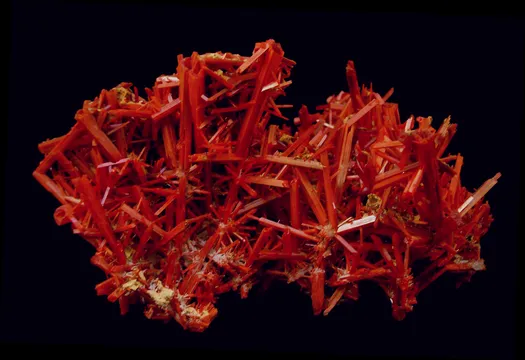
Historically, Red Lead belongs to the same South Dundas constellation as Adelaide, West Comet, Dundas Extended, Platt and Kosminsky, but it has its own personality. Where Adelaide is famous for prolific pockets and, at times, hollow “jackstraw” crocoite, Red Lead is noted for fewer but exceptionally gemmy, solid crystals, commonly on dark gossan and locally associated with pale lead carbonates, sulfate alteration, manganese oxides and rare chromium-bearing secondary minerals. The mine’s early silver-lead work began in the 1890s, its name became attached to crocoite specimen mining in the twentieth century, and modern small-scale specimen operations have kept Red Lead material visible in the collector market.
Regional View
Country View
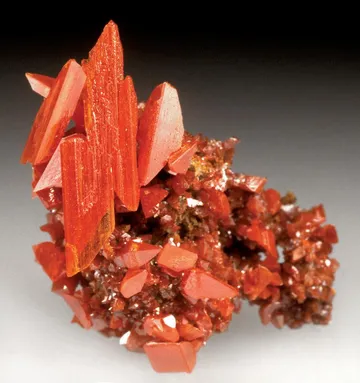
The finest Red Lead crocoites have the punch that made Tasmanian crocoite the world standard: sharply glowing scarlet to orange-red crystals, glassy to adamantine faces, strong contrast against black-brown gossan, and enough three-dimensional openness to show individual prisms rather than a matted crust. The top pieces are scarce because the pockets are narrow, wet, clayey, and mechanically unforgiving; a specimen can be geologically perfect and still be lost to mud, vibration, water, transport, or one careless touch.
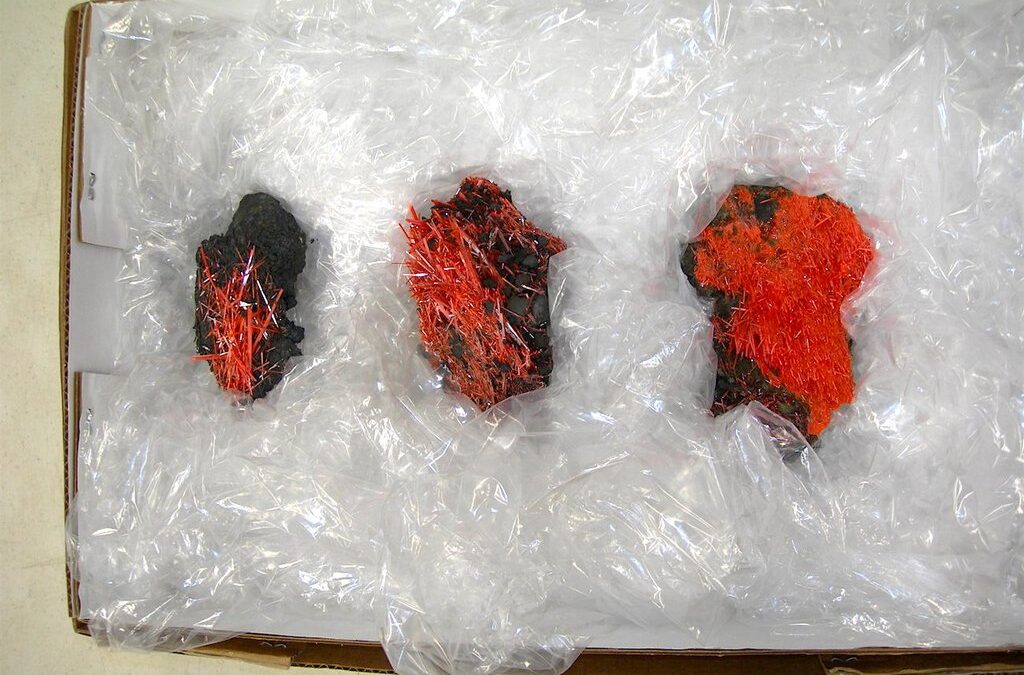
Photo: Collector’s Edge Minerals
Search for specimens: View all specimens from Red Lead Mine, Australia
Red Lead Mine is in the Dundas region of western Tasmania, approximately 10 km northeast of Zeehan and roughly 1 km south of the Adelaide Mine. The country is steep, wet, forested and historically difficult mining ground. Access to the mine area is by dirt road shared in part with the Adelaide workings, but the locality is not a casual public fossicking site. Collectors should treat it as a tenemented, worked, hazardous mine locality: entering or collecting requires permission from the owner or leaseholder and compliance with Tasmanian land-access and mining rules.
The deposit is a supergene silver-lead-crocoite occurrence developed in the oxidized parts of Pb-Zn-Ag lodes at South Dundas. The local bedrock setting is crucial. The lodes and their alteration products occur as veins and pods in carbonate-rich fault zones between Cambrian serpentinites or ultramafic rocks and sedimentary rocks. Hydrothermal alteration tied to regional Devonian intrusive activity produced carbonate-rich, quartz-bearing and chromian-muscovite-bearing altered ultramafic rocks, including listwanite-type assemblages. Later deep weathering converted the upper ore zones into porous goethite- and manganese-oxide-rich gossans.
The classic Red Lead chemistry is a rare coincidence: galena and other lead minerals supplied Pb; chromite, stichtite and chromian muscovite in the nearby ultramafic rocks supplied Cr; acidic oxidizing groundwater mobilized and recombined those elements in open fractures, cavities and vugs. Anglesite commonly forms early in the oxidation sequence from galena and may be followed, replaced or overgrown by cerussite, crocoite and other secondary lead minerals depending on acidity, carbonate availability and local anions. This explains both the brilliance of the crocoite and the presence of odd chromium-bearing rarities in the same gossan.
The mine’s first phase was not specimen mining but silver-lead exploration and extraction. The working was discovered by Thomas Page of Zeehan in 1890 and was initially associated with the historical name Dundas Extended, a source of later label confusion because the modern Dundas Extended Mine is a separate collecting locality. Early development reached the ore by a vertical shaft about 25 m deep and a horizontal adit about 92 m long. The oxidized nature of the ore frustrated conventional ore mining, but the red crystals recovered during this early work were immediately important to collectors because they surpassed the old Russian crocoite specimens in size and visual impact.
Mining resumed around 1902 for roughly two years, not primarily for collector specimens but for ferro-manganese material processed at Zeehan smelters for silver. During that period additional adit work was driven from the base of the 25 m shaft to intersect a broader part of the ore body. The name “Red Lead” appears to have become attached to the mine during or after this phase, an apt miner’s name for a place where scarlet lead chromate was so conspicuous in the gossan.
After long idle periods, the locality became a specimen mine. Surface work from the mid-1970s through the following decades recovered crocoite and associated minerals, and in 1986 Shane Dohnt acquired the lease. His work began in open-cut ground but later shifted underground into the old workings in search of better protected crocoite pockets. In October 2012, Collector’s Edge Minerals partnered with Dohnt to reopen, retimber and work the mine specifically for high-quality crocoite specimens. That modern phase involved cleaning out the old adit, drainage, new shoring and ventilation, mapping, and small mechanized mining suitable for narrow tunnels.
The underground workings described from the modern operation were tight: about 1.5 m wide and 2.4 m tall in places, with exploration of veins roughly 18–21 m below the existing open pit floor. The main tunnel was mapped at about 200 m long as of 2013, with crosscuts into fault zones carrying crocoite mineralization. The ground is wet and unstable, so wire mesh, new timbering, ventilation and careful extraction methods are central to preserving both people and specimens.
The best Red Lead crocoite comes from open cavities along the main lode, typically a few centimeters to nearly a meter long but only a few centimeters wide. Some pockets are clay-filled, which can protect crystals; others are tight fractures completely packed with crocoite but too narrow or too intergrown to yield aesthetic specimens. Small pneumatic tools may be used where clay and matrix can be worked gently, while larger blocks have been removed with a diamond chainsaw. Recovered specimens have been staged underground, packed, moved to the surface, then prepared and trimmed off site.
Documented modern pockets include Hannah’s Lode and the “Stop The Bleeding Pocket,” a small cavity reported at only about 60 cm wide, 10 cm high and 30 cm deep, yet productive enough to earn a name. More broadly, Red Lead has yielded bright red crystals in pockets a few centimeters across, vugs around 10 cm long, miniature specimens, fan-like clusters, and larger cabinet pieces. Historical reports and modern observations record crystals commonly in the 10–15 cm range, with evidence of crystals to about 30 cm that were too fractured to recover intact. Unlike the richer Adelaide pockets, Red Lead has not produced great abundance; its reputation rests on quality, gemminess and color rather than tonnage of specimens.
Crocoite from Red Lead Mine is prized for solid, lustrous, red to red-orange prisms in gossan cavities rather than the hollow, jackstraw-like habits so characteristic of some Adelaide Mine production. Good crystals may be sharp, transparent to translucent, strongly terminated and dramatically set on dark goethitic or manganese-rich matrix; documented Red Lead crystals commonly reach several centimeters and historically have been reported around 10–15 cm, with longer fractured crystals known but rarely recoverable. Associations include goethite and “limonite,” galena alteration products, anglesite, cerussite including pale greenish to yellow “chrome cerussite” material, petterdite, philipsbornite, grimaldiite, coronadite, lithiophorite and chalcophanite. The best Red Lead pieces separate themselves from ordinary Tasmanian crocoite by color saturation, glassy faces, intact terminations, sculptural spacing, and the dark gossan contrast that makes individual crystals look lit from within.
Beyond crocoite, Red Lead is a collector’s locality for rare supergene lead-chromium and lead-manganese chemistry. Petterdite, PbCr2(CO3)2(OH)4·H2O, is the Red Lead type-locality mineral: a pale grayish to pinkish-violet, earthy to pearly Cr-dominant analogue of dundasite occurring as thin crusts of microscopic platy crystals in crocoite-bearing gossan, associated with anglesite, crocoite and limonitic material. Reynoldsite, Pb2Mn4+2O5(CrO4), is tied to Red Lead as a co-type locality with the Blue Bell claims in California; at Red Lead it occurs as minute dark orange-brown to black rectangular blades, including coatings on stalactitic coronadite and lithiophorite locally overgrown by crocoite. Philipsbornite, PbAl3(AsO4)(AsO3OH)(OH)6, is recorded from Red Lead as yellow, green, grey or white powdery crusts on and in cavities in crocoite, although its exact type-locality attribution has been debated because the original Dundas description used mine names that later workers have interpreted differently. Other documented species include anglesite, cerussite, acanthite, azurite, chrysocolla, coronadite, dundasite, galena, goethite, grimaldiite, halloysite, lithiophorite, lizardite, magnesiochromite, malachite, muscovite var. fuchsite, pyrolusite, quartz, ranciéite, stichtite, talc and chalcophanite.
The main collector risk with Red Lead crocoite is condition. The crystals are brittle, relatively soft, and often project from friable gossan. Even when crystals are solid rather than hollow, they break, cleave and shed small fragments easily. Examine terminations under magnification; fresh chips often show bright, abrupt break surfaces that interrupt the natural luster. Check the undersides and backs of matrix pieces, where damage and saw cuts may be less obvious in photographs.
Repairs and stabilization should be expected possibilities on significant Red Lead specimens, not automatic disqualifications. The mine environment is wet, muddy and unstable, and the best crystals may grow in narrow cavities that have to be cut, pried, plaster-packed or trimmed. A high-value specimen should be inspected for reattached crystals, glossy glue seams at crystal bases, mismatched alignment of striations, consolidated gossan, and unnatural surface sheen. Good preparation preserves luster and composition; poor preparation leaves dulled faces, loosened crystals, resin shine or suspiciously rearranged sprays.
Locality labels deserve close attention. “Dundas,” “Zeehan,” “Tasmania,” “Adelaide,” “Red Lead,” and “Dundas Extended” have all circulated in collector usage, and the historical Dundas Extended name attached to the early Red Lead workings can be confused with the modern Dundas Extended Mine. When a specimen is priced as Red Lead specifically, the best supporting evidence is a mine-issued label, a trusted dealer history, a named modern pocket, an old collection label consistent with known Red Lead habits, or a comparison with Red Lead’s typical solid, gemmy crystals on dark gossan.
There are no famous wholesale fake Red Lead crocoite types comparable to manufactured “locality” frauds in some other minerals; the real issues are undisclosed repair, overcleaning, reconstructed sprays, and broad Tasmanian labels upgraded to a more desirable mine name. Because Red Lead pieces can be redder and more gemmy than many ordinary Dundas specimens, attractive but poorly documented examples should be judged on the whole package: habit, matrix, associations, provenance, and honesty of condition disclosure.
Crocoite is PbCrO4, a lead chromate. It should be handled as a toxic mineral specimen with ordinary but firm mineral-collection hygiene: do not lick, grind, tumble, cut, soak casually, or generate dust; wash hands after handling; keep crumbs away from children and pets; and store broken fragments securely. Display pieces where they will not be brushed by sleeves, case doors or dusting tools. Avoid ultrasonic cleaning, aggressive water jets and vibration. A soft air bulb and careful dry brushing around the matrix are safer than any treatment that moves the crystals.
Market availability is better than many nineteenth-century classics because modern Red Lead production has reached collectors, but truly fine pieces remain scarce. Small sprays, fragments and thumbnails appear with some regularity; attractive miniatures and small-cabinet specimens require patience; large, undamaged, aesthetic, strongly colored cabinet specimens are serious collector pieces. Red Lead is less prolific than Adelaide, so quality examples with intact crystals, dark matrix, and strong provenance deserve a premium.
The Red Lead story begins with a commercial disappointment that became a mineralogical success. Thomas Page of Zeehan discovered the mine in 1890, and early workers attacked it as a silver-lead prospect. They had a vertical shaft of about 25 m and a horizontal adit of about 92 m, but the ore was too oxidized for straightforward mining. For ore men, that was bad news. For collectors, it was exactly the accident that mattered: the oxidized gossan was full of the bright red lead chromate crystals that would make Dundas famous. Early Red Lead specimens immediately outclassed much of the older Russian material that had defined crocoite since the eighteenth century.
Around 1902 the mine had another brief industrial life, this time for ferro-manganese material. A second adit was driven from the base of the shaft to reach a wider ore zone, and the material was processed at the Zeehan smelters for its silver content. It is hard to imagine the quantity of crocoite that passed under miners’ eyes then as nuisance gangue, flux material, or simply red mineralization in oxidized ore. In that period the name “Red Lead” took hold — a plain miner’s phrase, but one of the most evocative names in Australian specimen mining.
A late nineteenth-century Foote catalogue, written when Tasmanian crocoite was beginning to astonish the international market, recorded the excitement in language that still carries the shock of discovery. The old Siberian specimens, it said, had been “totally outclassed.” In a clayey deposit, the collector struck loose prisms 3 to 9 cm long, superbly terminated and transparent to translucent scarlet-red. Only a few perfect crystals were saved compared with the number broken. Then came the cruel ending: after the great strike, months of expensive tunneling found no comparable continuation, and the work stopped at a depth of 232 ft. Later writers note that the historical Dundas Extended referred to in that account is probably part of what is now known as the Red Lead Mine, not the separate modern Dundas Extended locality.
The modern Red Lead chapter is more surgical. Shane Dohnt acquired the lease in 1986 and first worked open-cut ground before turning underground into the old adits. In 2012, the mine was reopened in partnership with Collector’s Edge Minerals for specimen mining. The romance of red crystals quickly gave way to wet boots, mud, shoring and ventilation. Old supports had to be removed or replaced, wire mesh installed against unstable gossan, and the mine drained and made workable. The tunnels were narrow enough that ordinary equipment was useless; small powered machines, including a “Dingo” fitted first with a 30 cm auger and then with a jackhammer attachment, were used to advance in tight ground.
One named pocket captures the scale of Red Lead collecting perfectly. The “Stop The Bleeding Pocket” was only about 60 cm wide, 10 cm high and 30 cm deep — not a cavern, not a bonanza room, just a narrow mineralized opening in a wet underground lode. Yet it produced good crocoite. That is Red Lead in miniature: little pockets, difficult extraction, and a reward measured not by volume but by the survival of bright, lustrous red crystals.
The mine’s best cavities are not necessarily large; they are the ones that protect their crystals. Some open cavities run only a few centimeters; others approach a meter in length but remain only a few centimeters wide. Clay can be a blessing, cushioning crocoite against collapse and water movement. Tight parallel fractures can be heartbreaking, completely packed with crystal but impossible to remove as aesthetic specimens. Where the matrix allowed, miners used small pneumatic tools. For larger pieces, they used a diamond chainsaw to cut blocks from the surrounding rock, then packed specimens underground before carrying them out for cleaning and grading.
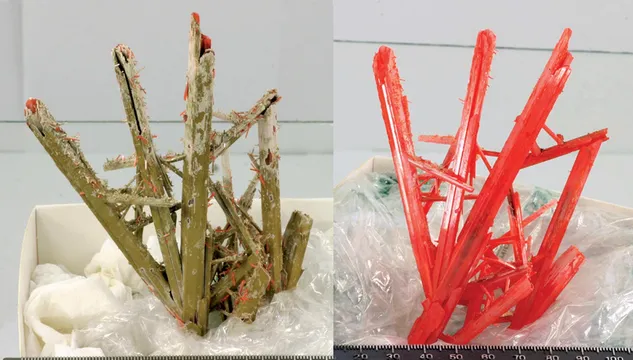
Transport is its own ordeal. Collector’s Edge documented Red Lead crocoite arriving in Golden, Colorado after being packed in foam rubber and encased in investment, a plaster-like material used in jewelry casting. Even then, crystals could loosen in transit. One specimen was about 38 cm long before trimming and became a finished 7.5 cm x 20 cm x 9 cm piece. Another large Red Lead specimen, documented after unwrapping and trimming, measured 25 cm x 26 cm x 7 cm and entered the Smithsonian Institution collection. That journey — mud pocket, chainsaw, plaster shell, air freight, laboratory trimming, museum case — is the modern life of a world-class Red Lead crocoite.
Ralph S. Bottrill, Peter A. Williams, Shane Dohnt, Steve Sorrell and Noel R. Kemp, “Crocoite and associated minerals from Tasmania,” Australian Journal of Mineralogy 12(2), 59–90, 2006 — The essential modern paper for Tasmanian crocoite localities, geology, paragenesis and associated secondary minerals, explicitly identifying Adelaide and Red Lead as the principal South Dundas silver-lead mines for world-class crocoite.
Shane Dohnt and Tomasz Praszkier, “Red Lead Mine, Tasmania: a new chapter of mining,” Minerals, Issue 7, 2013 — First-hand modern specimen-mining account covering locality, geology, reopening work, underground conditions, pocket extraction and specimen preparation.
William D. Birch, Uwe Kolitsch, Thomas Witzke, Lutz Nasdala and Ralph S. Bottrill, “Petterdite, the Cr-dominant analogue of dundasite: a new mineral species from Dundas, Tasmania, Australia and Callenberg, Saxony, Germany,” The Canadian Mineralogist 38(6), 1467–1476, 2000 — Type-mineral description for petterdite from Red Lead Mine; includes its formula, occurrence, associations and type material.
Petterdite mineral data, Mindat — Concise locality and type-occurrence record for petterdite, including Red Lead Mine as type locality and Museum Victoria type material M38601.
Anthony R. Kampf, Stuart J. Mills, Robert M. Housley, Ralph S. Bottrill and Uwe Kolitsch, “Reynoldsite, Pb2Mn4+2O5(CrO4), a new phyllomanganate-chromate from the Blue Bell claims, California and the Red Lead mine, Tasmania,” Mineralogical Magazine 76(1), 285–295, 2012 — New-mineral description documenting Red Lead as a locality for reynoldsite, where it occurs as small rectangular blades in the supergene assemblage.
Kurt Walenta, Martina Zwiener and Pete J. Dunn, “Philipsbornit, ein neues Mineral der Crandallitreihe von Dundas auf Tasmanien,” Neues Jahrbuch für Mineralogie, Monatshefte 1982, 1–5 — Original philipsbornite description from Dundas; important for understanding the Red Lead–Adelaide attribution discussion in later literature and databases.
R. S. Bottrill and W. E. Baker, A Catalogue of the Minerals of Tasmania, Geological Survey Bulletin 73, Mineral Resources Tasmania, 2008 — The modern state mineral catalogue, updating earlier Tasmanian catalogues and documenting hundreds of Tasmanian mineral species.
W. F. Petterd, “A catalogue of the minerals known to occur in Tasmania, with notes on their distribution,” Papers and Proceedings of the Royal Society of Tasmania, 1893 — Early foundational Tasmanian mineral catalogue by the collector after whom petterdite was named.
Red Lead Mine locality page, Mindat — Locality mineral list, species entries, maps and photo records for Red Lead Mine, Dundas mineral field, Zeehan mining district, West Coast municipality, Tasmania.
Smithsonian Institution specimen record: Crocoite, Red Lead Mine, Tasmania — National Museum of Natural History record for a Red Lead Mine crocoite specimen with coronadite association.
“RED LEAD Crocoite Mine, Open cut, Mt Dundas Tasmania” — LEON LION PROSPECTING — Short aerial and surface-view video of the Red Lead open-cut workings and mine area.
“Tasmania’s Fiery Jewel: The Remarkable Story of Crocoite” — OzGeology — Feature-style geology video on Tasmanian crocoite, including Dundas, Red Lead and the geological conditions that formed the specimens.
“The beauty and wonder of Tasmanian Crocoite” — ABC Hobart, Mel Bush with Shane Dohnt — Radio segment with Red Lead owner Shane Dohnt discussing Tasmanian crocoite and its appeal.
“Red Lead Redemption” — Outback Crystal Hunters, Season 2, Episode 7 — Television episode featuring work at Shane Dohnt’s crocoite mine at Dundas.
Collector’s Edge Minerals: Red Lead Mine, Dundas Region, Tasmania, Australia — The most useful illustrated public account of the modern reopening, geology, pockets, mining methods and specimen preparation.
Mindat: Red Lead Mine, Dundas mineral field, Zeehan mining district, Tasmania — Best working checklist for documented minerals, photo records and locality hierarchy.
Western Sydney University research profile: “Crocoite and associated minerals from Tasmania” — Abstract and bibliographic record for the major 2006 Tasmanian crocoite study.
Mineral Resources Tasmania: A Catalogue of the Minerals of Tasmania — State geological publication page for Bottrill and Baker’s updated catalogue.
Mineral Resources Tasmania: Mining leases — Practical regulatory background for understanding why operating mine localities such as Red Lead are not open casual collecting sites.
Mineral Resources Tasmania: Prospecting and land-access FAQs — Useful for collectors planning any Tasmanian field activity, especially permission and tenement issues.
Australian Government symbols booklet: Symbols of Tasmania — Official national reference noting crocoite as Tasmania’s formal mineral symbol.
Australian Museum: Crocoite on limonite — Accessible museum overview of Tasmanian crocoite and its collector importance.