Adelaide Mine, Australia - Tasmanian crocoite landmark yielding orange-red crystals and dundasite; prized for world-class specimens and history.
Key facts
Adelaide Mine is the modern classic among Tasmanian crocoite localities: an old underground silver-lead mine at South Dundas, near Zeehan on Tasmania’s wet west coast, transformed from a marginal ore producer into the world’s benchmark specimen mine for crocoite. Its fame rests on an unusual geological meeting: lead-rich sulfide lodes and ferro-manganese gossans developed beside chromium-bearing serpentinite and related listwanite alteration. In the oxidized zone, acidic groundwater mobilized lead and chromium into the same small chemical theater, producing PbCrO4 in a scale and beauty that no other district has matched.
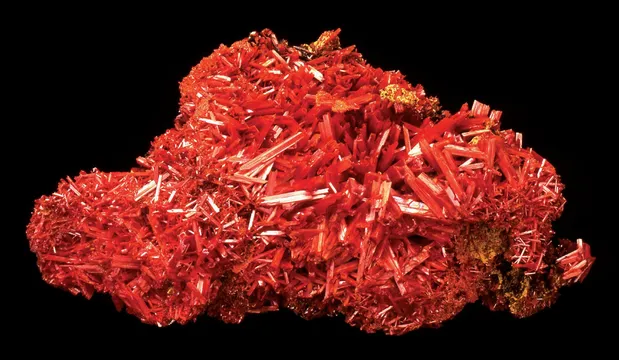
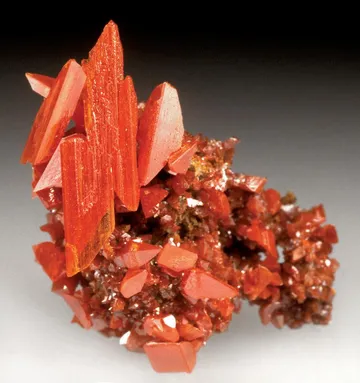
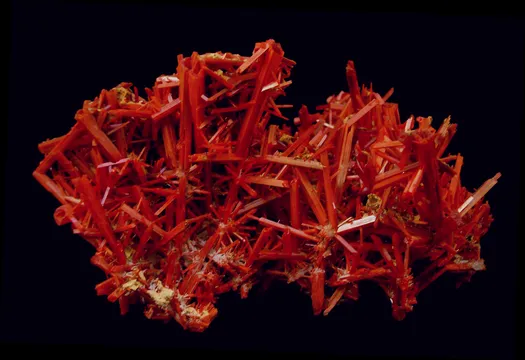
The best Adelaide specimens are instantly recognizable. They are sprays, jackstraw nests, open vugs, and clustered plates of fiery orange-red to deep scarlet crocoite on black-brown goethitic and manganiferous gossan, often with white to cream dundasite or gibbsite. Many of the larger crystals are hollow, sharply terminated, striated prisms, fragile enough to make handling feel like surgery. Old-time pieces can be loose single prisms several centimeters long; modern pocket pieces range from thumbnails to cabinet plates, with the finest examples combining length, luster, color saturation, upright architecture, clean terminations, and enough matrix strength to survive preparation and shipping.
Historically, Adelaide matters twice over. It was one of the early Dundas silver-lead workings of the 1890s, and it later became the mine that kept Tasmanian crocoite alive in the collecting world after much of the early material had gone to smelters as gossan flux. It is also the type locality for dundasite, and strong evidence supports Adelaide Proprietary Mine as the type locality for philipsbornite as well. Few specimen localities can claim both world-class cabinet minerals and this level of mineralogical history.
Regional View
Country View
The mine sits near the junction of Comet Creek and Adelaide Creek, below a spur of Stichtite Hill, about 2 km southeast of the former Dundas townsite. That ghost-town context is part of the locality’s identity: Dundas once belonged to the roaring Zeehan-Dundas silver-lead boom, but rainforest, mud, and water reclaimed much of the field. Adelaide is the rare survivor, not as an ore mine but as a carefully worked underground specimen operation.

Photo: Wikimedia Commons

Photo: Wikimedia Commons
Search for specimens: View all specimens from Adelaide Mine, Australia
Adelaide Mine is an underground silver-lead deposit in the Dundas mineral field, part of the Zeehan mining district of western Tasmania. The broader Dundas field occupies a compact mineralized area east of Zeehan, where lead-silver lodes occur near serpentinite bodies and related contact zones. The lead was supplied principally by galena-bearing lodes; the chromium that made crocoite possible came from chromium-rich ultramafic rocks, chromite-magnesiochromite, Cr-rich spinel, and chromian mica in and around the serpentinite. Weathering of those rocks in the extremely wet west-coast climate created thick, muddy gossans rich in goethite, limonite, coronadite-group manganese oxides, clay minerals, secondary lead minerals, aluminum phases, and chromates.
The deposit is not a simple “crocoite vein” in the way a collector might imagine it. Crocoite is a supergene product of the oxidized zone, especially where the lead-rich ore and chromium-bearing host environment were chemically connected by groundwater. The primary ore suite includes galena and associated sulfides and sulfosalts such as sphalerite, pyrite, jamesonite, and boulangerite, with carbonate gangue including dolomite, siderite, rhodochrosite, and related alteration products. Above and around these ores, the old workings entered vesicular ferro-manganese gossan, watercourses, clay-filled cavities, and vuggy oxide zones where crocoite could grow into open space.
The Adelaide lease was first pegged by T. Anderson in 1890 and was taken over the following year by the Adelaide Proprietary Silver Mining Company. By 1893 the company had driven adits and sunk a 176-foot shaft, with seven levels driven from the shaft in different directions. Early work found spectacular oxidized material but little economic ore, and the mine closed in 1895. From 1895 to 1901, while ore mining lay idle, the mine became briefly significant as a specimen source, with Warren Foote’s American mineral business marketing Adelaide crocoite that astonished collectors accustomed to smaller and duller crocoites from older world localities.
Ore mining resumed under new ownership in 1908, when commercial lead-silver ore was found on the 220-foot level. By the final closure in 1915, the mine had yielded 1,479 tons of lead, 147,000 ounces of silver, and nearly 3,000 tons of lead- and silver-bearing gossan used as flux at the Zeehan smelters. That flux history is painful for collectors: immense quantities of crocoite-bearing gossan were broken, loaded, and smelted, though the very best crystals were sometimes saved, traded, or sent to museums and private collections.
Modern collecting history begins with specimen miners rather than ore miners. Arthur Smith worked the old mine in the mid-20th century and recovered crocoite of mixed quality, including some fine pieces. Frank Mihajlowits, who had worked with Smith and later became known among collectors as “Mr. Crocoite” or “the Crocoite King,” leased Adelaide in 1970 and reopened parts of the old workings. In 1971 he broke into a major crocoite cavity, roughly 1.5 x 2 x 2.7 m, with walls, roof, and floor lined by crystals; about 1,000 specimens were recovered, with crystals to about 8 cm. That find reintroduced Adelaide as a serious specimen mine.
The next great Adelaide episode began in late 1990, when Mihajlowits encountered the upper part of a 14 m long watercourse. Reaching and safely mining it took years of wet, dirty, controlled underground work. From late 1992 into the following decade the watercourse produced thousands of fine specimens, many with deep orange-red crystals to 10 cm, associated with cerussite, dundasite, phosgenite, pyrite, and other minerals. The productive area also produced named sub-pockets familiar to advanced collectors: the Gibbsite Pocket, Bridge Pocket, Clay Pocket, and Black Forest Pocket. The Gibbsite Pocket was the upper part of the watercourse where crocoite was heavily coated by gibbsite; in some specimens multiple generations of gibbsite are visible, and removal of the coating can reveal etched, scarred crocoite beneath. The Black Forest Pocket, by contrast, contained black radiating sprays up to about 8 cm that proved to be crocoite forms replaced by iron oxides, so fragile on drying that much of the material disintegrated.
In 2004 Mihajlowits sold the mine to Adam Wright’s newly formed Adelaide Mining Company Pty. Ltd., which continued underground specimen mining. The first major find of this era was the 2006 Premiere Pocket, a vertical cavity up to about 50 cm wide, densely crossed by crocoite crystals. Careful extraction produced about 200 excellent specimens, from thumbnail loose prisms to cabinet clusters on gibbsite-coated, earthy brown matrix.
The 2010 Pocket was larger and became one of the key modern Adelaide finds. Mining followed a watercourse above the 2006 pocket and eventually opened a crystal-lined chamber about 45 cm x 1 m x 2 m. About 350 fine specimens were recovered, not counting numerous loose crystals that had fallen from the hanging wall. The largest crystal attached to a cluster was about 14 cm and terminated, and much of the material required meticulous cleaning of dark oxide and gibbsite coatings.
The 2012 Red River Find pushed the mine’s reputation still further. The exposed opening was about 1 m wide and 2 m high, leading into a curving watercourse with no visible end when first documented. The walls were bristling with red to orange-red crocoite, many crystals 5 cm or more, growing from waterlogged oxides in bunches, knots, and angled groups. As mining advanced from below, the narrow view widened into a workable vuggy zone, and hundreds of new specimens were harvested. More recently, the Adelaide Mining Company has listed Red River Falls material and, in 2025, extensive pages of Jarrin’s Surprise Pocket specimens, showing that the mine remains an active source of fresh Adelaide crocoite rather than merely a historic name on old labels.
Collecting access today should be understood as private, controlled, and safety-sensitive. Adelaide is an active underground specimen mine, not an open public fossicking locality. The ground is wet, muddy, unstable in places, and historically gated; serious collecting underground occurs only with permission of the operators. For most collectors, the practical route to Adelaide material is the specimen market: mine-direct offerings, show stock, dealer inventories, old collection pieces, and museum-deaccession or collection-dispersal material.
Adelaide crocoite is the locality’s defining mineral and appears as acicular to long-prismatic PbCrO4 crystals, commonly hollow, striated, sharply terminated, and colored orange, red-orange, scarlet, or deep red depending on lighting and pocket chemistry. Historic crystals from Adelaide reached several inches, and modern pocket material has produced crystals in the 5–10 cm range commonly enough to define the locality, with exceptional crystal groups carrying crystals around 14–15 cm and some gibbsite-coated first-generation forms reported still larger. The best pieces are open three-dimensional jackstraw groups, crystal-lined vugs, upright sprays, and plates on black-brown gossan, ideally with bright luster, undamaged terminations, saturated color, and minimal distracting coatings or repairs. Common associates include gibbsite, dundasite, goethite-limonite, coronadite-group manganese oxides, cerussite, anglesite, and rare philipsbornite or bindheimite; pocket names such as the 1971 cave, the 1990 watercourse, Premiere Pocket, 2010 Pocket, Red River Find, Red River Falls, and Jarrin’s Surprise are meaningful to specialists because they often imply different balance of crystal length, coating, matrix character, and delicacy.
Gibbsite from Adelaide is far more than a minor white coating: it is a diagnostic alteration and specimen mineral of the mine, occurring as white, cream, pale pink, grey, and rarely purple Cr-bearing botryoidal to fine platy aggregates, hollow crusts, and epimorphs after earlier dundasite and crocoite. Laboratory work on Adelaide samples described pink to grey botryoidal gibbsite forming hollow crusts to about 3 mm thick in limonitic gossan pockets, commonly with red crocoite; other grey material appears to form on white and pink gibbsite and may darken from white after exposure to sunlight. The Gibbsite Pocket at the top of the 1990 watercourse is the key named source, where crocoite was thickly coated by gibbsite and some specimens preserve several generations of growth. The most collectable Adelaide gibbsite pieces are not anonymous chalky crusts but sculptural pseudomorphic or epimorphic forms retaining radial dundasite or crocoite architecture, preferably with contrasting orange crocoite needles and enough matrix integrity to display safely.
Dundasite is one of Adelaide’s great mineralogical credentials because the Adelaide Proprietary Mine is its type locality; the species was first described from small silky, milk-white spherical aggregates encrusting ferro-manganese gossan. At Adelaide it occurs as snow-white to cream or pale greenish, silky fibrous crusts, botryoidal-radiating aggregates, acicular sprays, and “finger-like” radial growths commonly developed around crocoite cores and on gossan, with crocoite often piercing, coating, or overgrowing it. Older mining-era dundasite specimens from the Adelaide lodes are among the best for the species, while many modern pieces show partial to advanced alteration to gibbsite, so the finest collector examples are those preserving fresh silky luster, recognizable radial habit, visible association with crocoite, and a credible old Adelaide provenance rather than later pale alteration crusts of uncertain identity.
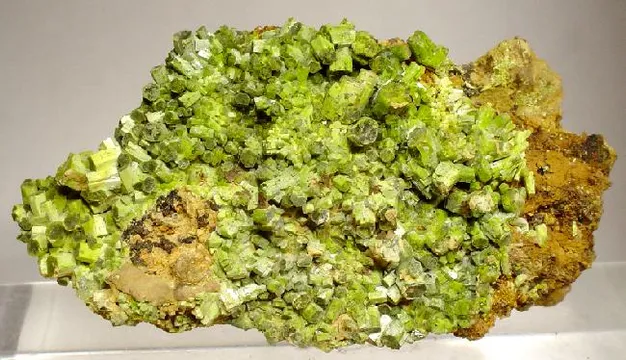
Beyond the three principal collector species, Adelaide has yielded an important suite of secondary lead, aluminum, arsenate, antimonate, manganese, and silver minerals. Cerussite and anglesite occur with crocoite and were important in the oxidized ore; chlorargyrite has been reported as yellow-green to grey modified cubic crystals to about 5 mm; phosgenite is a very rare historical species from the mine and surrounding Dundas field; mimetite, pyromorphite, bindheimite, coronadite-group oxides, goethite, limonite, halloysite, segnitite, fuchsite or chromian muscovite, acanthite, chalcocite, galena, sphalerite, pyrite, pyrrhotite, and antimony sulfosalts are all part of the locality’s broader paragenesis. Philipsbornite is especially important: although some databases and older discussions have assigned its type locality differently, detailed Dundas scholarship and the “Proprietary Mine” wording in the original history support Adelaide Proprietary Mine as the source of the type material, making Adelaide not just a crocoite giant but a genuine type-locality mine.
Adelaide crocoite demands unusually honest condition assessment. The crystals are commonly hollow, brittle, and mounted in crumbly, waterlogged goethite-limonite-manganese oxide matrix; even excellent specimens may show small broken needles, healed natural breaks, or loss hidden low in the crystal forest. Good modern mine-direct descriptions often explicitly state whether broken crystals are visible, whether terminations are complete, whether damage is on the display face, and whether the matrix has been stabilized or protected in a display box. For serious buyers, that condition language matters as much as dimensions.
Cleaning is part of the Adelaide story. Many specimens come from the mine coated with brown to black oxides, gibbsite, clay, or “china clay”-like material, and professional preparation has included chemical cleaning, notably phosphoric acid baths and proprietary procedures used by experienced Adelaide miners. This is not the same as making a fake specimen: the crocoite is natural, the coatings are natural, and careful cleaning reveals what the pocket produced. But collectors should recognize that many bright display specimens did not come out of the mine looking bright. Poorly cleaned pieces can show etched crystals, dulled faces, residual clay in protected corners, detached needles, or weakened matrix.
No well-documented epidemic of outright fake Adelaide crocoite is associated with the locality, but mislabeling is common in the broader market. “Dundas” is sometimes used loosely for several mines, and casual labels may even say “Adelaide, Australia,” which wrongly suggests the city in South Australia rather than Adelaide Mine in Tasmania. Adelaide, Red Lead, Dundas Extended, Kapi, Platt, and other Dundas-area mines have different habits and matrices, though old labels can be vague. Adelaide specimens commonly show hollow long prisms on muddy brown-black gossan, often with gibbsite or dundasite; Red Lead material more often includes solid, translucent to transparent crystals in dense jackstraw groups; Dundas Extended pieces tend to be smaller and may occur on pale quartz-rich matrix. These are tendencies, not proofs, so provenance and old labels remain important.
Crocoite is a lead chromate, so treat it as a toxic mineral for handling purposes. The risk to a responsible collector is controlled by common sense: do not lick, soak, grind, trim, or generate dust; keep fragments away from children and pets; wash hands after handling; and avoid storing loose broken needles where they can crumble into powder. Because many Adelaide specimens are very open and fragile, the safest storage is often in a fitted box, acrylic display case, or padded mount that prevents vibration and accidental brushing.
Light exposure is worth respecting. Crocoite is prized for its color, and prolonged direct sunlight is never advisable for display specimens; gibbsite from Adelaide has also been observed to change from white toward grey after exposure, and laboratory notes suggested that UV light may possibly contribute to darkening in some grey gibbsite. Keep Adelaide pieces in stable indoor light, away from strong sun, heat, and damp fluctuations.
Market availability is better than for many world-class localities because Adelaide has been actively specimen-mined in the modern era, but truly fine pieces remain expensive. Fresh mine production appears periodically, and small thumbnails, vugs, and modest matrix specimens can still be found. Large, undamaged, high-luster cabinet examples with strong three-dimensional architecture, named-pocket provenance, and minimal visible damage are much scarcer and trade as major classics. Type-locality dundasite, attractive gibbsite pseudomorphs, and confirmed philipsbornite-bearing pieces are specialist material and should be bought with analytical confidence or from a source that understands the Adelaide paragenesis.
The first great international Adelaide crocoite story belongs to the 1898–1901 specimen boom, when an American collector-agent working for Warren Foote turned an abandoned Tasmanian silver-lead mine into what Foote presented as a scientific specimen operation. The old Siberian crocoites had been the classic standard, but the Adelaide material overturned that hierarchy. Foote advertised the specimens as startling, sensational, and not cheap, then reported that after expensive tunneling his collector reached a clayey deposit with loose prisms 3–9 cm long, superbly terminated and brilliant. The campaign did not last. After months of fruitless work, the operation was abandoned at a depth of 232 feet, but it had done enough: Adelaide crocoite was now a world-class mineral name.
The 1971 find by Frank Mihajlowits is the pocket every Adelaide collector should know. Working alone in July, Frank broke into a cavity about eight feet long, six feet high, and four feet six inches wide. When he enlarged the opening enough to push his light and arm into the void, the roof, walls, and floor were all covered with crocoite, from pin-like needles to crystals exceeding three inches. About 1,000 specimens came out. For collectors used to hearing only about “old” Dundas crocoite, this was proof that Adelaide still had pockets of astonishing quality waiting in the wet gossan.
Frank’s later 1990 watercourse find was not a single magical room but a long, difficult mining problem. He first intersected the upper part of a 14 m watercourse, but the miners could not simply attack it from above without dropping debris onto better specimens below. They backed out, opened a lower work face on the hillside, and tried to reach it from beneath. Even then they had not reached the lowest level, so they ramped down again toward the water table and then worked upward as groundwater complicated everything. Out of that awkward, muddy, wet geometry came thousands of specimens over roughly fourteen years, along with named pockets that still carry meaning in advanced collections.
The Black Forest Pocket is a cautionary tale in mineral form. At the end of the 1990 watercourse the walls were covered with black radiating sprays that looked like crocoite up to about 8 cm long. The name made sense underground: a dark forest of needles on the walls. But when Adam Wright later mined some of the material, the “crocoite” proved to have been replaced by iron oxide. On drying, the pieces became incredibly light, soft, and fragile; many simply disintegrated. Frank had left them not because he lacked ambition, but because he understood the pocket’s treachery.
The 2012 Red River Find gave modern collectors one of the most vivid underground scenes in mineral literature. The approach was not a grand tunnel but a muddy squeeze: about 50 m into the working entrance, up a short steel ladder, then right into a narrow drift and roughly 10 m along a crawlway. The exposed mouth of the find was about a meter wide and two meters tall. Inside, the waterlogged oxide walls bristled with fiery red to red-orange crocoite, many crystals 5 cm or more, pointing toward the hollow center. The pocket was wet, dark, and alive-looking, with surfaces glistening as though the mine had been opened too early.
There is a marvelous human moment from that same Red River visit. While the author was staring into the pocket, Adam Wright noticed a small vuggy zone on the adit floor nearby and began testing it. When Adam moved away, the visitor asked permission to use the prybar and hammer. For half an hour he tapped into the muddy oxide, loosened plates, and teased out about a dozen small matrix specimens from what he christened the “Mineralogical Record Pocket.” Four made it home in a keep-this-side-up carry-on box that drew questions from airport security at three airports. That detail captures Adelaide collecting perfectly: even an ordinary little pocket there is memorable because every specimen feels improbably rescued.