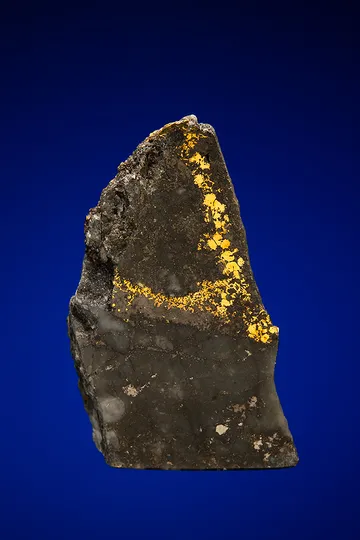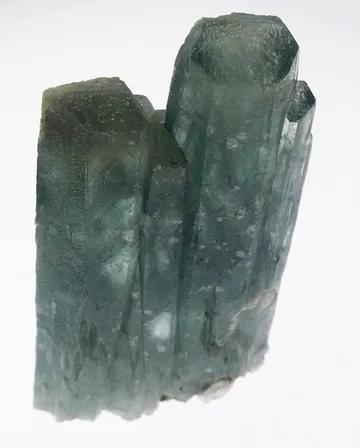
Stoneham, Colorado — premier barite locality with blue BaSO4 crystals in calcite; renowned Leeson pockets and gem-like specimens prized by collectors.
Key facts
Stoneham, Colorado, is one of the great American barite localities: a high-plains pocket deposit where pale to saturated blue BaSO4 crystals grew in open seams within Oligocene sedimentary rocks rather than in the hard-rock veins most collectors instinctively imagine. The classic locality lies northeast of the village of Stoneham in Weld County, in badland exposures of the White River Group, where the basal Chadron Formation rests above the Cretaceous Pierre Shale. In that deceptively soft sequence of claystone, siltstone, and volcanic-ash-rich beds, groundwater carried barium and sulfate through fractures and low-angle fault openings, leaving pockets lined with glassy blue barite and small rhombohedral calcite.
Regional View
Country View
The look is unmistakable when the piece is good: prismatic to tabular, beveled blue blades standing singly or in crossed groups, sometimes rising from a sugary yellow to honey calcite crust and, on the best 1989 material, contrasting against unusually white calcite made pale by a thin hyalite-opal coating. Stoneham barite can be gemmy enough to glow internally in transmitted light, but the locality also produced gray-blue, translucent, and calcite-encrusted material. Its best specimens are judged on color, transparency, sharp terminations, freedom from clay inclusions, and the rare aesthetic balance of blue crystals on a coherent matrix.

Photo: Wikimedia Commons
The locality’s modern fame rests especially on the Leeson pockets opened in 1989 by Bryan Lees and Dennis Wilson after the Leeson Partnership leased mineral rights on the Niklas Ranch. Those pockets produced thousands of specimens, including clusters with deep aquamarine color, unusually lustrous surfaces, and delicate barite “basework” strong enough to hold larger free-standing blades. Earlier collecting, however, goes back much farther: old labels often read “Sterling,” because Sterling was the better-known town, even though the famous blue-barite ground is in Weld County near Stoneham.

Search for specimens: View all specimens from Stoneham, USA
The collecting area most collectors mean by “Stoneham” is the Stoneham barite locality northeast of the village of Stoneham, Weld County, Colorado, historically also labelled “Sterling” on older specimens. It sits in the rolling high plains of northeastern Colorado, in a landscape of white bluffs and shallow badlands cut into Oligocene White River Group sediments. The most productive ground described in the classic accounts was on the Niklas Ranch, in the southwest corner of section 15, Township 8 North, Range 56 West, in the Stoneham NW 7.5-minute quadrangle. Nearby topographic descriptions refer to a bright, white, flat-topped hill and a small horseshoe-shaped erosional basin known locally as “the Blowout.”
This is not an ore mine in the metal-mining sense. It is a specimen deposit: barite and calcite crystallized in open pockets, seams, and fault-related cavities in the lower Chadron Formation. The key host bed is a near-white, montmorillonite-rich clay layer derived largely from altered volcanic ash. At the main Niklas Ranch workings, that barite-bearing bed is the lowermost exposed bed above the Pierre Shale and is described as roughly 4.6–6.1 meters thick in the 1990 study. Elsewhere, the same geological relationship is summarized as the lowermost Chadron member: a tan to cream claystone layer, approximately 15–20 feet thick, rich in volcanic glass shards and lying unconformably above the Pierre Shale.
The geometry of the pockets is central to understanding why Stoneham specimens look the way they do. The best crystals formed where faulting created open, low, flattened spaces rather than tight veins. In the 1989 excavation, the main barite-bearing structure was followed as a fault zone; steep, slickensided portions tended to be barren or poor, while flatter segments and intersections with bedding-plane-like horizontal partings opened into pockets. These low cavities gave crystals room to stand free from the floor, develop clean faces, and avoid much of the clay inclusion that dulls inferior material.
The mineralization is interpreted as groundwater deposition through fractures and permeable zones in the White River sediments. Barium was probably leached during alteration of volcanic glass in the tuffaceous beds; sulfate may have come from dissolved earlier gypsum, although gypsum itself is not now observed in the described occurrence. The Pierre Shale likely acted as a relatively impermeable barrier, influencing groundwater flow and saturation in the overlying ash-rich clay. In later work, pockets that approached the Pierre Shale were reported to become wetter and partly filled with cream-colored “gooey” clay, with the barite quality declining into cloudy, broken crystals.
Stoneham’s published collecting history is a long thread of field collecting, short locality reports, and several famous episodes. The locality entered literature under the older “Sterling” name in the late nineteenth century, with blue barite near Sterling noted by Dana and Randall in the 1890s. In the twentieth century, the site was repeatedly visited by collectors and mineral clubs. Clarence G. Coil and O. Art Reese made a notably successful 1953 dig, following a seam dipping into the hillside and recovering large crystals, including material that later entered the Harvard and Denver museum collections. In May 1985, Luke and Cathy Westervelt and Norman Bennett spent eight days digging and opened pockets of large barite crystals and clusters associated with pale yellow calcite.
The best-known commercial specimen operation was the 1989 Leeson Partnership dig by Bryan Lees and Dennis Wilson, with geological documentation by Peter J. Modreski of the U.S. Geological Survey. A 955 Caterpillar crawler-loader was brought in because hand digging had become impractical and dangerous under the increasing overburden. The excavation ultimately exposed roughly 45 meters of barite-bearing seam, reached about 11.7 meters below the original ground surface, and found two major pockets plus minor cavities. The first major pocket was approximately 3 meters wide, 1.8 meters deep, and only about 0.15 meter high. The second was tube-shaped, about 3.6 meters deep, 0.9–1.2 meters wide, and 0.15–0.23 meter high. Together with smaller finds, the 1989 project produced about 3,000 specimens, many cleaned, numbered, and distributed as “L” specimens from the Leeson pockets.
A further one-week specimen-mining operation in July 2002, reported by Michael R. Sanders and Frank Bendrick, worked state land northeast of Stoneham. That operation again found barite in open pockets in the lower Chadron Formation, along northwest-southeast fault trends with variable dips. A backhoe exposed cavities up to about 6 inches high, 6 feet long, and 3 feet deep. Pale to sky-blue crystals as long as 10 cm were recovered, mostly as singles and small groups, with quality strongly controlled by pocket position and clay contamination.
Collectors should treat access with particular care. The Niklas Ranch collecting areas described in the classic 1989 work are no longer open, and the owners have asked that collectors not come to the ranch; permission is not being granted and trespassers may be reported. Some broader Stoneham-area occurrences have involved state land leases or private ranch land, so a modern field visit requires current legal permission, not an old guidebook description or an inherited set of directions.
Stoneham barite is the locality’s signature mineral: flattened prismatic to tabular BaSO4 crystals, always elongated on the b axis in the classic descriptions, ranging from individual thumbnail blades to cabinet plates. The 1989 pocket #1 material commonly carried crystals from about 1.27 to 5.1 cm long, with a few to 10 cm, colored medium to deep aquamarine blue and often more delicate than the older gray-blue Stoneham pieces; pocket #2 yielded smaller but especially gemmy, transparent, deeper aquamarine to greenish-blue crystals on a criss-cross barite basework, sprinkled with pale calcite. Earlier and later finds produced crystals reported up to 15–18 cm, but the most desirable specimens are not merely large: they have sharp beveled terminations, glassy luster, saturated blue color, minimal clay or calcite burial, and clean contrast against yellow, honey, or opal-whitened calcite.
Under the spelling “baryte,” Stoneham is represented in many European and museum catalogues by the same classic blue BaSO4: lustrous, chisel-terminated blades and flattened prisms from the Chadron Formation pockets near Stoneham. Good baryte pieces from this locality show the open-space growth that makes Stoneham distinct from massive vein barite: doubly terminated or nearly complete blades, parallel sprays, and delicate lattices of smaller crystals supporting larger blue individuals. Associations are sparse but important—yellow to honey calcite is the standard matrix, and the finest Leeson-pocket examples may carry bright white-looking calcite whose color is actually caused by a thin hyalite opal coating; ordinary pieces are duller, clay-stained, broken, or isolated singles, while top pieces combine transparency, intact terminations, and a balanced specimen silhouette.
Stoneham calcite is primarily an associated mineral rather than the reason most collectors seek the locality, but it is essential to the best barite specimens. It ranges from pale yellow through deep honey color, with solid intergrown layers appearing brownish yellow, and distinct crystals forming small rhombohedra, often modified or distorted, typically around 2–4 mm across. In the major 1989 pockets, calcite acted as a natural cement that held larger plates together; pocket #1 produced barite groups increasingly supported by thicker calcite toward the back of the cavity, while pocket #2 produced the famous “snow on blue barite” look, where 1–2 mm calcite crystals appeared white because rough-surfaced microbotryoidal hyalite opal coated them. As a standalone collectible, Stoneham calcite is modest, but as matrix and contrast it makes the difference between a loose blue barite single and a complete, displayable Colorado classic.
The documented supporting suite is short but distinctive. Opal, specifically colorless hyalite, occurs as a late, glassy, microbotryoidal coating on barite and especially calcite; it fluoresces brilliant green under shortwave ultraviolet light and faint green under longwave ultraviolet. Montmorillonite is the principal clay mineral of the altered volcanic-ash host bed rather than a cabinet mineral, but it is fundamental to the deposit’s formation and to specimen preparation headaches. Calcite var. sand-calcite is documented from Stoneham and was important enough to receive its own 1961 Rocks & Minerals treatment; old collecting guides also mention barite roses, calcite crystals, and fluorescent opal coatings from the broader Stoneham collecting ground.
Stoneham pieces are generally easy to recognize when they are good: flattened blue barite blades, often with a slightly gray, aquamarine, or greenish cast, on yellow to honey calcite or on a delicate barite lattice. The commonest locality problem is not outright fakery but labelling. Older material may be labelled “Sterling,” even though the classic occurrence is near Stoneham in Weld County, not at Sterling in Logan County. More recent Colorado blue barite from other areas, especially visually similar high-plains occurrences, can also be confused with Stoneham unless the label carries a reliable chain of custody, pocket name, collector, or dealer history.
Condition deserves close attention. Barite has perfect cleavage, and Stoneham crystals are often flattened blades with exposed terminations and thin edges, so chipping, cleaved tips, repaired blades, and subtle edge bruising are normal things to inspect under magnification. Transparent crystals may show internal cleavage flaws; the 1989 accounts specifically noted that larger crystals sometimes displayed cleavage-plane flaws and that careless water-spray cleaning could start small internal flaws. Specimens with dozens of delicate intergrown crystals can be deceptively fragile even when they look solid.
Cleaning history matters. Fresh Stoneham material commonly came from clay pockets, and the best pieces were cleaned carefully after excavation. On pocket #2 material, much of the small white calcite “snow” was delicate; published accounts note that 20–50 percent of the calcite coating could fall off during cleaning. Avoid aggressive ultrasonic cleaning, thermal shock, strong acids around calcite matrix, and prolonged soaking without a reason. Use ultraviolet light judiciously: bright green shortwave fluorescence indicates hyalite opal coatings, not a separate showy uranium mineral, though the fluorescence is caused by uranyl traces in the opal.
Treatment and repair should be handled transparently. Because small bruises on blue barite can be visually softened with oil and because repaired or reattached crystals occur in the marketplace, high-grade pieces should be examined dry, under strong side light, and with attention to suspicious glue lines at the base of blades. Repairs are not inherently disqualifying on large, old, fragile plates, but they should be reflected in price and disclosed.
Market availability is uneven. Ordinary singles and small groups appear regularly, while top Leeson-pocket groups with saturated color, clean glassy crystals, and attractive calcite contrast are much scarcer and command strong prices. Provenance to the 1989 Leeson pockets, to earlier named collectors, or to published museum-quality finds adds value, particularly when the piece retains old labels or a credible inventory number.
In the old literature, Stoneham arrived almost sideways. The locality was long called “Sterling,” as if it belonged to the larger town to the east, and early writers repeated that name while the actual blue-barite ground lay in Weld County near Stoneham. By 1893, J. S. Randall had captured the essential collector’s image in a single sentence: pale blue crystals, some several inches long, set in fragile calcite, nearly all terminated and some doubly terminated. That is still the Stoneham promise—the possibility that under pale clay and prairie grass, a seam may open into blue crystals already displayed on their own calcite stage.
One of the great pre-Leeson digs came in the summer of 1953, when Clarence G. Coil and O. Art Reese followed a dipping seam from a surface pit into a large tunnel- to dome-shaped cavity. Their unpublished account, preserved in Denver museum files and later summarized by Modreski, Lees, and Wilson, described the cavity extending as much as 13.8 meters underground and large enough in places for the men to walk “stooped over.” They recovered many crystals up to 15–18 cm long. One of the great survivors of that work was a roughly 30 cm plate carrying about 115 barite crystals in calcite matrix, acquired by Harvard University.
The 1985 Westervelt-Bennett dig had the slow rhythm of serious hand work. Luke and Cathy Westervelt and Norman Bennett spent eight days digging along a seam or joint dipping 15–45 degrees into the clay. Their reward was a pocket of large crystals and pale yellow calcite, and one major plate later entered the Denver Museum collection. That specimen measured 43 by 23 cm and carried approximately seventy-five exposed crystals, the largest about 14 by 3.8 cm. It is exactly the kind of piece that explains why Stoneham is not just a blue-barite locality but a plate locality—one of the few American sources where barite could form handsome, multi-crystal display specimens rather than only isolated blades.
The 1989 story begins with the practical realization that hand digging had become dangerous. Dennis Wilson and Jim Smerglia had already found a pocket that spring, removing about 3.7 meters of clay overburden to reach a cavity roughly 0.6–0.9 meters wide and 1.2 meters long. It yielded dozens of specimens, enough to convince Wilson and Bryan Lees that deeper pockets might lie beyond the safe reach of shovels. The Leeson Partnership was formed, mineral rights were leased from the Niklas Ranch Company, and a 955 Caterpillar crawler-loader was brought in. The plan was not simply to gouge out a hill: they wanted to undercut the barite-bearing seam from below so plates could be removed intact rather than smashed from above.
The first days were humbling. The clay was much tougher than expected. Once the exposed dry rind was stripped away, the fresh clay behaved like compact rock, and the crew needed the tractor’s ripper to break it. Progress took roughly three times as long as anticipated. On the third day, a small pocket appeared at the east end of the pit, only about 45.7 cm wide, 5.1–10.2 cm high, and 0.6 meters deep, but it yielded deep blue, gemmy clusters several inches across. Then the seam became maddening: sporadic small pockets, barren slickensides, and finally a disappearance of visible barite and calcite just where thicker calcite had been expected.
On the seventh day, the dig changed from work into legend. A 0.3 meter brecciated clay zone appeared along the seam. The tractor stopped. The clay was probed by hand. A small opening led into darkness, and when a flashlight entered the hole the crew saw a flat cavity carpeted in blue. The first printable phrase was “Barite wasteland!” A question followed immediately: “How far does it go?” The answer was astonishing: a pocket about 3 meters wide, 1.8 meters deep, and only 0.15 meter high, its flat floor covered with a free-standing “forest” of barite crystals.
That first major pocket was nearly ideal mineralogically. The fault had intersected a horizontal plane and pulled it open; after the crystals grew, little or no later movement wrecked them. The whole bottom was lined with barite clusters, from single blades to groups of a dozen large crystals, supported by smaller barite prisms and thin calcite crusts. Near the front, calcite was sparse and mostly coated one side of the crystals; deeper in, it thickened enough to make larger plates, some with up to two dozen barite crystals. One calcite-coated plate from the center weighed more than 45 kilograms.
Then came the problem of collecting beauty fast enough. The pocket started drying out, and the ceiling began dropping small bits onto the specimens. A 2.3 kg sledge and a gad-pry bar were plainly inadequate, so the crew waited for compressors and drills while wetting the pocket every few hours. When George Robertson arrived from Cañon City to handle drilling, the excavation became a careful rhythm: undercut the clay, reach in, wiggle a cluster loose, wrap it immediately, and pack it. The competition began as “specimen of the hour,” then became “specimen of the quarter-hour.” For three days, one person worked in the pocket while two people wrapped and packed.
By the thirteenth day, the first major pocket was empty and the fault seemed to lose itself near the Pierre Shale contact. The next day was supposed to be refilling and reclamation. Only one place remained to check: the eastern end of the pit, where small pockets of aquamarine, lustrous, gemmy barite had appeared but no great groups. Again, the fault intersected what seemed to be the same horizontal layer. Again, a brecciated zone appeared. A small void opened, and a miner’s light showed a new kind of pocket: a tube-like cavity with a solid sheet of incredibly gemmy blue barite crystals, dusted with small white calcite crystals.
Exhaustion produced the first reaction: “Not another pocket!” It did not last. The first specimens out were clean, aesthetic, and abundant. The barite sat on a web-like intergrown base of smaller crystals rather than on heavy calcite, a structure different from anything previously seen in the dig. To loosen plates, the crew inserted a long sword into the opening beneath the barite sheet and rotated it side to side until a plate could be pried free. For two days and nights the second pocket produced specimens—about 1,500 of them—from a tube roughly 3.6 meters deep, 0.9–1.2 meters wide, and 0.15–0.23 meters high.
The aftermath was almost as demanding as the dig. Seven people had been involved in the field collecting, but cleaning the crystals took five people working full time for six weeks so the material could be ready for the Denver mineral show. The final count was about 3,000 specimens: roughly 2,100 singles and small groups, and about 890 carefully cleaned and numbered clusters. The “L” numbers on Leeson-pocket specimens are not a casual dealer mark; they are the trace of one of the most thoroughly documented modern specimen digs in Colorado mineral collecting.